
Humanoid robot technology has become a significant area of modern engineering education because it brings together mechanical engineering, electronics and electrical engineering, control science, information and communication, materials science, and nearly every other modern engineering discipline. A humanoid robot resembles a human in form and can imitate human behavior. Compared with other types of robots, a humanoid robot offers clear advantages in adaptability and flexibility, making it suitable for assisting human work and, in some settings, even replacing human work. Since 2000, humanoid robot research and applications have attracted sustained attention. The humanoid robot field now reaches healthcare, nursing, home services, entertainment, education, biotechnology, disaster relief, and many other domains. The market potential of the humanoid robot sector is large. Demand for humanoid robot talent is strong, and the professional skill requirements placed on that talent are high.
Against this background, a teaching reform and practice initiative has been developed for a Humanoid Robot Training Course at the College of Applied Technology, Beijing Information Science and Technology University. The initiative is built on industry-university cooperation and aims to explore a new model of collaborative education. Guided by technological innovation and application of biped humanoid robot systems, the course promotes practical teaching development in new artificial intelligence technologies and new directions. It brings the latest enterprise humanoid robot technology into classroom teaching. It also uses multimedia methods and physical robots to strengthen practical teaching, make difficult theory intuitive, and make learning operational. The overall goal is to improve students’ hands-on ability and their capacity for innovation and creation.
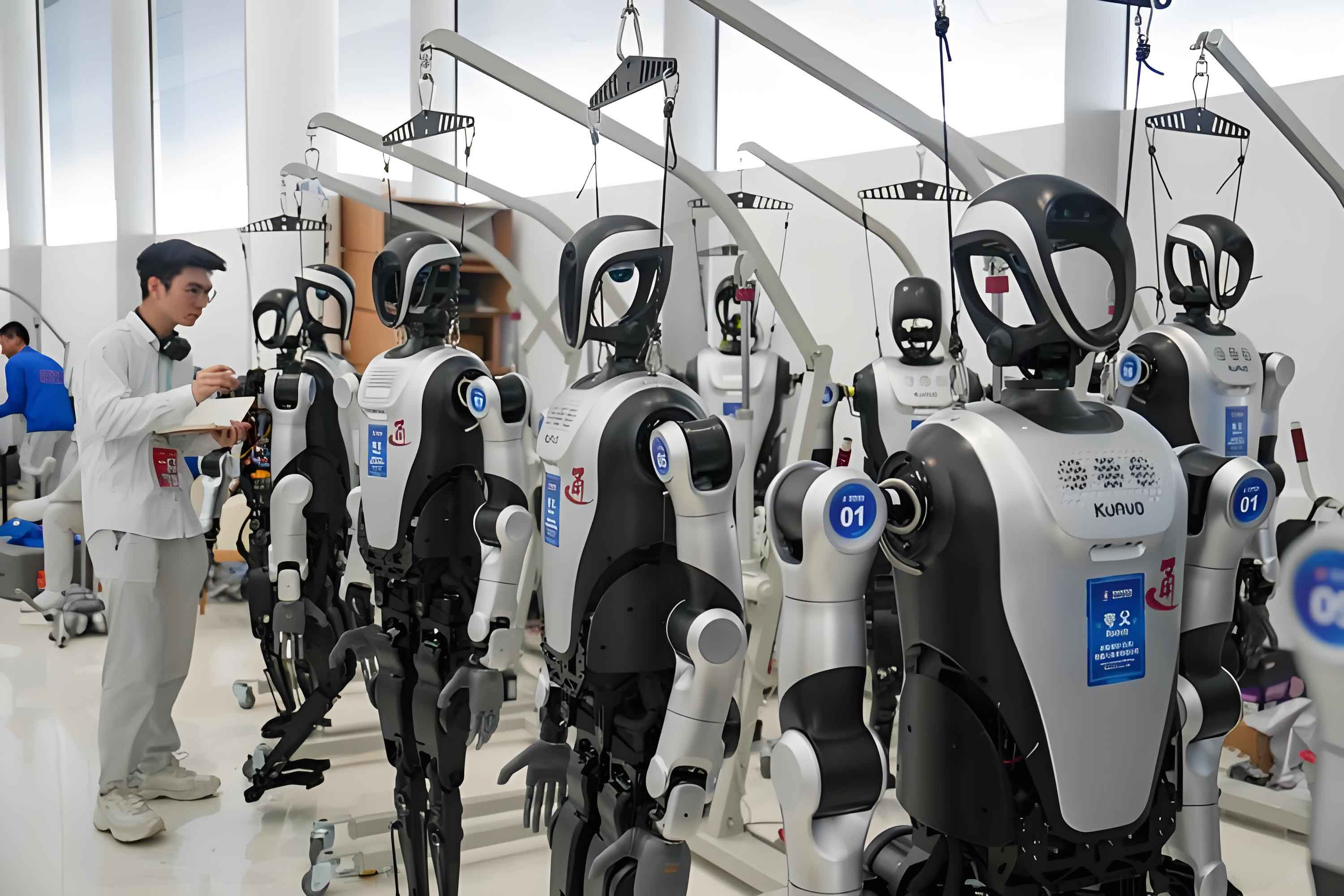
The course reform reflects a broader shift in applied technology education. Traditional professional courses often emphasize theoretical foundations, while students frequently report that practical and operational courses are fewer in number. The Humanoid Robot Training Course addresses that gap by placing the humanoid robot at the center of a modular, project-oriented learning experience. It connects software engineering, communication engineering, computer science and technology, and related fields with the hardware and software systems of a humanoid robot. In doing so, it creates a bridge between classroom theory and real-world humanoid robot development.
- Industry-University Collaboration and the Origin of the Humanoid Robot Training Course
The university has issued guidance for deepening education and teaching reform and for improving undergraduate talent cultivation capacity from 2020 to 2025. That guidance calls for building a new collaborative education mechanism that is comprehensive, runs through the whole process, and is deeply integrated. To cultivate applied, compound, and innovative talent that meets modern industrial development needs, the College of Applied Technology and a relevant robotics company carried out an industry-university cooperation project focused on teaching content and curriculum system reform. Together, they explored a new model of collaborative education. The result is a Humanoid Robot Training Course that allows the latest humanoid robot technology from the company to enter the classroom. It integrates robot control development, vision development, sensor development and application, simulation development, and other new technologies into teaching. The course uses biped humanoid robot technological innovation and application as its guide and promotes course development in new artificial intelligence education technologies and directions. It runs through the whole process of professional foundation education and professional innovation education, with the goal of improving students’ hands-on ability and innovation and creation ability.
The collaboration is not limited to a single lecture or a single laboratory demonstration. It is a structured effort to align university talent cultivation with the humanoid robot industry and its ongoing transformation. The College of Applied Technology and the robotics company jointly determine teaching content. The course is offered to students in software engineering, communication engineering, computer science and technology, and related majors as a professional elective teaching project. The design builds on the theoretical knowledge students have acquired during their studies. At the same time, the college purchases appropriate hardware equipment for the humanoid robot and organizes training and learning for teachers and students. This combination of curriculum design, equipment acquisition, and human resource development supports a sustainable humanoid robot teaching environment.
Students in the College of Applied Technology often have previous vocational education experience. They tend to have strong hands-on ability and a practical foundation. They also continue to study computer science and technology, software engineering, and related courses at the university, which gives them a theoretical basis. These characteristics create a favorable foundation for the Humanoid Robot Training Course. The course therefore does not treat the humanoid robot as a distant object of theory. Instead, it treats the humanoid robot as a platform for integrated learning, where mechanical structure, electronic control, embedded programming, vision processing, and communication work together.
The course is closely organized around the humanoid robot industry and industrial change. It uses the industry-university cooperative education project to carry out deeper cooperation. It integrates the advantages of both the university and the enterprise. The target is a high degree of matching between market talent demand and the university’s applied talent cultivation goals. The cooperation model seeks win-win results, open sharing, and multi-directional effort. It also combines team education and maker thinking. Through multidisciplinary knowledge, it cultivates students’ hands-on ability, logical thinking ability, and innovation ability, and it comprehensively improves their scientific literacy. The focus is on producing high-quality talent that meets social development needs. The model emphasizes the roles and evolution of teachers and students as subjects in the teaching and learning interaction. That interaction includes student-teacher interaction, student-student interaction, student-teaching resource interaction, and student-external environment interaction. Related professional courses are divided into application, technology, and intelligence sections. These sections are arranged from shallow to deep and step by step. Teachers also actively lead students to participate in relevant domestic training and competitions, exchange and learn, broaden their horizons, fully stimulate interest, and mobilize enthusiasm. The intended result is that, under teacher guidance, students can carry out independent innovation learning.
- Why Humanoid Robot Education Matters
The humanoid robot is a uniquely integrative engineering subject. A humanoid robot must stand, walk, balance, perceive, communicate, and interact with an environment that is designed for humans. This means the humanoid robot cannot be understood through a single discipline. A humanoid robot requires mechanical design for limbs and joints, electronic and electrical systems for power and sensing, control science for stability and motion, information and communication for data exchange, and materials science for structure and durability. When students work with a humanoid robot, they encounter all of these dimensions in a single system. This makes the humanoid robot an effective educational platform for applied technology, engineering integration, and innovation training.
The humanoid robot also has strong application appeal. Because the humanoid robot resembles a human, it can operate in environments and with tools that are already designed for people. A humanoid robot can assist in healthcare and nursing. A humanoid robot can support home services. A humanoid robot can appear in entertainment and education. A humanoid robot can contribute to biotechnology and disaster relief. These application areas are not isolated from engineering education. They require graduates who understand not only algorithms but also the physical body of the humanoid robot, the sensors of the humanoid robot, the control architecture of the humanoid robot, and the software that gives the humanoid robot behavior. The Humanoid Robot Training Course is designed to build exactly this kind of integrated understanding.
Market demand reinforces the educational value of the humanoid robot. The humanoid robot sector has large development potential. Employers need professionals who can work across hardware and software, who can debug a humanoid robot, who can develop vision functions for a humanoid robot, and who can integrate sensors into a humanoid robot. The skill requirements are high. A course that focuses on the humanoid robot can therefore help students connect their studies to a demanding and forward-looking field. It can also help the university fulfill its mission to produce applied, compound, and innovative talent.
- Cooperation Model Innovation
The first area of innovation is the cooperation model. The Humanoid Robot Training Course was jointly developed by the College of Applied Technology and a robotics company. It is delivered in a modular special-topic format. The course emphasizes students as the main body of learning. Teachers use guided teaching. Through practical training, competition-course integration, and related methods, the course aims to better cultivate applied talent that meets social needs. This model differs from a conventional lecture-only approach. It places the humanoid robot at the center of a collaborative ecosystem that includes university faculty, enterprise experts, students, hardware, software, and competition tasks.
The cooperation model is based on complementary strengths. The university contributes theoretical teaching, student management, curriculum structure, and academic guidance. The robotics company contributes the latest humanoid robot technology, industry insight, practical development experience, and hardware platforms. Together, they jointly formulate teaching content. The course is aimed at students in software engineering, communication engineering, computer science and technology, and related majors. It is set as a professional elective teaching project. The college also purchases corresponding hardware equipment for the humanoid robot and organizes teacher and student training. This ensures that the humanoid robot is not only discussed in theory but also used in practice.
The model also seeks to align market talent demand with the university’s applied talent cultivation goal. It pursues win-win cooperation, open sharing, and multi-directional development. It combines team education with maker thinking. It uses multidisciplinary knowledge to cultivate hands-on ability, logical thinking, and innovation ability. It also aims to improve scientific literacy. The interaction between teaching and learning is treated as a dynamic process. Students interact with teachers, with each other, with teaching resources, and with the external environment. The course content is divided into application, technology, and intelligence sections. These sections progress from basic to advanced. Teachers guide students to participate in relevant domestic training and competitions. These activities help students exchange ideas, learn from others, broaden their horizons, stimulate interest, and mobilize enthusiasm. The goal is for students to move toward independent innovation learning under teacher guidance.
In this cooperation model, the humanoid robot becomes a shared object of study. The company’s humanoid robot technology is not simply demonstrated. It is incorporated into teaching tasks. The university’s academic framework is not simply preserved. It is updated through industry cooperation. The result is a humanoid robot course that is both educationally sound and industrially relevant. The humanoid robot thus serves as a bridge between the classroom and the humanoid robot industry.
- Course Content Organization Innovation
The second area of innovation is course content organization. The teaching content is divided and integrated according to the professional basic knowledge required by the course. Teachers deliver the course in modular special-topic form. Each special topic, whether it discusses principles or application examples, is closely combined with the relevant course content. The content is highly condensed and organized. The main line of the course introduces the development history of robots, the system structure of robots, the hardware system of a humanoid robot, the software application of a humanoid robot, and the assembly and debugging of a humanoid robot.
Before the special-topic lectures, a general introduction is arranged. This introduction allows students to grasp the overall framework, main content, practical methods, and application scenarios of the course from a global perspective. It also helps students position their interests within the course system. On this basis, teachers guide students to move beyond books and connect with reality. Through physical displays, multimedia demonstrations, and other forms, teachers stimulate students’ interest in learning. The course pays special attention to keeping teaching content current, innovative, and open. It integrates the development origins of various robots, the latest domestic and international research results, and the current state of industry development into the course content. This stimulates students’ innovative vitality.
The content organization also reflects the complexity of the humanoid robot. A humanoid robot is not only a mechanical structure. A humanoid robot is not only a control algorithm. A humanoid robot is not only a software application. A humanoid robot is an integrated system. Therefore, the course introduces the humanoid robot hardware system, the humanoid robot software application, and the humanoid robot assembly and debugging process. Students learn how the humanoid robot is built, how the humanoid robot is programmed, how the humanoid robot perceives, and how the humanoid robot moves. This content organization helps students understand the humanoid robot as a complete engineering product rather than as an isolated topic.
The modular special-topic format also allows the course to adapt to different student interests. Some students may be more interested in the mechanical structure of the humanoid robot. Some may be more interested in control and programming. Some may be more interested in vision and sensing. Some may be more interested in system integration and debugging. By organizing content into modules, the course can support multiple paths into the humanoid robot field while maintaining a coherent overall structure. The general introduction ensures that all students share a common map of the humanoid robot learning journey.
- Teaching Method Innovation
The third area of innovation is teaching method. The course differs from the original spoon-feeding style of teaching. It adopts guided teaching, discussion-based teaching, and other interactive modes. It gives equal weight to theory and practice and encourages students to use both their hands and their minds. Students can form groups according to their interests and according to special topics. They can choose different types of humanoid robots and different research directions that interest them. The course content is jointly determined by college teachers and relevant experts from the robotics company.
Teachers help each special-topic group formulate a relevant learning plan based on the current state of humanoid robot technology development. They provide reference books and experimental operation guides. They guide students to carry out independent learning. At the same time, discussion classes and question-and-answer classes are arranged to improve the learning quality of each special-topic group. Independent learning does not occupy class hours. Class time is used for discussion and question-and-answer sessions. Each discussion class is related to a special topic but is not completely restricted to that topic. Discussion takes place interactively between teachers and students and among students themselves.
This teaching method places the humanoid robot at the center of active learning. Students do not merely listen to a lecture about a humanoid robot. They work with a humanoid robot. They discuss the humanoid robot. They debug the humanoid robot. They ask questions about the humanoid robot. They share findings about the humanoid robot with their peers. The teacher acts as a guide, helping students define problems, locate resources, and interpret results. The humanoid robot thus becomes a common reference point for dialogue and collaboration.
The method also supports the development of soft skills. Group work requires communication and coordination. Discussion requires listening and argumentation. Independent learning requires planning and self-discipline. Competition-oriented tasks require teamwork and time management. These skills are valuable for graduates who will enter the humanoid robot industry or related technology fields. The humanoid robot course therefore contributes not only to technical knowledge but also to professional readiness.
- Assessment and Competition-Oriented Evaluation
The fourth area of innovation is assessment. The course reforms the original assessment method and focuses on examining students’ practical application ability and innovation ability. In the course assessment stage, the teacher assigns a comprehensive competition. Each special-topic group is required to demonstrate its learning results in software and hardware implementation. Each group also submits a corresponding technical report. Every student must report the tasks they undertook in the design and the design results. They must also answer questions raised by the teacher. Teachers score each student separately. The final course score is determined through a comprehensive evaluation based on performance at the competition site and in the results presentation.
After the course assessment, excellent groups are selected to participate in relevant domestic and international competitions and scientific and technological innovation achievement exhibitions. These activities serve as an extension and expansion of classroom teaching. They promote teaching through competition and promote learning through competition. They help students better understand the direction of technological innovation, dynamic development trends, and frontier science and technology. They also broaden students’ horizons and help them establish career directions. In this way, the humanoid robot course connects assessment with authentic engineering practice. The humanoid robot is not only a subject of study but also a platform for demonstration, competition, and professional identity formation.
The assessment design also reinforces the course’s emphasis on integration. Students cannot succeed by only writing code or only assembling hardware. They must make the humanoid robot perform tasks in a physical environment. They must integrate software, hardware, sensing, and control. They must prepare a technical report that explains their design. They must present their work and answer questions. This form of assessment measures both the final humanoid robot behavior and the students’ understanding of the humanoid robot system.
- Course Module and Case Teaching Plan
The course includes a module titled Aelos training-AirTag case teaching plan. The module is organized into six teaching units. The first unit introduces basic robot operation. The second unit covers Raspberry Pi development environment setup. The third unit provides Python programming basics. The fourth unit teaches students to write Python programs to control the robot. The fifth unit introduces vision processing. The sixth unit is a comprehensive practice unit. The detailed teaching plan is presented in the following table.
| Sequence | Teaching Content | Basic Requirements | Hours |
|---|---|---|---|
| 1 | Robot operation basics | 1. Main parameters of the robot 2. Hardware structure of the robot 3. Use desktop software for action debugging |
2 class hours |
| 2 | Raspberry Pi development environment setup | 1. Image burning 2. Linux operating system basics 3. Installation of remote connection software 4. Setup of software development environment |
2 class hours |
| 3 | Python programming basics | 1. Variables and operations 2. Conditional statements 3. Loop statements 4. Functions and objects 5. Installation and reference of third-party libraries |
2 class hours |
| 4 | Writing Python programs to control the robot | 1. Basic logic of Lua programs on the microcontroller 2. Python and robot interface and communication methods 3. Run action examples and write simple Python code to control robot movement |
2 class hours |
| 5 | Introduction to vision processing | 1. Robot camera and methods for reading camera data through Python programming 2. OpenCV interfaces and methods for realizing color and shape recognition 3. Methods for recognizing ARtag |
2 class hours |
| 6 | Comprehensive practice | 1. Complete a full robot dance with music within a specified time 2. Competition field of 3 m by 3.5 m. Requirements for the robot: (1) Walk upright through a horizontal bar without touching the bar. (2) Walk upright across a single-plank bridge. The straight bridge is 60 cm long, with a surface width of 30 cm, and QR codes at the bridge head and bridge tail as markers. (3) Walk upright through a door without touching the door. The inner height of the door is 62 cm, the inner width is 30 cm, and the door frame width is 3 cm. A QR code near the door frame is used as a recognition marker. (4) Walk upright upstairs. There are 3 steps, each step is 3 cm high, 40 cm wide, and 15 cm long. A QR code at the first step is used for recognition. (5) A golf ball is placed on the road. The hole diameter is 10 cm, a QR code near the hole is used as a marker, and the distance between the hole and the ball is 50 cm. The robot may make multiple kicking attempts. After completion, the robot performs a bow salute to indicate completion of the entire project. |
2 weeks |
The table shows how the course moves from basic operation to programming and vision, and then to a comprehensive task that requires the humanoid robot to perform in a physical environment. The humanoid robot must walk, balance, recognize markers, climb steps, and interact with objects. The comprehensive practice unit requires the humanoid robot to complete a dance with music and then execute a sequence of tasks on a competition field. This design makes the humanoid robot a platform for integrating mechanical movement, software control, sensor input, and vision recognition.
The table also shows the progressive nature of the course. Students first learn the parameters and hardware structure of the robot. They then set up the development environment. They learn Python programming basics. They write programs to control the robot. They study vision processing. Finally, they apply these skills in a comprehensive practice. This progression supports students with different starting points and helps them build confidence as they work with the humanoid robot. The humanoid robot is present throughout the course, but the complexity of interaction with the humanoid robot increases step by step.
- Humanoid Robot Hardware, Software, and System Integration
The Humanoid Robot Training Course treats the humanoid robot as a complete system. The humanoid robot hardware system includes the main parameters of the robot and the hardware structure of the robot. Students learn how the humanoid robot is assembled and how its components interact. The humanoid robot software application includes desktop software for action debugging, Raspberry Pi environment setup, Linux operating system basics, remote connection software, Python programming, and robot control programs. The course also introduces the basic logic of Lua programs on the microcontroller and the interface and communication methods between Python and the robot. These topics help students understand how software commands become physical movement in a humanoid robot.
System integration is a central learning outcome. A humanoid robot must combine hardware and software in a single operating system. A humanoid robot must receive sensor data and use that data to adjust behavior. A humanoid robot must communicate with a development environment and execute programmed actions. A humanoid robot must maintain balance while performing tasks. These requirements mean that students cannot treat hardware and software as separate subjects. They must integrate them. The Humanoid Robot Training Course uses practical tasks to make this integration visible. When a humanoid robot walks through a door or climbs a step, the result depends on mechanical design, control logic, sensor input, and software code working together.
The course also introduces simulation development and sensor development and application. These elements expand the humanoid robot learning experience beyond basic movement. Simulation development allows students to test ideas in a virtual environment. Sensor development and application allows students to understand how a humanoid robot perceives the world. Vision development allows students to process camera data and recognize colors, shapes, and markers. Control development allows students to command the humanoid robot with increasing precision. Together, these elements form a comprehensive humanoid robot development stack.
- Humanoid Robot Vision, Sensing, and Communication
Vision and sensing are essential for a humanoid robot that must operate in a human-centered environment. The Humanoid Robot Training Course includes an introduction to vision processing. Students learn about the robot camera and methods for reading camera data through Python programming. They learn about OpenCV interfaces and methods for realizing color and shape recognition. They also learn methods for recognizing ARtag. These skills are directly connected to the comprehensive practice tasks. The humanoid robot must recognize QR codes at a bridge head and bridge tail, near a door frame, at a first step, and near a hole. These markers provide information that the humanoid robot uses to guide its movement.
Sensing and communication are equally important. A humanoid robot must receive data from its environment and from its internal state. A humanoid robot must communicate with a controller, a computer, or a development environment. The course introduces Python and robot interface and communication methods. It also introduces the basic logic of Lua programs on the microcontroller. These topics help students understand how commands and data move through the humanoid robot system. The humanoid robot is not a standalone machine. The humanoid robot is a networked system that depends on communication between software modules, hardware controllers, and sensors.
Vision, sensing, and communication also support competition performance. In the comprehensive practice unit, the humanoid robot must walk upright through a horizontal bar, cross a single-plank bridge, pass through a door, climb steps, and approach a golf ball and hole. Each task requires the humanoid robot to perceive its position and adjust its actions. The humanoid robot may need to recognize a QR code, align with a path, and execute a movement sequence. These tasks demonstrate how vision and sensing contribute to the autonomy and reliability of a humanoid robot.
- Humanoid Robot Motion, Balance, and Competition Tasks
Motion and balance are defining challenges for a humanoid robot. Unlike a wheeled robot, a humanoid robot must maintain stability while standing, walking, turning, and interacting with objects. The Humanoid Robot Training Course addresses these challenges through practical tasks. Students learn robot operation basics, including the main parameters and hardware structure of the robot. They use desktop software for action debugging. They write Python programs to control robot movement. They run action examples and create simple code to make the robot move. These activities build the foundation for more complex humanoid robot behavior.
The comprehensive practice unit brings motion, balance, and perception together. The humanoid robot must complete a full dance with music within a specified time. The humanoid robot must walk upright through a horizontal bar without touching the bar. The humanoid robot must walk upright across a single-plank bridge. The humanoid robot must walk upright through a door without touching the door. The humanoid robot must walk upright upstairs. The humanoid robot must approach a golf ball and attempt to kick it into a hole. After completion, the humanoid robot performs a bow salute. These tasks require precise motion control, balance adjustment, and visual recognition. They also require teamwork, because students must plan, program, test, and refine the humanoid robot behavior.
The competition tasks are not arbitrary. They reflect the kind of challenges that a humanoid robot may face in real environments. A humanoid robot may need to pass through a doorway. A humanoid robot may need to climb stairs. A humanoid robot may need to interact with an object on the ground. A humanoid robot may need to recognize a marker to locate a target. By working on these tasks, students develop skills that are relevant to the humanoid robot industry. They also experience the iterative nature of humanoid robot development, where testing and debugging are essential.
- Innovation Dimensions at a Glance
The reform can be summarized across several innovation dimensions. Each dimension addresses a different part of the teaching and learning process, and each dimension supports the central role of the humanoid robot in the course.
| Innovation Area | Key Features |
|---|---|
| Cooperation model | Joint curriculum design with a robotics company, targeted professional elective, purchase of humanoid robot hardware, teacher and student training, deep industry-university cooperative education, alignment with market talent demand |
| Course content organization | Modular special topics, general introduction, development history, system structure, humanoid robot hardware system, humanoid robot software application, humanoid robot assembly and debugging, latest research and industry status |
| Teaching method | Guided teaching, discussion-based teaching, theory-practice balance, student topic groups, independent learning, reference books, experimental operation guides, discussion and question-and-answer classes |
| Assessment | Comprehensive competition, software and hardware implementation, technical report, individual reporting, teacher scoring, final score based on competition site and results presentation, selection for further competitions and innovation exhibitions |
This summary highlights how the humanoid robot course is not a single intervention. It is a coordinated reform of cooperation, content, pedagogy, and evaluation. The humanoid robot is the common thread that connects these dimensions. The humanoid robot provides the technical challenge, the practical platform, the competition task, and the career context.
- Implementation Outcomes and Future Development
The teaching reform and practice have been implemented through innovation in the cooperation model, course content organization, teaching method, and assessment method. The original course system has been reformed, and the Humanoid Robot Training Course has been developed and practiced. The latest robot technology from the enterprise has entered the classroom and been integrated into the course. Practice has shown that the new teaching mode effectively stimulates students’ interest in learning and enhances the teaching effect. Students’ learning enthusiasm is high. They have repeatedly achieved good results in various competitions. The reform has improved students’ hands-on ability and innovation and creation ability as a whole.
In the future, the college will continue to improve the course syllabus, practical training guide, lesson plan slides, and other teaching materials. It will deepen the integration of industry and education. It will cultivate more high-quality specialized talent that meets market demand. The humanoid robot will remain central to this effort. As humanoid robot technology evolves, the course will need to evolve with it. New control methods, new vision algorithms, new sensors, and new humanoid robot applications will create new teaching content. The cooperation model will help ensure that these changes are reflected in the classroom in a timely manner.
The future development also points to a broader role for the humanoid robot in applied technology education. The humanoid robot can serve as a platform for project-based learning. The humanoid robot can serve as a platform for competition-based learning. The humanoid robot can serve as a platform for multidisciplinary integration. The humanoid robot can serve as a platform for industry-university collaboration. By continuing to develop the course, the college can strengthen its ability to produce graduates who are ready to work with the humanoid robot and related intelligent systems.
- Implications for Humanoid Robot Talent Development
The Humanoid Robot Training Course offers several implications for humanoid robot talent development. First, the humanoid robot should be taught as an integrated system. Students need to understand the humanoid robot hardware, the humanoid robot software, the humanoid robot control, and the humanoid robot perception. Second, the humanoid robot should be connected to industry. The latest humanoid robot technology from enterprise partners can bring real-world relevance to the classroom. Third, the humanoid robot should be connected to practice. Students learn best when they can operate a humanoid robot, debug a humanoid robot, and see a humanoid robot perform tasks. Fourth, the humanoid robot should be connected to assessment. A comprehensive competition can measure whether students can make a humanoid robot function in a physical environment. Fifth, the humanoid robot should be connected to career development. Competitions, exhibitions, and industry cooperation can help students understand the humanoid robot field and establish career directions.
These implications are relevant beyond a single course. They suggest a model for humanoid robot education that can be adapted to different majors and different levels. Software engineering students can focus on the humanoid robot software application and vision processing. Communication engineering students can focus on the humanoid robot communication interfaces and sensor data transmission. Computer science and technology students can focus on algorithms, programming, and system integration. Mechanical and electrical students can focus on the humanoid robot structure, actuators, and control. The humanoid robot provides a shared platform that can accommodate multiple disciplinary perspectives.
The humanoid robot also has a motivational advantage. A humanoid robot is visible, physical, and engaging. When students see a humanoid robot stand, walk, recognize a marker, or complete a task, the abstract concepts become concrete. When students program a humanoid robot and the humanoid robot responds, the feedback is immediate. When students work in teams to prepare a humanoid robot for a competition, the learning becomes social and goal-oriented. These features can increase persistence and deepen understanding. The humanoid robot therefore has value not only as an engineering subject but also as a pedagogical tool.
- Humanoid Robot Industry Demand and Talent Preparation
The humanoid robot industry continues to attract attention because the humanoid robot can support human activities in many settings. A humanoid robot can be used in healthcare, nursing, home services, entertainment, education, biotechnology, and disaster relief. These applications create demand for professionals who understand the humanoid robot as a system. They need to design the humanoid robot, build the humanoid robot, program the humanoid robot, test the humanoid robot, and maintain the humanoid robot. They also need to work with teams that include mechanical engineers, electrical engineers, control specialists, communication specialists, and software developers. The Humanoid Robot Training Course prepares students for this kind of multidisciplinary environment.
Talent preparation is not only about technical knowledge. It is also about the ability to learn continuously. The humanoid robot field is changing quickly. New sensors, new actuators, new control methods, and new artificial intelligence models appear over time. Students who learn how to learn with a humanoid robot are better prepared for these changes. The Humanoid Robot Training Course supports this by using guided learning, independent study, discussion sessions, and competition tasks. These methods encourage students to ask questions, find resources, test ideas, and improve their solutions. The humanoid robot becomes a partner in the learning process.
The course also supports career direction formation. Through competitions and innovation exhibitions, students can see what other teams are doing with the humanoid robot. They can compare their work with the work of peers. They can receive feedback from teachers and industry experts. They can identify areas of interest within the humanoid robot field. This experience can help them choose a career path in humanoid robot development, humanoid robot application, humanoid robot research, or a related technology area.
- Humanoid Robot Course Evaluation and Continuous Improvement
Evaluation is an important part of the Humanoid Robot Training Course. The course uses a comprehensive competition to assess student learning. Each group must demonstrate software and hardware implementation. Each group must submit a technical report. Each student must report individual tasks and design results and answer questions. Teachers score each student separately. The final score is based on the competition site and the results presentation. This evaluation method aligns with the practical and integrative nature of the humanoid robot. It measures what students can do with the humanoid robot, not only what they can recall about the humanoid robot.
Continuous improvement is also part of the reform. The college plans to improve the course syllabus, practical training guide, lesson plan slides, and other teaching materials. These improvements will help future students learn more effectively with the humanoid robot. They will also help teachers coordinate the course across different topics and student groups. As the humanoid robot industry develops, the course can update its content to include new humanoid robot technologies and new humanoid robot applications.
The cooperation model supports continuous improvement. The robotics company can provide updates about humanoid robot technology. University teachers can provide feedback about student learning. Students can provide feedback about course difficulty and relevance. Together, these inputs can help the Humanoid Robot Training Course remain current and effective. The humanoid robot thus becomes both a subject of study and a driver of curriculum improvement.
- Conclusion
The reform and practice of the Humanoid Robot Training Course demonstrate how industry-university cooperation can support practical teaching innovation. By bringing the latest humanoid robot technology into the classroom, the course connects mechanical engineering, electronics and electrical engineering, control science, information and communication, materials science, and other modern engineering disciplines. The humanoid robot serves as a focus for applied learning. The humanoid robot also serves as a bridge between university education and industry needs. Through innovations in cooperation model, course content organization, teaching method, and assessment, the course has improved student interest, teaching effect, hands-on ability, and innovation and creation ability. Students have shown strong enthusiasm and have achieved good results in various competitions.
The continued development of the Humanoid Robot Training Course will require ongoing attention to course materials, practical training guides, lesson plan slides, and industry-education integration. It will also require continued collaboration with robotics companies and continued engagement with humanoid robot competitions and innovation exhibitions. As the humanoid robot field advances, the course can serve as a model for how universities can prepare high-quality specialized talent for the humanoid robot industry. The humanoid robot is not only a technology of the future. The humanoid robot is also a powerful platform for education today. Through careful curriculum design and deep industry cooperation, the humanoid robot can help students develop the skills, confidence, and creativity needed to contribute to the next generation of intelligent systems.