
A new group standard for grading the intelligence of humanoid robots has been formally released by the Chinese Institute of Electronics, marking what its developers describe as the world’s first standard dedicated to humanoid robot intelligence capability levels. The standard, coded T/CIE 298-2025 and titled Humanoid Robot Intelligence Grading, was developed by the Beijing Humanoid Robot Innovation Center together with the Shanghai Humanoid Robot Innovation Center, the Zhejiang Humanoid Robot Innovation Center, and leading enterprises and research institutions including UBTECH, Unitree Robotics, the China Academy of Information and Communications Technology, and the Industrial Internet Institute. The release comes as humanoid robot products multiply rapidly, while the industry still lacks a shared evaluation framework for intelligence, technology, product design, and application.
The new group standard draws on classification logic used in autonomous driving and industrial robots, while adapting that logic to the special characteristics of humanoid robots. It establishes a four-dimensional, five-level evaluation framework. The four core capability dimensions are Perception and Cognition, or P; Decision and Learning, or D; Execution and Performance, or E; and Collaboration and Interaction, or C. On top of those dimensions, the standard creates an L1 to L5 five-level intelligence capability grading system.
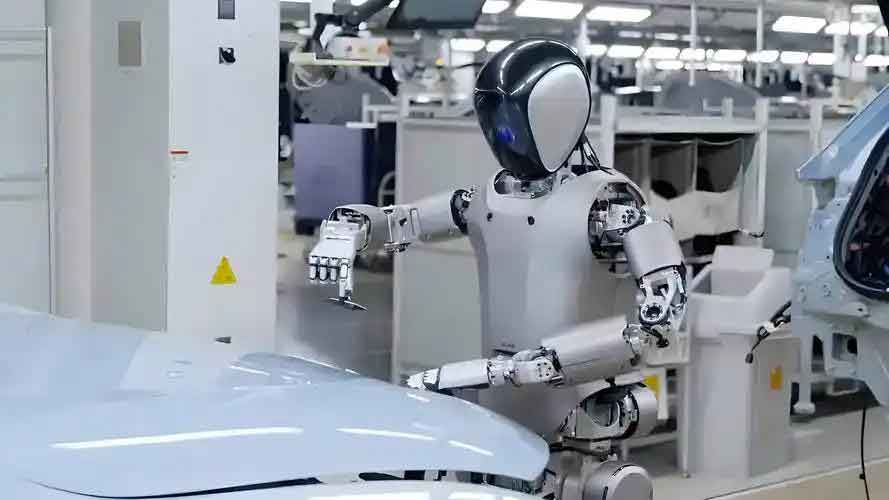
According to the standard, from L1 to L5, the intelligence capability level of a humanoid robot rises progressively. The document also provides 22 first-level indicators, more than 100 technical clauses, a general safety baseline, and mappings to typical application scenarios. These elements are intended to give enterprises an intuitive reference for product design, performance benchmarking, and capability declarations.
Experts regard the release of the Humanoid Robot Intelligence Grading standard as an important achievement in collaborative innovation across the humanoid robot industry. Like autonomous driving levels for intelligent vehicles, the standard offers the sector a scientific and unified technical language and evaluation tool. Through technology transparency, risk controllability, and industrial collaboration, it is expected to help regulate market order, guide the direction of technology research and development more precisely, and accelerate the application of humanoid robots across various fields. It may also help break down barriers between technology and scenarios, promoting the healthy and high-quality development of the entire industrial ecosystem.
China’s humanoid robot development is gradually moving from a function-oriented approach toward intelligence evolution. As humanoid robot intelligence improves, it can greatly enhance the application potential of humanoid robots when facing complex tasks, different scenarios, and real-time changing environments. Humanoid robot products are emerging one after another, but the industry has lacked corresponding intelligence evaluation standards. Technology, product design, and application issues have become urgent problems for the industry to solve.
1. A Shared Technical Language for Humanoid Robot Intelligence
The new standard arrives at a moment when humanoid robot development is accelerating on multiple fronts. Hardware platforms are becoming more capable, software architectures are becoming more adaptive, and application trials are expanding from laboratories and exhibition halls into factories, pharmacies, logistics, education, commercial services, and health care. Yet without a common grading language, buyers, developers, regulators, and researchers have had difficulty comparing humanoid robot intelligence in a consistent way.
The standard is designed to solve that problem. By defining capability dimensions, intelligence levels, safety baselines, and application mappings, it gives the humanoid robot industry a structured way to describe what a system can do and how intelligent it is. For enterprises, this can support product planning, competitive benchmarking, and public capability claims. For customers, it can make purchasing decisions more transparent. For regulators and research institutions, it can provide a common reference for testing, management, and policy implementation.
The framework also reflects a broader shift in the humanoid robot field. Earlier generations of humanoid robots were often judged primarily by mechanical form, walking ability, or predefined demonstrations. More recent humanoid robot systems are being evaluated by perception, learning, decision-making, execution, and interaction. That shift matters because a humanoid robot that only performs scripted actions in a controlled environment is fundamentally different from a humanoid robot that can understand tasks, adapt to changes, and collaborate with people.
2. Four Dimensions and Five Levels
The standard’s four-dimensional, five-level structure is central to its approach. The dimensions cover perception and cognition, decision and learning, execution and performance, and collaboration and interaction. Together, they aim to describe the intelligence of a humanoid robot not as a single score, but as a multidimensional capability profile. The five levels, L1 through L5, provide a ladder for increasing intelligence capability.
| Framework Element | What the Standard Provides |
|---|---|
| Core Dimensions | Perception and Cognition, or P; Decision and Learning, or D; Execution and Performance, or E; Collaboration and Interaction, or C |
| Intelligence Levels | L1, L2, L3, L4, and L5, with intelligence capability increasing from L1 to L5 |
| Supporting Indicators | 22 first-level indicators and more than 100 technical clauses |
| Safety and Application Mapping | A general safety baseline and mappings to typical application scenarios |
The four dimensions are not isolated categories. A humanoid robot must perceive its environment, understand relevant objects and people, make decisions, learn from experience or instructions, execute physical actions, and interact with humans or other machines. Weakness in any one dimension can limit the overall usefulness of a humanoid robot. For example, strong execution without perception may lead to unsafe movement. Strong perception without decision-making may produce awareness without action. Strong individual capability without collaboration may limit deployment in shared human environments.
The L1 to L5 structure gives the market a way to distinguish between basic humanoid robot intelligence and more advanced humanoid robot intelligence. The standard does not merely describe motion performance. It also addresses cognition, learning, execution, and interaction, which are increasingly important as humanoid robots move toward general-purpose use. The inclusion of 22 first-level indicators and more than 100 technical clauses means that the grading system can be applied with significant technical detail rather than broad marketing language.
The general safety baseline is also significant. As humanoid robots become more capable and enter more human-centered environments, safety cannot be treated as an afterthought. A grading standard that includes safety expectations and application scenario mappings can help align technical progress with practical risk management. This is especially important for humanoid robots that may work near people, handle objects, move through public spaces, or operate in industrial settings.
3. Policy and Standardization Timeline
The release of T/CIE 298-2025 did not happen in isolation. It follows a series of policy and standardization steps intended to support the humanoid robot sector. In 2023, the Ministry of Industry and Information Technology issued the Guiding Opinions on the Innovation and Development of Humanoid Robots. That document called for research on a standardization roadmap for humanoid robots and for a comprehensive review of standardization needs across the industrial chain. It also emphasized the establishment and improvement of a humanoid robot industry standard system and the promotion of standard formulation through classified and graded approaches.
| Time | Standardization and Policy Development |
|---|---|
| 2023 | The Ministry of Industry and Information Technology issued the Guiding Opinions on the Innovation and Development of Humanoid Robots, calling for a standardization roadmap and an improved humanoid robot industry standard system. |
| September 2024 | The Ministry of Industry and Information Technology publicized a plan for establishing a humanoid robot standardization technical committee, with emphasis on basic common technologies, safety, complete machines, key technologies, components, and applications. |
| February 2025 | The Chinese Institute of Electronics solicited public comments on the group standard Technical Requirements for Humanoid Robot Intelligence Grading. |
| Recent Release | The Humanoid Robot Intelligence Grading group standard, T/CIE 298-2025, was formally released by the Chinese Institute of Electronics. |
In September 2024, the Ministry of Industry and Information Technology publicized a plan for the preparation of a humanoid robot standardization technical committee. That plan required focused work on industry standards for basic common technologies, safety, complete machines and key technologies, components and parts, and applications. The move signaled that humanoid robot standardization would not be limited to a single technical domain but would cover the full product and application lifecycle.
In February 2025, the Chinese Institute of Electronics publicly solicited opinions on the group standard Technical Requirements for Humanoid Robot Intelligence Grading. The subsequent release of the new group standard is expected to provide foundational support for humanoid robot intelligence technology, product research and development, testing, management, and scenario applications. It is also expected to effectively provide a unified technical language and evaluation system for the humanoid robot market.
As the grading standard is implemented, humanoid robots are expected to move beyond demonstrative intelligence toward genuine general intelligence. That evolution could support large-scale applications in special operations, logistics handling, industrial manufacturing, education and research, commercial services, health care and elderly care, and many other fields. In that sense, the standard is not only a technical document but also a market coordination tool that may accelerate the integration of humanoid robots into thousands of industries and households.
4. Beijing’s Action Plan and Ecosystem Goals
Beijing has emerged as a major center for humanoid robot and embodied intelligence development. In February 2025, the Beijing Municipal Science and Technology Commission and other bodies jointly released the Beijing Embodied Intelligence Technology Innovation and Industry Cultivation Action Plan for 2025 to 2027. The plan states that by 2027, Beijing aims to achieve breakthroughs in no fewer than 100 key technologies and produce no fewer than 10 internationally leading hardware and software products. It also aims for the upstream and downstream industrial chain of embodied intelligence to basically achieve localization.
The accelerating humanoid robot industry in Beijing is being presented as a new model of Chinese intelligent manufacturing. The action plan connects technology research, product development, testing, application, and industrial clustering. It also sets targets for enterprises, products, applications, and mass production scale. These targets show that humanoid robot development is being treated not only as a research challenge but also as an industrial ecosystem challenge.
| Target Area by 2027 | Goal |
|---|---|
| Key Technology Breakthroughs | No fewer than 100 |
| Internationally Leading Hardware and Software Products | No fewer than 10 |
| Embodied Intelligence Industrial Chain | Basic localization across upstream and downstream links |
| Core Enterprises in the Industrial Chain | No fewer than 50 |
| Mass-Produced Products | No fewer than 50 |
| Large-Scale Applications | No fewer than 100 across research and education, industrial and commercial, and personalized service scenarios |
| Mass Production Scale | First to exceed 10,000 units |
| Industrial Cluster | Cultivate a hundred-billion-yuan-level industrial cluster |
The action plan also sets a goal of cultivating no fewer than 50 core enterprises across the upstream and downstream industrial chain. It calls for no fewer than 50 mass-produced products and no fewer than 100 large-scale applications in three major scenarios: research and education, industrial and commercial use, and personalized services. It also aims for mass production scale to first exceed 10,000 units and for the formation of a hundred-billion-yuan-level industrial cluster.
In 2025, a new robot industrial park is expected to be added in Future Science City in northern Beijing. Its establishment can link with the robot industrial park in Yizhuang in the south of the city. Together, these parks can provide space for research and development, manufacturing, testing, application, and display, accelerating industrial agglomeration. For the humanoid robot sector, such infrastructure can shorten the path from prototype to product and from product to scaled deployment.
Jiang Guangzhi, director of the Beijing Municipal Bureau of Economy and Information Technology, said Beijing is making every effort to build an international center for science and technology innovation and a global digital economy benchmark city. He said Beijing will work to contribute to embodied intelligence technology innovation and the cultivation of the humanoid robot industry. That message aligns the humanoid robot sector with broader municipal goals in digital economy, advanced manufacturing, and technology leadership.
5. From Wabot-1 to AI-Enabled Humanoid Robots
The history of humanoid robots can be viewed as a journey from similarity in form to similarity in intelligence. The first humanoid robot, Wabot-1, appeared in 1973. Since then, the field has advanced through multiple phases. From 2010 to 2020, the focus was on dynamic control for high-difficulty movements. From 2020 to 2025, the field entered an AI empowerment phase. During this period, humanoid robots began to become more human-like not only in shape but also in cognition and other capabilities.
In 2025, interest in humanoid robots has continued to rise. The momentum is visible in public events, industry competitions, and commercial announcements. Humanoid robots are no longer only research platforms. They are becoming candidates for real work in factories, warehouses, stores, hospitals, schools, and homes. The intelligence grading standard is intended to help the industry manage this transition by providing a common way to measure progress.
The evolution from mechanical fantasy to a golden track has not been linear. Early humanoid robots demonstrated basic movement and interaction, but they were limited by computing power, sensing, actuators, energy storage, and control algorithms. As those technologies improved, humanoid robots gained more stable walking, more complex manipulation, and more adaptive behavior. The recent AI empowerment phase has added learning, perception, and decision-making capabilities that make humanoid robots more useful in unstructured environments.
The new standard reflects this historical shift. It does not define a humanoid robot only by its body. It defines intelligence across perception, decision, execution, and collaboration. That broader definition is necessary because the next stage of humanoid robot development will depend on software and AI as much as on mechanical engineering.
6. Demonstrations Show Rapid Iteration
Public demonstrations have become a visible measure of humanoid robot progress. At the 2025 Zhongguancun Forum Annual Meeting, companies participating in a humanoid robot show prepared for three weeks for a three-minute program. At a humanoid robot half-marathon, 20 robot teams competed alongside 12,000 human runners. These events illustrate how humanoid robots are moving from laboratory demonstrations to public performance and competitive testing.
Cheng Hao, founder and chairman of Accelerated Evolution, offered an example of how quickly the field has changed. He said that in early 2024, humanoid robots around the world would fall after walking for a while. By the end of the year, T1, a humanoid robot from Accelerated Evolution, could avoid falling during intense contact and collisions such as soccer play. Even if it fell, it could autonomously get up within 1 to 2 seconds. That capability had not been possible before.
Beijing-developed Tiangong also demonstrated its strength by winning a humanoid robot half-marathon. Beyond running on flat roads, Tiangong can climb more than a hundred steps, reach the highest point of Haiziqiang Park, run quickly in snow, and remain standing when subjected to pushing, pulling, dragging, or impact. These capabilities show progress in balance, locomotion, environmental adaptation, and disturbance rejection.
An internal source at a humanoid robot company said the industry has small breakthroughs almost every week. Liu Weiliang, deputy director of the Beijing Municipal Bureau of Economy and Information Technology, also noted that innovative humanoid robot products continue to emerge, and that motion capability and intelligence are showing an unprecedented iteration speed. For the humanoid robot industry, this pace of improvement creates both opportunity and pressure. Opportunity comes from expanding technical possibilities. Pressure comes from the need to test, compare, and deploy systems safely.
7. Commercial Contracts Bring Humanoid Robots Into Factories
Technical breakthroughs are giving humanoid robot deployment more imaginative possibilities. UBTECH has signed a contract with Dongfeng Liuzhou Motor for 20 large bipedal humanoid robots. The products are mainly the industrial humanoid robot Walker S1 and the commercial humanoid robot Walker C. The related products will be used in automobile factory production and manufacturing, as well as commercial reception and other areas.
This contract is notable because it moves humanoid robots from demonstration to procurement. Factory environments can be structured, but they also involve safety requirements, workflow integration, maintenance, and return on investment. A humanoid robot used in automobile production must operate reliably around machinery, parts, and workers. A commercial humanoid robot used for reception must interact with people and represent a brand appropriately. The fact that both industrial and commercial humanoid robot models are included suggests that the market is testing multiple use cases at once.
The factory setting is often seen as an early market for humanoid robots because tasks can be defined and repeated, and because productivity gains can be measured. However, factories also demand high uptime and clear safety standards. The new intelligence grading standard could help buyers specify what level of humanoid robot intelligence is required for a given task. For example, a humanoid robot performing simple material handling may need different capabilities from a humanoid robot collaborating with workers on an assembly line.
Commercial reception is a different kind of test. It requires humanoid robots to perceive people, understand speech or gestures, respond appropriately, and manage unpredictable interactions. The combination of industrial and commercial deployments shows that humanoid robot development is branching into both high-value manufacturing and service-oriented applications.
8. Pharmacy Automation and Daily Service Scenarios
Galaxy General product partner Fu Qiang said the company and its partners have jointly created an unattended smart pharmacy solution involving humanoid robots. The solution is expected to be deployed in about 100 stores in 2025, with initial applications in first-tier cities such as Beijing, Shanghai, and Shenzhen. Some consumers who purchase goods through mobile phones have already had their items picked by robots in stores and handed to delivery riders before being delivered to users.
This example shows how humanoid robots can be integrated into existing retail and logistics workflows. The humanoid robot does not necessarily replace the entire store. Instead, it performs specific tasks such as picking and handing over goods. That division of labor can make deployment more practical. It also illustrates the importance of collaboration and interaction capabilities. A humanoid robot in a pharmacy must work with digital orders, physical shelves, store staff, and delivery riders.
The smart pharmacy scenario also highlights the value of embodied intelligence. An online order is digital, but the product is physical. A humanoid robot must locate the item, grasp it, move it, and deliver it to the right person or place. This requires perception, decision-making, execution, and interaction. The intelligence grading standard can help define what level of humanoid robot capability is needed for such tasks and how to compare different systems.
Retail and service environments are less structured than many factory cells. Shelves may change, packages may vary, and people may behave unpredictably. A humanoid robot operating in these environments must handle uncertainty. That is why the standard’s emphasis on perception and cognition, decision and learning, and collaboration and interaction is relevant beyond industrial applications.
9. General-Purpose Ambitions and Commercialization Choices
At present, most humanoid robots produced by industry enterprises are general-purpose products. That means task generality and scenario generality. Task generality means a humanoid robot can complete multiple types of tasks. Scenario generality means it can be applied in multiple application scenarios. From another perspective, this involves the generalization ability of humanoid robots.
Wang He, founder of Galaxy General, said the approach should be to first explore embodied intelligence generalization along dimensions that can generate productivity value, and then study its capabilities in more dimensions. This view suggests a pragmatic path. Instead of trying to make a humanoid robot do everything at once, companies may first target tasks where humanoid robot work creates measurable value. Once those capabilities are reliable, they can expand to broader tasks and environments.
Leng Xiaokun, founder of Leju Robotics, looked at the issue from the perspective of scenarios. He said industrial scenarios are only a transition, and humanoid robots will explode in family scenarios. He also said companies should prepare for a five-year or even ten-year protracted battle and should not be distracted by outside noise, because many technical routes have not yet been confirmed. In his view, the most important current priorities are cost reduction, batch production, and localization. These issues affect the whole system and must be promoted together.
This debate is central to the humanoid robot industry. Industrial deployments can provide early revenue, structured environments, and clear productivity metrics. Family scenarios promise a much larger long-term market but require higher safety, lower cost, more natural interaction, and greater robustness. The intelligence grading standard can support both paths by allowing developers to state the capability level of a humanoid robot and by helping users match a humanoid robot to a task.
The general-purpose humanoid robot vision also depends on supply chains. If key components remain expensive or dependent on limited suppliers, mass production will be difficult. If software and AI capabilities are not robust, humanoid robots may remain confined to demonstrations. If safety and reliability are not proven, deployment in homes and public spaces will be slow. The standard alone cannot solve these challenges, but it can create a common reference for measuring progress.
10. Cost, Scale, and Localization Challenges
The humanoid robot industry faces several interconnected challenges. Cost reduction is one. Batch production is another. Localization of the supply chain is a third. These issues are linked. Lower costs can enable larger batches. Larger batches can improve supply chain maturity and reduce unit costs. Localization can reduce dependency and improve responsiveness. Together, they can make humanoid robot deployment more economically viable.
Leng Xiaokun’s comment that many technical routes have not yet been confirmed is important. In a field with rapid change, companies must make bets on actuators, sensors, control architectures, AI models, energy systems, and manufacturing methods. Some bets may pay off. Others may not. A standardized intelligence grading framework can help the industry focus on outcomes rather than only on internal technical choices. If different technical routes can be compared using common dimensions and levels, the market can better judge which humanoid robot systems are truly capable.
The policy environment also supports scale. The Beijing action plan targets no fewer than 50 core enterprises, no fewer than 50 mass-produced products, no fewer than 100 large-scale applications, and mass production scale first exceeding 10,000 units by 2027. These are ambitious targets, but they indicate that local governments and industry participants are preparing for a transition from research prototypes to commercial products.
For humanoid robot companies, the challenge is to move from one-off demonstrations to repeatable delivery. That requires manufacturing discipline, quality control, after-sales support, software updates, and safety management. A humanoid robot that performs well in a show may not perform reliably in daily work. The new standard’s technical clauses and safety baseline can help companies design for reliability and document capability in a structured way.
11. What the Standard Means for the Humanoid Robot Market
The Humanoid Robot Intelligence Grading standard is expected to provide basic support for humanoid robot intelligence technology, product research and development, testing, management, and scenario applications. It can also provide the humanoid robot market with a unified technical language and evaluation system. That matters because markets need comparability. Without comparability, buyers rely on demonstrations, marketing claims, or custom benchmarks. With comparability, buyers can specify requirements and evaluate offers more systematically.
The standard may also help guide investment and research priorities. If the industry agrees on four dimensions and five levels, then gaps in perception, decision-making, execution, or collaboration become clearer. Researchers can target specific weaknesses. Developers can plan product generations. Investors can assess technical progress against a common framework. Regulators can consider safety and capability thresholds for different application scenarios.
Experts say the standard’s impact will come through technology transparency, risk controllability, and industrial collaboration. Technology transparency means that capabilities can be described more openly and consistently. Risk controllability means that safety and capability levels can be matched to application contexts. Industrial collaboration means that different companies, research institutes, and application partners can work from a shared vocabulary. These factors can help regulate market order, guide technology research and development, and accelerate the application of humanoid robots in various fields.
The standard may also help break the barrier between technology and scenarios. In many cases, a humanoid robot may be technically impressive but poorly matched to a real task. Conversely, an application may need only a moderate level of humanoid robot intelligence, but buyers may not know how to specify it. By mapping intelligence levels to typical application scenarios, the standard can help align supply and demand. That alignment is essential for scaling humanoid robot deployment.
12. Outlook: From Demonstration Intelligence to General Intelligence
The future of the humanoid robot industry will depend on whether today’s demonstrations can become tomorrow’s productive tools. The new grading standard is designed to support that transition. As the standard is implemented, humanoid robots are expected to break through demonstrative intelligence and move toward genuine general intelligence. If that happens, humanoid robots could achieve large-scale applications in special operations, logistics handling, industrial manufacturing, education and research, commercial services, health care and elderly care, and many other fields.
The path will not be simple. Humanoid robots must become safer, more reliable, more affordable, and more adaptable. They must learn to work with people, not just near them. They must handle tasks that change over time and environments that are not fully predictable. They must also be supported by supply chains, manufacturing systems, software ecosystems, and service networks that can deliver at scale.
Yet the direction is clear. The release of T/CIE 298-2025 gives the humanoid robot sector a shared reference for intelligence. It defines dimensions, levels, indicators, technical clauses, safety expectations, and application mappings. It brings together major innovation centers, enterprises, and research institutes. It connects humanoid robot development to broader policy goals in standardization, industrial upgrading, and embodied intelligence.
For the humanoid robot market, the standard may become a common language for product design, performance benchmarking, capability declaration, testing, management, and application planning. For the humanoid robot industry, it may help turn fragmented technical progress into coordinated ecosystem development. For society, it may help ensure that humanoid robots enter workplaces and homes with clearer capability expectations and stronger safety foundations.
As humanoid robot technology continues to iterate, the most important question will not be whether a humanoid robot can perform a single impressive action. The question will be whether a humanoid robot can reliably perceive, decide, act, and collaborate across real tasks. The new intelligence grading standard is intended to help answer that question in a systematic way. If successful, it can accelerate the journey of the humanoid robot from exhibition stage to general-purpose tool, enabling humanoid robots to empower thousands of industries and eventually reach thousands of households.