
In the Yaohai District of Hefei, at China Net Valley, the first dedicated SIM card for embodied intelligent robots was placed into the hands of a robot, a moment that may mark a turning point in how communication networks classify their users. For three decades, the SIM card was designed for people. It carried voice, connected social relationships, served entertainment, and built every package logic around human communication habits. That logic never included robots as network users. Now, as robots become network users, and as inspection-class robots become representatives of many embodied intelligence scenarios, their traffic structure and latency requirements are completely different from those of human users.
The event was not limited to a single product release. China Telecom Anhui, together with Huawei and Leju Robot, launched “Embodied Wing Link,” described as China’s first communication package for embodied intelligent robots, and simultaneously implemented the industry’s first 5G-A embodied humanoid robot park group inspection application demonstration. More than a product launch, the development suggests that communication networks are beginning to treat embodied intelligent robots, including humanoid robots, as an independent class of network users.
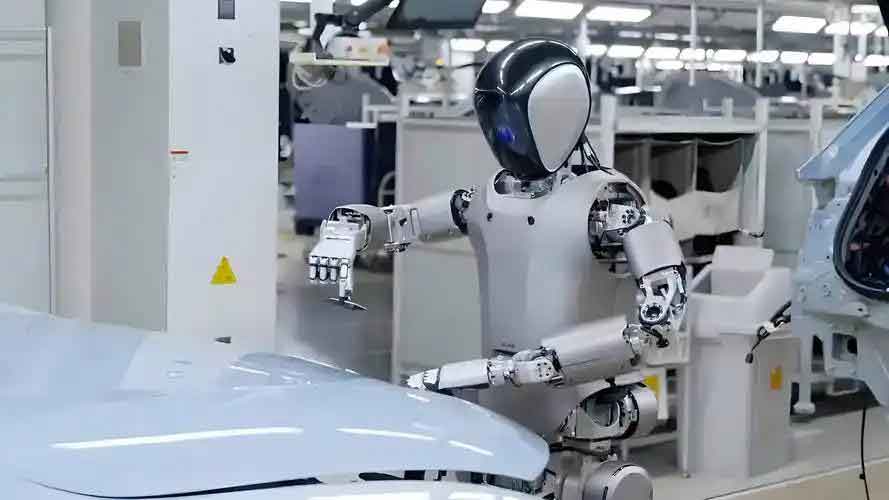
1. Why humanoid robots need a dedicated SIM card
To understand the value of this SIM card, one must first understand the unusual position of embodied intelligent robots in a communication network. Human mobile phone use is mainly downlink-dominated. People watch video, browse web pages, and consume content, while uplink traffic is far lower than downlink traffic. Most embodied intelligent robots are the opposite. Take a robot capable of park inspection. Multiple high-definition cameras transmit in real time, LiDAR point clouds are continuously uploaded, and joint sensors synchronize at high frequency. Its uplink traffic share is far higher than that of a traditional mobile phone user.
Latency sensitivity is also on a different scale. Humans can tolerate a few hundred milliseconds of buffering during video playback. But for embodied intelligence that requires real-time collaboration through the network, remote intervention, or cloud-based intelligent decision-making, a late command during obstacle avoidance may result in a fall or collision. For humanoid robots, this is not an abstract concern. It is a direct safety and operational reliability issue.
| Dimension | Human smartphone users | Humanoid robots in embodied intelligence scenarios |
|---|---|---|
| Traffic direction | Downlink-dominant | Uplink-intensive |
| Typical traffic | Video, web browsing, social and entertainment | Multiple HD camera feeds, LiDAR point cloud, high-frequency joint sensor synchronization |
| Latency tolerance | Can tolerate video buffering and brief interruption | Requires timely commands for obstacle avoidance, remote intervention and cloud intelligence |
| Concurrency challenge | Individual human users share resources | Multiple humanoid robots and human users share resources, requiring priority differentiation |
| Uplink requirement | Generally lower than downlink | At least 20 Mbps for stable single-robot operation, with 500 Mbps peak uplink as a safeguard |
On March 2, 2026, during the Mobile AI Industry Summit held in conjunction with the Barcelona World Mobile Communications Congress, Bi Qi, chief scientist and deputy director of the Science and Technology Committee of China Telecom, said that embodied intelligence needs an uplink rate of more than 20 Mbps to ensure that data does not stutter and commands are not delayed. That statement helps explain why a standard consumer SIM card is not enough for humanoid robots operating in real environments.
Multi-machine concurrency is another test. When multiple embodied intelligent robots and human users share network resources, without priority differentiation, robot commands may be squeezed out during congestion. This is precisely the problem that “Embodied Wing Link” is intended to solve. The challenge is not only speed. It is the combination of uplink capacity, low latency, reliability, and scheduling priority in a network that was originally built around human behavior.
The difference matters for humanoid robots because they are not simply another connected device. A connected camera can sometimes buffer. A connected sensor can sometimes resend. A humanoid robot moving through a physical environment, especially one working alongside people or other machines, cannot rely on best-effort connectivity. The network becomes part of the robot’s control and perception loop. If the network treats humanoid robots like ordinary smartphone users, the result can be instability, inefficiency, or worse.
2. What the “Embodied Wing Link” package provides
The “Embodied Wing Link” package, described as China’s first dedicated package for embodied intelligent robots, is a customized communication product built by China Telecom Anhui for robots and other new intelligent connection subjects. Relying on 5G-A network slicing and edge computing core technologies, the product constructs a deterministic intelligent connection service system. It can provide embodied intelligent devices with a 500 Mbps peak uplink rate, 20 ms ultra-low latency, and exclusive communication guarantees through service priority scheduling.
Hu Xiaoqiao, deputy general manager of the market department at China Telecom Anhui, told the press that 20 Mbps is the basic threshold for stable operation of a single robot, while 500 Mbps peak is a guaranteed upper limit reserved for multi-channel high-definition video, point cloud transmission, and multi-machine concurrency. The point is not to give embodied intelligence a faster card. The point is to provide a dedicated “VIP guarantee channel.”
| Specification | Details |
|---|---|
| Product name | Embodied Wing Link |
| Target users | Robots and new intelligent connection subjects, including humanoid robots |
| Core network technologies | 5G-A network slicing, edge computing |
| Peak uplink rate | 500 Mbps |
| Latency | 20 ms ultra-low latency |
| Scheduling | Business priority scheduling and exclusive communication guarantee |
| Single-robot stability threshold | 20 Mbps |
| Service logic | Deterministic intelligent connection service system |
Once the “channel” exists, a “test field” is also needed. At the launch event, the “5G-A Embodied Intelligence Application Scenario Incubation Base” was officially unveiled. The base is a core innovation platform built by China Telecom Anhui in coordination with upstream and downstream partners in the industrial chain. It focuses on full-chain empowerment for embodied intelligence technology research and development, scenario testing, and commercialization. It provides a real commercial trial environment for frontier technology iteration, innovative product pilots, and industry scenario adaptation.
This combination is important for humanoid robots. A dedicated SIM card is a visible object, but its value depends on the network behind it. Network slicing, edge computing, priority scheduling, and a controlled test environment together create the conditions for humanoid robots to move from demonstrations into daily operations. Without such a foundation, dedicated connectivity remains a technical curiosity. With it, humanoid robots can be treated as a distinct class of network users with their own service-level requirements.
The package also reflects a broader shift in the communications industry. For years, operators designed packages around human consumption patterns: data allowances, voice minutes, roaming, entertainment bundles, and social media behavior. Humanoid robots do not fit those categories. Their needs are closer to industrial control, real-time teleoperation, and distributed intelligence. They require guaranteed uplink, predictable latency, and priority when the network is busy. The launch in Hefei shows that these needs are now being translated into commercial products rather than remaining laboratory requirements.
3. A real industrial stress test with humanoid robots
Released alongside the package was the industry’s first 5G-A embodied humanoid robot park group inspection application demonstration. This was not a laboratory demonstration. It was a scale validation in a real operating scenario. Relying on 5G-A large uplink, low latency, and high-reliability network guarantees, multiple “Kuafu” humanoid robots conducted parallel inspections on eight main routes in the demonstration area. In complex environments, they were able to “see clearly, transmit quickly, and move accurately.”
Ren Guangjie, deputy general manager of Hefei Leju Robot Technology Co., Ltd., introduced that the inspection frequency of these robots is four times per day, two times in the morning and two times in the afternoon. Inside China Net Valley, through several months of inspection, they obtained high-quality data from real scenarios. These data are transmitted in real time to the Leju data collection platform. After cleaning and annotation, they feed back into model iteration, forming a complete closed loop of “inspection operation, real-scene data collection, and data return training.”
Xu Bo, chairman of Hefei Yaohai Science and Technology Innovation Group, said that the park and Leju have achieved a real inspection application, creating a cycle in which scenario data feeds back into optimization. This integrates an all-round, all-time embodied intelligent inspection solution into the park’s smart operation. What it validates is not whether a robot can move. What it validates is whether a robot cluster can collaborate stably in a real network.
That distinction is central to the future of humanoid robots. A single robot walking in a controlled environment demonstrates mechanical capability. A group of humanoid robots working on multiple routes, sending high-volume uplink data, receiving timely commands, and coordinating with a network demonstrates system capability. The park inspection application is therefore a stress test not only for robots, but also for the network. It tests whether the network can support the traffic profile of embodied intelligence without treating humanoid robots as second-class users behind human smartphones.
Zhao Dong, vice president of Huawei’s wireless network business, said that the issuance of China’s first dedicated SIM card for embodied intelligent robots in Hefei’s Yaohai District has a strong demonstration effect. In his view, this will allow robots to move from laboratories into broader spaces and serve more application scenarios. For humanoid robots, that broader space includes inspection, logistics, services, and other environments where reliable connectivity is not optional but foundational.
4. From technical feasibility to scalable products
The inspection demonstration at China Net Valley verified one thing: it is technically feasible for robots to collaborate stably in a 5G-A network. But “feasible” does not equal “replicable.” A single park running successfully does not mean hundreds or thousands of parks can run successfully. The real threshold is whether this connectivity capability can be standardized, productized, and delivered at scale.
The release of the “Embodied Wing Link” package answers precisely this question. It turns a one-time scenario validation into a reusable communication product. It also marks the formal entry of an operator into the “new infrastructure” of embodied intelligence. The path taken by China Telecom Anhui, Huawei, and Leju does not start from the single point of a SIM card. It starts from a systemic solution combining network capability, package design, and scenario validation.
Song Bo, deputy general manager of China Telecom Anhui, said that the company and Huawei have completed China’s first batch of 5G-A large uplink contiguous large-scale deployment and commercial coverage in Hefei, reserving network capability for emerging businesses such as embodied intelligence. At present, China Telecom Anhui has deployed nearly 100 5G-A large uplink base stations in Hefei’s urban area. In Luogang Park, it built the province’s first contiguous demonstration zone, achieving premium coverage across the area.
During the Spring Festival, relying on the 5G-A large uplink network, major events including the Luogang Park drone light show and the Spring Festival Gala Hefei sub-venue achieved zero lag in live broadcasts. These examples show that the network is not being prepared only for humanoid robots. It is being upgraded for a wider set of high-uplink, low-latency applications. Humanoid robots are one of the most demanding beneficiaries of that upgrade.
Beyond network capability, the technical foundation is also being strengthened. During MWC Shanghai 2025, China Telecom and Huawei released the “Smart Aggregation Uplink” innovation. The technology uses AI models to predict channel quality in real time. Through AI, it enables five-dimensional collaborative scheduling of time, frequency, space, and power, along with multi-band intelligent selection, allowing uplink free scheduling according to business needs. It reduces latency by more than 30 percent, increases uplink rate by more than 15 percent, and improves edge experience by more than 15 percent. This technical achievement forms the underlying support for the 5G-A large uplink network capability on which the “Embodied Wing Link” package relies.
| Capability | Details |
|---|---|
| 5G-A large uplink deployment in Hefei | China’s first batch of contiguous large-scale deployment and commercial coverage, completed with Huawei |
| Hefei urban base stations | Nearly 100 5G-A large uplink base stations |
| Provincial contiguous demonstration zone | Luogang Park, the province’s first contiguous demonstration zone with premium coverage |
| Spring Festival event support | Luogang Park drone light show and Spring Festival Gala Hefei sub-venue live broadcasts with zero lag |
| Smart Aggregation Uplink | AI-based real-time channel quality prediction, five-dimensional collaborative scheduling, multi-band intelligent selection, uplink free scheduling |
| Performance improvement | Latency reduced by more than 30 percent, uplink rate increased by more than 15 percent, edge experience improved by more than 15 percent |
For humanoid robots, these capabilities matter because they determine whether the robot can depend on the network for perception, decision-making, and control. If the network can provide deterministic uplink and low latency, humanoid robots can offload more intelligence to the edge or cloud, coordinate with other machines, and operate in larger areas. If the network cannot provide those guarantees, humanoid robots remain limited to local autonomy or controlled environments.
The systemic approach also matters because it avoids treating the SIM card as a standalone accessory. A dedicated SIM card for humanoid robots only becomes meaningful when it is linked to network slicing, edge computing, priority scheduling, and real scenario validation. In Hefei, those elements are being assembled into a commercial framework. That framework is what allows humanoid robots to be served not as experimental devices, but as a recognized category of network user.
5. What Hefei provides to the humanoid robots ecosystem
The first dedicated SIM card for embodied robots was issued in Hefei, and that was not accidental. In 2025, the Hefei Embodied Intelligent Robot Data Collection and Training Center, described as a “robot school,” was opened. Its total building area is about 6,461 square meters. It is equipped with 83 robots from different enterprises. Around four major application fields, industrial manufacturing, commercial services, home life, and smart logistics, it has built 33 types of data collection scenarios.
Data collectors teach robots by hand to tighten screws, grab goods, and organize shelves. Every action is fully recorded and aggregated into standardized datasets. This kind of data infrastructure is essential for humanoid robots and other embodied intelligent machines. Connectivity allows robots to transmit data. Data allows robots to learn and improve. When both are present, a robot can move from a demonstration to a repeatable operation.
In July, the “2025-2026 Hefei Intelligent Robot Universal Grasping Dataset” officially received a registration certificate. It became Anhui’s first multi-modal grasping dataset property rights registration result for embodied intelligent robots. It covers full-process operation scenarios such as object grasping, placement, organization, and storage. It includes robot task text instructions, three-channel camera synchronized video, and real-time pose information from the end gripper.
Hefei has now gathered nearly 200 enterprises in the robot and embodied intelligence industrial chain. In 2025, it released 17 models of humanoid robot complete machines. Industrial robot output reached 22,000 sets, accounting for 2.8 percent of the national total. The city has initially built a full-chain industrial ecosystem covering the “brain, cerebellum, core components, and complete machine.” For humanoid robots, this ecosystem provides hardware, software, data, testing, and application scenarios in one geographic area.
| Indicator | Details |
|---|---|
| Robot and embodied intelligence enterprises | Nearly 200 |
| Humanoid robot complete machine models released in 2025 | 17 |
| Industrial robot output | 22,000 sets |
| National share of industrial robot output | 2.8 percent |
| Data collection and training center area | About 6,461 square meters |
| Robots configured in the training center | 83, from different enterprises |
| Data collection scenario types | 33 |
| Major application fields | Industrial manufacturing, commercial services, home life, smart logistics |
| Dataset registration | 2025-2026 Hefei Intelligent Robot Universal Grasping Dataset, a multi-modal grasping dataset property rights registration result |
This ecosystem helps explain why Hefei became the site for the first dedicated SIM card and the first 5G-A humanoid robot park group inspection demonstration. The city offers more than a network. It offers robots, data collection facilities, application scenarios, and industrial partners. The dedicated SIM card becomes useful only when humanoid robots have places to work, data to learn from, and networks that can support their traffic. Hefei connects those pieces.
The presence of humanoid robots in a real park also generates a loop that benefits both robots and networks. Inspection operations produce real-scene data. That data is collected, cleaned, annotated, and returned to model training. Improved models can then be deployed to humanoid robots for better inspection. Meanwhile, the network learns from the traffic and latency demands of those humanoid robots. The result is co-evolution: robots become more capable, and the network becomes better adapted to embodied intelligence.
6. Why the dedicated SIM card matters for humanoid robots
For three decades, the SIM card was a human-centered object. It represented a person’s identity in the network. It enabled voice calls, social connections, entertainment, and mobile internet access. All package logic was built around human communication habits. Humanoid robots were never part of that logic. They were not considered network users with their own traffic patterns, latency requirements, or priority needs.
The first dedicated SIM card for embodied intelligent robots changes that assumption. It signals that humanoid robots can be recognized as independent network users. It also signals that network design must account for machines that generate high uplink traffic, require low latency, and operate in groups. This is not a small change. It affects how networks are sliced, how resources are scheduled, how edge computing is deployed, and how commercial packages are designed.
For humanoid robots, the benefits are practical. A dedicated package can provide stable uplink for multiple cameras and sensors. It can reduce the risk that commands arrive too late. It can ensure that robot traffic is not squeezed out when many human users and machines share the same network. It can support multi-machine coordination in parks, factories, logistics centers, and commercial spaces. It can also provide a foundation for cloud-based intelligence, where humanoid robots rely on external computing for decisions that would be too heavy or too slow to run entirely on board.
The Hefei deployment also shows that humanoid robots are moving from isolated demonstrations to group operations. A single humanoid robot can be a spectacle. A group of humanoid robots conducting inspections on eight main routes four times a day is an operational system. That system requires scheduling, data transmission, model updates, and network reliability. The dedicated SIM card and the 5G-A network are part of that system.
The launch of “Embodied Wing Link” and the 5G-A embodied humanoid robot park group inspection demonstration should therefore be understood together. The package provides the connection guarantee. The demonstration provides the real-world proof. The incubation base provides the environment for further development. The data center and dataset registration provide the learning infrastructure. Together, they form a chain that supports humanoid robots from research to commercial deployment.
This chain is still at an early stage. The demonstration covers one park, eight routes, and a specific inspection use case. The package is newly launched. The dataset registration is a first for Anhui. The deployment of nearly 100 5G-A large uplink base stations in Hefei’s urban area is a beginning, not an endpoint. But the direction is clear. Networks are being prepared for humanoid robots, and humanoid robots are being prepared for real work.
The significance for the communications industry is equally clear. Operators have historically competed on consumer packages, coverage, and speed. The rise of humanoid robots and embodied intelligence creates a new category of customers. These customers do not make phone calls. They do not watch entertainment video. They do not browse social media. They transmit sensor data, receive control commands, and collaborate with other machines. They need deterministic performance. The operator that can serve them with standardized, productized, scalable connectivity will help define the next phase of network evolution.
For humanoid robots, the dedicated SIM card is a symbolic and practical milestone. It symbolizes that humanoid robots are no longer invisible to network planners. It is practical because humanoid robots need a connection path that matches their traffic profile. The first card was issued in Hefei, but the model it represents can be replicated. If the model proves scalable, humanoid robots will be able to operate in more parks, factories, warehouses, stores, and public spaces. Each new environment will generate more data, more scenarios, and more demand for reliable connectivity.
In that sense, the first dedicated SIM card for embodied intelligent robots is not only about a card. It is about the network recognizing a new kind of user. It is about humanoid robots becoming first-class participants in the digital infrastructure. It is about building the uplink, latency, priority, edge computing, and data loop that humanoid robots need to move from laboratories into broader spaces and serve more application scenarios.
7. A new infrastructure phase for humanoid robots
The Hefei development brings together several trends. The first is the growth of embodied intelligence and humanoid robots as a real industrial category. The second is the evolution of 5G-A networks toward uplink-intensive, low-latency, deterministic services. The third is the emergence of data collection and training infrastructure as a foundation for robot intelligence. The fourth is the productization of connectivity for machines rather than people.
Each trend supports the others. Humanoid robots need data to improve. Data collection requires robots to operate in real scenarios. Real operations require reliable connectivity. Reliable connectivity requires network upgrades and dedicated packages. Dedicated packages require standards and commercial models. The “Embodied Wing Link” package, the 5G-A demonstration, and the incubation base are early steps in this chain.
The use of network slicing and edge computing is especially relevant to humanoid robots. Network slicing allows a network to be divided into logical networks with different performance characteristics. Edge computing moves computation closer to the robot, reducing latency and backhaul load. For humanoid robots, this means that some intelligence can reside near the robot rather than only in a distant cloud. It also means that the network can prioritize robot traffic without degrading human services beyond defined limits.
Priority scheduling addresses a practical problem. In a shared network, human users and humanoid robots may compete for resources. Human users may generate large downlink traffic. Humanoid robots may generate large uplink traffic. Without priority differentiation, robot commands may be delayed or dropped during congestion. The dedicated package’s service priority scheduling is designed to prevent that outcome. It gives humanoid robots a guaranteed path when they need it.
The 500 Mbps peak uplink and 20 ms ultra-low latency figures should be understood in this context. They are not merely marketing numbers. They define a service level that can support multiple high-definition video streams, point cloud uploads, and multi-robot concurrency. The 20 Mbps single-robot threshold defines the minimum for stable operation. Together, they create a range from basic stability to high-load performance. That range is important because humanoid robots will operate in different scenarios with different sensor suites and different levels of autonomy.
As humanoid robots become more common, the network requirements will become more diverse. A humanoid robot in a factory may need deterministic control. A humanoid robot in a park may need wide-area mobility and video uplink. A humanoid robot in a commercial service setting may need natural language interaction and cloud-based reasoning. A humanoid robot in a home may need privacy-sensitive edge processing. The dedicated package and network architecture provide a starting point for this diversity.
The Hefei demonstration also shows the value of real-scenario data. Inspection is repetitive but variable. Weather, obstacles, people, lighting, and network conditions change. Humanoid robots must handle those variations. Real-scene data collection captures them. The closed loop of inspection, collection, and training allows humanoid robots to improve over time. The network supports this loop by transmitting data reliably and quickly.
The registration of the “2025-2026 Hefei Intelligent Robot Universal Grasping Dataset” adds another dimension. Grasping, placement, organization, and storage are fundamental manipulation skills. A multi-modal dataset with task instructions, synchronized camera video, and gripper pose information can help train humanoid robots to perform these skills more reliably. The property rights registration also suggests that data itself is becoming an asset in the humanoid robots ecosystem.
Hefei’s industrial base supports this evolution. Nearly 200 robot and embodied intelligence enterprises, 17 humanoid robot complete machine models released in 2025, and 22,000 sets of industrial robot output accounting for 2.8 percent of the national total provide scale. The full-chain ecosystem covering brain, cerebellum, core components, and complete machine provides depth. The data collection center and datasets provide learning capacity. The 5G-A network and dedicated package provide connectivity. This combination is rare and helps explain why the first dedicated SIM card appeared in Hefei.
For humanoid robots, the next challenge is replication. A single park, a single package, and a single demonstration are important firsts, but they do not guarantee broad adoption. Standardization, productization, and scaling are required. The “Embodied Wing Link” package is a step toward productization. The incubation base is a step toward scenario adaptation. The network deployment is a step toward coverage. The data infrastructure is a step toward continuous improvement. If these steps are repeated in other locations, humanoid robots can move from showcase projects to everyday infrastructure.
The first dedicated SIM card for embodied intelligent robots in Hefei is therefore more than a news event. It is a signal that the communication network is preparing for a world in which humanoid robots are common network users. It is a signal that traffic models, latency requirements, and priority scheduling are being redesigned around machines. It is a signal that humanoid robots are being treated not as gadgets, but as a new class of connected workforce and service provider.
That future will not arrive all at once. It will be built through packages, base stations, datasets, demonstrations, and commercial trials. It will be measured by whether humanoid robots can operate reliably in real environments, whether their data can improve their models, and whether their connectivity can scale across industries. The Hefei launch provides an early answer. It shows that the network can recognize humanoid robots, serve their uplink and latency needs, and support group operations in a real park. The next phase will determine how quickly that recognition spreads.
8. What the Hefei launch means for humanoid robots and network planning
The dedicated SIM card for embodied intelligent robots is not simply a new product line. It represents a change in network planning assumptions. When humanoid robots are treated as independent network users, operators must consider new identity management, authentication, billing, policy control, and service-level guarantees. A robot may operate on behalf of a company, a park, a factory, or a public service provider. It may move across cells, cooperate with other robots, and send different types of data at different priorities. These are not the same requirements as those of a human smartphone user.
For humanoid robots, the network must support mobility, uplink capacity, low latency, and group coordination at the same time. A humanoid robot may carry multiple cameras, LiDAR, inertial sensors, microphones, and joint encoders. Each of these data sources has different transmission needs. Video may be bandwidth-heavy. Control commands may be latency-critical. Sensor synchronization may require precise timing. The network must be able to distinguish among these flows and schedule them appropriately. The dedicated package’s priority scheduling and deterministic service model are designed for this kind of differentiation.
The Hefei demonstration shows why real-world validation is necessary. In a laboratory, network conditions can be controlled. In a park, conditions change. Humanoid robots must interact with pedestrians, vehicles, obstacles, weather, and other robots. The network must remain reliable as robots move. The demonstration on eight main routes, with inspections four times per day, creates a repeated operational pattern. That pattern produces data and exposes problems that a one-time demonstration may miss.
The closed loop of inspection, data collection, and training is especially important for humanoid robots. Inspection generates real scenes. Real scenes generate data. Data improves models. Improved models enhance inspection. The network enables this loop by moving data from robots to the platform and by delivering updated models or commands back to robots. Without reliable connectivity, the loop is slow or incomplete. With reliable connectivity, the loop can operate continuously.
The cooperation among China Telecom Anhui, Huawei, and Leju also suggests a new division of roles. The operator provides network capability, slicing, edge computing, and commercial packages. The equipment vendor provides network technology and innovation such as 5G-A large uplink and Smart Aggregation Uplink. The robot company provides humanoid robots, application scenarios, and operational data. This three-party model can be replicated in other regions and industries. It brings together connectivity, computing, and robotics in a single framework.
For humanoid robots, the first dedicated SIM card in Hefei is a foundation, not a finish line. The next steps include expanding coverage, supporting more robot types, refining service-level guarantees, and integrating with industrial systems. The package must prove that it can serve many humanoid robots at once, in different environments, without losing the determinism that makes it valuable. The network must prove that it can scale from a park demonstration to city-level and industry-level deployment.
The significance of the Hefei launch is therefore both symbolic and practical. Symbolically, it shows that humanoid robots are being recognized as a distinct class of network user. Practically, it provides a package, a network, a test base, and a data loop that can support humanoid robots in real operations. The combination may help accelerate the transition of humanoid robots from laboratories to broader spaces and more application scenarios.
As the first dedicated SIM card was handed to a robot in Hefei, the meaning was not only that a robot received a connection. The meaning was that the network began to see humanoid robots as users with distinct requirements. For an industry moving from laboratories to real work, that recognition may be as important as any single robot capability. Humanoid robots need more than motors, batteries, and AI models. They need a network that understands them. In Hefei, that understanding has taken a concrete step forward.
9. The wider implications for humanoid robots and embodied intelligence
The launch in Hefei also highlights a broader point about embodied intelligence. Humanoid robots are often discussed in terms of mechanical design, artificial intelligence, and manipulation. Those elements are essential, but they are not sufficient for commercial deployment. A humanoid robot that cannot communicate reliably with a control center, a data platform, or other robots is limited in where and how it can work. Connectivity is therefore not an accessory to embodied intelligence. It is part of the operating environment.
This is why the dedicated SIM card matters for humanoid robots. It gives them a network identity and a service profile. It allows the network to distinguish their traffic from human traffic and to apply appropriate policies. It creates the possibility of guaranteed uplink, low latency, and priority scheduling. It also makes it possible to manage humanoid robots at scale. A fleet of humanoid robots cannot be managed one by one through manual configuration. It needs standardized connectivity, authentication, and policy enforcement.
The 5G-A network capabilities in Hefei provide the technical basis for this management. Large uplink supports the data volume generated by humanoid robots. Low latency supports timely control and coordination. High reliability supports safety and operational continuity. Network slicing allows different robot applications to receive different levels of service. Edge computing reduces the distance between computation and action. Together, these capabilities create a network environment suited to embodied intelligence.
The incubation base adds an important dimension. Innovation in humanoid robots requires testing in realistic conditions. A base that focuses on technology research and development, scenario testing, and commercialization can help shorten the path from prototype to product. It can also help match robot capabilities with network capabilities. For example, a humanoid robot designed for inspection may need a different network profile from a humanoid robot designed for logistics or commercial service. The incubation base can help define those profiles.
The data collection and training center in Hefei supports the intelligence side of humanoid robots. Real-scene data from inspection, grasping, placement, organization, and storage can be used to train models. The registered multi-modal grasping dataset adds structure and legal recognition to this data. As humanoid robots become more capable, the value of high-quality data will continue to rise. The network helps move that data from robots to training platforms, and then helps move improved models back to robots.
The industrial ecosystem in Hefei provides scale and diversity. Nearly 200 enterprises in the robot and embodied intelligence chain, 17 humanoid robot complete machine models released in 2025, and 22,000 sets of industrial robot output show that the region has a broad base. The full-chain ecosystem covering brain, cerebellum, core components, and complete machine means that humanoid robots can be developed, tested, and deployed with local support. This reduces the friction that often slows the transition from research to commercial application.
For the communications industry, humanoid robots represent a new growth area. They are not simply more smartphones. They are machines with different traffic patterns, different latency needs, and different scheduling priorities. They require new packages, new service-level agreements, and new network capabilities. The “Embodied Wing Link” package is an early example of how operators can serve this new category. The 5G-A deployment in Hefei is an early example of the network foundation required.
For humanoid robots, the Hefei launch is an early example of the support system they need. It includes connectivity, computing, data, testing, and commercial products. It includes a real park with real inspection routes. It includes a data loop that connects operations to model improvement. It includes a network that can distinguish humanoid robots from human users and provide appropriate guarantees. This support system is what allows humanoid robots to move from demonstrations to daily work.
The first dedicated SIM card for embodied intelligent robots was issued in Hefei, but its implications extend beyond one city. It shows that humanoid robots can be treated as independent network users. It shows that networks can be designed to meet their uplink and latency requirements. It shows that operators, equipment vendors, and robot companies can work together to build a commercial framework. If this framework is standardized and scaled, humanoid robots can operate in more places and serve more purposes.
In the end, the significance of the Hefei launch is not only that a robot received a dedicated SIM card. It is that the network began to recognize humanoid robots as a new kind of user. That recognition is a prerequisite for large-scale deployment. It is also a signal that the next phase of embodied intelligence will depend as much on connectivity and data infrastructure as on robot hardware and artificial intelligence. Humanoid robots are moving into the network. In Hefei, the network has started to move toward them.