
At the Second World Humanoid Robot Games, fifty Tiangong humanoid robots moved with steady steps and orderly formation. Using precise autonomous navigation, they paraded around the National Speed Skating Oval like athletes. For Zhang Xiangyu, a post-90s navigation algorithm engineer at the Beijing Humanoid Robot Innovation Center, the scene was far more than a ceremonial display. It was a high-intensity test of swarm intelligence for humanoid robots. Zhang said that a formation entrance may look as if humanoid robots are simply walking forward together, but in reality it is a demanding exercise in collective coordination. Fifty humanoid robots cannot start moving on the basis of one simple command. Each humanoid robot must have its own position, its own path, and its own rhythm while remaining consistent with the overall formation. They must listen to collective instructions and also make local adjustments according to what is happening directly in front of them.
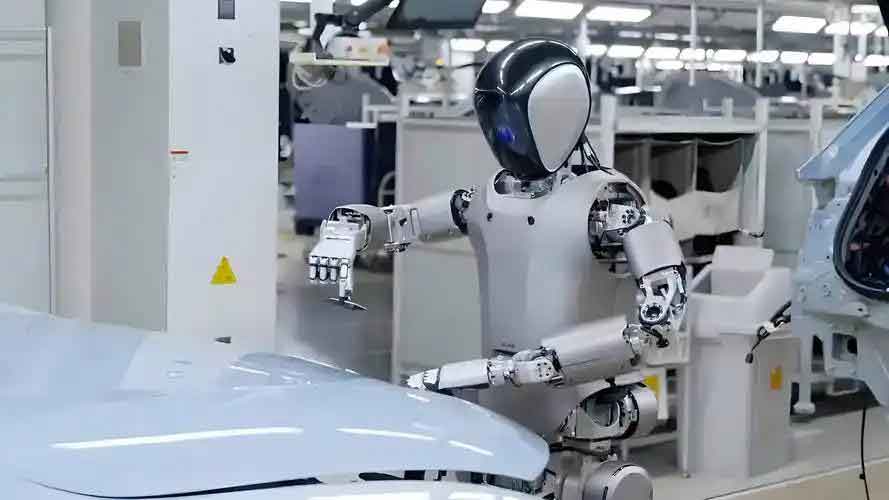
For humanoid robots to walk steadily, they cannot rely only on task planning in the brain. They also need motion capability. In the industry, this capability is compared to the cerebellum of humanoid robots. It continuously senses posture and position, corrects gait and speed in real time, and maintains balance and safe operation when the ground is uneven, when localization fluctuates, or when sudden interference occurs. Zhang Xiangyu’s work in navigation and collaboration is precisely about enabling humanoid robots to have a highly developed cerebellum. The effort is not merely about making humanoid robots move, but about making them move reliably, repeatedly, and safely in real environments.
1. A Parade of Humanoid Robots Becomes a Test of Swarm Intelligence
The opening ceremony of the Second World Humanoid Robot Games placed humanoid robots in a setting that demanded more than individual performance. Fifty Tiangong humanoid robots maintained a整齐 formation, but the order on display was not the result of rigid choreography alone. Each humanoid robot had to navigate autonomously while staying aligned with the group. The formation was a visible expression of invisible computation. Every humanoid robot had to understand where it was, where it should be, how fast it should move, and how to respond if its position or timing deviated from the plan.
Zhang Xiangyu described the event as a stress test of swarm intelligence. For humanoid robots, swarm intelligence does not mean that every unit behaves identically. It means that many humanoid robots can align with one another under a shared task while also tolerating local errors. A single humanoid robot may encounter a small localization fluctuation. Another may respond slowly during a turn. Another may reduce speed because of ground conditions, gait state, or safety strategy. In a group of fifty, even a tiny single-unit error can be amplified. The real challenge is not achieving one successful demonstration, but ensuring that humanoid robots can complete a task safely, stably, and repeatedly even when the real site has fluctuations and interference.
The parade therefore became a practical lesson in coordination for humanoid robots. The formation looked orderly because each humanoid robot was doing more than following a line. Each was continuously checking its own condition and making small corrections. The scene showed that humanoid robots are moving from isolated demonstrations toward collective operations. That shift requires not only stronger individual control, but also better communication between navigation, perception, planning, and safety systems inside every humanoid robot.
2. From One Humanoid Robot to Fifty: The Scale of Coordination
Zhang Xiangyu graduated from Beihang University with a master’s degree in Transportation Engineering. He joined the Beijing Humanoid Robot Innovation Center after graduation. In his view, the humanoid robotics industry has broad prospects. Soon after joining, he and his colleagues formed a team and won the 2026 Robot Warriors Challenge. At that time, he was responsible for debugging only one humanoid robot. Now he is responsible for formation debugging for fifty humanoid robots. The change in scale reflects a broader change in the field: humanoid robots are no longer only individual machines under test. They are increasingly expected to operate as coordinated groups.
The largest difficulty, according to Zhang, is that humanoid robots are not completely identical copies. Some may have slight localization fluctuations. Some may react a little more slowly when turning. Some may actively reduce speed because of ground conditions, gait status, or safety strategy. A very small error in a single machine can be magnified when fifty humanoid robots operate together. The true challenge is not to make fifty humanoid robots walk successfully in one demonstration. The true challenge is to make them complete a task safely, stably, and repeatedly in a real venue where fluctuations and interference are unavoidable.
Fifty humanoid robots in formation correspond to fifty cerebellums thinking at the same time. If one humanoid robot experiences localization fluctuation, delayed turning, or voluntary speed reduction due to safety strategy, its cerebellum must complete correction within a short period. It must fine-tune its path, restrain its speed, and重新 engage with the formation. It must not carry the error all the way to the finish. In other words, whether a formation walks well depends on whether the cerebellum of each humanoid robot is stable enough. The formation is not held together only by external control. It is held together by distributed correction inside each humanoid robot.
3. Unified Rules and Elastic Local Decisions
To address this challenge, Zhang Xiangyu and his colleagues did not make fifty humanoid robots rigidly step in perfect synchronization. Instead, they created a set of coordination rules for each humanoid robot’s cerebellum that is both unified and elastic. The unified elements are task time, formation goals, and safety boundaries. The elastic element is that local decision-making authority is left to each humanoid robot. Each humanoid robot can make fine adjustments based on its actual position, motion state, and immediate conditions, thereby absorbing the fluctuations and interference that are unavoidable on a real site.
As a result, humanoid robots share the same broad direction while also taking care of the small situations beneath their feet. The orderliness of the formation depends on fifty cerebellums digesting errors within the same rule set. This is a shift from single-machine intelligence to swarm intelligence. Single-machine intelligence means that one cerebellum continuously senses, continuously corrects, and continuously judges in a complex environment. Swarm intelligence means that many cerebellums align with one another and tolerate one another’s faults under the same task. For humanoid robots, this is a critical step toward operating in open, dynamic, and unpredictable spaces.
| Dimension | Single-Machine Intelligence for Humanoid Robots | Swarm Intelligence for Humanoid Robots |
|---|---|---|
| Scope | One humanoid robot senses, corrects, and judges in a complex environment. | Many humanoid robots align and tolerate faults under one shared task. |
| Core capability | A single cerebellum maintains continuous perception and correction. | Multiple cerebellums coordinate within unified and elastic rules. |
| Error handling | The humanoid robot absorbs local disturbance on its own. | Each humanoid robot digests local error while remaining aligned with the group. |
| Formation outcome | The humanoid robot can complete an individual action. | The humanoid robots can maintain safe, stable, and repeatable collective movement. |
4. The Cerebellum of Humanoid Robots: Perception, Correction, and Balance
The cerebellum metaphor is useful for understanding what humanoid robots need beyond high-level planning. The brain handles task planning. The cerebellum handles motion capability. For humanoid robots, the cerebellum must continuously sense posture and position. It must correct gait and speed in real time. It must maintain balance and safety when the ground rises and falls, when localization data jitters, or when unexpected interference appears. Zhang Xiangyu’s work in navigation and collaboration is directly connected to this need. His goal is to help humanoid robots develop a strong cerebellum.
This cerebellum is not a single component. It is a loop that connects perception, localization, path planning, speed control, safety strategy, and formation logic. When a humanoid robot moves, it must repeatedly ask itself whether its current position is correct, whether its speed is appropriate, and whether its surroundings are safe. Zhang often places himself in the role of the humanoid robot during research and development. He does not imagine a machine that only turns back after going the wrong way. He imagines a machine that continuously confirms its state while moving. That continuous confirmation is what allows humanoid robots to remain stable in changing conditions.
For humanoid robots, continuous perception and correction are not optional refinements. They are foundational capabilities. A humanoid robot that can walk in a laboratory may still fail in a real environment if its cerebellum cannot handle uneven ground, localization jitter, or sudden obstacles. A humanoid robot that can follow a fixed path may still struggle when people move nearby or when the environment changes. The cerebellum must therefore operate at high frequency and with high reliability. It must turn small errors into small corrections before they become large failures.
5. Young Engineers and the Talent Foundation for Humanoid Robots
At the Beijing Humanoid Robot Innovation Center, many young engineers like Zhang Xiangyu are working on humanoid robots. Daily research is full of energy, and laboratories are filled with young researchers. Tao Yong, an associate professor at the School of Mechanical Engineering and Automation and the Institute of Embodied Intelligence Robotics at Beihang University, said that humanoid robots are a multidisciplinary innovation field. Young researchers have contributed to core algorithms, core components, system integration, and scenario deployment exploration for humanoid robots. Beihang University and other universities have established embodied intelligence programs, but the demand for talent remains urgent. The cultivation and recruitment of the talent team needed for humanoid robot development still requires further strengthening. In Tao Yong’s view, the young talent team is a core element in the development of embodied intelligence and humanoid robots.
Zhang Xiangyu said that everyone in the team is from the post-90s or post-2000s generation, and cooperation is particularly smooth. The team includes people working on models and perception, as well as people working on control and navigation software. Team members often say that a humanoid robot is like a new colleague who needs many people to take care of it together. Someone is responsible for helping it see clearly. Someone is responsible for helping it think clearly. Someone is responsible for helping it stand steadily and walk well. This division of labor reflects the complexity of humanoid robots. No single skill is enough. Humanoid robots require the integration of many disciplines and many forms of engineering judgment.
The growth of young engineers is closely tied to the growth of the humanoid robot industry. As humanoid robots move from laboratory demonstrations to real applications, the demand for talent will continue to expand. The work requires not only theoretical knowledge but also hands-on debugging, field testing, and iterative problem solving. Young engineers are contributing across the stack, from the cerebellum-like navigation and control layers to the higher-level task planning that allows humanoid robots to understand what they should do. Their presence in the field is one reason why humanoid robots are advancing rapidly.
6. From Code to Real Action: The Appeal of Humanoid Robot Research
Zhang Xiangyu finds a strong sense of contrast in his work. Sometimes he sits in front of a computer looking at maps, trajectories, and data. Sometimes he is on site chasing humanoid robots to see why one slows down at a certain place, deviates slightly, or suddenly stops. Many people think navigation means drawing a line on a map. In real research and development, it is more like continuously teaching humanoid robots to understand the world. The effectiveness of a piece of code is not ultimately judged by results on a screen. It is judged by whether the humanoid robot can complete a task in a real environment.
For example, optimizing path planning may allow a humanoid robot to avoid one unnecessary turn. Tuning speed and safety distance may allow it to walk more naturally beside people. Improving exception handling may prevent it from panicking and spinning in place when a sudden situation occurs. These improvements may appear small in isolation, but together they determine whether humanoid robots can operate safely and comfortably in human-centered spaces. The feedback loop from code to real action is especially attractive in humanoid robot research. A change in software can produce an immediate change in physical behavior, and that behavior can then be observed, measured, and improved.
This feedback loop also shapes how engineers think about humanoid robots. They do not treat the machine as a static product. They treat it as a system that must be taught, corrected, and refined. The process resembles education more than simple assembly. Humanoid robots must learn to handle real-world variation, and engineers must learn how their algorithms behave when the world does not match the model. That two-way process is central to the development of capable humanoid robots.
7. Navigation as Spatial Intuition for Humanoid Robots
Zhang Xiangyu said that in the past, robots more often executed actions along fixed routes. Now, the focus is on continuous perception, continuous correction, and continuous judgment during a task. In research and development, he often puts himself in the role of the humanoid robot. The humanoid robot does not wait until it has gone wrong to turn back. Instead, it continuously confirms its current position, its speed, and the safety of its surroundings. This is a different model of navigation. It is not a static map lookup. It is an ongoing conversation between the humanoid robot and its environment.
For humanoid robots, navigation is like spatial intuition. It lets a humanoid robot know where it is, where it should go, and how to go safely. When a command such as delivering an item to a designated location is given, the humanoid robot must understand where the destination is. It must judge how to get there. It must avoid people and obstacles along the way. After arrival, it must complete a handover or operation. Each of these steps depends on navigation and on the cerebellum-like ability to keep the body stable while the task is being carried out.
In the future, humanoid robots must be able to pass autonomously through complex spaces. They must also gradually develop navigation capabilities for more open environments. The goal is to make humanoid robot navigation more intelligent. That goal is not only about reaching a destination. It is about reaching the destination safely, efficiently, and in a way that fits human expectations. Humanoid robots that can do this will be far more useful in factories, service settings, and homes.
8. Beijing’s Ecosystem and the Path from Laboratory to Application
Tao Yong said that Beijing has already been in the first echelon nationally in the development of humanoid robots and embodied intelligence. In the fields of embodied intelligence and humanoid robots, Beijing has a complete ecosystem from basic research to innovation and entrepreneurship. This ecosystem is the result of long-term and sustained effort. For humanoid robots, such an ecosystem matters because the technology is not developed in a single laboratory or by a single company. It requires universities, research institutes, startups, large enterprises, testing environments, and application partners.
Zhang Xiangyu and his colleagues are now aiming their navigation work at industrial, commercial service, and home scenarios. In the future, humanoid robots will not merely complete one action. They will need to truly understand a task and complete it fully. For example, if a humanoid robot is instructed to deliver an item to a designated location, it must understand the destination, decide how to get there, avoid people and obstacles, and complete the handover or operation after arrival. Navigation in this context is like the spatial intuition of humanoid robots. It allows them to know where they are, where they should go, and how to move safely.
| Application Scenario | Navigation Requirement for Humanoid Robots | Desired Outcome |
|---|---|---|
| Industrial settings | Move through complex spaces, avoid obstacles, and maintain safe operation. | Humanoid robots can support tasks with reliable movement and repeatable behavior. |
| Commercial service | Navigate among people, adjust speed and distance, and handle unexpected situations. | Humanoid robots can interact and move more naturally in public-facing environments. |
| Home environments | Understand tasks such as delivering items to a designated location and completing a handover. | Humanoid robots can move from simple actions to complete task execution. |
9. Why a Strong Cerebellum Matters for Humanoid Robots
A strong cerebellum matters because humanoid robots operate in a world that is never perfectly controlled. The ground may be uneven. Localization may fluctuate. People may move unexpectedly. A door may open. A path may be blocked. A humanoid robot that relies only on high-level planning will not be able to handle these conditions. It needs a cerebellum that can sense, correct, and stabilize in real time. The cerebellum is not a secondary accessory. It is the foundation that allows humanoid robots to use their intelligence in the physical world.
In the formation demonstration, the cerebellum of each humanoid robot had to work with the cerebellums of the other humanoid robots. The unified rules provided shared task time, formation goals, and safety boundaries. The elastic local decisions allowed each humanoid robot to adjust its path, speed, and position. When one humanoid robot slowed down or deviated, it did not simply pass the error to the group. It corrected locally. When many humanoid robots did this at the same time, the formation remained orderly. This is a powerful example of how distributed correction can support collective behavior in humanoid robots.
The same principle applies outside the parade ground. In a factory, a humanoid robot may need to move between workstations without colliding with people or equipment. In a commercial space, a humanoid robot may need to guide or assist people while navigating crowded areas. In a home, a humanoid robot may need to move through rooms, avoid furniture, and deliver items. In every case, the cerebellum must keep the humanoid robot stable while the brain focuses on the task. The two layers must work together.
| Core Function of the Cerebellum | Description for Humanoid Robots | Practical Importance |
|---|---|---|
| Continuous sensing | Perceive posture, position, and surroundings while moving. | Humanoid robots can remain aware of their state in dynamic environments. |
| Real-time correction | Adjust gait, speed, and path as conditions change. | Humanoid robots can reduce small errors before they become failures. |
| Balance and safety | Maintain stability on uneven ground, during localization jitter, or under sudden interference. | Humanoid robots can operate safely around people and objects. |
| Local adjustment | Make elastic decisions within unified task rules. | Humanoid robots can absorb disturbances without breaking formation or task flow. |
| Formation alignment | Stay aligned with other humanoid robots under a shared task. | Humanoid robots can support swarm intelligence in coordinated operations. |
10. The Humanoid Robots Team as a Collective of Specialists
The development of humanoid robots is a collective effort. Zhang Xiangyu’s team includes people working on models and perception, control, and navigation software. Each specialty addresses a different part of the humanoid robot’s overall capability. Models and perception help the humanoid robot understand what is around it. Control helps it move its body with stability and precision. Navigation software helps it plan and adjust its path. Together, these specialists support the cerebellum-like functions that make humanoid robots useful outside the laboratory.
Team members describe the humanoid robot as a new colleague who requires many people to take care of it. Someone helps it see clearly. Someone helps it think clearly. Someone helps it stand steadily and walk well. This metaphor captures the collaborative nature of humanoid robot research. A humanoid robot is not a single algorithm. It is an integration of sensing, planning, control, and safety. The success of the system depends on how well these parts work together.
Young engineers play a central role in this integration. They are close to the code, close to the hardware, and close to the field tests. They can observe how a small change in one module affects the behavior of the whole humanoid robot. They can iterate quickly. They can share knowledge across disciplines. This way of working is especially important for humanoid robots because the field is still developing rapidly. There is no single established playbook for every problem. Progress comes from experimentation, measurement, and refinement.
11. From Single Demonstration to Repeatable Capability in Humanoid Robots
The most important lesson from the fifty-humanoid-robot formation is that a single demonstration is not enough. A demonstration can succeed once, under favorable conditions, with careful preparation. A capability must succeed repeatedly, under real conditions, with fluctuations and interference. For humanoid robots, repeatability is the bridge from the laboratory to deployment. It is also the bridge from public spectacle to practical value.
Zhang Xiangyu emphasized that the real challenge is not to make fifty humanoid robots walk successfully one time. The real challenge is to make them safe, stable, and repeatable in a real site. That requires each humanoid robot to handle its own local errors. It requires each cerebellum to correct path, speed, and formation alignment in a short time. It requires the group to remain coherent even when individual humanoid robots behave slightly differently. This is a demanding form of engineering, but it is also the foundation for trust in humanoid robots.
In the future, humanoid robots will need to operate in environments that cannot be fully scripted. They will encounter people, vehicles, obstacles, changes in lighting, changes in floor conditions, and unexpected events. A humanoid robot that can only follow a fixed route will be limited. A humanoid robot that can continuously perceive, correct, and judge will be far more capable. The cerebellum is what makes this possible. It turns navigation from a static plan into a dynamic skill.
12. The Next Step for Humanoid Robots Is Intelligent Navigation
The work of Zhang Xiangyu, Tao Yong, and their colleagues points to a clear direction for humanoid robots. The brain of a humanoid robot must understand tasks. The cerebellum of a humanoid robot must keep the body stable, safe, and responsive. Navigation connects the two. It allows humanoid robots to know where they are, where they should go, and how to move through the world. As navigation becomes more intelligent, humanoid robots will move more confidently from laboratories into industrial, commercial service, and home environments.
Beijing’s ecosystem provides a strong foundation for this transition. The city has a complete chain from basic research to innovation and entrepreneurship in embodied intelligence and humanoid robots. Universities are training new talent. Research institutes are developing core algorithms and components. Young engineers are working across models, perception, control, and navigation. The demand for talent remains urgent, but the direction is clear. Humanoid robots need both advanced intelligence and a highly capable cerebellum.
For Zhang Xiangyu, the goal is simple to state and difficult to achieve: make humanoid robot navigation more intelligent. That goal means humanoid robots should not merely complete an action. They should understand a task and complete it fully. They should deliver an item to a designated location, avoid people and obstacles, and complete a handover or operation upon arrival. They should move safely through complex spaces and gradually handle more open environments. The cerebellum will remain central to this progress. It is the quiet, continuous, and essential capability that allows humanoid robots to turn code into real action.
The parade of fifty Tiangong humanoid robots at the Second World Humanoid Robot Games offered a glimpse of what is coming. It showed humanoid robots moving in formation, not as identical copies, but as individual machines with distributed correction and shared purpose. It showed humanoid robots handling real-world fluctuation within a unified rule set. It showed that swarm intelligence for humanoid robots is not only a concept but a practical engineering challenge. As humanoid robots continue to develop, the strength of their cerebellums will determine how well they can move, how safely they can operate, and how broadly they can be deployed. The future of humanoid robots depends on making that cerebellum more capable, more intelligent, and more reliable.