
Humanoid robots are entering a new phase of cross-border commercialization, with Chinese developers shipping early units to Europe and preparing for further expansion in Asia. The first batch of humanoid robots from Wujie Dynamics has already been sent to France, and South Korea may become the company’s second overseas destination. The development marks a shift for humanoid robots from exhibition prototypes and controlled demonstrations toward real-world deployment in factories, commercial service spaces, and agricultural production.
The global artificial intelligence industry continues to expand rapidly. In 2025, China’s artificial intelligence core industry scale exceeded RMB 1.2 trillion, with more than 6,200 enterprises operating in the sector. For 2026, full-year output of humanoid robots is expected to exceed 100,000 units. These figures underline both the scale of the market and the pressure on humanoid robots manufacturers to find practical applications beyond showcases.
At the 2026 World Robot Conference, international buyers made clear that demand is broadening. Jack Perry, chairman of the 48 Group Club in the United Kingdom, brought a European robot procurement demand that focused on construction, logistics warehousing, hotel and catering, retail services, and agriculture. These are not simple environments. They require humanoid robots and embodied intelligence systems to operate around people, handle varied objects, and adapt to unpredictable conditions.
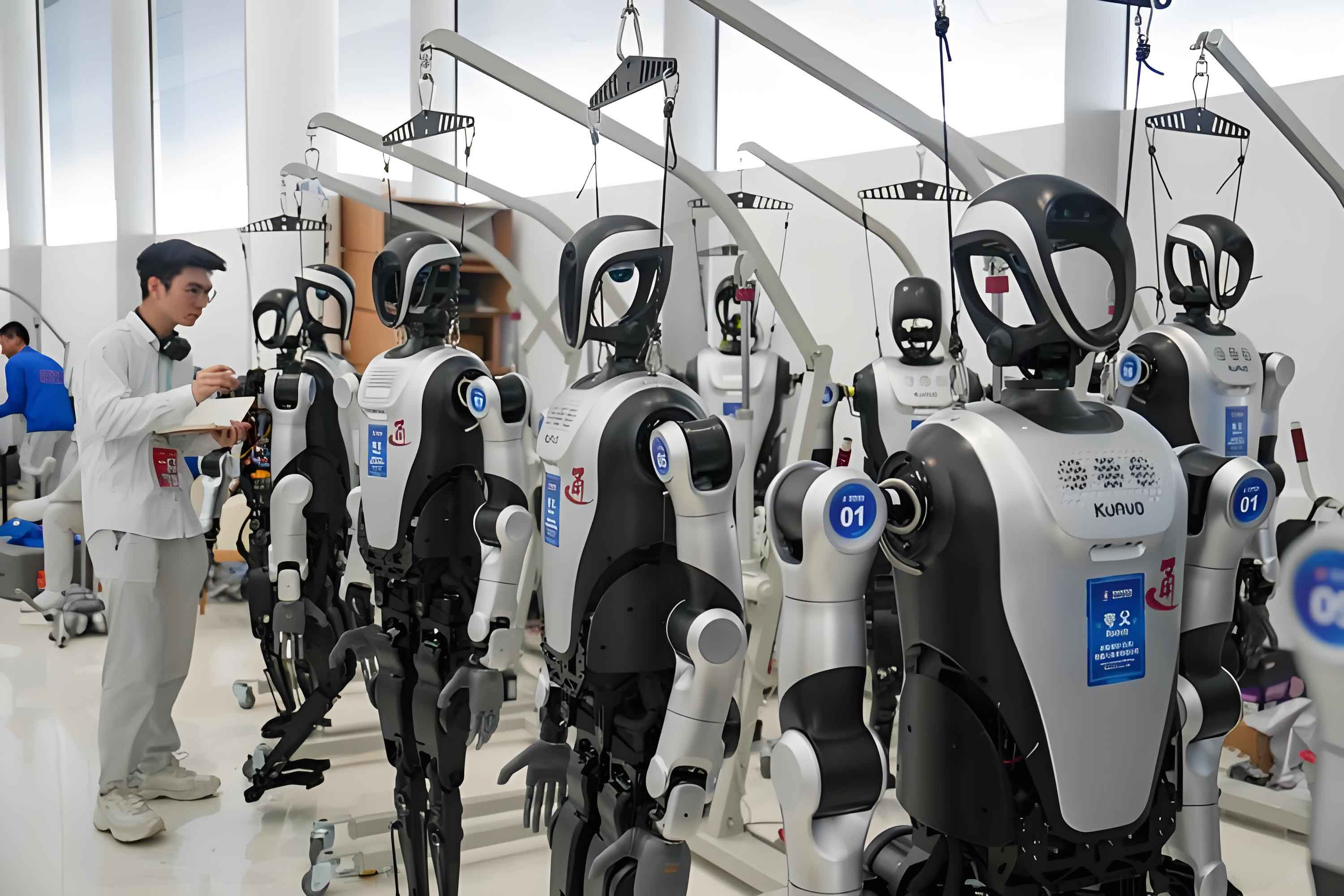
Unlike earlier overseas deployments of Chinese service robots in cleaning and inspection, the new wave of humanoid robots is being aimed at more complex tasks. Companies are no longer satisfied with selling a machine that can move or gesture. They are testing whether humanoid robots can work in factories, serve coffee, harvest crops, and support rehabilitation. The transition from “going out” to “landing” is now the central challenge. Market access and localized delivery have become the two gates that humanoid robots must cross.
1. Humanoid robots move from show floors to overseas factories and farmland
Wujie Dynamics is among the companies pushing humanoid robots into overseas markets. Wang Yingyun, co-founder of the company, said the first batch of humanoid robots has been shipped to France, and South Korea is likely to be the second overseas market. The company’s overseas partners are mainly European auto parts manufacturers and international energy enterprises. These customers are not purchasing humanoid robots as entertainment devices. They are evaluating whether humanoid robots can perform useful work in industrial and energy-related environments.
South Korea is attractive because labor costs are high, and customers there have shown strong interest in commercial applications for robots. Geographic proximity also matters. China and South Korea are close, which makes travel, response, and service more efficient. For humanoid robots, after-sales support is not a minor issue. A humanoid robot that cannot be maintained, updated, or repaired quickly will struggle to justify its cost in a commercial setting.
Wujie Dynamics was founded by core members with backgrounds in autonomous driving. In just over one year, the company has signed global orders totaling about RMB 700 million. One project alone, a battery factory for Envision Technology in France, accounts for RMB 500 million in orders. These figures do not prove that humanoid robots have solved every technical problem, but they do show that industrial customers are willing tocommit substantial resources to test and deploy humanoid robots at scale.
The factory environment is a natural early market for humanoid robots because tasks are often structured, repeatable, and measurable. Humanoid robots can be compared directly with human workers in terms of speed, safety, uptime, and cost. That makes the economic case clearer. In factories, humanoid robots may handle material movement, quality inspection, machine tending, and flexible tasks that traditional fixed automation cannot easily address.
Yet the factory is also demanding. Humanoid robots must operate safely near people and machinery. They must maintain precision over long shifts. They must be robust enough to survive dust, vibration, temperature changes, and continuous use. The order from Envision Technology’s French battery factory suggests that some customers are willing to move beyond pilot projects and explore larger deployments of humanoid robots.
2. European buyers seek proof before purchase
At the 2026 World Robot Conference, the message from European buyers was cautious but open. Jack Perry, chairman of the 48 Group Club, presented a European robot procurement demand covering construction, logistics warehousing, hotel and catering, retail services, and agriculture. He advised European enterprises not to rush into direct purchases. Instead, they should allow robots to be used for one or two months in real scenarios, verify the results, and then decide whether to buy more.
This “trial before purchase” approach is especially relevant for humanoid robots. A humanoid robot often costs several hundred thousand yuan, and overseas procurement decisions involve not only the purchase price but also integration, training, maintenance, insurance, and compliance. Buyers want evidence that humanoid robots can perform reliably in their own environments before making a long-term commitment.
Juha Ronin, vice-chair of the European Robotics Association, said the global robotics industry is shifting from displaying movement ability to emphasizing continuous operation, learning, and task execution in real environments. Market attention is moving away from whether a robot can run, jump, or somersault, and toward whether it can be applied in logistics, manufacturing, and service scenarios to complete practical tasks in a stable and repeatable way. That shift directly affects humanoid robots. The ability to walk is no longer enough. The ability to work is the new benchmark.
For humanoid robots, this means the evaluation criteria are changing. Buyers want to know how long a humanoid robot can operate before failure, how quickly it can be repaired, how well it handles exceptions, and whether it can share space safely with employees and customers. These questions are practical, and they cannot be answered by a stage demonstration alone.
European buyers are also aware that humanoid robots may need to be integrated into existing workflows. A factory may already have conveyors, safety systems, and enterprise software. A hotel may have booking systems and service procedures. A retail store may have inventory systems and customer service standards. Humanoid robots must connect to these systems or work alongside them. The trial period is a way to test integration, not just robot hardware.
3. Coffee space demonstrates long-horizon tasks for humanoid robots
Wujie Dynamics and the South Korean coffee chain HOLLYS jointly created a “human-machine coexistence immersive robot coffee space” at the robot conference. The project illustrates how humanoid robots and embodied intelligence can be deployed in commercial service. Unlike a robot fixed to a single workstation, the Wujie Dynamics humanoid robots were expected to perform a series of long-horizon operations.
Wang Yingyun said a robotic arm takes about 3 minutes to complete a pour-over coffee. Another robot body then delivers the coffee to customers in an open space. After that, the system performs table cleaning, waste recycling, and hand disinfection. These tasks may sound simple when separated, but together they require perception, planning, mobility, manipulation, and interaction. For humanoid robots, this is a demanding sequence.
The coffee space tests the general generalization capability of the embodied “brain.” A large model must decompose tasks step by step, track progress, and correct errors in real time. If a cup is misplaced, a customer moves a chair, or a spill occurs, the humanoid robot must adapt. This is different from a factory cell where every object has a fixed position. In a coffee shop, humanoid robots face a semi-structured environment with people moving unpredictably.
The deployment strategy also matters. Wang Yingyun said the team tries to minimize changes to the customer’s store environment. This is important for commercial adoption. If a coffee brand has to rebuild its store to accommodate humanoid robots, the cost and disruption may outweigh the benefit. If humanoid robots can work within existing layouts, the business case improves.
The coffee project is not only a marketing display. It is a test of whether humanoid robots can perform service tasks that combine physical labor, customer interaction, and process control. Coffee preparation is time-sensitive. Delivery requires navigation. Cleaning requires manipulation. Hand disinfection requires hygiene awareness. Each step adds complexity. For humanoid robots to succeed in commercial service, they must complete such sequences without constant human intervention.
Service work may become a major market for humanoid robots because labor shortages are widespread in hospitality, retail, and food service. However, service environments are also less predictable than factories. Humanoid robots must be safe around children, elderly customers, and crowded spaces. They must handle noise, lighting changes, and unexpected obstacles. The coffee space provides a controlled but realistic setting for testing these capabilities.
4. Agriculture becomes a new frontier for embodied intelligence and humanoid robots
Agriculture is another emerging frontier. Li Nan, founder, chairman, and chief executive officer of Maimai Technology Group, said agriculture has long been considered one of the hardest sectors for artificial intelligence and robots to enter. Scenes are scattered, environments are complex, and digital foundations are weak. These conditions make large-scale deployment difficult.
Li Nan nevertheless sees a possible advantage. Agriculture may be able to “leapfrog” because it can build intelligent technical pathways from zero rather than retrofit legacy systems. He also noted that a humanoid form may not always be the optimal solution for agricultural scenarios. This is an important point. Humanoid robots are flexible, but agriculture may require specialized bodies for specific tasks. The intelligence can be embodied in different forms.
Maimai Technology announced that this year it partnered with several domestic robot manufacturers to secure an overseas order for 20,000 robots. The company provides the embodied “brain,” while partner companies provide the robot body. The systems are mainly used in crop operations where labor is insufficient but economic value is high, such as rubber, durian, and palm harvesting.
Malaysia’s rubber plantations face a significant labor gap. Nighttime tapping is a high-risk, heavy, and labor-intensive job, and workers are increasingly hard to find. This creates a clear need for automation. Humanoid robots may not be the only answer, but the underlying embodied intelligence can support robotic systems that operate in plantations, identify trees, navigate uneven ground, and perform harvesting or collection tasks.
The agricultural case shows that humanoid robots and embodied intelligence are not limited to factories and service sites. Agriculture can benefit from autonomous systems that reduce reliance on scarce labor, improve safety, and extend operating hours. However, the delivery challenge is severe. Farms and plantations are often remote, connectivity may be limited, and local technical support may be scarce. A robot that works in a laboratory may fail in a muddy field.
Other companies are also watching overseas interest. UBTECH, Zhongqing, and Luming Robotics said that multiple overseas customers have shown interest in robot products, and the companies are laying out overseas market strategies. The interest is not limited to one industry. It spans manufacturing, logistics, service, agriculture, and rehabilitation. Humanoid robots are part of this broader wave, but they must compete with specialized robots that may be simpler, cheaper, and more reliable for particular tasks.
| Indicator | Reported figure |
|---|---|
| China artificial intelligence core industry scale in 2025 | More than RMB 1.2 trillion |
| Number of artificial intelligence enterprises in China in 2025 | More than 6,200 |
| Expected full-year output of humanoid robots in 2026 | More than 100,000 units |
| Humanoid robot shipments in China in the first half of the year | More than 40,000 units |
| China’s share of global humanoid robot shipments in that period | 97 percent |
| Wujie Dynamics global orders signed in just over one year | About RMB 700 million |
| Envision Technology France battery factory project order | RMB 500 million |
| Maimai Technology overseas robot order with domestic partners | 20,000 robots |
| Maimai Technology target for agricultural robot deliveries this year | 1,000 units |
| Key humanoid robot standards targeted by 2028 | At least 100 |
5. Shipment data show scale of China’s humanoid robots sector
The numbers tell a story of rapid growth. In the first half of this year, China shipped more than 40,000 humanoid robots, accounting for 97 percent of global humanoid robot shipments. That is a remarkable concentration of production. It reflects the strength of China’s manufacturing base, supply chain, and component ecosystem. Humanoid robots require motors, reducers, sensors, batteries, controllers, actuators, and advanced software. A complete industrial system can reduce costs and shorten development cycles.
Robots, artificial intelligence, and innovative drugs have together been described as the “new new three” export items. The phrase signals that robots are no longer a niche category. They are part of a broader export shift toward higher-value technology products. Humanoid robots are among the most visible symbols of that shift, even though their commercial deployment is still at an early stage.
A report from Finland’s national broadcaster, cited by Xinhua, noted that one important advantage of China’s robot industry is its comprehensive manufacturing and supply chain system. China also has rich application scenarios in industry, logistics, agriculture, services, and consumption. These scenarios allow companies to discover problems, accumulate data, and improve performance. For humanoid robots, this is crucial. Real-world data is the raw material for better embodied intelligence.
Humanoid robots cannot be perfected in a laboratory alone. They need to encounter different floors, doors, tools, objects, lighting conditions, and human behaviors. The scale of China’s domestic market provides more opportunities for humanoid robots to be tested. That data can then support overseas expansion. However, data collected in one country may not always transfer directly to another. Cultural norms, building codes, privacy rules, and work practices differ. Humanoid robots must be adapted locally.
The shipment figures also attract attention from investors and policymakers. When China accounts for 97 percent of global humanoid robot shipments, other markets take notice. European and Asian buyers may see China as a source of cost-effective humanoid robots. At the same time, they may worry about dependence, cybersecurity, and data governance. These concerns shape procurement decisions and create demand for certification and compliance.
6. Market access and certification are the first gates for humanoid robots
A humanoid robot often costs several hundred thousand yuan, so overseas buyers will not easily place orders. The first barrier is market access. Multiple industry interviewees said that expanding into overseas markets requires product-related qualifications and certifications. Without them, humanoid robots cannot enter regulated industrial or commercial markets.
Wang Yingyun said robot products must hold certificates before entering the European industrial market. Wujie Dynamics obtained industrial CE certification for the European market, a development the company describes as leading within the industry. Certification is not a formality. It covers safety, electromagnetic compatibility, machinery directives, and other requirements. For humanoid robots, certification is complicated because the product combines mobility, manipulation, sensing, and artificial intelligence.
Data compliance is another gate. A company representative noted that the European Union’s General Data Protection Regulation places strong emphasis on data security and privacy protection, requiring substantial time and effort. Humanoid robots often collect visual, audio, spatial, and behavioral data. That data may include personal information, such as faces, voices, and movement patterns. Compliance with GDPR is therefore not optional.
Wang Yingyun added that the company’s algorithms and software must comply with relevant local market regulations. The team previously worked in autonomous driving and encountered similar compliance issues, giving it relatively rich experience. This background is useful because autonomous vehicles also face strict rules on data, safety, and software updates. Humanoid robots are following a similar path from experimentation to regulated deployment.
Overseas market expansion also requires a long cycle and trust-building with customers. Wang Yingyun said some projects choose small-scale deployment in the early stage and then move to large-scale replication. This staged approach reduces risk for both the robot company and the buyer. It allows humanoid robots to be tested in real conditions, with clear metrics and limited exposure. If the results are good, the customer can expand.
For humanoid robots, trust is built through uptime. A robot that fails frequently will not be trusted with important tasks. A robot that requires constant expert supervision will not reduce labor costs. A robot that cannot be updated securely will create long-term risks. Certification and compliance are part of that trust, but they are not the whole story. Operational reliability and local service are equally important.
7. Local delivery and engineering talent shape execution
Li Nan of Maimai Technology Group said that although foreign markets have stronger willingness to pay, product delivery is more difficult. One practical problem is that it is hard to find local deployment engineers in Southeast Asia. This is a common challenge for advanced robotics. Humanoid robots and embodied intelligence systems require skilled personnel for installation, calibration, integration, maintenance, and troubleshooting.
To address this, Maimai Technology established its first overseas subsidiary and ASEAN headquarters in Malaysia. The company plans to recruit local after-sales service execution personnel to support business landing. Its target this year is to deliver 1,000 agricultural robots. That target shows the company is not only signing orders but also building delivery capacity.
Local delivery is especially important for humanoid robots because they interact with dynamic environments. A factory may change its layout. A coffee shop may change its menu. A plantation may face different weather conditions. Local teams can respond quickly, collect feedback, and adapt the system. Remote support alone may not be enough when a humanoid robot is physically stuck, unsafe, or unable to complete a task.
The “trial before purchase” model recommended by European buyers also depends on local support. If a European company agrees to use humanoid robots for one or two months, someone must install them, train staff, monitor performance, and handle failures. Without local engineering capacity, the trial can fail for reasons unrelated to the robot’s core technology. Humanoid robots companies must therefore think like service companies, not only hardware manufacturers.
Localization also affects the user experience. Humanoid robots may need to speak the local language, follow local social norms, and respect local privacy expectations. In a hotel, a humanoid robot may need to greet guests politely. In a factory, it may need to follow specific safety protocols. In agriculture, it may need to operate according to local crop cycles. These details determine whether humanoid robots are accepted.
8. Standards and clinical collaboration point to a longer adoption path
Standards are beginning to take shape. China’s national humanoid robot industry standard system construction guide has been released for public comment. The Ministry of Industry and Information Technology published the “National Humanoid Robot Industry Standard System Construction Guide (2026 Edition)” draft for comments. It proposes that by 2028, at least 100 key standards should be completed in areas such as humanoid robot capability testing and evaluation methods, key technologies, platforms and systems, application scenarios, and safety governance.
Industry standards can support market recognition and expansion. For humanoid robots, standards can define how to measure performance, safety, and reliability. They can help buyers compare products and reduce uncertainty. They can also help regulators assess risks. Without standards, every procurement becomes a custom evaluation, which slows adoption. With standards, humanoid robots can move more quickly into regulated sectors.
In healthcare and rehabilitation, adoption may take longer. A representative from Fourier’s rehabilitation overseas business said that some overseas regions remain conservative about rehabilitation robots. The company’s approach is to begin with clinical-stage cooperation with local universities or research institutions. From current cooperation, those efforts may later convert into sales.
This model is relevant to humanoid robots in care settings. Clinical validation takes time. Safety and efficacy must be demonstrated. Humanoid robots that assist with rehabilitation, mobility, or daily care must meet medical and ethical standards. The path to market may be slower than in factories or agriculture, but the potential is significant as populations age and labor shortages grow.
Standards and clinical collaboration both point to the same conclusion: humanoid robots will not achieve widespread adoption overnight. The technology must be validated, regulated, and trusted. Early deployments will be concentrated in environments where the economic case is strong and the risks can be managed. Over time, standards and evidence can broaden the market.
9. What comes next for humanoid robots overseas
Humanoid robots are moving from “going out” to “landing.” Companies are choosing overseas scenarios with high labor costs so that the economic account makes sense. They are polishing products and cost-performance before expanding further. The first destinations include Europe, South Korea, and Southeast Asia. The first applications include factories, coffee service, agriculture, and rehabilitation.
The common thread is not the robot’s appearance. It is the ability to perform useful work. Humanoid robots must complete tasks stably and repeatedly. They must operate safely around people. They must comply with local data and safety rules. They must be supported by local engineers and spare parts. They must offer a return on investment that customers can measure.
The market interest is real. European buyers are asking for robots in construction, logistics, hospitality, retail, and agriculture. South Korean customers are interested because labor costs are high. Southeast Asian plantations need alternatives to scarce manual labor. Chinese manufacturers have supply chain advantages and a large domestic testing ground. These factors create a strong foundation for humanoid robots exports.
Yet the barriers are equally real. Certification, data compliance, local delivery, and trust-building take time. A humanoid robot that works in one country may need adaptation in another. A humanoid robot that performs well in a demonstration may fail in a busy factory or a muddy plantation. The companies that succeed will be those that treat deployment as a long-term process, not a one-time sale.
Humanoid robots will continue to attract attention at conferences and in investment circles. But the next phase of competition will be less about spectacle and more about execution. The winners will be companies that can deliver compliant, reliable, maintainable humanoid robots in real environments. They will need strong engineering, local service, and clear business models.
For now, the direction is clear. Humanoid robots are leaving the stage and entering the workplace. They are being tested in French factories, South Korean coffee shops, Malaysian plantations, and other overseas locations. Each deployment adds data, exposes weaknesses, and improves the technology. The journey from robot “going out” to robot “landing” is difficult, but it has already begun.
As humanoid robots move into factories, fields, and service spaces, the global market will judge them by their results. Can they work a full shift? Can they handle exceptions? Can they reduce costs? Can they respect privacy and safety rules? Can they be repaired quickly? The answers will determine how quickly humanoid robots become a normal part of the international economy.
The rise of humanoid robots is therefore not only a technology story. It is a story about trade, standards, labor, data, and trust. The companies that understand all these dimensions will be best positioned to turn interest into orders and orders into lasting deployments. Humanoid robots have become a visible symbol of China’s advanced manufacturing export ambitions. The next challenge is to prove that they can deliver value wherever they are sent.