
In Guangdong, the distance between a humanoid robots design idea and a humanoid robots factory line is no longer measured by the slow movement of paperwork. It is measured by a little more than one hundred kilometers, by same-day logistics and information flows, and by a manufacturing ecosystem that allows design changes, process validation, and volume production to occur in a tightly connected loop. That loop is now at the center of how the Greater Bay Area is attempting to industrialize humanoid robots.
In an interview on August 31, Leng Xiaokun, founder of Leju Robotics, described a route that has become a shorthand for the region’s approach to humanoid robots: research and development in the urban center of Shenzhen, pilot production at the Longhua base, and ten-thousand-unit-class production in Foshan. The arrangement is not a single company’s internal plan alone. It is a division of labor shaped by the market, by local supply chains, and by the need to move humanoid robots from demonstration to repeatable delivery.
The core idea is simple but difficult to execute. Shenzhen has dense research talent and many application scenarios. Longhua handles the “from 1 to 100” stage, turning research results into standard operating procedures through process validation. Foshan, with its high-end manufacturing foundation, handles the “from 100 to 10,000” stage, where humanoid robots can be produced at scale. The two locations are separated by just over one hundred kilometers, and logistics and information flows can close the loop within the same day. In the Pearl River Delta, the physical distance between research and development, pilot production, and mass manufacturing has been compressed to an unusual degree.
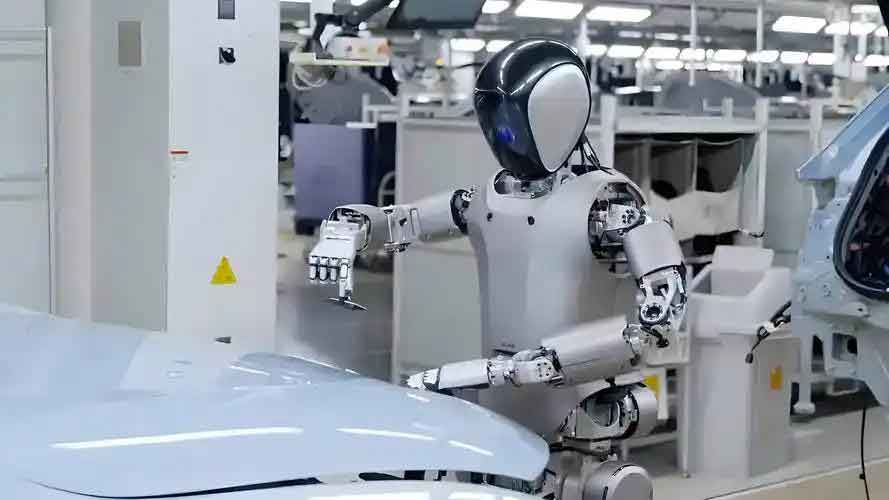
For humanoid robots, this compression matters because the category is not a single product. It is a convergence of mechanics, electronics, control systems, sensors, software, and artificial intelligence. A humanoid robots program depends on dozens of specialized fields and a deep supporting supply chain. When those fields are geographically close, iteration becomes faster. When iteration becomes faster, the path from prototype to standardized product becomes shorter. That is the logic behind the Greater Bay Area’s humanoid robots corridor.
- A One-Hundred-Kilometer Corridor for Humanoid Robots Industrialization
The route described by Leng Xiaokun follows a clear sequence. Shenzhen’s urban center is where research and development takes place, supported by talent density and a wide range of potential application scenarios. Longhua is where humanoid robots move from laboratory success to process discipline. Foshan is where humanoid robots move from validated process to large-scale output. Each stage has a different task, and each stage depends on the others.
The Longhua base is focused on the “from 1 to 100” problem. In the lab, a humanoid robots prototype may work once, under controlled conditions, with engineers adjusting it by hand. In pilot production, the same humanoid robots design must be turned into a standard operating procedure. Components must be assembled in a repeatable order. Tests must be defined. Failure points must be identified. The goal is not merely to make one more humanoid robots unit work. The goal is to make the process stable enough that it can be transferred to a larger factory.
Foshan then takes on the “from 100 to 10,000” problem. This is where humanoid robots production becomes a question of scale. A ten-thousand-unit-class line requires more than floor space and machinery. It requires supply chain coordination, work instruction discipline, quality control, and the ability to absorb design changes without losing consistency. In this environment, a humanoid robots unit can come off the line every thirty minutes. That cadence is not only a production metric. It is evidence that the process has been divided, sequenced, and controlled.
The distance between Shenzhen, Longhua, and Foshan is just over one hundred kilometers. For many industries, that distance would still create friction. For humanoid robots, the Greater Bay Area attempts to remove that friction. A design change made in Shenzhen can be tested in Longhua and introduced into batch production in Foshan within a short cycle. Logistics and information flow can close on the same day. This same-day closure is what makes the corridor more than a geographic coincidence. It is an industrial method.
The market division behind this method is important. Research and development cannot be isolated from manufacturing if humanoid robots are to improve quickly. Manufacturing cannot remain passive, waiting for a finished drawing before it begins to think about process, cost, and quality. In the Greater Bay Area model, research, pilot production, and volume manufacturing are not separate phases managed by separate organizations with long handoffs. They are adjacent functions that constantly feed one another. Humanoid robots benefit because every stage learns from the next.
The model also reflects the nature of humanoid robots as a product category. A conventional appliance may be designed around a stable architecture and then manufactured for years with limited change. Humanoid robots are still evolving. Their joints, drives, sensors, computing platforms, and software stacks are all under rapid development. A supply chain that can support frequent changes is therefore more valuable than a supply chain that is optimized only for low-cost repetition. The Greater Bay Area’s density gives humanoid robots teams the ability to change, test, and reintroduce designs at a pace that would be difficult in a more dispersed system.
- How the Greater Bay Area Built a Fast Humanoid Robots Supply Chain
The Greater Bay Area’s advantage is often described through the example of Huaqiangbei: a one-meter counter can be connected to a one-kilometer supporting network. That image is usually associated with consumer electronics, but its logic applies directly to humanoid robots. A humanoid robots platform involves mechanical structures, electronic modules, sensors, actuators, wiring, fasteners, and many other components. Each category may have multiple specialized suppliers. The strength of the region is not only that these suppliers exist, but that they are close enough to interact quickly.
Leng Xiaokun explained that humanoid robots production relies heavily on a complete supply chain because the industry spans dozens of subfields. In the Greater Bay Area, a structural part design can be changed today. The next day, the Longhua pilot base can complete sample production and assembly testing. Within one week, the Foshan factory can introduce the optimized plan into batch production. This response speed is described as a unique core competitiveness of the Greater Bay Area.
That speed is not only about convenience. It changes the economics of innovation. When the feedback loop is short, engineers can test more ideas. When more ideas are tested, the probability of finding a better design increases. When better designs are introduced quickly into production, the market learns faster. For humanoid robots, which still face many unresolved questions in hardware and software integration, this rapid loop is a form of industrial advantage.
The supply chain also supports localization. According to Leng Xiaokun, the domestic content rate of core components for the Kuafu humanoid robots platform exceeds ninety-five percent. Most of that localization can be solved through nearby supporting networks in the Greater Bay Area. This does not mean the work is finished. It means the foundation is strong enough that most components can be sourced, iterated, and integrated within the region.
The remaining gap is concentrated in high-end chips and edge computing. These are not only hardware problems. The largest gap is described as the development ecosystem. Humanoid robots need computing platforms that can run increasingly complex models at the edge, often under strict power, heat, size, and cost constraints. If the hardware exists but the development ecosystem is weak, integration becomes slower and less efficient. That is why the final piece of full-stack localization is not simply a chip or a module. It is a complete environment for building, testing, and deploying edge intelligence for humanoid robots.
To address this, Leju Robotics is working with companies such as Huixi Intelligent and Weifan Intelligent, and it is using open platforms such as OpenLET to advance a domestic edge computing development ecosystem. The objective is to complete the last piece of the full-stack localization puzzle as quickly as possible. At the same time, the company is using investment and industrial collaboration to support continuous domestic iteration of core components such as joints and drives. For humanoid robots, this combination of supply chain localization and ecosystem building is essential.
| Stage or Dimension | Location or Focus | Role in Humanoid Robots Industrialization | Key Feature from the Interview |
|---|---|---|---|
| Research and development | Shenzhen urban center | Creates core technology and explores application scenarios for humanoid robots | Dense research talent and many scenarios |
| Pilot production | Longhua base | Moves humanoid robots from 1 to 100 by validating processes and standard work | Process validation and standard operating procedures |
| Mass manufacturing | Foshan | Moves humanoid robots from 100 to 10,000 through scalable production | A humanoid robots unit can come off the line every 30 minutes |
| Industrial corridor | Pearl River Delta | Compresses research, pilot production, and mass manufacturing for humanoid robots | More than 100 kilometers; logistics and information flow close the same day |
| Localization | Greater Bay Area supporting network | Provides most core components for humanoid robots | Domestic content rate of core components exceeds 95 percent |
| Remaining gap | High-end chips and edge computing | Represents the last piece of full-stack localization for humanoid robots | Development ecosystem is the largest gap |
| Production digitalization | Assembly process | Turns craft into standards for humanoid robots | 24 precise assembly processes are fully digitalized |
| Quality control | Every humanoid robots unit | Tests stability and consistency before industrialization | 77 inspections and 41 automated tests per unit |
| Process optimization | MES and AI analysis | Traces the full chain and improves bottleneck processes for humanoid robots | Full-chain traceability and AI-based bottleneck analysis |
- From One-Meter Counters to Cross-City Humanoid Robots Production
The Huaqiangbei metaphor has a direct emotional and practical meaning for many people in Guangdong’s electronics industry. The image of a one-meter counter connected to a one-kilometer supporting network captures how small-scale entrepreneurship and dense supply chains reinforce one another. In humanoid robots, the same pattern appears at a higher level of complexity. A single humanoid robots platform may require precision reducers, harmonic drives, joint modules, motor controllers, sensors, wiring harnesses, structural components, batteries, computing boards, and software integration. No single company can efficiently master every detail alone.
When those details are distributed across a dense region, the humanoid robots developer can work with specialized suppliers without losing time. A change in a joint design can be discussed with a nearby partner. A new sensor bracket can be prototyped quickly. A wiring layout can be adjusted after assembly feedback. A control module can be retested with updated software. Each of these steps may seem small, but together they determine how fast a humanoid robots platform can mature.
This is why the Greater Bay Area’s response speed is described as a core competitiveness. It is not only the speed of one factory. It is the speed of an entire network. For humanoid robots, the network includes research talent, component suppliers, pilot lines, testing equipment, software developers, and end users. The closer these participants are, the more frequently they can interact. The more frequently they interact, the faster problems are discovered and solved.
The interview illustrates this with a concrete cycle. A structural part design is changed today. The next day, the Longhua pilot base completes sample production and assembly testing. Within one week, the Foshan factory can bring the optimized plan into batch production. For traditional manufacturing, such a cycle might be considered unusually fast. For humanoid robots, it is the kind of speed needed to support continuous improvement. The product is still learning how to be a product, and the production system must be able to learn with it.
This cross-city model also shows how Guangdong’s economic ecology is changing. Technology origination no longer has to remain far from manufacturing. Manufacturing no longer has to wait passively for drawings. In the humanoid robots corridor, research and production are mutually dependent. Research needs manufacturing feedback to know what is practical. Manufacturing needs research direction to know what to build next. The one-hundred-kilometer corridor makes that mutual dependence operational.
- The Hard Part of Humanoid Robots Mass Production Is Consistency
Moving from one thousand humanoid robots to ten thousand humanoid robots is not simply a matter of multiplying floor space and workers. The hardest challenge is often described as making ten thousand units behave as one. Batch manufacturing for humanoid robots depends on turning craftsmanship into standards. A skilled engineer can assemble a prototype with care and judgment. A factory must reproduce that quality across shifts, suppliers, and production runs. That requires documented processes, measurable tests, and traceable data.
In this context, Leju Robotics has digitalized twenty-four precise assembly processes for humanoid robots. Compared with traditional modes, overall production efficiency has increased by more than fifty percent. Each humanoid robots unit passes through seventy-seven inspections and forty-one automated tests. The MES system provides full-chain traceability. Artificial intelligence is used to look back at bottleneck processes and then feed improvements back into the workflow. These are not isolated tools. They form a system for making humanoid robots production more stable and more consistent.
The importance of consistency cannot be overstated. A humanoid robots unit that performs well in a demonstration may still fail in daily operation if it cannot be produced with repeatable quality. Customers in logistics, manufacturing, and service inspection need humanoid robots that can work reliably, not just impressively. They need maintenance schedules, spare parts, software updates, and predictable behavior. Mass production is therefore not only a manufacturing milestone. It is a condition for commercial trust.
Leng Xiaokun noted that passing the test of mass production capability, batch stability, and consistency is what allows a humanoid robots company to cross the industrialization threshold. This threshold is different from the technology threshold. A company may be able to build a remarkable humanoid robots prototype and still fail to industrialize it. Another company may have less dramatic technology but a stronger production system. In the long run, the ability to deliver ten thousand consistent humanoid robots may matter more than the ability to build one exceptional machine.
The digitalization of assembly processes is a key part of this transition. When a process is digitalized, it can be measured. When it is measured, it can be optimized. When it is optimized, it can be scaled. For humanoid robots, every joint, cable, sensor, and control module must fit into this system. The goal is not to remove human skill. The goal is to capture human skill in a form that the entire production network can repeat.
- Why Data and Scale Matter for Humanoid Robots
Leng Xiaokun has said that humanoid robots must become “as smart as a PhD and as cheap as a home appliance” before a true breakout occurs. That phrase captures two requirements that must advance together. The first is intelligence. Humanoid robots need to learn from data gathered in commercial service inspection, industrial manufacturing, and other real-world environments. The second is cost. Humanoid robots need sufficient production scale to spread the cost of the entire supply chain and bring prices down.
Data and scale reinforce each other. More humanoid robots in real applications generate more data. More data improves learning and allows humanoid robots to handle more tasks. More capable humanoid robots encourage more deployment. More deployment increases production volume. Higher production volume reduces unit cost. Lower unit cost makes further deployment possible. This cycle is difficult to start because it requires early applications before the technology is fully mature and early scale before the market is fully proven.
The interview points to progress in this cycle. The Kuafu humanoid robots platform has already been able to enter normalized and batch application at customer sites such as Haichen Logistics and Zhaofeng Electromechanical. This does not mean the breakout has already occurred. It means the first critical step has been taken. Humanoid robots are moving from staged demonstrations into actual operational environments where they can generate feedback and prove their value.
That step is important because real-world deployment exposes problems that laboratories cannot fully simulate. A humanoid robots unit in a logistics setting must handle variation in packages, routes, lighting, and human traffic. A humanoid robots unit in industrial manufacturing must cope with dust, vibration, cycle-time pressure, and safety requirements. These conditions generate data and engineering requirements that push the next generation of humanoid robots forward.
The cost side is equally demanding. A humanoid robots platform contains many precision components. If production volume is low, each component remains expensive. If production volume rises, suppliers can invest in tooling and automation, and the cost per unit can fall. But reaching that volume requires confidence that the market will absorb the output. The Greater Bay Area’s manufacturing density helps because it allows humanoid robots companies to work with suppliers on cost reduction before scale is fully achieved. Joint development and nearby iteration can lower costs even before the ten-thousand-unit stage.
- The Last Piece of the Humanoid Robots Supply Chain
The domestic content rate of core components for the Kuafu humanoid robots platform exceeds ninety-five percent. This is a significant foundation. It means that most of the mechanical and electronic supply chain for humanoid robots can be supported within the Greater Bay Area. The region’s nearby supporting network can solve a large share of component needs. For humanoid robots, this reduces exposure to distant supply disruptions and shortens the feedback loop between design and production.
The remaining gap is not spread evenly across the supply chain. It is concentrated in high-end chips and edge computing. These areas are critical because humanoid robots must process sensory data, run control algorithms, and increasingly execute artificial intelligence models close to the device. Edge computing determines how much intelligence a humanoid robots platform can carry without relying on remote servers. It affects latency, privacy, power consumption, heat, and reliability.
The largest gap in this area is described as the development ecosystem. A high-performance chip alone does not solve the problem. Developers need tools, libraries, compilers, frameworks, and community support. They need a path from model training to deployment on edge hardware. They need to debug and optimize for the specific constraints of humanoid robots. If that ecosystem is incomplete, even strong hardware can be difficult to use at scale.
Leju Robotics is therefore working with Huixi Intelligent, Weifan Intelligent, and others, using open platforms such as OpenLET to advance a domestic edge computing development ecosystem. The aim is to complete the final piece of full-stack localization for humanoid robots as quickly as possible. At the same time, the company is using investment and industrial collaboration to support continuous domestic iteration of joints, drives, and other core components. This dual approach recognizes that full-stack localization is not only about replacing imported parts. It is about building a self-reinforcing ecosystem around humanoid robots.
The remaining five percent should not be underestimated. In complex systems, the last few percentage points often determine whether the whole system can operate independently and efficiently. For humanoid robots, edge computing and high-end chips may influence how quickly the platform can learn, how safely it can operate, and how easily developers can create new capabilities. Closing this gap will require cooperation across chip design, software tools, algorithms, and applications.
- What the Greater Bay Area Model Means for Humanoid Robots
The Greater Bay Area model is not simply a story about one company or one humanoid robots platform. It is a template for how advanced manufacturing can absorb a new technology category. The model brings research talent, pilot production, mass manufacturing, and supply chain density into one compact region. It allows humanoid robots to be developed with manufacturing in mind from the beginning. It also allows manufacturing to influence design before it is too late to change.
In many technology sectors, research and manufacturing are separated by long distances and organizational boundaries. A design team may create a product, then hand it to a factory, then wait for feedback. That process can work for stable products with predictable requirements. It is less effective for humanoid robots, which are still changing rapidly. The Greater Bay Area’s compressed corridor reduces the cost of iteration. It makes feedback faster, and it makes adaptation more likely.
This matters because humanoid robots are not just another consumer device. They must operate in human environments, handle unpredictable tasks, and interact with people and existing workflows. Their development requires continuous learning from deployment. Their production requires continuous learning from assembly and testing. Their supply chain requires continuous learning from component performance. A region that can connect these learning loops has an advantage in humanoid robots industrialization.
The interview also shows that the model is not based on ignoring weaknesses. The ninety-five percent domestic content rate is a strength, but the remaining five percent is clearly identified. The mass production line is a strength, but consistency remains the hard part. The supply chain is a strength, but edge computing and high-end chips still require focused effort. This combination of confidence and awareness is important for humanoid robots, where rapid progress can easily create overconfidence.
The Greater Bay Area’s role may therefore be understood as providing an industrial calibration for humanoid robots. It sets a standard for how quickly a design change can move into production, how many processes can be digitalized, how many tests each unit can undergo, and how closely suppliers can work with manufacturers. These standards are not only technical. They are organizational. They define what it means to industrialize humanoid robots in a competitive market.
- Challenges That Remain for Humanoid Robots
Several challenges remain before humanoid robots can reach widespread commercialization. The first is application depth. Humanoid robots need more real-world scenarios in commercial service inspection, industrial manufacturing, logistics, and other areas. Each scenario provides data, but it also imposes requirements. A humanoid robots platform must be adaptable enough to serve multiple use cases while remaining stable enough to be maintained and supported.
The second challenge is scale. The path from hundreds of units to thousands and then to tens of thousands requires more than demand. It requires production discipline, supplier readiness, after-sales service, and cost reduction. The Foshan production model shows that a humanoid robots unit can come off the line every thirty minutes, but maintaining that cadence across a large order requires constant coordination. The ten-thousand-unit-class target is a test of the entire system, not just the assembly line.
The third challenge is the development ecosystem for edge computing and high-end chips. Humanoid robots need to run increasingly sophisticated models locally. If developers lack good tools and platforms, progress will be slower. Open platforms such as OpenLET and collaboration with specialized companies are attempts to address this gap. The goal is to make full-stack localization possible, not only for hardware but also for software and development workflows.
The fourth challenge is consistency. Mass production for humanoid robots is not only about producing many units. It is about producing units that behave the same way, meet the same standards, and can be serviced in the same way. The twenty-four digitalized assembly processes, seventy-seven inspections, forty-one automated tests, MES traceability, and AI-based bottleneck analysis are all part of this effort. They show that the company is treating humanoid robots as an industrial product, not a one-off engineering project.
The fifth challenge is market education. Customers need to understand what humanoid robots can do today, what they cannot yet do, and how they can be integrated into existing operations. The deployments at Haichen Logistics and Zhaofeng Electromechanical are important because they demonstrate normalized and batch application. They provide evidence that humanoid robots can move beyond novelty and into operational use. But broader adoption will require more examples, more data, and more confidence.
- The Critical First Step for Humanoid Robots
Leng Xiaokun’s assessment is that the most critical step has already been taken. The Kuafu humanoid robots platform has entered normalized and batch application at customer sites. That does not mean the industrialization of humanoid robots is complete. It means the first bridge has been built between laboratory capability and real-world operation. The next steps will involve expanding applications, accumulating data, reducing costs, and improving consistency.
The Greater Bay Area’s one-hundred-kilometer corridor provides a foundation for those next steps. Shenzhen contributes research talent and scenarios. Longhua contributes pilot production and process validation. Foshan contributes large-scale manufacturing. The surrounding supply chain contributes components, materials, and engineering support. Together, these elements create a system in which humanoid robots can be improved, tested, and produced at a faster pace than would be possible in a more fragmented landscape.
For the global humanoid robots industry, the significance of this model is not that it solves every problem. It does not. High-end chips, edge computing, development ecosystems, data collection, cost reduction, and consistency all remain active challenges. The significance is that it shows how a region can organize itself around the industrialization of humanoid robots. It shows that the distance between research and manufacturing can be compressed. It shows that supply chain density can become a form of innovation speed. It shows that mass production can be treated as a learning system.
Humanoid robots will not become commonplace simply because a prototype can walk, gesture, or perform a task. They will become commonplace when they can be produced reliably, improved continuously, supported economically, and deployed at scale. The Greater Bay Area’s approach is aimed at exactly that transition. The one-hundred-kilometer corridor is not only a logistics route. It is a route for learning, for iteration, and for industrial scale.
In this sense, the story of Leju Robotics and the Kuafu humanoid robots platform is part of a larger story. Guangdong’s economic ecology is changing so that technology origination and manufacturing are no longer separated. Research does not remain distant from production. Manufacturing does not wait passively for drawings. The two sides work together. For humanoid robots, this integration may be one of the most important competitive advantages of the coming decade.
The path ahead will be measured by many indicators: how many humanoid robots enter daily service, how much data they generate, how quickly their costs fall, how reliably they perform, and how completely the supply chain can be localized. The interview suggests that the first indicators are already moving. Humanoid robots are leaving the stage and entering the workflow. The Greater Bay Area is using its industrial density to make that transition faster. The result is a model in which humanoid robots are not only invented but also industrialized.
For companies working on humanoid robots, the lesson is clear. A great prototype is only the beginning. The real competition will be in process discipline, supply chain response, edge computing ecosystems, quality consistency, and scale. The Greater Bay Area’s compressed corridor gives humanoid robots teams a place to practice all of these disciplines at once. That is why the region’s experience is being watched closely by the humanoid robots industry. It offers a practical answer to a difficult question: how does a humanoid robots laboratory discovery become a humanoid robots product that can be manufactured by the thousands?
The answer is still being written, but the outline is already visible. Research and development in Shenzhen, pilot production in Longhua, mass manufacturing in Foshan, and a supporting network across the Pearl River Delta form a loop. Within that loop, humanoid robots can be changed, tested, produced, deployed, and improved. The distance is short. The feedback is fast. The standards are becoming stricter. For humanoid robots, that combination may be the difference between a promising technology and a true industry.