
In my assessment, the most important story in advanced manufacturing is not a single machine, a single arm, or a single software package. It is the arrival of embodied industrial robots that can move, perceive, decide, and act inside real factories. I followed the 2026 World Robot Conference closely because it brought this theme into focus. On August 19, 2026, the conference opened under the sponsorship of national ministries, and I observed a clear shift from laboratory demonstrations toward deployable systems. The debut of an embodied industrial robot developed through a collaboration between a major industrial vehicle manufacturer and a frontier technology collaborative innovation center struck me as a practical milestone. I see it as evidence that industrial robots are moving from fixed cells into the last meter of production, where materials are still moved, sorted, loaded, and unloaded by human hands.
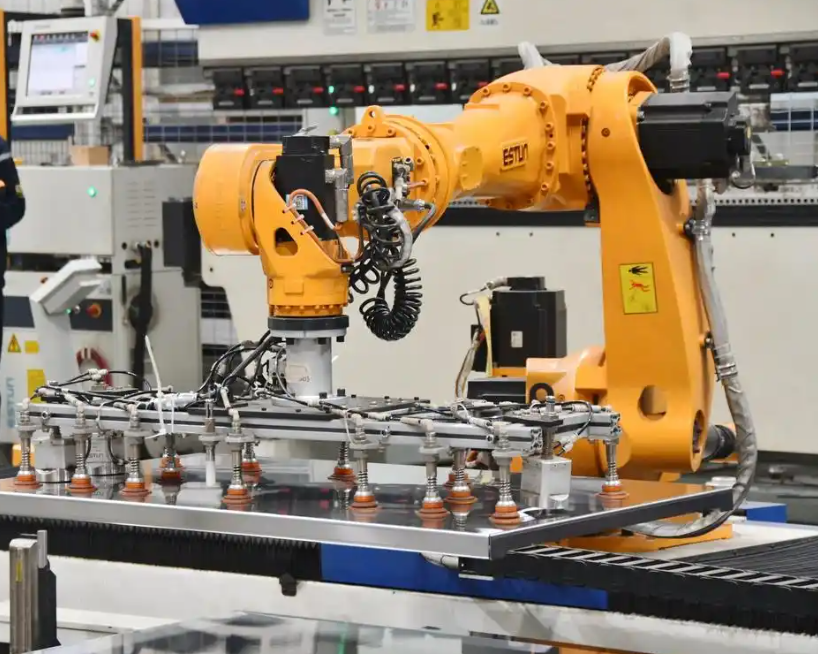
From my perspective, the last-meter problem is the bottleneck that keeps many smart factories from reaching their full potential. I have seen automated systems that work beautifully in controlled trials but fail when a bin is shifted, a part is tangled, or a workstation changes. I have also seen factories where industrial robots are isolated behind fences, unable to help with the unorganized material flows that dominate daily operations. The new embodied industrial robot I examined is designed around a different assumption: the factory is messy, dynamic, and full of exceptions. That assumption changes everything about how industrial robots should be built, programmed, integrated, and evaluated.
My View of the Last-Meter Problem
I define the last meter as the distance between organized logistics and organized production. A conveyor may deliver a pallet, an automated guided vehicle may move a cart, and a warehouse system may track inventory. Yet the final transfer into a machine, a fixture, a kit, or a workstation often remains manual. In my experience, this is where variability explodes. Parts may be stacked without order. Bins may be inconsistent. Operators may adjust positions. Workstations may change between shifts. Traditional industrial robots can handle repetition, but they struggle with this disorder unless engineers spend significant time on fixtures, feeders, and reprogramming.
I summarize the last-meter delay with a simple decomposition:
$$ T_{\text{last-meter}} = T_{\text{transport}} + T_{\text{handling}} + T_{\text{inspection}} + T_{\text{recovery}} $$
Here, \(T_{\text{transport}}\) is movement time, \(T_{\text{handling}}\) is grasping and placement time, \(T_{\text{inspection}}\) is verification time, and \(T_{\text{recovery}}\) is the time lost to exceptions. In many factories I have studied, \(T_{\text{recovery}}\) is the hidden cost. A fixed industrial robot may be fast in theory, but when a part is misplaced, the entire cell stops. An embodied industrial robot that can adapt reduces \(T_{\text{recovery}}\) directly. That is why I see high generalization as more valuable than peak speed in many real production environments.
I also think about the problem as a gap between factory-level automation and workstation-level autonomy. Factory-level systems can plan, schedule, and route. Workstation-level systems can execute. The missing layer is an embodied industrial robot that can bridge both worlds. It must understand tasks, perceive objects, move safely, and coordinate with other machines. When I evaluate industrial robots, I no longer ask only about repeatability. I ask whether the system can handle disorder, whether it can be redeployed, and whether it can learn from deployment.
Architecture I Examine
The architecture that caught my attention is a mobile base combined with dual collaborative arms. I see this as a practical configuration for embodied industrial robots because it separates mobility from manipulation while integrating both under one control framework. The mobile base provides reach across a factory floor. The dual arms provide dexterity for lifting, orienting, inserting, and placing. The collaborative design allows the system to work near people, which matters in factories where full separation is impractical.
| Layer | Function | What I Look For | Why It Matters for Industrial Robots |
|---|---|---|---|
| Mobility layer | Navigation, docking, obstacle avoidance | Turning radius, speed, localization stability | Industrial robots must reach machines and buffers without new conveyors |
| Manipulation layer | Arm motion, grasp, insert, place | Payload, reach, repeatability, tool exchange | Industrial robots need enough force and precision for real parts |
| Perception layer | Object detection, pose estimation, bin analysis | Robustness to clutter, lighting, occlusion | Industrial robots must handle unordered and heterogeneous workpieces |
| Decision layer | Task planning, grasp planning, exception recovery | Generalization, cycle time, safety constraints | Industrial robots must adapt without frequent reprogramming |
| Integration layer | MES, WMS, AGV dispatch, remote operation | Interfaces, latency, traceability | Industrial robots must act as part of a production system |
I view the mobile base plus dual-arm architecture as a response to a fundamental limitation of earlier industrial robots. A fixed arm has a bounded workspace. A conventional automated guided vehicle has mobility but no manipulation. A dual-arm laboratory robot may have manipulation but lacks industrial ruggedness and integration. The embodied industrial robot combines these capabilities into one deployable unit. In my reading, the value is not simply the sum of parts. The value comes from coordination: the base positions the arms, the arms change the base’s effective workspace, and the perception system informs both.
I express the effective workspace of the system as a union of reachable sets:
$$ W_{\text{effective}} = \bigcup_{b \in B} \left( W_{\text{left}}(b) \cup W_{\text{right}}(b) \right) $$
Here, \(B\) is the set of feasible base poses, \(W_{\text{left}}(b)\) is the left-arm reachable workspace at base pose \(b\), and \(W_{\text{right}}(b)\) is the right-arm reachable workspace. This equation helps me compare industrial robots. A larger base travel range can compensate for a smaller arm reach, but only if navigation is reliable. A larger arm reach can compensate for a smaller base range, but only if the arm remains stable. The embodied industrial robot I studied appears to balance these trade-offs for machine tending and material handling.
Key Performance Envelope
I like to reduce a robot’s capability to a compact performance envelope. The figures I noted are practical rather than theatrical. A minimum turning radius of 510 mm tells me the system can operate in narrow aisles and crowded cells. A single-arm payload of 7 kg tells me it can handle many machined parts, small assemblies, and totes. An electromagnetic suction cup with a quick-change interface tells me the tooling strategy is intended for rapid task switching. These are the kinds of details that separate industrial robots that demo well from industrial robots that work well.
| Metric | Value I Noted | My Interpretation | Impact on Industrial Robots |
|---|---|---|---|
| Minimum turning radius | 510 mm | Very tight maneuverability | Enables industrial robots to serve narrow machine cells |
| Single-arm payload | 7 kg | Useful for small and medium parts | Expands tasks for industrial robots beyond light pick-and-place |
| End effector | Electromagnetic suction cup with quick-change interface | Fast tool swapping | Lets industrial robots adapt to different workpieces |
| Architecture | Mobile base plus dual collaborative arms | Mobility and dexterity in one unit | Reduces dependence on fixed fixtures for industrial robots |
| Generalization | High, with reduced reprogramming | Less engineering per task | Improves deployment economics for industrial robots |
I also model the turning behavior in a simplified way. If the base follows a circular arc, the minimum radius constrains path curvature:
$$ \kappa_{\max} = \frac{1}{R_{\min}} = \frac{1}{510\text{ mm}} $$
I interpret a small \(R_{\min}\) as a reduction in the amount of factory modification required. Instead of widening aisles or removing equipment, the embodied industrial robot can navigate existing layouts. For me, this is one of the strongest arguments for mobile industrial robots. Factory space is expensive, and production lines are rarely designed with future robots in mind.
The payload constraint can be expressed as a static condition:
$$ m_{\text{part}} g \le F_{\text{lift,max}} $$
With \(m_{\text{part}}\) around 4 kg in the validation scenario and a 7 kg arm payload, I see a reasonable margin. That margin matters because acceleration, tool mass, and center-of-gravity offsets can reduce effective capacity. I therefore prefer to evaluate industrial robots with a dynamic payload equation:
$$ F_{\text{required}} = m_{\text{part}} \left( g + a_{\text{vertical}} \right) + m_{\text{tool}} g + F_{\text{inertia}} $$
In my view, a 7 kg rating is not just a number. It is a constraint that determines whether an embodied industrial robot can serve a given machine, bin, or fixture. If the required force exceeds the rating, the robot must either slow down, use a different tool, or rely on a human. That is why payload, reach, and speed must always be evaluated together.
Precision and Throughput
I was particularly interested in the reported validation on a computer numerical control machine loading task. The scenario involved unordered stacked workpieces of about 4 kg. The system achieved a material grasping precision of plus or minus 1 mm and a loading positioning precision of plus or minus 2 mm. It met a production rhythm of 240 parts per day. For me, these numbers are meaningful because they connect precision to throughput. A robot that is precise but slow cannot meet takt time. A robot that is fast but imprecise creates scrap, rework, and downtime.
| Validation Metric | Reported Value | My Engineering Interpretation | Relevance to Industrial Robots |
|---|---|---|---|
| Workpiece mass | About 4 kg | Representative medium-duty part | Tests practical payload for industrial robots |
| Grasping precision | Plus or minus 1 mm | High repeatability in cluttered picking | Supports reliable handling by industrial robots |
| Loading precision | Plus or minus 2 mm | Adequate for many machine tending tasks | Confirms industrial robots can meet fixture tolerances |
| Production rhythm | 240 parts per day | Steady industrial cadence | Shows industrial robots can match real output targets |
| Operation mode | Unordered stacked workpieces | High variability | Demonstrates generalization for industrial robots |
I calculate the available cycle time from the daily output. If I assume a single-shift equivalent of 480 productive minutes, then:
$$ C_{\text{cycle}} = \frac{T_{\text{available}}}{Q_{\text{day}}} $$
$$ C_{\text{cycle}} = \frac{480\text{ min}}{240\text{ parts}} = 2\text{ min/part} $$
This tells me the embodied industrial robot must complete navigation, recognition, grasping, loading, and verification within about two minutes per part on average. That is a realistic target for many machine-tending cells. I can also express throughput as the reciprocal:
$$ Q_{\text{hour}} = \frac{60}{C_{\text{cycle,min}}} $$
If the cycle time is 2 minutes, the hourly throughput is 30 parts per hour. I find this useful because factory managers often think in hours, while engineers think in seconds. Industrial robots must be evaluated in both units.
I also consider process capability. For a loading tolerance with an upper specification limit and a lower specification limit, I use:
$$ C_p = \frac{USL – LSL}{6\sigma} $$
$$ C_{pk} = \min\left( \frac{USL – \mu}{3\sigma}, \frac{\mu – LSL}{3\sigma} \right) $$
In my assessment, a reported precision of plus or minus 2 mm is not enough by itself. I want to know the distribution, the repeatability over thousands of cycles, and the drift over temperature changes. Industrial robots are judged by their worst day, not their best demo. That is why I would track \(C_p\) and \(C_{pk}\) over time for any embodied industrial robot deployment.
I also model the probability of a successful grasp in cluttered conditions. A simple exponential reliability model helps me reason about recovery:
$$ P_{\text{success}} = 1 – e^{-\lambda t} $$
Here, \(\lambda\) is the failure rate of the perception-action loop and \(t\) is the time available for a grasp attempt. If the system can replan quickly, it can increase the effective success probability without increasing hardware precision. This is a key advantage I see in embodied industrial robots: they can retry, adjust, and recover.
Autonomy and Planning
I consider autonomy to be the defining feature of embodied industrial robots. The system must not wait for a human to teach every pose. It must perceive a bin, estimate poses, plan a collision-free path, choose a grasp, and adapt when the first attempt fails. The reported ability to handle unordered stacked workpieces and to adapt to changes in bin specifications or workstation positions without reprogramming is exactly the kind of autonomy I look for.
I formulate grasp planning as an optimization problem:
$$ \pi^* = \arg\min_{\pi} \sum_{i=1}^{N} \left( w_1 d_i + w_2 \tau_i + w_3 c_i + w_4 r_i \right) $$
In this equation, \(d_i\) is path length, \(\tau_i\) is execution time, \(c_i\) is collision risk, and \(r_i\) is recovery cost. The weights \(w_1\) through \(w_4\) depend on the task. For a machine-tending cell, I would increase the weight on precision and recovery cost. For a mobile logistics task, I would increase the weight on path length and time. An embodied industrial robot should be able to adjust these weights based on context.
I also think about task-level planning across multiple workstations. If a fleet of industrial robots serves several machines, the scheduling problem becomes:
$$ \min \sum_{j=1}^{M} \left( C_j – r_j \right)^+ $$
Here, \(C_j\) is the completion time of job \(j\), and \(r_j\) is its release time. The positive part penalizes late jobs. I see this as the bridge between single-robot autonomy and fleet-level intelligence. Industrial robots that can communicate with a factory task system and an automated guided vehicle dispatch system can reduce waiting time and improve machine utilization.
| Autonomy Capability | What I Expect | Why It Matters for Industrial Robots |
|---|---|---|
| Object detection | Identify parts in bins, carts, and fixtures | Industrial robots must work with mixed and moving inventory |
| Pose estimation | Estimate 6D position and orientation | Grasping depends on accurate pose for industrial robots |
| Grasp planning | Select stable contact points and approach vectors | Reduces damage and failed picks for industrial robots |
| Motion planning | Avoid collisions with machines, people, and other robots | Safety and uptime depend on reliable motion for industrial robots |
| Exception recovery | Retry, regrasp, request help, or skip | Industrial robots must handle disorder without stopping the line |
In my experience, the hardest part is not picking a known object from a known position. The hardest part is deciding what to do when the object is upside down, partially occluded, or nested inside another object. This is where learned perception and model-based planning must cooperate. I do not believe pure learning or pure geometry is enough. The most robust industrial robots will combine both.
System Integration
I cannot evaluate an embodied industrial robot without looking at integration. A robot that cannot talk to the factory task system is an island. A robot that cannot coordinate with automated guided vehicles creates traffic jams. A robot that cannot be monitored remotely creates new maintenance burdens. The system I reviewed is designed for seamless integration with factory task systems and automated guided vehicle dispatch systems, and it supports remote operation from a tablet. I see this as essential for industrial robots that operate across multiple cells.
| Integration Interface | Data I Would Exchange | Purpose | Impact on Industrial Robots |
|---|---|---|---|
| Factory task system | Work orders, priorities, status, exceptions | Align robot tasks with production schedule | Makes industrial robots responsive to changing demand |
| AGV dispatch system | Vehicle positions, routes, reservations, handoff states | Coordinate material flow | Prevents conflicts among industrial robots and vehicles |
| Machine controller | Door status, cycle state, safety interlock | Enable machine tending | Allows industrial robots to load and unload safely |
| Remote tablet | Live view, task override, diagnostics | Support operators and maintenance | Improves trust and uptime for industrial robots |
| Quality system | Measurement results, traceability, defect flags | Close the loop on precision | Helps industrial robots maintain process capability |
I model integration latency as a sum of communication delays:
$$ T_{\text{integration}} = T_{\text{sensor}} + T_{\text{network}} + T_{\text{planner}} + T_{\text{actuator}} $$
If any term is too large, the robot appears slow or unresponsive. For industrial robots in machine tending, the network and planner delays often dominate. I therefore look for edge computing, deterministic communication, and local safety logic. Cloud services are useful for fleet learning, but they should not be in the critical path for every grasp.
Comparative Economics
I compare embodied industrial robots with three common alternatives: fixed industrial robots, conventional automated guided vehicles, and laboratory dual-arm robots. My comparison is not about which category is best in isolation. It is about which category solves the last-meter problem under real constraints.
| Solution | Mobility | Manipulation | Adaptability | Deployment Cost | My Assessment |
|---|---|---|---|---|---|
| Fixed industrial robot | None | High for specific tasks | Low without fixtures | High for reconfiguration | Excellent for high-volume fixed cells, poor for last-meter disorder |
| Conventional AGV | High | None | Medium for transport | Medium | Good for moving materials, cannot grasp or load |
| Laboratory dual-arm robot | Limited | High in controlled settings | High in demos | High for industrial hardening | Promising but often not production-ready |
| Embodied industrial robot | High | High with dual arms | High with perception and planning | Moderate because less custom fixturing | Best fit for flexible machine tending and material handling |
I calculate the payback period for an embodied industrial robot as:
$$ t_{\text{payback}} = \frac{C_0}{B_{\text{annual}} – C_{\text{annual}}} $$
Here, \(C_0\) is initial investment, \(B_{\text{annual}}\) is annual benefit, and \(C_{\text{annual}}\) is annual operating cost. I include labor savings, quality improvement, uptime gains, and redeployment value in \(B_{\text{annual}}\). In my experience, redeployment value is often underestimated. A fixed industrial robot may be cheaper for one task, but an embodied industrial robot can be reassigned when the product changes. That flexibility has real financial value.
I also use net present value to evaluate multi-year deployments:
$$ NPV = \sum_{t=1}^{n} \frac{B_t – C_t}{(1+r)^t} – C_0 $$
For industrial robots, I recommend a scenario analysis with three cases: conservative, expected, and aggressive. The conservative case should assume lower utilization and more exceptions. The aggressive case should assume fleet coordination and shared learning. The expected case should be grounded in measured cycle time and reliability.
| Economic Factor | Fixed Industrial Robot | AGV Only | Embodied Industrial Robot |
|---|---|---|---|
| Fixture and feeder cost | High | Low | Lower due to adaptability |
| Redeployment cost | High | Medium | Low to medium |
| Labor displacement | Task-specific | Transport only | Transport plus handling |
| Exception handling | Weak without human support | None | Strong with autonomy |
| Scalability | Line-specific | Fleet-based | Fleet-based and task-based |
Validation in Machine Loading
I place high value on the reported industrial workshop validation because it tests the complete loop: navigation, perception, grasping, loading, and verification. The task involved a computer numerical control machine, unordered stacked workpieces of about 4 kg, and a daily target of 240 parts. I see this as a realistic test of industrial robots because it combines physical handling with process precision.
| Validation Step | What Happens | Key Metric | My Concern |
|---|---|---|---|
| Navigation to machine | Base moves through factory aisle | Turning radius 510 mm | Reliability in crowded aisles |
| Bin perception | Detect unordered stacked parts | Pose accuracy | Occlusion and lighting variation |
| Grasp | Select and pick a part | Plus or minus 1 mm | Damage to fragile surfaces |
| Load | Insert part into machine fixture | Plus or minus 2 mm | Fixture wear and thermal drift |
| Verify | Confirm placement and release | Cycle time | False positives in verification |
I use a simple takt-time inequality to judge feasibility:
$$ C_{\text{cycle,actual}} \le C_{\text{takt}} $$
If the actual cycle time exceeds takt time, the industrial robots cannot meet demand without parallel units. If the actual cycle time is much lower than takt time, there may be room for additional tasks. I see this as a practical way to plan fleets of industrial robots rather than single machines.
I also examine the precision allocation. If the total loading tolerance is plus or minus 2 mm, I can decompose it as:
$$ \epsilon_{\text{total}}^2 = \epsilon_{\text{robot}}^2 + \epsilon_{\text{perception}}^2 + \epsilon_{\text{fixture}}^2 + \epsilon_{\text{thermal}}^2 $$
This equation reminds me that precision is a system property. Improving the arm alone may not improve the final placement if perception or fixtures dominate the error. For industrial robots to achieve reliable machine tending, all error sources must be managed.
Scalability and Fleet Operations
I think about scalability in two dimensions: task scalability and fleet scalability. Task scalability means the same embodied industrial robot can perform more types of work. Fleet scalability means many industrial robots can coordinate without central bottlenecks. Both matter for factory-wide adoption.
| Scalability Dimension | Question I Ask | Metric | Target for Industrial Robots |
|---|---|---|---|
| Task variety | How many part families can it handle? | Number of validated SKUs | Growing over time with learning |
| Deployment speed | How fast can a new cell be commissioned? | Hours or days per cell | Short, without deep custom engineering |
| Fleet coordination | Can multiple robots share tasks? | Utilization and waiting time | High utilization with low conflict |
| Maintenance | Can faults be diagnosed remotely? | Mean time to repair | Low MTTR for industrial robots |
| Learning transfer | Can one robot’s experience help others? | Model update cycle | Fast, safe, and traceable |
I model fleet availability as:
$$ A_{\text{fleet}} = 1 – \frac{MTTR}{MTBF + MTTR} $$
For a fleet of \(N\) industrial robots, the probability that at least one is available is:
$$ P_{\text{at least one}} = 1 – \left( 1 – A_{\text{fleet}} \right)^N $$
This is a useful reminder that fleets can be more resilient than single robots, but only if tasks can be redistributed. If every robot is specialized to one cell, fleet redundancy does not help. I therefore prefer embodied industrial robots that can be reassigned dynamically.
Industry Applications I Foresee
I see strong near-term applications in automotive parts, consumer electronics, and construction machinery. These industries share a need for flexible material handling, machine tending, and small-batch production. They also have enough variability to make fixed automation expensive.
| Industry | Typical Task | Why Embodied Industrial Robots Fit | Key Challenge |
|---|---|---|---|
| Automotive parts | Machine loading, deburring support, kitting | Mixed parts and changing models | Cycle time and quality traceability |
| Consumer electronics | Small part handling, inspection, assembly support | High product turnover | Delicate surfaces and tight tolerances |
| Construction machinery | Heavy component tending, fixture loading | High mix and low volume | Payload and safety around large equipment |
| General manufacturing | Bin picking, cart loading, machine tending | Labor shortages and last-meter disorder | Integration with legacy machines |
I also see potential in logistics-intensive factories where automated guided vehicles already move materials. In those settings, embodied industrial robots can close the final gap between vehicle and machine. Instead of a human unloading a cart, the robot can pick, place, and verify. This reduces waiting time and improves traceability.
Research and Innovation Chain
I believe the next phase of industrial robots depends on a strong innovation chain. The collaboration I observed connects research, development, and industrial validation. I see a dedicated laboratory established in September 2025 as an important institutional step. Its focus on intelligent logistics, embodied robotics, and industrial application aligns with the needs I have identified.
The key technical challenges I would prioritize are:
- Mobile perception in dynamic factory environments.
- Dual-arm coordination for stable handling and insertion.
- Heterogeneous workpiece recognition across part families.
- Multi-robot scheduling and conflict-free navigation.
- Safety assurance for human-robot shared spaces.
- Tool changing and end-effector standardization.
- Data-efficient learning from real deployments.
I express the learning problem as a trade-off between exploration and exploitation:
$$ \max_{\theta} \mathbb{E}_{\tau \sim \pi_{\theta}} \left[ \sum_{t=0}^{T} \gamma^t r_t \right] $$
In industrial settings, I cannot allow unlimited exploration because mistakes are costly. I therefore favor constrained learning:
$$ \max_{\theta} \mathbb{E} \left[ R(\theta) \right] \quad \text{subject to} \quad C(\theta) \le C_{\max} $$
Here, \(C(\theta)\) represents safety or damage risk. This is how I would approach learning for industrial robots: improve performance while staying inside strict safety and quality limits.
Safety and Human Collaboration
I do not see embodied industrial robots as replacements for all human work. I see them as partners that take over repetitive, dangerous, and physically demanding tasks. Safety is therefore not an add-on. It is a design constraint. Collaborative arms help, but mobility introduces new risks. A moving base with two arms must detect people, avoid collisions, and stop safely.
| Safety Layer | Function | My Evaluation Criteria |
|---|---|---|
| Sensor layer | Detect humans, obstacles, and unexpected motion | Coverage, latency, redundancy |
| Control layer | Limit force, speed, and workspace | Certified limits and response time |
| Task layer | Plan safe paths and handoffs | Predictable behavior near people |
| System layer | Coordinate with machines and vehicles | Interlocks and emergency stops |
I use a simple safety margin equation:
$$ d_{\text{safe}} = d_{\text{stop}} + d_{\text{reaction}} + d_{\text{margin}} $$
For industrial robots, \(d_{\text{stop}}\) depends on speed and braking. \(d_{\text{reaction}}\) depends on perception and control latency. \(d_{\text{margin}}\) accounts for uncertainty. I would rather see a slower robot with a larger margin than a fast robot that is unpredictable.
Data, Digital Twin, and Fleet Learning
I expect successful industrial robots to generate data continuously. Grasp success, cycle time, pose error, tool wear, and exception type are all valuable. When aggregated across a fleet, this data can improve perception models, planning policies, and maintenance schedules.
| Data Stream | Frequency | Use | Value for Industrial Robots |
|---|---|---|---|
| Pose and motion | High | Diagnostics and optimization | Improves speed and precision |
| Grasp outcome | Per attempt | Learning and recovery | Increases autonomy |
| Cycle time | Per task | Throughput analysis | Supports production planning |
| Fault logs | Event-driven | Maintenance prediction | Reduces downtime |
| Quality data | Per part | Process control | Ensures specification compliance |
I model fleet learning as a shared parameter update:
$$ \theta_{t+1} = \theta_t + \eta \sum_{i=1}^{N} \nabla L_i(\theta_t) $$
Here, \(N\) is the number of industrial robots contributing data, \(\eta\) is the learning rate, and \(L_i\) is the local loss. In practice, I would use federated or privacy-preserving methods so that factories retain control of their data. I would also require validation before any update is deployed to production.
A digital twin can help. I represent the robot, cell, and material flow as a simulation:
$$ S_{t+1} = f(S_t, a_t, w_t) $$
Here, \(S_t\) is the system state, \(a_t\) is the action, and \(w_t\) is disturbance. The digital twin allows me to test new tasks, new layouts, and new fleet strategies without stopping production. For industrial robots, this reduces risk and accelerates commissioning.
Deployment Roadmap
I would deploy embodied industrial robots in stages. The first stage is a single cell with a well-understood task. The second stage adds multiple tasks and machine interfaces. The third stage adds fleet coordination. The fourth stage integrates learning across sites. Each stage should have clear metrics and exit criteria.
| Stage | Scope | Primary Goal | Metric I Would Track |
|---|---|---|---|
| Stage 1 | Single machine tending cell | Prove reliability | Cycle time, grasp success rate |
| Stage 2 | Multiple cells and part families | Prove adaptability | Redeployment time, precision |
| Stage 3 | Fleet coordination with AGVs | Prove system integration | Utilization, waiting time, conflicts |
| Stage 4 | Multi-site learning | Prove scalable improvement | Model update cycle, quality gain |
I also define a readiness score for industrial robots:
$$ R_{\text{readiness}} = w_1 A + w_2 P + w_3 I + w_4 S + w_5 E $$
Here, \(A\) is autonomy, \(P\) is precision, \(I\) is integration, \(S\) is safety, and \(E\) is economic value. The weights depend on the application. For a high-mix factory, I would increase the weight on autonomy. For a safety-critical cell, I would increase the weight on safety. This score helps me compare industrial robots objectively.
Risks and Mitigations
I see several risks in the adoption of embodied industrial robots. The first is overpromising autonomy. The second is underestimating integration. The third is poor exception handling. The fourth is unsafe behavior in shared spaces. The fifth is unclear return on investment. I would address each risk with specific engineering and management actions.
| Risk | My Concern | Mitigation |
|---|---|---|
| Autonomy gap | Robot fails in rare but important cases | Fallback modes, human handoff, safe stopping |
| Integration complexity | Legacy machines lack digital interfaces | Retrofit sensors, edge gateways, staged rollout |
| Precision drift | Thermal and mechanical changes reduce quality | In-process measurement, calibration, compensation |
| Safety incidents | Mobile dual-arm system near people | Redundant sensing, speed limits, risk assessment |
| Economic uncertainty | Benefits are hard to measure | Baseline data, pilot metrics, scenario analysis |
I use a risk-adjusted benefit equation:
$$ B_{\text{adjusted}} = B_{\text{expected}} – \lambda R_{\text{risk}} $$
Here, \(R_{\text{risk}}\) is the expected cost of failures, and \(\lambda\) reflects risk aversion. For industrial robots, I would set \(\lambda\) higher in safety-critical or high-value processes. This keeps the business case honest.
What I Conclude
I conclude that embodied industrial robots represent a meaningful step beyond fixed automation and simple automated guided vehicles. The combination of a mobile base, dual collaborative arms, perception, planning, and system integration addresses the last-meter problem that has limited factory automation for years. The reported validation on machine loading with unordered stacked workpieces shows that industrial robots can handle variability while meeting precision and throughput targets. The ability to adapt without frequent reprogramming lowers the barrier to adoption, especially for small and medium-sized manufacturers.
I also conclude that the future of industrial robots is not a single product. It is a system of systems. Mobility, manipulation, perception, learning, safety, and scheduling must work together. The innovation chain matters as much as the hardware. Research institutions, technology providers, and manufacturers must collaborate to move embodied intelligence from the laboratory to the factory floor. I see the 2026 debut as an early but important signal that this transition is underway.
My final view is optimistic but disciplined. I believe embodied industrial robots will become common in machine tending, material handling, and flexible assembly. They will not replace every fixed robot, and they will not eliminate every human task. They will, however, fill the gap that has been hardest to automate. For me, that is the real measure of success. When industrial robots can move through existing factories, pick unordered parts, load machines with precision, coordinate with other vehicles, and learn from experience, the smart factory becomes more than a concept. It becomes a working environment.
I will continue to evaluate industrial robots by their ability to perform in messy, real conditions. I will look for precision under variation, autonomy under uncertainty, integration under legacy constraints, and safety under human presence. The systems that meet these tests will define the next decade of manufacturing. In my assessment, the embodied industrial robot is moving in exactly that direction.