
The 2026 World Robot Conference made one signal unmistakable: humanoid robots are no longer confined to glass display cases, carefully staged videos, or protected laboratory environments. At this year’s gathering, 373 companies presented more than 3,000 innovative products, while 311 new products made their debut. These included robot chefs, robot baristas, autonomous sorting arms, mobile service units, and increasingly capable humanoid robots designed to work in factories, supermarkets, hotels, kitchens, and other real-world settings. The central question has shifted from whether a robot can move impressively to whether it can work reliably when conditions are messy, unpredictable, and constantly changing.
The conference theme also reflected that shift. The language moved from making robots smarter and embodied systems more intelligent toward human-machine symbiosis and the co-integration of production and demand. That change in emphasis captures a broader transition in the robotics industry: from supply-side display to demand-supply matching. For humanoid robots, the test is no longer only technical elegance. The test is whether humanoid robots can enter real operations, adapt to unstructured environments, recover from interruptions, and deliver measurable value.
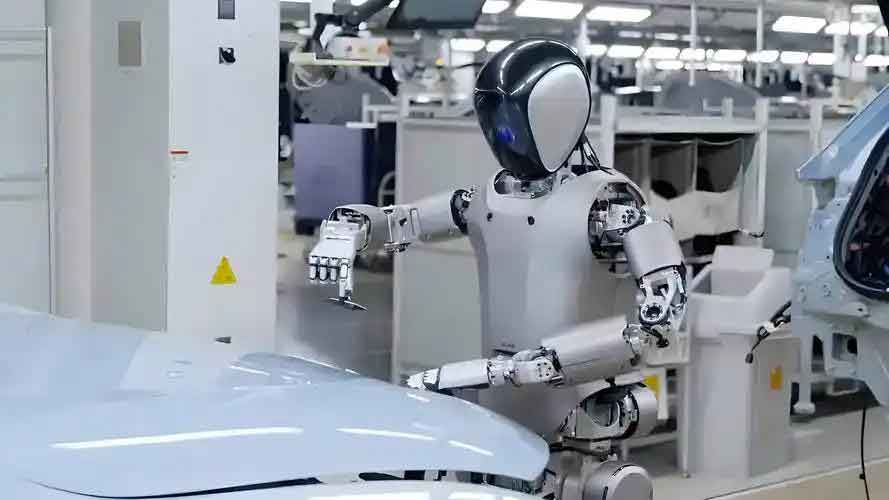
1. From Single-Arm Demonstrations to Embodied Work: Humanoid Robots Learn to Act
At the Xixi Intelligence booth, two AI chef robots prepared cold noodles and light meals in a continuous workflow that drew a steady crowd. After a visitor placed an order, the robot’s left arm precisely picked up an empty bowl while the right arm simultaneously took side ingredients from the preparation area and placed them into the bowl. After adding ingredients and seasoning, the robot automatically sent used tools to a cleaning device. The entire sequence was smooth, with controlled force and no manual intervention. Visitors deliberately added difficulty by requesting no scallions or extra sauce, and the robot responded accurately to those personalized requirements. Unlike traditional industrial robotic arms that rely on rigid point-to-point motions, this robot even reproduced a human chef’s slight shaking motion when dispensing ingredients, using it to drop excess material and reduce the cold, mechanical feel of the equipment.
According to Tan Chuxin, market manager at Xixi Intelligence, the two meal categories demonstrated on site were intended to show the multi-scenario deployment capability of the company’s vertical AI model for food. Supported by that AI model, the robot uses multimodal fusion across vision, touch, and language to identify ingredient types, shapes, quality, and conditions. It can understand user meal requirements and select appropriate processing methods. More importantly, the robot can switch production tasks at any time, meeting the needs of food processing enterprises that require small batches, multiple batches, and rapid changes. For humanoid robots, this kind of flexibility is a critical step beyond fixed automation.
Xianglu Robotics brought its embodied cooking robot, Xianchao Fangzhou, to the conference. According to the booth manager, Xianchao Fangzhou is a movable micro unmanned kitchen system. Its working scope covers fresh ingredient preservation and storage, cooking, serving, oil fume treatment, and equipment self-cleaning. On the screen to the left of the unit, a user selects a dish. The robot then turns to a refrigerated fresh-ingredient rack, picks the corresponding ingredients, and completes stir-frying, serving, and cleaning in sequence. Chun Xia, product manager at Xianglu Robotics, said the goal is not for the robot to complete a single demonstration on site, but for it to enter real scenarios and work efficiently, stably, and continuously. That statement captures the new standard for humanoid robots and embodied systems: they must move beyond one-time performance and into repeatable work.
Humanoid robots also appeared in more playful service roles. At the Zhipingfang Technology booth, a robot barista named Aibao greeted visitors with a playful wink, adding emotional value to the interaction. Aibao can directly operate mainstream commercial coffee equipment to make coffee and can also prepare ice cream and specialty drinks. Wang Xiaofei, brand public manager at Zhipingfang Technology, explained that after an order is placed, Aibao relies on the AlphaBrain NeuroVLA brain-inspired embodied large model to autonomously identify points, grasp paper cups, operate the coffee machine, receive drinks, and hand them to customers. It can also interact with customers through language and gestures. For humanoid robots, this kind of integrated perception, action, and interaction is a sign that they are moving closer to service roles once reserved for people.
One visitor observed that last year most exhibits were still single-point demonstrations by robotic arms. This year, the most obvious change was the increase in humanoid robots. These humanoid robots no longer felt like cold machines, the visitor said, but more like real service providers. That impression reflects a broader evolution in the field: humanoid robots are being evaluated less by how human they look and more by how usefully they behave.
Compared with traditional industrial robotic arms, do humanoid robots offer greater advantages? Ren Guangjie, assistant vice president of Leju Robotics, said the two are not in a replacement relationship but are more often complementary across scenarios. Traditional industrial robotic arms are mostly fixed deployments and are better suited to single, high-intensity, standardized operations. When production lines have changing conditions and many part categories, traditional arms can face adaptation limits. A new generation of robots, including humanoid robots, has flexible operation capabilities in generalized and unstructured scenarios. They can allow one device to handle multiple work tasks,弥补ing the shortcomings of traditional automation equipment on flexible production lines. This complementarity is important because it positions humanoid robots not as simple substitutes but as new tools for environments that demand adaptability.
Xu Xiaolan, chairman of the Chinese Institute of Electronics, pointed out that embodied intelligence is injecting new momentum into global economic development. It can be widely applied in industrial manufacturing, warehousing and logistics, domestic services, and other scenarios, with broad development prospects. The 2026 Humanoid Robot Industry Development Report, released at the conference, noted that technological innovation in humanoid robots has entered a new stage of cluster emergence. Their capabilities in environmental perception, planning and decision-making, and motion control are continuously improving, while their adaptability and stability in complex environments continue to rise. Xu Xiaolan said humanoid robots will become an important engine for upgrading manufacturing. At present, the humanoid robot industry is showing strong development potential, and it will drive new consumption, foster new industries, expand new employment, and accelerate the development of new quality productive forces.
2. Humanoid Robots Learn to Judge, Correct, and Recover
Xinghaitu created a robot front warehouse at its booth, designed to support online ordering and a fully automatic closed-loop fulfillment process. The setup replicated the workflow of a real commercial front warehouse on a one-to-one scale. Visitors placed random orders through a mini program, and the robot autonomously identified goods, planned paths, picked items, opened bags, and packed them, completing the entire closed loop from order acceptance to delivery. How did the robot do this? According to booth staff, Xinghaitu relied on brain generalization to achieve breakthroughs at multiple levels. First, the robot could rely only on model-based autonomous recognition and perception to handle massive categories and randomly placed items. Second, when environments changed, tasks were interrupted, or execution errors occurred, it could autonomously correct errors and restore the process, stably completing long-sequence complex operations. Third, it overcame the problem of diverse plastic bag deformation, breaking through a flexible operation bottleneck in real logistics fulfillment. During the exhibition, the front-warehouse demonstration completed more than 900 full-process orders, performed 1,775 picks, and completed 1,560 packs. These figures show that humanoid robots and embodied systems are being tested against the kind of operational pressure found in real commerce.
In the supermarket scanning and sorting scenario, Kuaiwei Intelligence’s autonomous scanning and sorting robot added recognition and grasping functions for bagged and soft-packaged goods beyond the original bottled products. This allows it to better adapt to the multi-category, non-standardized operational needs of supermarkets. Zhang Zhanqi, head of the Kuaiwei Intelligence exhibition area, demonstrated the sorting robot’s anti-interference ability. During a bottle-grasping demonstration, even when a person suddenly took the bottle away, the robotic arm did not freeze or crash. Instead, it quickly sensed that the target was lost, re-planned its motion path, and continued executing subsequent tasks. When facing soft, wrinkled, irregularly shaped soft-packaged materials, the robotic arm also handled them with ease. It flexibly adjusted its gripping angle, actively turned the package, and flipped the side with a barcode toward a position convenient for scanning and recognition. The sorting robot’s model already possesses active perception ability, Zhang Zhanqi said. It can autonomously find the best observation angle to complete the scanning and checkout process and can handle scenarios with stacked bags or a mixture of bags and bottles. For humanoid robots, such recovery and perception capabilities are essential if they are to work outside carefully controlled demonstrations.
Galaxy General Robot performed a long-sequence breakfast task that included toasting bread and pouring drinks. When staff randomly moved the bread away or removed the kettle, the robot did not freeze in place. After identifying that the target was lost, it immediately re-observed the environment, updated its path, and continued completing the breakfast preparation. In a bin-sorting demonstration, when people repeatedly moved the goods to be grasped or temporarily threw in unfamiliar objects, Geek+ Gino 1 continued tracking object positions and dynamically adjusted its arm trajectory. In the past, when a robot was working and an item was moved or the environment changed, it would often report an error, stop, and interrupt the task. Now, many robots can autonomously perceive changes after a task is interrupted, re-plan their trajectory, and continue the full operation. These behaviors are especially important for humanoid robots because real factories and service spaces rarely remain perfectly still.
These performances of judging and thinking depend on training with large amounts of real-scenario data and continuous optimization of algorithm models. Beyond technical breakthroughs, however, a change in industry understanding is even more noteworthy. As one industry insider put it, the key to robots entering people’s lives is not the stacking of technical parameters but whether they can find real, high-frequency, unmet pain points. When robots learn to deal with disruption, it means they are leaving the laboratory and beginning to integrate into everyday life. That transition is particularly visible in humanoid robots, which are being asked to operate in spaces designed for people rather than in isolated automation cells.
3. From Booth Demonstrations to Real Jobs: The Scale Test Begins
Behind the collective evolution of robots is a constantly updated industrial logic. The conference theme changed from last year’s emphasis on making robots smarter and embodied bodies more intelligent to this year’s focus on human-machine symbiosis and the co-integration of production and demand. This change reflects the robot industry’s move from supply-side display toward demand-supply matching. Walking through the exhibition halls, the change in the industry was clear. Once the focus was whether a robot could move and whether its actions were cool enough. This year, the standard for judging a robot’s value became whether it could handle uncertainty in the real world and whether it could truly go on duty and work. More and more companies no longer brought only edited promotional videos. Instead, they directly replicated industrial workshops and retail stores in a one-to-one format at their booths, bringing real working conditions into the exhibition hall and replacing pure parameter presentations and performance-style demonstrations with live operations.
Goods placed crookedly, items moved away in the middle of a task, materials with different soft and hard forms, and the same robot needing to rotate across multiple workstations: these demonstrations at the conference are exactly the daily realities of factories, supermarkets, and logistics warehouses. Industry insiders pointed out that a stable demonstration at a booth does not equal trouble-free employment. At an exhibition, engineers are on standby, lighting conditions are controllable, and interference factors are relatively limited. In real production lines and commercial stores, materials are diverse, people move back and forth, and equipment must face wear and tear from long periods of continuous operation. As many industry practitioners said at conference forums, a demo running through only represents the upper limit of capability. Large-scale deployment is the real industrial examination. That examination is now beginning for humanoid robots as well as for broader embodied intelligence systems.
At the Leju Robotics exhibition area, Kuafu 5W publicly conducted an all-weather, non-stop operation challenge. A large display behind it showed working time and completed pieces in real time. The content demonstrated on site consisted of mature commercial solutions that can be directly delivered and deployed, according to the company. The robot can run stably and continuously for eight hours per day, and the product already has the capacity for large-scale batch delivery and deployment. Ren Guangjie said Kuafu 5W is equipped with a complete full-stack self-developed toolchain system, which can support secondary development teams in quickly completing customized development and deployment, greatly lowering the threshold for deployment. In addition to handling, Kuafu 5W also transformed into an exhibition guide, interacting with visitors and autonomously explaining the work situation at each booth workstation. The robot combines vision and UWB dual-sensing technology to achieve autonomous greeting, task guidance, human-machine interaction, and autonomous farewell across the entire chain. The solution has been deployed in 23 provinces across China. This is a strong example of how humanoid robots are moving from controlled demonstrations to repeatable service and work roles.
Xixi Intelligence’s meal preparation robot technology has been applied in the airline catering production base of a domestic airline, where a single production line can produce up to 10,000 meals per day. Yunji Technology’s noodle-cooking robot can deliver a bowl of hot noodles to consumers in about one minute. On-site staff said the robot has already been deployed in hotels and has withstood the test of morning peak periods. Aibao has been operating regularly in more than 10 provinces and cities across China, independently completing the preparation of coffee, ice cream, matcha, beer, cocktails, and other beverages. Unlike previous years, some robots exhibited this year have already been on duty in real commercial spaces for some time. One industry expert analyzed that discussion in the robot industry has moved from technology itself into business models. In the past, people discussed how many degrees of freedom a robot had, whether it could walk, and whether it could complete complex actions. Now they are discussing where the orders are, who the customers are, how to maintain the robots, and how to mass-produce them. For humanoid robots, these questions are no less important than advances in perception or motion control.
Zhang Feng, chairman of the China Humanoid Robot and Embodied Intelligence 100 Association, said intelligent robots have moved from the stage of talent shows to real operations such as express delivery sorting, noodle cooking, and product packaging. Humanoid robots are moving from jumping and running toward working in factories and being used in homes. This shift is not merely a change in marketing language. It represents a new phase in which humanoid robots are expected to deliver practical value in daily economic activities.
| Company or robot | Application area | Capability demonstrated | Reported deployment or trial |
|---|---|---|---|
| Xixi Intelligence AI chef robots | Food preparation and meal assembly | Multimodal perception, personalized orders, task switching, handling fragile ingredients | Applied in an airline catering production base, with a single line capable of producing up to 10,000 meals per day |
| Xianglu Robotics Xianchao Fangzhou | Mobile micro unmanned kitchen | Fresh ingredient storage, cooking, serving, oil fume treatment, self-cleaning | Presented as a system intended for efficient, stable, continuous work in real scenarios |
| Zhipingfang Technology Aibao | Beverage and dessert service | AlphaBrain NeuroVLA model, point recognition, cup grasping, coffee machine operation, delivery, interaction | Operating regularly in more than 10 provinces and cities across China |
| Leju Robotics Kuafu 5W | Material handling and exhibition guidance | Full-stack toolchain, vision and UWB dual sensing, autonomous greeting, guidance, interaction, farewell | Deployed in 23 provinces across China; demonstrated eight-hour continuous operation |
| Xinghaitu robot front warehouse | Online order fulfillment | Autonomous recognition, path planning, picking, bag opening, packing, error recovery | Completed more than 900 full-process orders, 1,775 picks, and 1,560 packs during the exhibition |
| Kuaiwei Intelligence scanning and sorting robot | Supermarket scanning and sorting | Recognition and grasping of bottled, bagged, and soft-packaged goods; active perception; anti-interference | Demonstrated recovery after target removal and handling of mixed and irregular packaging |
| Galaxy General Robot | Breakfast preparation | Re-observation, path updating, continuation after target loss | Demonstrated bread toasting and drink pouring under human interference |
| Geek+ Gino 1 | Bin sorting | Continuous object tracking, dynamic arm trajectory adjustment | Demonstrated sorting when goods were moved or unfamiliar objects were added |
| Yunji Technology noodle-cooking robot | Hotel food service | Rapid noodle preparation | Deployed in hotels and tested during morning peak periods |
4. Food Service Becomes a Proving Ground for Humanoid Robots
Food service is emerging as one of the most demanding proving grounds for humanoid robots and embodied systems. Kitchens are crowded, ingredients are irregular, orders change quickly, and hygiene requirements are strict. A robot that can stir-fry in a demonstration is not necessarily a robot that can work in a commercial kitchen for hours. Yet the 2026 World Robot Conference showed that food-related robots are moving closer to that standard. Xixi Intelligence’s AI chef robots demonstrated the ability to handle cold noodles and light meals, including fragile ingredients and personalized requests. The system used vision, touch, and language to identify ingredients and understand user needs. It also switched production tasks, which matters for food processing enterprises that must respond to small batches, multiple batches, and fast changes. For humanoid robots, food service offers a practical environment in which perception, manipulation, sequencing, and recovery can all be tested at once.
Xianglu Robotics’ Xianchao Fangzhou presented a different model: a movable micro unmanned kitchen that covers storage, cooking, serving, oil fume treatment, and self-cleaning. This kind of integrated system is important because real food operations are not limited to one action. A robot must manage the before, during, and after of a meal. The same logic applies to humanoid robots expected to work in restaurants, central kitchens, hotels, and retail food counters. The value of a humanoid robot is not only in its ability to perform a single cooking motion. The value lies in its ability to coordinate multiple steps, handle unexpected conditions, and maintain stable output over time.
Aibao, the robot barista from Zhipingfang Technology, shows how humanoid robots can operate existing commercial equipment rather than requiring a fully rebuilt environment. Aibao can identify points, grasp paper cups, operate a coffee machine, receive drinks, and hand them to customers. It can also prepare ice cream, matcha, beer, and cocktails. The ability to work with mainstream commercial coffee equipment is significant because it reduces the need to redesign an entire service space around the robot. For humanoid robots, this kind of compatibility with human tools and human-scale workplaces is a central promise. If humanoid robots can use the same machines that people use, they can be deployed in more existing commercial settings.
Yunji Technology’s noodle-cooking robot offers another example of food service as a real test. It can deliver a bowl of hot noodles in about one minute, and it has already been deployed in hotels, where it has faced morning peak demand. Morning peak periods are a useful stress test because they combine speed requirements, repetitive tasks, customer expectations, and limited tolerance for delay. A robot that can survive such conditions is moving beyond novelty. It is entering the domain of daily operations. Humanoid robots may follow a similar path in food service, first by proving reliability in constrained tasks and then by expanding into broader roles.
Still, large-scale adoption of food-service robots faces multiple thresholds, including cost, scenario adaptation, and operation and maintenance. The conference did not suggest that all barriers have disappeared. It suggested that the direction is clear. Food-service robots are no longer only traffic-generating props. They are being tested for continuous work, flexibility, and commercial value. That is also the standard against which humanoid robots will be judged. Humanoid robots must be able to handle real ingredients, real orders, real interruptions, and real maintenance demands. The food industry, with its mix of standardized and highly variable tasks, is likely to remain one of the most revealing arenas for humanoid robots and embodied intelligence.
5. What Changed at the 2026 World Robot Conference
The five-day World Robot Conference came to a close, and the contrast with the previous year was striking. Last year, coffee, pancake, and bartending robots were more like traffic props at exhibition booths. Fixed-trajectory robotic arms were common. Their movements were smooth, attractive, and easy to photograph, but their application scenarios were relatively limited, and many exhibits leaned toward concept demonstrations. A recurring question was when these robots would truly enter kitchens and stores. This year, the feeling of watching novelty faded, while the feeling of watching an industry became stronger. Humanoid robots were no longer only visual attractions. They were being presented as potential workers, service providers, and operational tools.
Robotic arms were still in motion, but their core had iterated. Many products had moved beyond simple mechanical execution and begun to possess visual perception and environmental judgment. They used dual arms for flexible meal preparation and could handle relatively fragile ingredients such as cold noodles and vegetable leaves. They relied on visual perception to adjust cooking heat in real time. Some had humanoid appearances and could blink and interact with people during work intervals. They learned to respond to accidents. When products on a checkout counter were suddenly disordered, they could autonomously correct the process and continue working. More importantly, many companies no longer simply displayed prototype machines. They presented real cases of delivery and deployment. This is a crucial step for humanoid robots because it shows that the industry is moving from technical possibility to operational reality.
These seemingly small demonstration details represent a key step for the robot industry toward real, complex commercial scenarios. The competition among robots is no longer about cool appearances and flashy functions. It is about whether they can work stably and solve real industry problems. For humanoid robots, this means the evaluation criteria are changing. A humanoid robot that can walk on stage may attract attention. A humanoid robot that can work a full shift, recover from errors, and integrate into an existing workflow is far more valuable. The 2026 World Robot Conference made that distinction clearer than ever.
Of course, the road remains long. The large-scale popularization of robots in the food sector still must cross multiple thresholds, including cost, scenario adaptation, and operation and maintenance. But it is increasingly clear that the day when robots become practical workers in the food industry is not far away. The same can be said for humanoid robots. The next World Robot Conference may see another breakthrough in intelligence. By then, some of the equipment on today’s exhibition stands may already be applied at scale in central kitchens and chain restaurant stores. Humanoid robots may likewise be found in more factories, warehouses, hotels, and homes, not as demonstrations but as working systems.
6. The Outlook for Humanoid Robots and Embodied Intelligence
The 2026 World Robot Conference showed that humanoid robots are entering a more demanding phase. The industry is no longer satisfied with isolated capabilities. It is asking how humanoid robots can operate in unstructured spaces, how they can use human tools and equipment, how they can recover from interruption, and how they can be maintained and mass-produced. The conference’s 373 companies and more than 3,000 innovative products represented a wide range of approaches, but the strongest through-line was the movement from demonstration to deployment. Humanoid robots are part of that movement, and their progress will depend on whether they can deliver stable value in real operations.
Xu Xiaolan’s comments placed humanoid robots and embodied intelligence within a broader economic context. Embodied intelligence can be widely used in industrial manufacturing, warehousing and logistics, domestic services, and other scenarios. The 2026 Humanoid Robot Industry Development Report noted that humanoid robot technology innovation has entered a stage of cluster emergence. Environmental perception, planning and decision-making, and motion control are improving. Adaptability and stability in complex environments are rising. Xu Xiaolan said humanoid robots will become an important engine for manufacturing upgrades. The industry is showing strong potential to drive new consumption, create new industries, expand employment, and accelerate new quality productive forces. These are large claims, but they rest on a simple requirement: humanoid robots must work.
Zhang Feng’s assessment focused on the transition already underway. Intelligent robots have moved from talent shows to real operations such as express delivery sorting, noodle cooking, and product packaging. Humanoid robots are moving from jumping and running toward working in factories and being used in homes. That description captures the essential change at the 2026 World Robot Conference. Humanoid robots are no longer only performance guests. They are becoming practical workers. The path ahead will not be smooth, and cost, reliability, safety, maintenance, and scenario adaptation will remain difficult. But the direction is clear. Humanoid robots are leaving the display stand and entering the real world, where their value will be measured by the work they can do.
The 2026 World Robot Conference therefore marked more than a showcase of technology. It marked a shift in expectations. Companies are no longer asking only what a robot can do in a controlled demonstration. They are asking where a robot can be deployed, who will buy it, how it will be maintained, and how it will scale. For humanoid robots, these questions are now central. The conference showed that humanoid robots can cook, serve, sort, pack, guide, recover from disruption, and interact with people. It also showed that stable demonstration is not the same as reliable employment. The real industrial examination has begun. The next stage will determine which humanoid robots move from exhibition halls into daily operations and which remain impressive prototypes. The direction, however, is no longer in doubt. Humanoid robots are moving from spectacle to work.