
SHIJINGSHAN DISTRICT, Beijing — During the 2026 China International Fair for Trade in Services, the Shijingshan District Humanoid Robot Data Training Center, the first humanoid robot data training center in Beijing, completed an iterative upgrade and appeared under a new identity as the district’s embodied intelligence training center. The project is now being positioned together with the second and third phases of the data training center to form capability coordination and system connectivity, creating an integrated development pattern that covers the full chain from data acquisition, simulation generation, model training, body verification, and application deployment. The center is located at the Shougang Park Science Fiction Industry Innovation Center and covers more than 1,500 square meters.
The upgrade marks a significant step for humanoid robots in Beijing and for the broader embodied intelligence ecosystem. By bringing together data collection, simulation, model training, verification, and deployment, the center aims to support humanoid robots as they move from controlled demonstrations toward practical roles in industrial and home environments. The project’s new identity as the Shijingshan District Embodied Intelligence Training Center reflects a wider effort to build a shared infrastructure for humanoid robots and related intelligent systems.
1. A New Identity and an Integrated Role for Humanoid Robots
The Shijingshan District Humanoid Robot Data Training Center has completed an iterative upgrade and is now presented as the Shijingshan District Embodied Intelligence Training Center. This change is not merely a renaming. It signals a broader role for the facility within the development of humanoid robots and embodied intelligence. The center is being connected with the second and third phases of the data training center so that capabilities can be coordinated, systems can be connected, and development can proceed through an integrated framework.
For humanoid robots, this integrated approach matters because the path from laboratory research to real-world application is complex. Humanoid robots require large amounts of high-quality data, robust simulation environments, reliable model training, and practical verification before they can be deployed. The Shijingshan District center is designed to support each of these stages. It brings together data acquisition, simulation generation, model training, body verification, and application deployment into a full-chain closed loop. This means that work done at one stage can inform and improve the next, helping humanoid robots become more capable and more adaptable.
The center’s location at the Shougang Park Science Fiction Industry Innovation Center places it within an environment that connects technology, creativity, and industrial application. With more than 1,500 square meters of space, the facility is intended to serve as a practical base for training infrastructure that can be standardized, reused, and scaled. For humanoid robots, such infrastructure is essential because the field demands repeatable processes and reliable datasets. The center’s new identity as an embodied intelligence training center reflects the understanding that humanoid robots are not only machines that move; they are systems that must perceive, interpret, and act within complex physical environments.
2. Human-Centered Data Collection for Humanoid Robots
Inside the training center, staff members wear professional motion capture equipment and perform a series of set actions. These actions include walking, avoiding obstacles, and picking up and putting down boxes. The data generated through these movements is collected by the equipment and then loaded into robots for reinforcement learning. After training, the results are prepared for deployment in industrial scenarios. This process places human movement and human decision-making at the center of data collection, creating a practical bridge between human behavior and humanoid robots.
Shi Guangyao, North China regional head of Beijing Yuanke Vision Technology Co., Ltd., the technology support provider for the project, explained that compared with the previous generation of technology, this human-centered data collection method offers higher data quality, better data validity, and a larger volume of data collected per unit of time. The data collected in this way is also more general and more universal, making it suitable for different brands of robot bodies. For humanoid robots, this cross-brand compatibility is a critical advantage. It means that data collected through human-centered methods can support a wider range of humanoid robots rather than being tied to a single hardware platform.
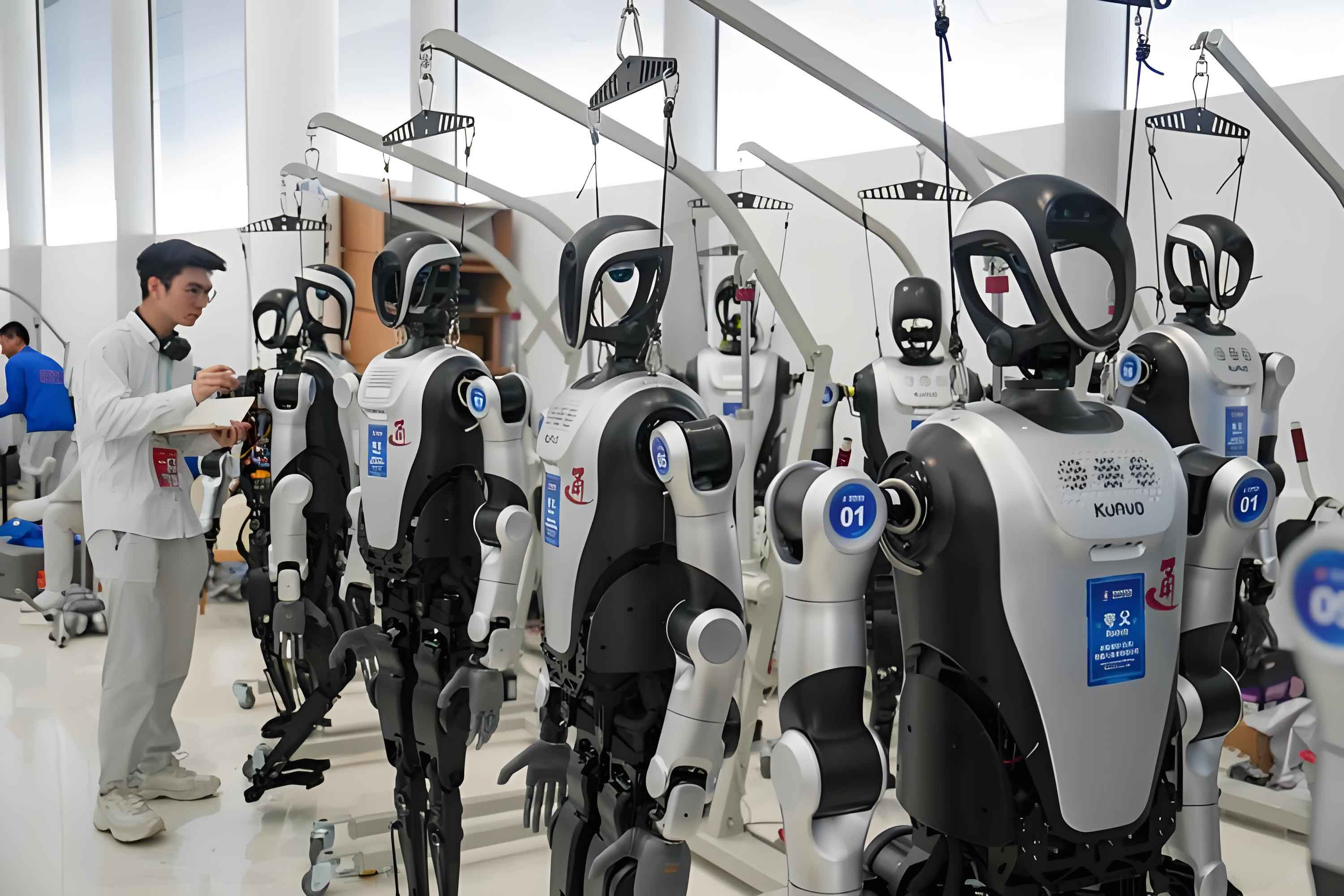
The importance of this approach for humanoid robots can be understood through the challenges they face. Humanoid robots must operate in environments built for humans. They must walk on uneven surfaces, avoid obstacles, handle objects of different shapes and weights, and respond to changing conditions. Collecting data from human actions helps humanoid robots learn from the very behaviors they are expected to perform. When the data is high quality and broadly applicable, humanoid robots can be trained more efficiently and can transfer learned skills across different tasks and hardware designs.
The human-centered method also helps address a common bottleneck in robotics: the gap between simulated data and real-world performance. By capturing real human movements and real object interactions, the center produces data that reflects physical reality. For humanoid robots, this reduces the risk that a model trained only in simulation will fail when deployed in a factory, a home, or another real setting. The result is a training pipeline that supports humanoid robots in learning not just isolated motions but also the structure and variability of real tasks.
3. A 4D World Model as the Unified Foundation
In terms of technical framework, the training center uses a 4D world model as a unified foundation. This framework connects digital intelligence, spatial intelligence, and physical intelligence. It links cognitive decision-making, scene reconstruction, and real-machine execution across the full chain. The goal is to build standardized, reusable, and mass-producible professional robot training infrastructure. For humanoid robots, this kind of infrastructure can provide low-cost, high-quality, and full-scenario data training services. It also supports regional humanoid robot enterprises by giving them access to shared capabilities that might otherwise be too expensive or too complex to develop individually.
A 4D world model, in this context, serves as a common reference for understanding space, time, physical relationships, and action outcomes. By connecting digital intelligence with spatial and physical intelligence, the center creates a framework in which humanoid robots can be trained to understand not only where objects are but also how they behave, how they change over time, and how actions affect them. This is especially important for humanoid robots because they must interact with the world using hands, arms, legs, and other body parts in ways that require coordinated perception and control.
The framework also links cognitive decision-making with scene reconstruction and real-machine execution. This means that a humanoid robot can be trained to make decisions based on a reconstructed understanding of a scene and then execute those decisions through its physical body. The integration of these stages helps ensure that training is not disconnected from deployment. For humanoid robots, the ability to move smoothly from perception to decision to action is a central requirement for useful operation in real environments.
By building standardized and reusable infrastructure, the center also supports the broader industrialization of humanoid robots. Standardization can reduce fragmentation, improve comparability, and make it easier for different teams to build on shared data and methods. Reusability means that investments in data collection, simulation, and training can serve multiple projects and multiple generations of humanoid robots. Mass producibility suggests that the infrastructure is designed to be scaled, which is essential if humanoid robots are to move beyond limited trials and into wider deployment.
4. Data Capabilities for Home and Industrial Scenarios
In terms of data collection capability, the training center has built a multi-viewpoint light field acquisition system. This system can restore object motion trajectories, deformation processes, and light-shadow changes with high precision, producing high-fidelity original training materials. For humanoid robots, high-fidelity data is valuable because it captures the subtle details of real-world interaction. Objects bend, slide, rotate, reflect light, and change appearance as they move. A humanoid robot that can learn from data containing these details is better prepared for the messy and unpredictable nature of real environments.
For home scenarios, the system can fully reproduce real actions such as housework cleaning, cooking and meal preparation, and family care. It can output high-quality home scenario datasets. These datasets are important for humanoid robots that are intended to assist people in domestic settings. A home is a highly varied environment. Floors, tables, kitchens, utensils, clothing, and personal items all present different physical properties and interaction challenges. Humanoid robots trained with home scenario data can learn to handle these variations more effectively.
For industrial manufacturing, the system can deeply collect workflows such as cloth sewing, packaging and handling, and product assembly. This helps consolidate robot cognition of industrial physical laws. Humanoid robots in industrial settings must often work with materials and processes that demand precision, repetition, and safety. By collecting data from these workflows, the center supports the development of humanoid robots that can understand the physical constraints of industrial tasks. This includes how materials deform, how objects should be gripped, how forces should be applied, and how tasks progress from one state to another.
| Scenario area | Actions and workflows | Data output and value for humanoid robots |
|---|---|---|
| Home scenarios | Housework cleaning, cooking and meal preparation, family care | High-quality home scenario datasets that help humanoid robots understand domestic objects, human-centered tasks, and changing home environments |
| Industrial manufacturing | Cloth sewing, packaging and handling, product assembly | Deep workflow data that strengthens robot cognition of industrial physical laws and supports precise, repeatable deployment |
| Human-centered motion capture | Walking, obstacle avoidance, picking up and putting down boxes | Higher data quality, better validity, larger data volume per unit of time, and more general data suitable for different robot bodies |
| Multi-viewpoint light field acquisition | Motion trajectories, deformation processes, light-shadow changes | High-fidelity original training materials for humanoid robots that must perceive and act in physically realistic conditions |
The combination of home and industrial datasets gives the center a broad foundation for humanoid robot training. Humanoid robots are expected to operate across many domains, and the skills required in a home may differ from those required in a factory. However, there are also shared foundations: perception, manipulation, spatial reasoning, and task sequencing. By collecting data across both home and industrial scenarios, the center can support humanoid robots in developing transferable capabilities while also providing specialized datasets for particular applications.
5. A Closed Loop from Collection to Reflux
Through its new generation of technical support, the training center has built a data closed loop described as “collection—modeling—training—validation—reflux.” This closed loop is important for humanoid robots because it allows data to be improved continuously. Data is collected, models are built, training is conducted, results are validated, and feedback is returned to the data and modeling stages. For humanoid robots, this cycle supports iterative improvement rather than one-time training.
On the basis of original two-dimensional video and motion trajectory data, the center adds dimensions of depth, spatial relationships, and physical information. This allows the system to fully depict object pose, contact events, mechanical relationships, and task state evolution. Humanoid robots need this kind of rich representation because their actions depend on understanding objects in three-dimensional space, recognizing when contact occurs, estimating forces, and tracking how a task changes over time.
For example, when a humanoid robot picks up a box, it must know where the box is, how it is oriented, whether it is stable, how much force to apply, and what should happen next. When a humanoid robot avoids an obstacle, it must understand the spatial relationship between its body and the obstacle, the direction of movement, and the timing of its response. When a humanoid robot participates in an assembly task, it must understand contact events and mechanical relationships between parts. The center’s data closed loop is designed to capture and represent these dimensions so that humanoid robots can learn from them more effectively.
The closed loop also supports validation. Validation is the stage at which trained models are tested against real or realistic conditions. For humanoid robots, validation is essential because a model that performs well in simulation may still struggle with the physical world. By including validation in the loop, the center helps ensure that training results are not accepted blindly. Feedback from validation can be returned to improve data collection, scene modeling, or training methods. This makes the overall system more robust and more useful for humanoid robots.
6. From Doing Actions to Seeing, Understanding, and Entering the World
The center’s approach is intended to help robots advance from “can do actions” to “see the world, understand the world, and enter the world.” For humanoid robots, this progression captures a central ambition of embodied intelligence. A humanoid robot that can perform a motion is not necessarily a humanoid robot that understands why the motion is needed, when it should be used, or how it should adapt when conditions change. Seeing, understanding, and entering the world require perception, cognition, and action to work together.
Seeing the world involves more than capturing images. It involves depth, spatial relationships, object pose, and dynamic changes. Understanding the world involves interpreting contact events, mechanical relationships, task states, and the consequences of actions. Entering the world involves executing actions through a physical body in a way that is safe, effective, and responsive. The training center’s data closed loop is designed to support all three dimensions by adding depth, spatial, and physical information to the data used for training humanoid robots.
This progression is particularly important for humanoid robots because they are expected to work in human environments. Human environments are not static or fully predictable. Doors open and close, objects move, people change tasks, and surfaces vary. A humanoid robot that only knows how to repeat a fixed action may fail when the environment changes. A humanoid robot that can see, understand, and enter the world has a better chance of adapting to new situations. The center’s focus on high-quality data, 4D world modeling, and closed-loop training supports this more advanced form of embodied intelligence.
7. Coordination Across Phases and Regional Infrastructure
At present, the first phase of the Shijingshan District Embodied Intelligence Training Center has completed its upgrade, while the second and third phases of the data training center are already in effective operation. The next step is for the district to promote connected and coordinated capabilities across all three. Together, they are intended to form a comprehensive embodied intelligence infrastructure that integrates real-machine data collection, real-person data, 4D light field reconstruction, and world model simulation deduction. This infrastructure is expected to provide key hardware and data foundation support for the domestic embodied intelligence industry and to accelerate the creation of a leading domestic embodied intelligence industry innovation highland.
For humanoid robots, this coordination across phases can create a stronger and more complete support system. Real-machine data collection allows humanoid robots to learn from actual robot operation. Real-person data allows humanoid robots to learn from human movement and behavior. 4D light field reconstruction provides detailed spatial and visual information. World model simulation deduction allows scenarios to be explored, predicted, and tested. When these capabilities are connected, humanoid robots can be trained with a richer and more integrated view of the world.
The regional dimension is also significant. Humanoid robot enterprises in the region can benefit from shared infrastructure that provides low-cost, high-quality, full-scenario data training services. Instead of each company building its own isolated data pipeline, they can access a common foundation that supports multiple robot designs and multiple application areas. This can lower barriers to development, encourage collaboration, and accelerate the translation of humanoid robot research into practical products and services.
8. Significance for the Humanoid Robot and Embodied Intelligence Industry
The Shijingshan District Embodied Intelligence Training Center represents a practical response to one of the central challenges in humanoid robotics: data. Humanoid robots need data that is rich enough, realistic enough, and general enough to support learning in complex environments. The center’s human-centered data collection method, multi-viewpoint light field acquisition system, 4D world model, and closed-loop training process are all aimed at meeting this need. For humanoid robots, these capabilities can improve learning efficiency, support cross-platform generalization, and reduce the cost of developing new skills.
The center also reflects a broader shift in the field toward embodied intelligence. Embodied intelligence emphasizes that intelligence cannot be separated from the body and the environment. For humanoid robots, this means that perception, cognition, and action must be developed together. A humanoid robot must not only process information but also act on it in a physical world. The center’s integrated infrastructure supports this integrated view by connecting data collection, simulation, training, verification, and deployment.
Another important aspect is standardization. When data collection and training processes are standardized, different teams can compare results, share methods, and build on one another’s work. For humanoid robots, standardization can help avoid duplicated effort and can make it easier to transfer capabilities between projects. Reusability and mass producibility further support the growth of the industry by making training infrastructure more accessible and more scalable.
Finally, the center’s focus on both home and industrial scenarios reflects the dual promise of humanoid robots. In industry, humanoid robots can support tasks such as cloth sewing, packaging and handling, and product assembly. In the home, humanoid robots can support housework cleaning, cooking and meal preparation, and family care. These are different environments with different requirements, but they share a need for reliable perception, safe manipulation, and adaptable behavior. By collecting data across both domains, the center helps humanoid robots develop capabilities that can serve a wide range of real-world needs.
9. Outlook for Humanoid Robots and Embodied Intelligence
The completion of the first phase upgrade and the effective operation of the second and third phases position the Shijingshan District Embodied Intelligence Training Center as a coordinated infrastructure for humanoid robots and embodied intelligence. The planned integration of real-machine data collection, real-person data, 4D light field reconstruction, and world model simulation deduction suggests a future in which humanoid robots can be trained across physical and simulated environments in a more seamless way.
For humanoid robots, the ability to see the world, understand the world, and enter the world will depend on continued advances in data quality, model training, and physical execution. The center’s closed loop from collection to modeling, training, validation, and reflux provides a structured path for such advances. Each stage can feed into the next, allowing humanoid robots to learn from both successes and failures. This iterative process is likely to be central to the development of more capable and more reliable humanoid robots.
The regional innovation highland that the district aims to build can also play a role in the wider embodied intelligence industry. By providing key hardware and data foundation support, the center can help humanoid robot enterprises reduce development costs, shorten training cycles, and focus on application-specific innovation. This can create a more vibrant ecosystem in which humanoid robots move from research prototypes to useful systems in factories, homes, and other environments.
As humanoid robots continue to develop, the relationship between data, simulation, and real-world execution will remain a defining challenge. The Shijingshan District Embodied Intelligence Training Center’s upgrade and its new identity show a practical commitment to addressing that challenge. The center’s work is not only about collecting data; it is about building the conditions under which humanoid robots can learn, adapt, and operate in the physical world.
10. Key Facts at a Glance
| Item | Detail |
|---|---|
| Facility name | Shijingshan District Embodied Intelligence Training Center, upgraded from the Shijingshan District Humanoid Robot Data Training Center |
| Status | First phase completed iterative upgrade; second and third phases are in effective operation |
| Location | Shougang Park Science Fiction Industry Innovation Center |
| Area | More than 1,500 square meters |
| Core full chain | Data acquisition, simulation generation, model training, body verification, and application deployment |
| Technical foundation | 4D world model as a unified foundation, connecting digital intelligence, spatial intelligence, and physical intelligence |
| Data collection method | Human-centered motion capture with staff performing walking, obstacle avoidance, and box pick-and-place actions |
| Key technology provider statement | Shi Guangyao, North China regional head of Beijing Yuanke Vision Technology Co., Ltd., noted higher data quality, better validity, larger data volume per unit time, and greater generality across different robot bodies |
| Home scenario data | Housework cleaning, cooking and meal preparation, and family care |
| Industrial scenario data | Cloth sewing, packaging and handling, and product assembly |
| Closed loop | Collection, modeling, training, validation, and reflux |
| Data dimensions | Two-dimensional video, motion trajectory, depth, spatial relationships, and physical information |
| Representation targets | Object pose, contact events, mechanical relationships, and task state evolution |
| Progression goal | From “can do actions” to “see the world, understand the world, and enter the world” |
| Regional goal | Build a comprehensive embodied intelligence infrastructure and accelerate a leading domestic embodied intelligence industry innovation highland |
The Shijingshan District Embodied Intelligence Training Center’s upgrade reflects a clear understanding that humanoid robots require more than isolated algorithms or individual hardware advances. They require integrated data, simulation, training, validation, and deployment pathways. By connecting the first, second, and third phases, the center is designed to provide such pathways at a regional level. For humanoid robots, this can mean better data, more general skills, and stronger support for real-world applications.
As the facility continues to operate as an embodied intelligence training center, its work will be closely watched by those developing humanoid robots. The center’s emphasis on human-centered data, 4D world modeling, high-fidelity light field acquisition, and closed-loop training aligns with the needs of humanoid robots in both industrial and home environments. The project’s integrated approach offers a practical foundation for humanoid robots as they move toward seeing the world, understanding the world, and entering the world.
In this sense, the upgrade is not only a milestone for one facility. It is also a signal of how humanoid robots and embodied intelligence are being supported through shared infrastructure. By combining data collection, simulation generation, model training, body verification, and application deployment, the center aims to help humanoid robots become more capable, more adaptable, and more useful in the environments where people live and work.