
Recent developments have placed humanoid robots at the center of global attention. The 2026 World Robot Conference opened with a large display of domestic humanoid robots that did more than flip and perform stunts. They demonstrated factory work and household services on site. Shortly afterward, the Second World Humanoid Robot Games began, with more than 2,000 robots competing. The contests measured the technological strength behind the machines. These scenes show that Chinese humanoid robots are accelerating from moving on stage and running in competition arenas toward being used in homes and working in factories. They are running out a new breakthrough speed.
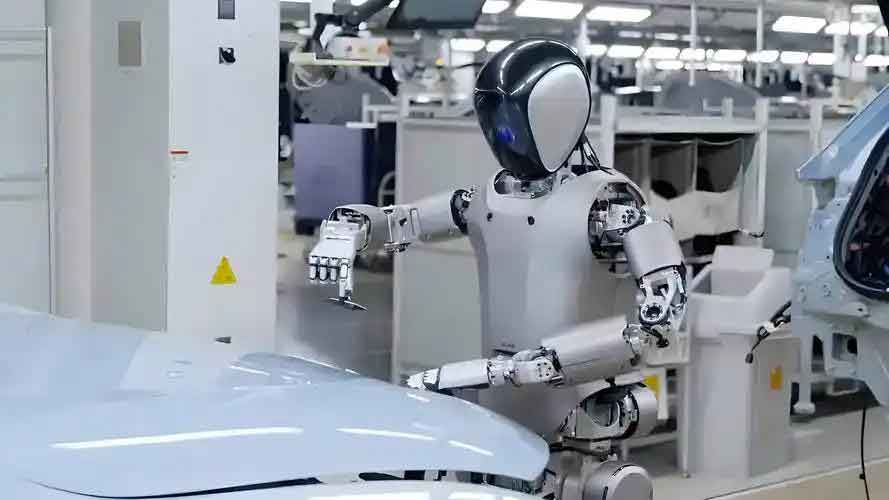
Humanoid robots are regarded as another disruptive product after computers, smartphones, and new energy vehicles. Industry estimates place embodied intelligence at a 1:10 industrial multiplier effect, and humanoid robots are the best carrier of embodied intelligence. They integrate multiple technologies and have a strong role in driving the industrial chain. If computers extended the human brain, smartphones extended human senses, and new energy vehicles extended human legs and feet, then humanoid robots extend the whole-body action capability of humans. They can push artificial intelligence from the digital world into physical reality. The industry expects that the future global market for humanoid robots could be comparable to the scale of the automobile industry.
1. From Public Spectacle to Practical Deployment
To release such industrial potential, the field cannot only pursue the performance effects of prototypes. It must cross the threshold of practical deployment. The standard for judging humanoid robots has shifted from the early question of how cool their movements are to whether they can stably complete real tasks. At the 2026 World Robot Conference, domestic humanoid robots no longer focused solely on eye-catching performances. Practical demonstrations became the mainstream. Dexterous hand grasping, environmental perception, and autonomous decision-making appeared together. Reducers, servo motors, robot brains, and other core components were also displayed. Complete machines and supply chain support advanced side by side, making the industrial foundation more solid.
This shift matters because humanoid robots must eventually create value. A robot that can bow, dance, or jump may attract crowds, but a robot that can pick up parts, sort packages, or assist with household chores can enter an economic cycle. The movement from demonstration to operation requires every subsystem to work together. Vision must identify objects. Hands must grasp them. Legs must maintain balance. The brain must plan. The power system must last. The control system must respond in real time. When these abilities are shown in public, they signal that humanoid robots are moving closer to useful work.
Practical deployment also changes the way humanoid robots are evaluated. A machine that performs well in a controlled laboratory may fail in a noisy factory or a cluttered home. A machine that looks elegant in a video may be difficult to maintain. A machine that can complete one task may not be able to switch to another. The new evaluation standard is therefore broader. It includes stability, safety, speed, energy use, ease of repair, and cost. Humanoid robots must be judged as complete products and as parts of larger systems. That is a more demanding standard, but it is also the standard that matters for commercialization.
2. The World Robot Conference as an Industrial Review
The 2026 World Robot Conference served as a concentrated review of industrial achievements. It was not only a showcase for individual machines. It was a view of the broader ecosystem around humanoid robots. The exhibits included complete humanoid robots, key components, sensing systems, and software platforms. The presence of core parts such as reducers, servo motors, and robot brains shows that the supply chain is becoming more complete. This is important because humanoid robots are complex products. Their performance depends on thousands of parts, materials, algorithms, and manufacturing processes.
When domestic humanoid robots demonstrate factory tasks and household services, they reveal the direction of competition. The contest is no longer limited to the appearance or agility of a single prototype. It is about whether the entire system can be produced, maintained, improved, and deployed at scale. The conference therefore offers more than spectacle. It offers a map of where the industry stands and what remains to be solved. Humanoid robots are moving from laboratory curiosities to candidates for real economic roles.
The conference also shows the importance of coordination. A strong robot requires strong components. A strong component requires strong materials and precision manufacturing. A strong application requires strong software and data. When these elements appear together, they create momentum. When one element lags, it can hold back the entire system. For humanoid robots, progress is therefore not a single breakthrough but a chain of improvements. The World Robot Conference makes that chain visible.
3. The World Humanoid Robot Games as a Stress Test
If the World Robot Conference is a concentrated industrial review, the World Humanoid Robot Games are a practical technological stress test. More than 2,000 robots competed in events that included long jump, high jump, running, weightlifting, tug-of-war, and ball games. The events looked lively, but the competition behind them was about algorithms, hardware, and control systems. A robot that jumps far or runs fast must coordinate motors, sensors, balance control, energy management, and decision-making in real time. A robot that plays a ball game must perceive a dynamic environment and respond within fractions of a second.
Because of this, media coverage in multiple countries described the results of the humanoid robot games as evidence that China’s humanoid robot technology innovation is accelerating. The coverage noted that Chinese humanoid robots have already shown significant industrial advantages. The purpose of the games, however, is not ranking alone. The deeper purpose is to promote research through competition and promote production through competition. Events create clear technical challenges. They expose weaknesses. They push teams to improve reliability, speed, and robustness. In this way, the games help the entire humanoid robots sector iterate faster.
The games also help the public understand what humanoid robots can and cannot yet do. A robot that falls during a race shows the difficulty of balance. A robot that completes a complex task shows the progress of control. A robot that wins a weightlifting event shows the power of actuators. A robot that participates in a ball game shows the challenge of perception and planning. These public tests are valuable because they turn abstract technical claims into visible performance. They also create pressure for continuous improvement. For humanoid robots, competition is not the end goal. It is a tool for accelerating maturity.
4. China’s Expanding Advantages in Humanoid Robots
China’s humanoid robots are accelerating for several reasons. In the first half of 2026, China’s humanoid robot shipments exceeded 40,000 units, accounting for 97 percent of the global total. This figure reflects scale, but it also reflects the broader manufacturing foundation that supports humanoid robots. China is the world’s largest industrial robot market. It has a complete industrial chain, rapid supporting capacity, and cost advantages. These factors allow humanoid robots to move from design to prototype and from prototype to production more quickly.
The country also has rich scenario resources in industry, logistics, services, and other fields. These scenarios generate abundant data. That data can help humanoid robots learn while working and become smarter with use. A robot that performs the same task repeatedly can improve its motion planning. A robot that encounters varied objects can improve its perception. A robot that interacts with people can improve its decision-making. This creates a positive cycle between deployment and improvement. Policy, capital, and talent together form a relatively complete innovation ecosystem, promoting the efficient transformation of technological achievements.
Another advantage is the depth of the supplier network. Humanoid robots need precision reducers, high-performance servo motors, sensors, batteries, computing platforms, and lightweight materials. A broad supplier network can shorten development cycles. It can also reduce costs through competition and scale. When suppliers are close to manufacturers, feedback loops become faster. Problems can be identified and corrected more quickly. For humanoid robots, this matters because hardware and software must be refined together. A strong supply chain is not only a cost advantage. It is a speed advantage.
| Signal | What It Shows | Why It Matters |
|---|---|---|
| 2026 World Robot Conference | Domestic humanoid robots demonstrated factory work, household services, dexterous hand grasping, environmental perception, and autonomous decision-making | Indicates a shift from performance-oriented displays to practical task demonstrations |
| Second World Humanoid Robot Games | More than 2,000 robots competed in running, jumping, weightlifting, tug-of-war, and ball games | Tests algorithms, hardware, and control systems while promoting research and production through competition |
| Shipments in the first half of 2026 | China’s humanoid robot shipments exceeded 40,000 units, accounting for 97 percent of the global total | Shows scale, supply chain strength, and market momentum for humanoid robots |
| Industrial and application ecosystem | Complete industrial chain, rapid supporting capacity, cost advantages, and rich scenarios in industry, logistics, and services | Supports rapid iteration, data accumulation, and deployment of humanoid robots |
5. Three Thresholds from Performance to Work
From being able to perform to being able to work, humanoid robots still need to cross three thresholds. These thresholds are not isolated. They interact with each other. A weakness in one area can slow progress in another. The first threshold is technical reliability. The second is commercial cost. The third is real-world scenario adaptation. Together, they define the distance between a compelling demonstration and a sustainable industry.
- Technical reliability: Humanoid robots must move from occasional success in demonstrations to stable, full-process reliability in engineering operations.
- Commercial cost: Humanoid robots must reduce costs, improve efficiency, and become mass-producible so that enterprises can afford them and find them worthwhile.
- Scenario adaptation: Humanoid robots must flexibly adapt to different scenarios and working conditions to meet differentiated needs across industries.
These thresholds also shape investment priorities. If reliability is weak, customers will not deploy humanoid robots at scale. If cost is too high, even reliable robots will remain limited to niche applications. If adaptation is poor, robots will require expensive customization for every new task. Solving one threshold without the others is not enough. The industry must advance on all three fronts. That is why the next phase of humanoid robots development will require collaboration among hardware companies, software developers, component suppliers, system integrators, and end users.
6. Technical Reliability Remains the Cornerstone
Technical reliability is the cornerstone. The hardest step for humanoid robots is often not achieving a single successful demonstration. It is achieving repeated success. A robot that can walk across a stage once may still fail in a factory where it must work for long hours. A robot that can grasp one object may still struggle with thousands of objects of different shapes, weights, and surfaces. A robot that can follow a scripted routine may still be confused by an unexpected obstacle or a changed workflow.
Reliability requires engineering discipline. It requires robust hardware, durable joints, reliable batteries, stable sensors, and fault-tolerant software. It requires testing under real conditions. It requires maintenance plans, safety protocols, and clear failure recovery. Humanoid robots operate in unstructured or semi-structured environments. They must handle variation. They must handle noise. They must handle human presence. They must handle the unexpected. The transition from an occasional success to reliable, full-process operation is one of the most difficult breakthroughs for humanoid robots to achieve.
For this reason, the industry needs more than exciting videos. It needs data on uptime, mean time between failures, repair time, and safety performance. It needs standards for testing and certification. It needs validation in warehouses, factories, hospitals, hotels, and homes. Only when humanoid robots can be trusted to perform tasks consistently can they become part of normal operations. Reliability is not a single feature. It is the foundation on which every commercial promise rests.
Reliability also affects public trust. When humanoid robots work near people, a failure can cause injury or damage. Even a minor incident can slow adoption. Developers must therefore design for safety from the beginning. Emergency stop systems, force limits, collision detection, and secure communication are not optional. They are part of the product. Humanoid robots must be reliable not only in the laboratory but also in the real world, where conditions change and people behave unpredictably.
7. Commercial Cost Determines Market Reach
Commercial cost is the key to market reach. Humanoid robots must reduce cost, improve efficiency, and become mass-producible. Enterprises will not adopt them simply because they are impressive. Enterprises will adopt them when the economics work. A humanoid robot must be affordable to buy or lease. It must be cost-effective to operate. It must be easy to integrate. It must deliver measurable value compared with existing automation or human labor. If it cannot, it will remain a showroom product rather than a workplace tool.
Cost reduction is not only about cheaper components. It is about design for manufacturing. It is about modularity. It is about supply chain scale. It is about reducing the number of custom parts. It is about improving production yield. It is about simplifying maintenance. It is about extending service life. Every part of the humanoid robots value chain matters. Reducers, servo motors, sensors, batteries, computing platforms, and software all contribute to total cost. When these elements are standardized and produced at scale, prices can fall and reliability can improve.
Business models will also matter. Some customers may prefer to buy humanoid robots outright. Others may prefer leasing, robot-as-a-service, or subscription models. These models can lower the initial barrier and align costs with productivity gains. But no business model can compensate for a product that does not work. Cost and reliability must advance together. Humanoid robots must become both capable and economical. That is the second unavoidable threshold.
Cost also includes the cost of integration. A humanoid robot must fit into an existing workflow. It may need to connect with enterprise software, safety systems, and other machines. It may need training for workers. It may need spare parts and service. These hidden costs can be significant. Developers must therefore think beyond the sticker price. They must consider total cost of ownership. If humanoid robots can reduce total cost while improving output, they will find a market. If they only reduce the sticker price but increase operating complexity, they will not.
8. Real-World Adaptation Tests the Value of Humanoid Robots
Real-world scenario adaptation is the practical test. A robot that can work in one setting may not work in another. Factories have structured layouts, repetitive tasks, and strict safety requirements. Logistics centers have varied packages, fast cycles, and high throughput demands. Households have unpredictable objects, informal spaces, and close human interaction. Service environments have changing customers, complex communication, and unpredictable requests. A useful humanoid robot must adapt to these differences.
Adaptation means more than moving the same robot to a new location. It means transferable skills. It means flexible perception. It means context-aware decision-making. It means the ability to learn from demonstration and from experience. It means understanding when to ask for help. It means operating safely around people. It means fitting into existing workflows rather than forcing a complete redesign. Humanoid robots must meet the differentiated needs of thousands of industries. That is why general-purpose intelligence and scenario-specific optimization must go hand in hand.
The data advantage of rich application scenarios becomes important here. When humanoid robots work in real settings, they collect real data. That data can improve models. Improved models can make the next deployment better. This cycle can accelerate adaptation. But it also raises questions about privacy, security, and data governance. Real-world adaptation is therefore not only a technical challenge. It is also an operational, legal, and social challenge. Solving it will determine how quickly humanoid robots move from pilot projects to daily work.
Adaptation also requires flexibility in hardware. A humanoid robot that works in a factory may need different hands, different sensors, or different mobility from one that works in a home. Modular design can help. A common platform with interchangeable parts can serve multiple markets. This approach can reduce development costs while increasing variety. It can also help humanoid robots evolve as new tasks emerge. The goal is not a single perfect robot. The goal is a family of capable robots that can be adapted to real needs.
9. Policy, Capital, and Talent Build the Innovation Ecosystem
Policy, capital, and talent together form the innovation ecosystem for humanoid robots. Policy can support research and development, set standards, encourage pilot applications, and create a stable environment for investment. Capital can fund long development cycles, especially because humanoid robots require breakthroughs in hardware and software. Talent can bring together mechanical engineering, electronics, control theory, artificial intelligence, materials science, and human factors. No single discipline is enough.
A complete ecosystem also includes suppliers, manufacturers, testing facilities, and customers. It includes open platforms and shared tools. It includes collaboration between universities, research institutes, and companies. It includes international exchange. The humanoid robots sector is global. Progress in one country can benefit the world. At the same time, competition is intense. Countries and regions are investing in humanoid robots because they see the potential for productivity, strategic advantage, and future industrial leadership. China’s ecosystem has the advantage of scale, supply chain depth, and diverse application scenarios.
Policy can also help reduce fragmentation. If standards are unclear, companies may develop incompatible systems. If testing is inconsistent, customers may not trust performance claims. If safety rules are missing, deployment may be delayed. Clear and practical policies can accelerate progress. They can also attract investment by reducing uncertainty. For humanoid robots, policy is not only about funding. It is about creating the conditions for reliable, safe, and scalable growth.
10. Market Potential and the Long Road Ahead
The market potential for humanoid robots is significant. Industry estimates suggest that the future global humanoid robot market could be comparable to the automobile industry in scale. If that potential is realized, humanoid robots could affect manufacturing, logistics, healthcare, elderly care, retail, hospitality, education, and household services. They could take on dangerous, repetitive, or physically demanding tasks. They could support aging societies. They could improve productivity. They could create new services and new industries.
But potential is not the same as reality. The road ahead is long. Humanoid robots must prove themselves task by task. Early deployment is likely to focus on environments where the value is clear and the conditions are manageable. Structured industrial settings may come first. Commercial and service settings may follow. Household use may take longer because homes are complex, safety demands are high, and cost sensitivity is strong. Each step requires reliability, affordability, and adaptation. The industry must avoid overpromising and underdelivering.
The market will also develop in segments. Some customers will need a small number of highly capable humanoid robots for specialized tasks. Others will need many lower-cost robots for repetitive work. Some will prioritize payload. Others will prioritize dexterity. Some will prioritize mobility. Others will prioritize safety. This diversity means that no single design will serve every need. Humanoid robots will likely evolve into multiple product lines and configurations. That is normal for a maturing industry. The key is to match capability with value.
11. Global Competition and Cooperation
Humanoid robots are becoming a global race. Advances in artificial intelligence, actuators, sensors, batteries, and materials are converging. Companies and research teams around the world are working on different approaches. Some focus on whole-body control. Some focus on dexterous hands. Some focus on robot brains. Some focus on low-cost hardware. Some focus on factory integration. This diversity is healthy. It increases the chance of breakthroughs.
At the same time, global cooperation is necessary. Humanoid robots will operate around people. They need common safety standards. They need clear ethical guidelines. They need interoperable components and interfaces. They need shared benchmarks. The World Humanoid Robot Games and similar events can contribute by providing neutral tests and by encouraging transparency. Chinese humanoid robots can benefit from global exchange and can also contribute to it. Competition can push innovation. Cooperation can build trust. Both are needed for the humanoid robots industry to grow responsibly.
Global competition also means that speed matters. Companies that can iterate quickly may gain advantages. Countries with strong supply chains may scale faster. But speed without reliability can be dangerous. A fast-moving industry still needs standards, testing, and safety. The most successful humanoid robots will be those that combine rapid innovation with disciplined engineering. That balance will determine which companies and regions lead in the long term.
12. A Long Race Requiring Determination and Endurance
The development of the humanoid robots industry is a long race that tests determination and endurance. It is not a sprint. It requires patient investment, engineering discipline, and continuous learning. It requires the ability to turn exciting demonstrations into dependable products. It requires the ability to reduce costs without sacrificing quality. It requires the ability to adapt to real scenarios and to earn the trust of users.
China has a complete industrial foundation and massive application scenarios. These advantages can be used well. By tackling reliability, cost, and adaptation step by step, the country can help humanoid robots become more capable and more useful. The brains of humanoid robots will become smarter. Their bodies will become more flexible. Their movements will become more stable. Their tasks will become more varied. They will move from stage to factory, from competition to service, and eventually from early adopters to broader markets.
Recent events have shown the momentum. The 2026 World Robot Conference demonstrated that domestic humanoid robots can do more than entertain. The Second World Humanoid Robot Games showed that competition can drive technical progress. The shipment figures for the first half of 2026 show that China’s humanoid robots have already achieved significant scale. Yet the most important work remains ahead. Reliability must improve. Costs must fall. Scenarios must expand. Data must be used responsibly. Standards must mature. Talent must grow.
13. Safety, Standards, and Public Trust
Safety is a prerequisite for the widespread use of humanoid robots. Unlike industrial robots that often work behind fences, humanoid robots are designed to share spaces with people. They may work in factories, warehouses, hospitals, hotels, shops, and homes. They may handle tools, lift objects, and move through crowded areas. Every action creates a potential risk. Safety must therefore be designed into the hardware, software, and operating procedures from the beginning.
Standards are essential. The industry needs common definitions for safety performance, testing methods, and certification. It needs rules for emergency stopping, force limits, collision avoidance, and secure communication. It needs clear responsibilities when a humanoid robot is deployed. Without standards, customers may hesitate. Insurers may be unwilling to provide coverage. Regulators may be forced to act slowly. Standards can reduce uncertainty and build confidence. They can also help humanoid robots cross borders more easily.
Public trust is closely linked to safety. People are more likely to accept humanoid robots if they believe the machines are reliable and accountable. Transparency matters. Performance claims should be testable. Incidents should be reported and analyzed. Improvements should be shared. Trust is not built by advertising alone. It is built by consistent, safe operation over time. For humanoid robots, public trust is a strategic asset. Once lost, it is difficult to regain.
14. Data, Learning, and the Improvement Loop
Data is a key resource for humanoid robots. Real-world operation generates information about objects, environments, motions, failures, and human interactions. That information can be used to improve perception, planning, and control. It can help humanoid robots learn new skills and refine existing ones. It can also help developers identify common failure modes and design better products. The improvement loop between deployment and learning is one of the strongest advantages of real-world applications.
But data must be managed carefully. Privacy, security, and ownership must be addressed. Some data may be sensitive. Some may reveal business processes. Some may involve personal information. Companies must establish clear rules for collection, storage, and use. They must also ensure that humanoid robots do not become vulnerable to cyberattacks. A robot that is connected to a network must be protected. A robot that learns from data must be protected from bad data. Data governance is therefore part of product quality.
Simulation can complement real-world data. Simulated environments allow developers to test humanoid robots under many conditions without the cost and risk of physical trials. But simulation cannot replace reality. The gap between simulation and the real world remains a challenge. Developers must combine simulated learning with real-world validation. They must build systems that can adapt when conditions change. The goal is not perfect data. The goal is continuous improvement. Humanoid robots that can learn safely and efficiently will have a major advantage.
15. Supply Chain Depth and Manufacturing Scale
The supply chain is the backbone of the humanoid robots industry. Humanoid robots require a wide range of components. They need precision reducers, servo motors, sensors, batteries, computing modules, lightweight structures, and advanced software. They need materials that are strong, light, and durable. They need manufacturing processes that are precise and repeatable. Without a deep supply chain, even the best design cannot become a reliable product.
China’s manufacturing base provides significant advantages. The country has a complete industrial chain, rapid supporting capacity, and cost advantages. These strengths can shorten development cycles and reduce production costs. They can also help companies scale quickly when demand grows. The presence of core components at major events such as the 2026 World Robot Conference shows that the supply chain is maturing. Complete machines and components are advancing together. That is a healthy sign for the industry.
Manufacturing scale also improves quality. When production volumes rise, companies can invest in better tooling, automation, and testing. They can learn from production data and reduce defects. They can negotiate better prices for materials. They can develop specialized suppliers. These improvements create a virtuous cycle. Lower costs lead to more adoption. More adoption leads to higher volumes. Higher volumes lead to better quality and lower costs. For humanoid robots, manufacturing scale is not just about quantity. It is about maturity.
16. The Robot Brain and Physical Intelligence
The robot brain is central to the value of humanoid robots. It must perceive the environment, understand tasks, plan actions, and control the body in real time. It must handle uncertainty and respond to unexpected events. It must work within strict limits on computing power, energy, and heat. It must also be safe. A smart robot brain is not enough if it cannot act reliably in the physical world.
Physical intelligence is different from digital intelligence. A language model can generate text without moving. A humanoid robot must move, balance, grasp, and interact. It must understand physics. It must know how much force to apply. It must know when an object might slip. It must know how to recover from a stumble. This requires a tight connection between perception, planning, and control. It also requires hardware and software to be designed together. The brain and body cannot be separated.
Progress in artificial intelligence is helping humanoid robots become more capable. Better models can improve vision, language understanding, and decision-making. But humanoid robots also need specialized models for motion and manipulation. They need real-time performance. They need robustness. They need the ability to learn from limited data. The robot brain will continue to evolve. The most successful systems will likely combine general intelligence with task-specific skills. They will be smart enough to adapt and disciplined enough to be safe.
17. Human-Robot Collaboration and the Future of Work
Humanoid robots will change work, but the change will not be simple. In some cases, they may replace tasks that are dangerous, repetitive, or physically demanding. In other cases, they may augment human workers. A humanoid robot could lift heavy objects while a person guides the process. It could inspect a site while a person analyzes the data. It could handle routine tasks while a person focuses on complex decisions. The goal is not necessarily full replacement. The goal is better use of human capability.
This shift will create new roles. People will be needed to supervise humanoid robots, maintain them, train them, and integrate them into workflows. New skills will be required. Companies and governments should prepare for this transition. Training programs can help workers move into new roles. Clear rules can protect workers and ensure fair treatment. Public dialogue can address concerns about safety, privacy, and job displacement. Humanoid robots will be more accepted if their benefits are shared broadly.
Human-robot collaboration also requires good design. Humanoid robots must communicate clearly. They must signal their intentions. They must understand human instructions. They must respect personal space. They must be predictable. In factories and warehouses, this can improve efficiency. In homes and service settings, it can improve comfort. The best humanoid robots will not be those that work in isolation. They will be those that work well with people.
18. Investment Discipline and Business Model Innovation
Investment in humanoid robots must be patient and disciplined. The technology is complex. Development cycles are long. Hardware, software, and manufacturing must all mature. Hype can attract capital, but hype can also create unrealistic expectations. If products do not meet promises, confidence can fall. Investors and companies must focus on real milestones. They must measure progress in reliability, cost, and deployment. They must support the unglamorous work of testing, standards, and maintenance.
Business model innovation can help. Robot-as-a-service, leasing, and subscription models can lower the barrier to adoption. They can align costs with productivity gains. They can also give developers ongoing feedback from customers. But these models require strong service networks. They require clear contracts. They require data security. They require maintenance capacity. A business model is only as good as the product and service behind it.
The most important metric is value. Humanoid robots must solve real problems. They must reduce cost, improve safety, increase output, or improve quality. They must be worth the investment. If they can do that, customers will pay. If they cannot, no amount of marketing will create a sustainable market. Investment discipline means focusing on value rather than novelty. It means supporting companies that can execute. It means accepting that the humanoid robots industry will be built step by step.
19. Global Market Entry and Local Adaptation
Humanoid robots will enter a global market, but they must adapt to local conditions. Different countries have different regulations, safety standards, labor practices, and cultural expectations. A humanoid robot that works in one market may need changes for another. It may need different language capabilities, different service models, and different safety features. Local partnerships can help. Local manufacturing can reduce costs and improve responsiveness. Local support can build trust.
Global market entry also requires respect for data rules. Different jurisdictions have different requirements for privacy and data security. Humanoid robots collect data as they work. Companies must comply with local laws and build systems that protect data. They must also be transparent with users. Trust is essential in every market. Without it, adoption will be slow.
International cooperation can help humanoid robots spread safely. Shared standards can reduce fragmentation. Joint research can accelerate progress. Open benchmarks can improve accountability. Competition will remain, but cooperation can create a larger market for everyone. Chinese humanoid robots have strengths in supply chain, cost, and application scenarios. They can use these strengths to compete globally and to contribute to global standards. The key is to combine speed with responsibility.
20. Conclusion: From Breakthrough Speed to Lasting Value
The recent wave of attention around humanoid robots is not accidental. It reflects years of progress in artificial intelligence, robotics, manufacturing, and supply chains. The 2026 World Robot Conference showed that domestic humanoid robots are moving from performance to practical tasks. The Second World Humanoid Robot Games showed that competition can test and accelerate technology. The shipment figures for the first half of 2026 showed that China’s humanoid robots have already achieved significant scale. These are important signals.
But the real test is still ahead. Humanoid robots must cross the thresholds of technical reliability, commercial cost, and real-world adaptation. They must become safe, dependable, and affordable. They must work with people, not just impress them. They must create value in factories, warehouses, hospitals, hotels, shops, and homes. They must earn trust through consistent performance. This will take time, investment, and discipline.
China has a complete industrial foundation and massive application scenarios. These advantages can support the growth of humanoid robots. Policy, capital, and talent can help turn technological achievements into real products. Supply chain depth can reduce costs and speed iteration. Rich scenarios can generate data and drive improvement. If these strengths are used well, humanoid robots can become a major platform for embodied intelligence.
The journey from stage to factory, from competition to service, is already under way. Humanoid robots are becoming smarter, more flexible, and more capable. They are moving from demonstrations to deployments. They are moving from novelty to necessity. The pace of progress will depend on how well the industry solves real problems. With determination and endurance, humanoid robots can deliver lasting value. The world will continue to watch as Chinese humanoid robots run further, work harder, and become part of everyday life and production.