
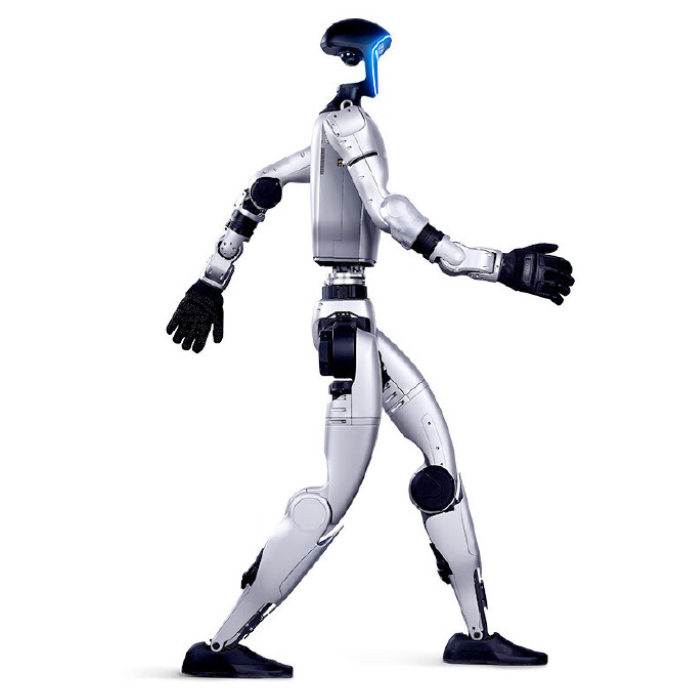
The 2026 World Robot Conference opened on August 19 in Yizhuang, Beijing, bringing the humanoid robotics industry together for one of its largest annual showcases. At the booth of the Beijing Humanoid Robot Innovation Center, widely described as the national team of China’s embodied intelligence sector, the entire Tiangong family appeared together, alongside two flagship releases: Pelican-Unify, a unified embodied intelligence model, and Tiangong Omni, a lightweight humanoid robot. During the event, Xiong Youjun, general manager of the Beijing Humanoid Robot Innovation Center, sat down with media outlets to share his views on where the industry stands today, how the technology is being deployed, why open-source ecosystems matter, and what the road to commercialization actually looks like for embodied intelligence.
His central message was consistent throughout the conversation. Embodied intelligence has arrived at the eve of commercial deployment, but crossing that threshold will not be the work of a single breakthrough. It will depend on system-level maturity, on shared infrastructure, on standards, and on an open ecosystem that allows many companies to build at once.
- From Stage Tricks to Industrial Logic: The Shift Visible on the Show Floor
Xiong observed that the most obvious change at this year’s conference was a broad move away from pure demonstration and toward industrial logic and industrial models. In his view, this is not merely a change in how companies present themselves at an exhibition. It reflects a deeper transformation taking place across the entire embodied intelligence industry.
Behind that transformation lies a critical crossing from technology validation to commercial validation. Companies that once competed on specification sheets are now being measured by something far more demanding: their ability to build an integrated system that includes research and development capability, supply chain capability, scenario engineering capability, and customer experience and service capability. Xiong argued that none of these can be missing, and that this raises the bar for technological comprehensiveness across the board.
For an industry that spent its early years proving that humanoid robots could walk, balance and recover from a push, the shift is significant. Walking is no longer the headline. The headline is whether a robot can complete a real task, in a real environment, at a cost that a real customer is willing to pay. That is the question embodied intelligence companies are now being asked, and it is a question that cannot be answered by a single demonstration video.
- The Industry Stands at the Eve of Commercial Deployment for Embodied Intelligence
Xiong’s assessment of the current moment is that the sector is at the eve of commercialization for embodied intelligence. He described the period ahead as one in which companies and the industry as a whole shift their attention from technical parameters to the construction of systematic capability.
Asked about the widely discussed idea of an “iPhone moment” or a “ChatGPT moment” for robotics, Xiong offered a more measured reading. In his view, such a disruptive node is not a one-size-fits-all instantaneous leap. It is instead a gradual process in which technology maturity, commercial value and social demand become deeply coupled with one another. The moment, when it arrives, will be the visible result of many quieter advances converging.
He disclosed that China’s humanoid robot shipments reached close to 20,000 units in 2025, and that 2026 is expected to bring rapid growth. Application scenarios, he suggested, may land faster than many people expect. That combination of steady groundwork and accelerating deployment is, in his framing, exactly what the eve of commercialization looks like: not a single dramatic announcement, but a growing number of practical installations that begin to add up.
- Not Only a Car Maker, but Also a Seller of Shovels
On the exhibition floor, Tiangong 3.0 performed a synchronized group dance with multiple formations and high fluidity, as well as a human-versus-robot tug of war, all coordinated through the Huisikaiwu unified scheduling hub. The newly released Tiangong Omni demonstrated obstacle crossing and full-body dexterous control on plum blossom piles, a traditional training arrangement of spaced posts.
Xiong was clear that these displays are not about showing off. They exist to validate how well the platform adapts to multiple agents and multiple scenarios, and to refine a collaborative architecture built around a “brain plus cerebellum” design. In other words, the performance is a stress test for the underlying system, not an end in itself.
The center’s core strategy can be summarized with a single metaphor: it does not only want to be the one building the car, it also wants to be the one selling the shovels. According to Xiong, the organization has consistently built its core capabilities around two general-purpose platforms. The first is Embodied Tiangong, a general-purpose robot body platform. The second is Huisikaiwu, a general-purpose embodied intelligence platform.
That positioning shapes the center’s relationship with the rest of the industry. Xiong stated plainly that Tiangong Omni will not compete directly with other vendors building comparable lightweight humanoid platforms. The center is more focused on the shared and critical core technologies that the whole industry needs, rather than on capturing a specific product segment for itself.
Platform or Product Category Notable Details Embodied Tiangong General-purpose humanoid robot body platform One of the two core platforms around which the center builds its capabilities Huisikaiwu General-purpose embodied intelligence platform Serves as a unified scheduling hub; more than 16 million downloads of open-source data; more than ten open-source models released; more than 200 partners and universities building on it Pelican-Unify Unified embodied intelligence model Released at the 2026 World Robot Conference alongside Tiangong Omni Tiangong Omni Lightweight humanoid robot 1.35 meters tall, 39 kilograms; described as the first Humanoid Native open base combining perception-based mobility with full-body general control; opens joint, sensor, system and motion control APIs Tiangong 3.0 Humanoid robot platform Demonstrated synchronized multi-robot dance formations and a human-versus-robot tug of war under Huisikaiwu scheduling Robo-ValueRL Open-source skill library Released jointly by the Huisikaiwu platform and Renmin University of China in July 2026 - An Open Ecosystem Built on Data, Models and Partners
In March 2026, the Beijing Humanoid Robot Innovation Center announced the launch of an open-source and open ecological construction plan for embodied intelligence. According to the center, this is the first full-chain ecosystem plan in the world to take a national and locally co-built innovation platform as its core carrier. Its stated purpose is to break down technical barriers and data silos that would otherwise slow the entire field down.
The results of that effort are beginning to show. Xiong reported that open-source data from Huisikaiwu has been downloaded more than 16 million times. More than ten open-source models have been released. More than 200 partners and universities have carried out secondary development based on the platform. In July 2026, the Huisikaiwu platform worked with Renmin University of China to open-source the Robo-ValueRL skill library, further broadening the platform’s capabilities.
Speaking at the 2026 World Robot Conference, Xiong said the center will continue to open up core capabilities including the embodied body, Huisikaiwu, and the developer toolchain, so that small and medium-sized enterprises can build secondary developments on top of the platform. The logic is straightforward: a shared foundation lowers the cost of entry, and lower entry costs multiply the number of teams working on embodied intelligence applications.
This platform-enabling posture is what allows the center to avoid head-on competition with companies pursuing their own product strategies. Rather than racing to own a particular market segment, the center positions itself as the layer beneath those products, providing what Xiong describes as an operating-system-level base so that smaller companies can focus their innovation on their own strengths.
- Three-Dimensional Scenarios Come First
Walking through the exhibition halls, visitors could see multiple companies demonstrating concrete work scenarios: power grid inspection, hazardous material handling, logistics sorting and more. Xiong believes humanoid robots are accelerating away from performance-style showmanship and moving comprehensively toward practical use.
In his view, one of the most meaningful priority deployment areas will be replacing humans in dangerous and harsh working environments, rather than merely performing simple repetitive labor. He laid out a staged path for the industry. The first stage is entry into what he calls 3D scenarios: dangerous, dirty and dull specialized work. From there, deployment extends into broader industrial fields, and ultimately into commercial and household domains.
That judgment was echoed at the conference by Zhang Jianwei, a foreign member of the Chinese Academy of Engineering, who likewise emphasized that the development of embodied intelligence must be driven by the pain points and real needs of actual scenarios, and that the barriers between technology and industry must be opened up.
Xiong also cautioned against placing too much pressure on companies during the early stages of an industry’s development. He noted that humanoid robots have not yet reached maturity, and that some companies choosing to build products designed for the stage is itself a reflection of their positioning and their product strategy. Such products, he said, can still accumulate data along the way and lay a foundation for later iteration, and there is nothing wrong with that. At the same time, he added that as the industry develops, he hopes companies will aim their product iteration at the scenarios that people genuinely and urgently need.
On the commercial side, Xiong framed commercial capability as important but not mandatory. When the ability to land commercial deployments becomes a key yardstick for measuring embodied intelligence companies, having some commercial strength is better than having none, but in his words it is a nice to have rather than a must have. The keyword he returned to repeatedly during the interview was service: serving the industry, and serving the ecosystem. That emphasis aligns closely with the center’s role as a national-level platform rather than a conventional product vendor.
- Standards as Tracks, Not Walls
For an emerging industry to scale, standards are an unavoidable piece of infrastructure. In February 2026, the Ministry of Industry and Information Technology established a standardization technical committee for humanoid robots and embodied intelligence, and Xiong serves as its vice chairman.
He explained that as a national-level platform, the Beijing Humanoid Robot Innovation Center has been advancing standardization work for embodied intelligence and humanoid robots. The center has led the formulation of an integrated joint interface standard and an integrated joint evaluation standard for humanoid robots, addressing the current problems of inconsistent joint interfaces and an absence of testing norms. It has also led the drafting of a data collection specification for artificial intelligence and embodied intelligence. In addition, the center leads the safety standards group, with 49 organizations currently participating in standards development.
Xiong framed the philosophy behind this work with a single line: standards are not a wall around development, but the track along which an industry moves forward together. At the same time, the center builds its industrial ecosystem by open-sourcing leading technologies and providing an operating-system-level platform foundation, allowing small and medium-sized enterprises to concentrate on innovation in their own areas of advantage.
- International Reach and a Growing Global Footprint
China’s influence in robotics continues to expand internationally. Xiong noted that the protagonists delivering reports at international academic conferences are increasingly Chinese engineers, technologists and university faculty, and that the fields they research and the platforms they use are already at the forefront of the industry in both height and depth.
The center’s open-source ecosystem has also reached customers in the United States and Europe as well as leading universities overseas. On August 20, at an event dedicated to innovation in embodied intelligence applications, the Beijing Humanoid Robot Innovation Center completed a group signing with more than 20 enterprises and institutions from six countries and regions, including Germany, South Korea, Japan and Spain. The partner organizations cover fields as varied as intelligent manufacturing, artificial intelligence infrastructure and quantum computing.
According to publicly available figures, Chinese humanoid robot manufacturers already account for more than 97 percent of global shipments, a number that further confirms China’s manufacturing capacity and industrial support capability in the humanoid robot sector. For a field as capital-intensive and supply-chain-dependent as embodied intelligence, that concentration of production capability is a structural advantage that shapes how quickly new platforms can reach volume.
- Tiangong Omni: A Lower-Cost Open Foundation
On the exhibition floor, the newly released Tiangong Omni became a focal point. According to staff at the booth, Tiangong Omni stands just 1.35 meters tall and weighs 39 kilograms. It connects the hardware body with on-device intelligence and is described as the world’s first Humanoid Native open foundation that combines perception-based mobility with full-body general control.
The robot targets scenarios including operations in confined spaces, scientific research and education, emergency rescue and household services. Relying on a secondary development framework, it opens joint, sensor, system and motion control APIs in order to lower the threshold for developers working at the underlying levels of robotics.
Xiong said the release of Omni is intended to provide the industry with a platform that costs less and is better suited to volume production and industrialization. Looking ahead, the center will focus on continuous platform iteration and will provide a diversified ecosystem of “brains” on top of it.
In terms of practical deployment, the Tiangong series has already achieved industrial application in a range of 3D scenarios, including live-line power work, hazardous materials laboratory testing, energy operation and maintenance inspection, commercial showroom explanation, and logistics sorting. These are not demonstration environments. They are workplaces where reliability, safety and uptime carry real consequences, which is precisely why they serve as a proving ground for embodied intelligence.
- Return on Investment, Reliability and Collaboration Across the Chain
On the practical question of return on investment, Xiong was candid. Humanoid robots entering factories and similar environments remain at an early stage. At present, the return on investment for humanoid robots still lags behind that of industrial robots or human labor, but the gap is narrowing quickly.
Reducing cost, improving reliability and raising service efficiency, he said, are directions the entire industry needs to accelerate together. No single company can drive those three variables alone. Cost depends on supply chains and volumes. Reliability depends on testing, standards and field data. Service efficiency depends on software ecosystems and integration partners. Each of these is a collective undertaking.
Xiong’s broader framing is that embodied intelligence is not a matter for one company. It represents a leap in the productivity paradigm of humanity as a whole. Only when all parties across the industrial chain join hands to build an open ecosystem, and to connect technology, talent, standards and validation at every link, can the industry accelerate toward a future of human-robot coexistence.
- What the Show Floor Revealed
A walk through the 2026 World Robot Conference made one change immediately visible. Far fewer companies relied on spectacle alone to hold attention. Performances still existed, but more booths devoted their limited space to concrete tasks and complete workflows. Production lines, warehouses, coffee shops and living rooms were moved into the exhibition halls. Robots folded clothes, gathered scattered items, made coffee, cleared food waste, sorted and assembled components, and loaded and unloaded materials.
From daily life scenarios to commercial services and industrial special operations, the industry is accelerating its试… its trials in real environments. Crowds remained large, but the focus of attention had shifted. Visitors were no longer waiting to see flips and dances. They were gathered around booths asking how much cargo a robot can carry, what kind of workshop it can enter, and when it will be available for purchase.
This is precisely what Xiong meant by the move from showing off skills to doing work. During the interview, he returned repeatedly to the word service, in the sense of serving industries and serving the ecosystem. The Beijing Humanoid Robot Innovation Center devotes more of its energy to open-source platforms, standards development and industrial chain cultivation, a path that differs markedly from the vast majority of companies competing directly on products.
The exhibition halls were loud, signing ceremonies followed one after another, and shipment figures kept climbing. Beyond the noise, Xiong’s judgment is that the industry is still early, that return on investment has not yet been fully worked out, and that commercialization will require patience. At the same time, he believes the pace of application deployment may be faster than many expect. Placed together, those two assessments may capture the current state of the embodied intelligence industry: on one side, a slow磨合… a gradual process of alignment between technology and scenarios; on the other, sustained groundwork by all parties in standards, open source and platforms. And in the moment when Tiangong Omni landed steadily on the plum blossom piles, that path became visible.
Taken as a whole, the message from the Beijing Humanoid Robot Innovation Center at the 2026 World Robot Conference is that embodied intelligence has moved past the question of whether it can work and into the far more demanding question of whether it can be deployed, standardized, serviced and scaled. The center’s answer is to build the platform layer, open it widely, lead the standard-setting work, and let the broader ecosystem build the products. Whether that approach shortens the distance to commercialization will be determined not on a stage, but in the workshops, substations, laboratories and warehouses where embodied intelligence is now being asked to prove itself.