
BEIJING — The August heat in Yizhuang, Beijing, arrived wrapped in a wave of technology. Walking through the crowds into the exhibition hall of the 2025 World Robot Conference, the first thing that met the eye was robot after robot: some shuttling busily between booths to demonstrate their distinctive skills, others standing quietly in demonstration zones waiting to interact with visitors. The air carried the unmistakable scent of innovation, every booth seemed a miniature of a future world, and everywhere there was something new, something that overwhelmed the eye.
What unfolded across those halls was the clearest possible confirmation of the surging pulse of today’s robotics industry. From precision manufacturing to emotional interaction, embodied intelligence keeps breaking down the boundaries that once separated industries, and it is profoundly reshaping the way humans and machines collaborate. The 2025 World Robot Conference made that shift visible in a way that no laboratory paper or quarterly earnings report could.
- A Packed Hall and a Demand-Side Undercurrent Beneath the Buzz
The conference this year was organized around three exhibition halls — an Innovation Hall, an Application Hall and a Technology Hall — and brought together more than 200 outstanding robotics companies from China and abroad, including ABB, KUKA, Festo, Estun, Unitree Robotics, Galbot and CITIC Heavy Industries. Together they displayed more than 1,500 exhibits, among which over 100 were newly launched products making their debut. Notably, 50 full-size humanoid robot manufacturers brought their latest products and industry solutions, an exhibitor count that set a record among comparable exhibitions.
Walking along the main thoroughfare of the exhibition floor, one could hardly avoid stopping. At a “robot marketplace,” a Moz1 humanoid robot from Qianxun Intelligence picked up a bamboo skewer and replicated the craft of making candied hawthorn sticks, step by step. Its handling force was accurate, and the bright red hawthorn fruits were held firmly in place; the moment a single stick was finished, onlookers queued up to taste the result. The same Moz1 performed a clothes-folding skill at a booth, drawing a crowd of “appreciators.” Faced with garments freshly taken from a washing machine, its robotic arms accurately identified collars, smoothed out wrinkles, folded neatly along creases and pressed the lines flat, turning short-sleeved shirts into tidy, squared packages.
At the DexForce booth, the second-generation humanoid robot DexForce W1 Pro demonstrated high-precision capability for long-duration tasks. Visitors issued voice commands, and W1 Pro accurately identified and grasped a target from a pile of capsules. After an elegant mid-air hand-off, it placed the capsule steadily into a coffee machine, waited for the brewing to finish, and then steadily served the coffee to a consumer.
In a front-desk reception scenario, the full-size humanoid robot Kuafu from Leju Robotics was able to proactively identify visitors and step forward to greet them, answering questions and guiding registration through natural voice interaction. Its human-like motions noticeably raised the warmth and approachability of what would otherwise be mechanical service.
At the Galaxea booth, the R1 Lite robot faced a bed laid out in an arbitrary, deliberately disordered arrangement. Given a single natural-language instruction to tidy the bed, it immediately planned its motions, walked from the head of the bed to the foot, and smoothly and steadily put the bedding in order — a demonstration of competence in a genuinely real-world task.
Standing beside the robot demonstrating clothes folding, one male visitor observed that robot technology keeps advancing, that the folding was no worse than a human being’s, and that the motions were executed quite well — the only shortfall being speed.
The halls also attracted a considerable number of students, who moved through the booths in small groups and showed intense interest in the robots. Some stepped up to interact directly, directing the machines to perform various actions and experiencing the pleasure that technology can deliver. Their faces carried excitement and curiosity, as though, in that moment, the future had become something they could reach out and touch.
Although humanoid robots are still in the early stage of popularization, that did not dampen consumers’ enthusiasm for asking about prices and expressing intent to purchase. Many exhibitors said that although their humanoid products are not inexpensive, the number of people proactively seeking information was large. Consumers clearly look forward to owning highly intelligent, highly autonomous robots and hope such machines can become members of the household — accompanying children in study and play, and helping with housework.
Wherever one walked, the murmur of the crowd rose and fell, and curiosity about robots was hard to contain. Inside these technology-filled halls, every robot seemed like a small miracle, showing people the infinite possibilities of the future.
Taken as a whole, the exhibition floor was packed to the point of overflow. The booths of some leading enterprises were so crowded that movement was nearly impossible, and the spaces in front of booths on both sides of the aisles were surrounded by spectators — some raising cameras to take pictures, some carefully reading materials, and others engaged in heated discussion with company staff.
Behind the crowded halls, however, something quieter was moving through the industry: an undercurrent of supply and demand. The enthusiasm of visitors is one signal, but the deeper signal is that the technology has reached the point where ordinary people can imagine owning it. That imagination is precisely what embodied intelligence has unlocked. Embodied intelligence is no longer a laboratory slogan; it is a purchase consideration, a household budget line, a question asked out loud at a booth.
- A Record of Representative Embodied Intelligence Exhibits at the Conference
The following table summarizes several of the most closely watched embodied intelligence demonstrations observed on the exhibition floor. Each entry reflects what was actually shown to visitors, rather than a specification sheet.
Company Product or Platform Demonstrated Capability Scenario Qianxun Intelligence Moz1 humanoid robot Replicating the handcraft of candied hawthorn sticks with accurate force control; identifying collars, smoothing wrinkles and folding garments into squared packages Food preparation and household chores DexForce DexForce W1 Pro, second-generation humanoid High-precision, long-duration task execution; identifying and grasping a target capsule from a pile, performing a mid-air hand-off, loading a coffee machine and serving the finished drink Service and retail Leju Robotics Kuafu, full-size humanoid robot Proactively identifying and greeting visitors, answering inquiries by natural voice, guiding registration, and displaying human-like motion Front-desk reception Galaxea R1 Lite robot Responding to a single natural-language instruction by planning and executing a complete bed-making sequence on an arbitrarily disordered bed Household tasks What these four demonstrations share is the displacement of pre-programmed repetition by generalized, instruction-driven behavior. That is the practical meaning of embodied intelligence: a body that can perceive, decide and act inside an environment it has never seen before.
- Ambition, Data and the Challenges That Embodied Intelligence Still Faces
Intelligent robotics is one of the commanding heights of global technological and industrial development, and China’s robotics industry is currently enjoying an exceptionally strong period of growth. Data show that in the first half of this year, the operating revenue of China’s robotics industry grew by 27.8 percent year on year. Output of industrial robots rose 35.6 percent year on year, while output of service robots rose 25.5 percent. China has now been the world’s largest market for industrial robot applications for 12 consecutive years.
Yet scale of production and scale of deployment are two different things. On the question of large-scale application, Wang Xingxing, founder and chief executive officer of Unitree Robotics, was direct: the biggest challenge facing robots today is that embodied intelligence is not yet sufficient. This, he said, is the greatest difficulty limiting the large-scale application of robots, and especially of humanoid robots. It is also a common problem the whole world faces, and the industry is working hard on it. As long as artificial intelligence technology keeps advancing, the robotics industry will keep getting better. He added that the enthusiasm around humanoid robots this year may, viewed over the long term, turn out to be only a small spark — much like the birth of the internet once was.
Wang Tianmiao, president of the Zhongguancun Zhiyou Research Institute, described two routes for the application of embodied intelligence. The first is the idealist route: rebuilding a world model and combining it with rich data so that it generalizes across many scenarios — the outcome many people hope to see. The second is to deconstruct the world model that people have constructed and ground it in a customer’s actual physical model. This second route is what is often called “intelligent hardware,” and it amounts to drawing a frame around intelligence rather than generalizing it. In specific scenarios — making coffee, sweeping a floor, performing surgery — it can resolve problems of stability and reliability.
Yao Maoqing, partner at AgiBot and president of its embodied intelligence business unit, argued that embodied intelligence should be understood as “robotics plus AI,” not “AI plus robotics.” It is not a matter of hastily assembling a large model and then attaching an arbitrary body to it. Designing a product starting from the model alone misses the point; the work must combine the model with hardware and with the body itself. A good body configuration has high degrees of freedom that are very difficult for a model to replace, and in any case models essentially evolve and iterate around a given body. In design and manufacturing, he noted, every error along the chain of software, data and model processing will ultimately become an enormous shackle, amplified level by level. That is precisely why his company pursues volume production and product consistency. Minimizing error at every stage of design, execution and production for intelligent robots is the meaning of volume production and the foundation for data sharing.
Liu Cong, vice president of iFLYTEK and president of its research institute, divided the AI capabilities required in the era of embodied intelligence into three parts. The first is how to move toward autonomous intelligence in execution and motion capability. The second is how to better conduct human-robot interaction, especially interaction in complex scenarios. The third is the need to improve capabilities comprehensively and across multiple languages, in order to push robots into overseas markets.
Together, these assessments sketch a picture in which embodied intelligence is simultaneously the industry’s greatest promise and its most stubborn bottleneck. The hardware exists. The demand exists. What remains contested is the intelligence that must animate the hardware.
- The Automotive Supply Chain Sets Its Sights on the Embodied Intelligence Track
The explosive development of embodied intelligence is reshaping the underlying logic of the automotive supply chain, creating cross-dimensional opportunities for value reconstruction for both vehicle manufacturers and component suppliers. This transformation is visible not only in the cross-sector migration of technology, but also in the evolution of the roles played by vehicle makers and parts companies, in business model innovation, and in the reconstruction of the industrial ecosystem — opening new space for market participants.
At a critical moment in the transition toward industrial intelligence, humanoid robots are becoming a new source of productivity for factories seeking to cut costs and raise efficiency. The series of industrial applications of Leju Robotics’ full-size humanoid Kuafu, for example, has moved from the laboratory to the production line in a stable and reliable way. In a bin-handling scenario, Kuafu can autonomously plan its route, precisely locate the position of a bin, and complete the grasping and transport task. Earlier, Kuafu achieved multi-robot, long-duration, high-intensity cyclic operation at the FAW Hongqi plant, effectively addressing core industrial pain points such as walking stability under heavy loads and operational efficiency, and offering a feasible path for humanoid robots in the intelligent upgrading of automotive and other heavy industries.
In the material sorting stage, Kuafu, equipped with an intelligent operating system, uses a high-precision vision module to parse material features in real time, and combines AI algorithms to control its robotic arm and dexterous hand for accurate grasping. This system can dispatch multiple classes of robots to achieve multi-robot collaborative operation. In a first-ever public demonstration of an SMT reel outbound scenario, Kuafu showed a fully autonomous process: identifying shelving in a complex environment, precisely grasping reels, and stably transporting and placing them. This offers a new automation option for intelligent warehouse logistics.
As highly integrated intelligent devices, humanoid robots involve multiple systems including transmission, perception and control in their core components. Automotive component enterprises, drawing on their advantages in precision manufacturing, materials science and electronic control, are actively participating in the research, development and production of humanoid robots, seeking new support points for corporate growth.
- Component Makers Carry Their Capabilities Into the Robot Track
As the optimal sensor for robot mobility, LiDAR uses three-dimensional spatial understanding to empower robots with precise positioning, stable navigation and nimble obstacle avoidance, significantly improving their efficiency of interaction with the physical world. At the same time, LiDAR plays a key role in the closed loop of perception, decision and execution for robots: the high-quality environmental data it collects can effectively drive iterative upgrades of algorithmic models and accelerate the progress of robot intelligence. Moreover, the large-scale application of LiDAR in the vehicle market has accumulated three core capabilities. An automotive-grade reliability testing system ensures robot stability in harsh environments; volume production experience lowers the marginal cost of robot products; and the technical experience accumulated in intelligent driving can be directly transferred to robot scenarios.
At this year’s conference, Hesai Technology concentrated on showing two core product lines for robot scenarios: the miniaturized, super-hemispherical JT series of 3D LiDAR, and the new-generation automotive-grade pure solid-state LiDAR FTX. According to the company, both products follow its automotive-grade reliability standards and its self-developed fourth-generation chip technology architecture, providing a hardware foundation for the upgrading of robot perception and empowering the industry to move toward a higher level of autonomy.
This year, RoboSense introduced a new category of robot vision called Active Camera, intended to provide robots with a next-generation perception solution and developer ecosystem services. Products in this series adopt an innovative architecture with multiple sensors integrated into one unit, delivering color information, depth information and motion state information from a single piece of hardware, and achieving spatiotemporal fusion of the three types of information. According to the company, this fully breaks through the technical bottlenecks of traditional 3D vision — the inability to see clearly, the inability to see accurately, and slow response — and delivers strong perception with high robustness, high precision, active detection and understanding of the environment. It also supports data mapping and collection tasks such as digital twins across industrial, commercial and consumer scenarios.
Welling’s heavy-duty servo motors for robots also drew considerable attention. Servo motors affect a robot’s arm control — position, angle and linear motion — and differences in their performance will directly influence a robot’s level of capability.
Company Offering Presented Stated Technical Emphasis Contribution to Embodied Intelligence Hesai Technology Miniaturized super-hemispherical JT series 3D LiDAR; FTX new-generation automotive-grade pure solid-state LiDAR Automotive-grade reliability standards and a self-developed fourth-generation chip architecture Provides a hardware foundation for upgrading robot perception and supports higher autonomy RoboSense Active Camera, a new category of robot vision Multi-sensor integration in a single unit, delivering color, depth and motion state information with spatiotemporal fusion Addresses traditional 3D vision bottlenecks and supports digital twin and mapping tasks Welling Heavy-duty servo motors dedicated to robots Performance determines position, angle and linear motion control of a robot arm Directly influences the level of capability a robot can achieve What these companies have in common is that they did not enter the robot market as strangers. Their reliability systems, their volume production discipline and their cost structures were built in the automotive business, and those capabilities transfer directly into the embodied intelligence era. Embodied intelligence, in other words, is not only a new destination for automotive suppliers; it is a destination they are unusually well equipped to reach.
- An Automaker Steps Onto the Floor in Person
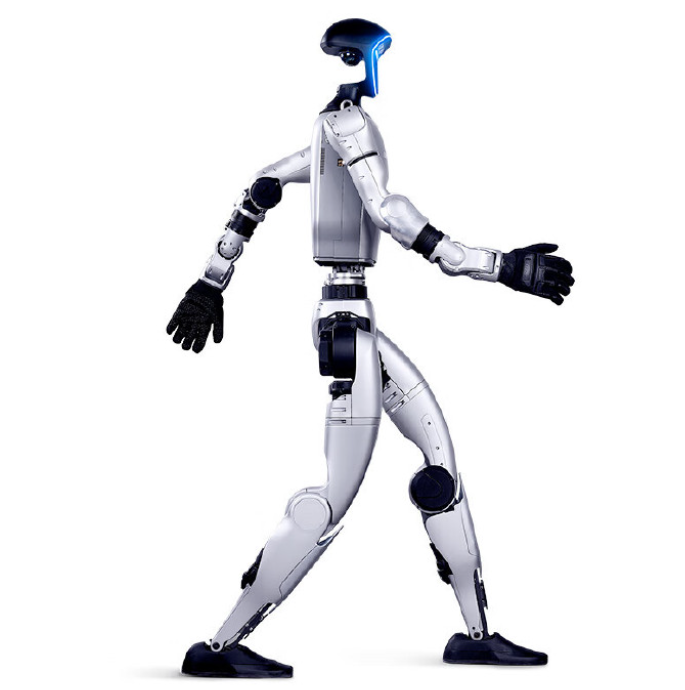
GAC Group was the only automotive company exhibiting at the conference. Unlike approaches based on equity investment, parts supply or partnership, GAC chose to enter the field itself. Its third-generation embodied intelligence humanoid robot, GoMate, adopts a variable wheel-legged structure that can switch between two-wheeled and four-wheeled modes and possesses all-terrain mobility. Another product, an intelligent electric wheelchair, can carry a person up and down stairs, with a maximum load of 90 kilograms.
Humanoid robots and the automotive industry both belong to the category of high-end precision manufacturing, and the two share highly similar core technologies in materials, processes, transmission systems and precision machining. Vehicle and component enterprises have long cultivated the automotive supply chain, accumulating rich experience in high-precision manufacturing, large-scale production and cost control, and they possess mature supply chain systems. The development of technologies such as autonomous driving has turned the automobile itself into an embodied intelligence terminal, creating a synergistic effect across the two industries.
GAC’s presence on the exhibition floor is therefore more than a product announcement. It signals that the boundary between the automotive industry and the robotics industry is becoming a matter of degree rather than of kind. When a vehicle is understood as an embodied intelligence terminal, the question of who competes with whom in the next decade becomes considerably harder to answer.
- Hype, Pseudo-Demand and the Case for Long-Termism
The market for humanoid robots is expanding rapidly. Some institutions predict that by 2029 the figure will rise to 150 billion yuan. China’s performance in that market is particularly worth watching, with its share expected to climb from the current 20 percent to more than 50 percent, making the country a core growth pole for the global industry.
Over the past year or two, a large number of companies upstream and downstream in the automotive industrial chain have actively entered the embodied intelligence track. Yet under the dual drivers of capital enthusiasm and industrial expansion, a series of structural disorders have emerged within the industry, and these call for rational scrutiny and systematic correction.
The prevalence of concept speculation constitutes a primary risk. Some enterprises exploit the information asymmetry between capital markets and frontier technology, grafting marginal technology onto a robot concept and driving valuations upward through packaging and rhetoric.
The spread of pseudo-demand and technology bubbles further aggravates the “false heat” in the intelligent robotics industry. On the current market, some products marketed under the name of intelligent robots are in fact traditional electromechanical equipment with a simple intelligent retrofit. They neither solve the pain points of real scenarios nor achieve any breakthrough in efficiency.
This model of capital operation stands in fundamental conflict with the development pattern of the robotics industry. As a typically technology-intensive industry, intelligent robotics requires long-term investment in core component research and development, algorithm iteration and scenario deployment, and its technology maturity curve often spans decades. When the profit-seeking nature of capital overrides the laws of industrial development, the result is necessarily an imbalance in the industry ecosystem.
For this reason, industry figures suggest that government, enterprises and investors should work together to strengthen supervision, guide the rational flow of capital, avoid blind following and speculation, and ensure that funds flow to robot projects that genuinely possess innovative strength and market prospects.
Historical experience shows that any emerging industry inevitably passes through a phase of bubbling during its explosive period, and that market mechanisms will ultimately play a purifying role. Those market participants that survive on gimmickry and capital games will be eliminated in the wave of technological iteration and demand upgrading. To achieve the healthy development of the intelligent robotics industry, industry figures say, it is necessary to rebuild an industry ecosystem centered on value creation, with technological breakthrough as the fundamental precondition. Enterprises should focus on bottleneck fields and build independent technology systems through sustained research and development investment. Whether founders or investors, all should hold fast to the original purpose of the industry, abandon the mentality of making quick money, and participate in industrial development from a long-term perspective.
That conclusion returns the discussion to where it began: on the exhibition floor, where a robot carefully folds a shirt, pours a coffee or makes a bed. Those demonstrations are not merely entertaining. They are the visible edge of a long, expensive and deeply technical undertaking — one in which embodied intelligence moves, step by step, from a promise into a product, and from a product into an industry. The crowds in Yizhuang are a signal of appetite. Whether that appetite is met depends on how patiently the underlying work of embodied intelligence is done.