
I examine how changes in the import prices of industrial robots reshape wage gaps within firms. My central argument is that the falling import price of industrial robots is not merely a cost shock to capital equipment. It is a task-reallocating shock that changes the relative demand for routine-task labor and non-routine-task labor. When industrial robot import prices decline, firms expand automation, substitute industrial robots for routine tasks, and simultaneously scale up activities that require non-routine cognitive, managerial, technical, and commercial tasks. The result is an employment polarization between non-routine and routine positions, which in turn widens the wage gap between these two types of jobs. I develop this argument from the perspective of task-biased technological change and test it with firm-level panel data.
1. Motivation and Research Question
Industrial robot adoption has become a defining feature of contemporary manufacturing. In my framing, the key economic driver is not the absolute number of industrial robots in operation, nor the density of industrial robots per worker, but the effective user cost of industrial robot technology. In an economy where industrial robots are heavily imported, the import price of industrial robots is a direct measure of that user cost. A decline in the import price of industrial robots makes automation economically feasible for a wider set of firms and tasks. It therefore provides a cleaner exogenous shift than observed robot density, because robot density is jointly determined with wages, employment, and firm performance.
My research question is therefore: how does a decline in the import price of industrial robots affect the wage gap between non-routine-task positions and routine-task positions within firms? I further ask whether this effect operates through employment polarization, and whether the effect differs by industrial robot type, region, industry, ownership, and position in the wage-gap distribution.
The task-biased technological change framework provides the natural lens. Routine tasks are codifiable, repetitive, and procedurally programmable. They can be automated by industrial robots. Non-routine tasks require judgment, adaptation, creativity, interpersonal communication, and complex problem solving. Industrial robots complement rather than replace these tasks. When industrial robot import prices fall, firms substitute industrial robots for routine labor and expand the scale of production and related non-routine activities. The relative demand for non-routine labor rises, while the relative demand for routine labor falls. This demand asymmetry is the core mechanism behind the widening wage gap.
I organize the empirical analysis around three propositions. First, a lower industrial robot import price increases firm-level industrial robot application. Second, a lower industrial robot import price widens the wage gap between non-routine and routine positions. Third, this widening occurs through employment polarization: non-routine employment rises and routine employment falls. I then extend the analysis to heterogeneous effects and quantile effects.
2. Stylized Facts and Conceptual Framing
The empirical context is one of rapid industrial robot diffusion and declining global industrial robot prices. The stock and installation of industrial robots have grown substantially, and imported industrial robots account for a large share of new installations. Because domestic production of industrial robots remains concentrated in lower-end segments and many core components are imported, the import price of industrial robots strongly influences the domestic cost of industrial robot adoption. This makes the import price of industrial robots a meaningful shift variable for automation.
Table 1 summarizes the stylized facts that motivate my analysis.
| Dimension | Pattern | Implication for industrial robot adoption | Expected wage-gap effect |
|---|---|---|---|
| Industrial robot import dependence | Imported industrial robots account for a dominant share of new installations | Import price of industrial robots is a primary determinant of user cost | Lower import price expands industrial robot use |
| Global industrial robot prices | Average industrial robot prices have declined over time | Automation becomes viable for more firms and tasks | Routine labor demand falls; non-routine labor demand rises |
| Task content of production | Routine tasks are programmable; non-routine tasks are complementary to automation | Industrial robots substitute for routine tasks and complement non-routine tasks | Relative wage of non-routine positions increases |
| Firm-level heterogeneity | Industrial robot use varies by region, industry, ownership, and robot type | Exposure to import price shocks differs across firms | Wage-gap widening is uneven |
The conceptual chain is straightforward. A decline in the import price of industrial robots lowers the marginal cost of automating routine tasks. Firms respond by adopting more industrial robots. The substitution effect reduces routine-task employment and routine-task wages. At the same time, the scale effect and the complementarity between industrial robots and non-routine tasks increase the demand for non-routine labor. The relative wage of non-routine positions rises. The within-firm wage gap therefore widens.
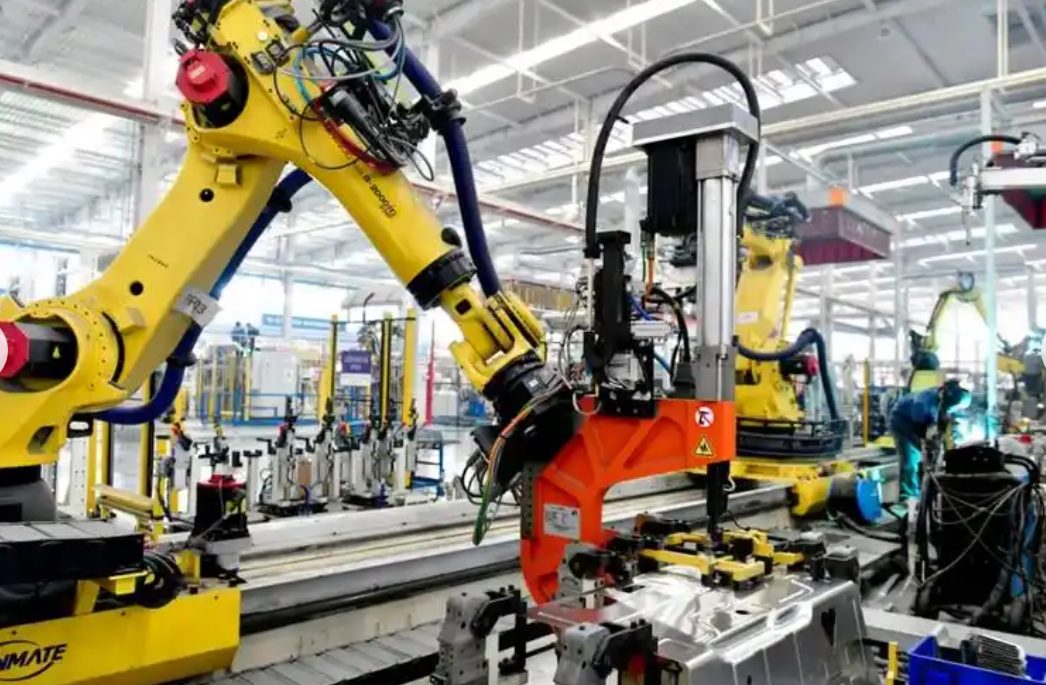
I use the term “industrial robot” throughout in a broad sense: it includes multi-functional industrial robots, handling industrial robots, welding industrial robots, and painting industrial robots. Each type has a different task footprint. Multi-functional industrial robots are especially relevant because they can perform a wider range of programmable operations and therefore have a stronger substitution effect on routine tasks and a stronger complementary effect on non-routine coordination and technical tasks.
3. Theoretical Model
I extend the canonical task-biased technological change model to allow industrial robot import prices to determine industrial robot use. The production function depends on industrial robot capital, routine-task labor, and non-routine-task labor. Let \(R\) denote industrial robot capital, \(C\) denote routine-task labor, and \(N\) denote non-routine-task labor. The firm produces output \(Y\) according to a nested constant-elasticity-of-substitution technology:
$$Y = \left[ (\alpha_1 R)^{\theta} + (\alpha_2 C)^{\theta} \right]^{\frac{\beta}{\theta}} N^{1-\beta},$$
where \(\alpha_1 \gt 0\), \(\alpha_2 \gt 0\), \(\beta \in (0,1)\), and \(\theta \in (0,1)\). The parameter \(\theta\) governs the substitutability between industrial robots and routine-task labor. The elasticity of substitution between industrial robots and routine tasks is \(1/(1-\theta)\), which is greater than one. Industrial robots and non-routine-task labor are assumed to have an elasticity of substitution equal to one, meaning that they are relatively complementary. This captures the idea that industrial robots replace routine work but require and generate non-routine work in management, engineering, maintenance, logistics coordination, sales, and research.
I normalize the output price to one. Profit maximization gives the inverse demand for industrial robots and the wage equations for routine and non-routine labor:
$$P = \frac{\partial Y}{\partial R} = \beta \alpha_1^{\theta} \left[ (\alpha_1 R)^{\theta} + (\alpha_2 C)^{\theta} \right]^{\frac{\beta}{\theta}-1} R^{\theta-1} N^{1-\beta},$$
$$W_C = \frac{\partial Y}{\partial C} = \beta \alpha_2^{\theta} \left[ (\alpha_1 R)^{\theta} + (\alpha_2 C)^{\theta} \right]^{\frac{\beta}{\theta}-1} C^{\theta-1} N^{1-\beta},$$
$$W_N = \frac{\partial Y}{\partial N} = (1-\beta) \left[ (\alpha_1 R)^{\theta} + (\alpha_2 C)^{\theta} \right]^{\frac{\beta}{\theta}} N^{-\beta}.$$
Here \(P\) is the price of industrial robots, which I interpret as the import price of industrial robots. \(W_C\) is the wage of routine-task positions, and \(W_N\) is the wage of non-routine-task positions. Dividing the non-routine wage by the routine wage and taking logs yields the relative wage equation:
$$\ln\left(\frac{W_N}{W_C}\right) = \ln(1-\beta) – \ln\beta + \ln\left[ (\alpha_1 R)^{\theta} + (\alpha_2 C)^{\theta} \right] – \theta \ln\alpha_2 – (\theta-1)\ln C – \ln N.$$
Differentiating this expression with respect to industrial robot capital \(R\) gives:
$$\frac{\partial \ln\left(\frac{W_N}{W_C}\right)}{\partial R} = \frac{\theta \alpha_1^{\theta} R^{\theta-1}}{\alpha_1^{\theta} R^{\theta} + \alpha_2^{\theta} C^{\theta}} \gt 0.$$
Because \(\theta \in (0,1)\), \(\alpha_1 \gt 0\), \(\alpha_2 \gt 0\), and \(R, C \gt 0\), the derivative is positive. This means that greater industrial robot use raises the relative wage of non-routine tasks and widens the wage gap between non-routine and routine positions.
To connect this result to the import price of industrial robots, I combine the profit-maximization conditions for \(P\) and \(W_C\):
$$R = P^{\frac{1}{\theta-1}} \left( \frac{\alpha_2^{\theta} C^{\theta-1}}{\alpha_1^{\theta} W_C} \right)^{\frac{1}{\theta-1}}.$$
Differentiating \(R\) with respect to \(P\), I obtain:
$$\frac{\partial R}{\partial P} = \frac{1}{\theta-1} P^{\frac{1}{\theta-1}-1} \left( \frac{\alpha_2^{\theta} C^{\theta-1}}{\alpha_1^{\theta} W_C} \right)^{\frac{1}{\theta-1}} \lt 0.$$
Since \(\theta \in (0,1)\), the derivative is negative. A lower import price of industrial robots increases industrial robot capital. Combining this with the positive derivative of the relative non-routine wage with respect to \(R\), I obtain:
$$\frac{\partial \ln\left(\frac{W_N}{W_C}\right)}{\partial P} \lt 0.$$
Therefore, a decline in the import price of industrial robots widens the wage gap between non-routine and routine positions.
I also examine the employment composition. From the profit-maximization conditions, the ratio of non-routine employment to routine employment can be written as:
$$\frac{N}{C} = \frac{1-\beta}{\beta} \cdot \frac{\alpha_1^{\theta} R^{\theta} + \alpha_2^{\theta} C^{\theta}}{\alpha_2^{\theta} C^{\theta}} \cdot \frac{W_C}{W_N}.$$
Differentiating with respect to \(R\) yields:
$$\frac{\partial (N/C)}{\partial R} = \frac{1-\beta}{\beta} \frac{\theta \alpha_1^{\theta}}{\alpha_2^{\theta} C^{\theta}} \frac{W_C}{W_N} R^{\theta-1} \gt 0.$$
Because \(\partial R / \partial P \lt 0\), it follows that \(\partial (N/C) / \partial P \lt 0\). A lower import price of industrial robots raises the ratio of non-routine to routine employment. This is employment polarization. The change in relative employment demand is the mechanism through which the import price of industrial robots affects the wage gap.
Table 2 summarizes the theoretical predictions.
| Prediction | Mathematical expression | Economic interpretation |
|---|---|---|
| Lower industrial robot import price raises industrial robot use | \(\partial R / \partial P \lt 0\) | Automation becomes cheaper and more attractive |
| Greater industrial robot use raises the relative non-routine wage | \(\partial \ln(W_N/W_C) / \partial R \gt 0\) | Industrial robots complement non-routine tasks |
| Lower industrial robot import price widens the wage gap | \(\partial \ln(W_N/W_C) / \partial P \lt 0\) | Relative demand shifts toward non-routine labor |
| Lower industrial robot import price polarizes employment | \(\partial (N/C) / \partial P \lt 0\) | Non-routine employment rises relative to routine employment |
I therefore formulate the first hypothesis: a decline in the import price of industrial robots widens the wage gap between non-routine-task positions and routine-task positions within firms. I formulate the second hypothesis: this effect operates through employment polarization, namely an increase in non-routine employment and a decrease in routine employment.
4. Empirical Strategy
I estimate a firm-level panel model. The first equation links the import price of industrial robots to firm-level industrial robot application. The second equation links the import price of industrial robots to the firm-level wage gap between non-routine and routine positions. The baseline specifications are:
$$\ln Inrobot_{ijt} = \alpha_0 + \beta_1 \ln Riprice_{jt} + \beta_2 Z_{ijt} + \theta_i + \lambda_j + \phi_t + \varepsilon_{ijt},$$
$$Wage\_gini_{ijt} = \alpha_3 + \beta_3 \ln Riprice_{jt} + \beta_4 Z_{ijt} + \theta_i + \lambda_j + \phi_t + \varepsilon_{ijt},$$
where \(i\) indexes firms, \(j\) indexes provinces, and \(t\) indexes years. \(\ln Inrobot_{ijt}\) is the firm’s industrial robot application. \(Wage\_gini_{ijt}\) is the wage gap between non-routine and routine positions. \(\ln Riprice_{jt}\) is the log of the province-level weighted import price of industrial robots. \(Z_{ijt}\) is a vector of firm-level and province-level controls. \(\theta_i\), \(\lambda_j\), and \(\phi_t\) are firm, province, and year fixed effects. I cluster standard errors at the province level.
The key identification argument is that the import price of industrial robots is largely driven by global technological progress and supply-side conditions in the industrial robot market. Individual firms in a province are unlikely to materially affect the global import price of industrial robots. This reduces reverse causality from the firm wage gap to the import price of industrial robots. I nevertheless supplement the baseline with robustness checks, lagged specifications, alternative measures, and instrumental-variable estimation.
I measure the province-level import price of industrial robots using a weighted average of unit values across industrial robot types:
$$Riprice_{jt} = \frac{\sum_s (P_{jst} \times W_{jst})}{\sum_s W_{jst}},$$
where \(P_{jst}\) is the unit import price of industrial robot type \(s\) in province \(j\) in year \(t\), and \(W_{jst}\) is the corresponding import quantity. This weighting scheme accounts for composition differences across industrial robot types. I take the natural logarithm in the regressions.
I measure firm-level industrial robot application using the frequency of industrial robot-related terms in firm annual reports, taking the inverse hyperbolic sine or logarithmic transformation. I also construct an alternative measure based on industrial robot penetration to check robustness. The wage gap measure follows the task-based wage-gap literature. I classify non-routine positions as management, professional, technical, and sales positions, and routine positions as production, logistics, and similar positions. I then estimate the firm-level wage gap from average wages, the share of non-routine employment, and firm profitability.
Table 3 reports variable definitions and expected signs.
| Variable | Definition | Expected sign in wage-gap equation | Role |
|---|---|---|---|
| \(\ln Riprice\) | Log weighted import price of industrial robots | Negative | Core explanatory variable |
| \(Wage\_gini\) | Wage gap between non-routine and routine positions | Dependent variable | Outcome |
| \(\ln Inrobot\) | Firm-level industrial robot application | Negative in the first stage | Intermediate outcome |
| Size | Log fixed assets | Positive | Control |
| ROE | Return on equity | Positive | Control |
| Debt | Total liabilities over total assets | Ambiguous | Control |
| \(\ln KL\) | Log capital-labor ratio | Positive | Control |
| Competition | Herfindahl-Hirschman index | Ambiguous | Control |
| Industry | Secondary industry share | Ambiguous | Province control |
| Open | Trade volume over GDP | Ambiguous | Province control |
| \(L\_wage\) | Log minimum wage | Negative | Province control |
| \(\ln PGDP\) | Log GDP per capita | Ambiguous | Province control |
5. Data and Measurement
I use a firm-level panel covering listed firms over the period 2015 to 2023. The sample is constructed from annual reports, financial databases, and customs records. I exclude firms with fewer than twenty employees on average, firms under special treatment or delisting risk, financial and service firms, and observations with severe missing data. I winsorize continuous variables. The final sample contains 23,220 firm-year observations.
The import price of industrial robots comes from customs records that report product names, product codes, destination province, import quantity, and import value. I identify industrial robots using the harmonized system product codes and the definition of industrial robots. I compute unit values and then construct the weighted average import price of industrial robots at the province-year level. I also separate industrial robot types for heterogeneity analysis: multi-functional industrial robots, handling industrial robots, welding industrial robots, and painting industrial robots.
I measure the wage gap between non-routine and routine positions using a task-based decomposition. Let \(w^N_{iht}\) be the non-routine wage in firm \(i\), industry \(h\), and year \(t\), and let \(w^C_{iht}\) be the routine wage. I model each as the sum of an industry average and a firm-specific residual:
$$w^N_{iht} = w^N_{ht} + \varepsilon^N_{iht},$$
$$w^C_{iht} = w^C_{ht} + \varepsilon^C_{iht}.$$
The firm wage gap is:
$$Wage\_gini_{iht} = w^N_{iht} – w^C_{iht} = (w^N_{ht} – w^C_{ht}) + (\varepsilon^N_{iht} – \varepsilon^C_{iht}).$$
Let \(\delta_{ht} = w^N_{ht} – w^C_{ht}\) be the industry task wage gap. Because wage residuals depend on firm profitability, I write:
$$\varepsilon^N_{iht} – \varepsilon^C_{iht} = \beta_{ht} \pi_{iht},$$
where \(\pi_{iht}\) is firm profitability. The firm wage gap becomes:
$$Wage\_gini_{iht} = \delta_{ht} + \beta_{ht} \pi_{iht}.$$
Using the firm average wage \(\bar{w}_{iht}\) and the share of non-routine employment \(\theta_{iht}\), I estimate:
$$\bar{w}_{iht} = w^C_{ht} + \delta_{ht} \theta_{iht} + \beta_{ht} \theta_{iht} \pi_{iht} + \varepsilon^C_{iht}.$$
This yields estimates \(\hat{\delta}_{ht}\) and \(\hat{\beta}_{ht}\), which I use to construct \(Wage\_gini_{iht}\). I also verify that the constructed wage gap moves with broader income inequality over time, which supports the validity of the measure.
Table 4 summarizes the data structure and measurement approach.
| Block | Source | Level | Key variable | Use |
|---|---|---|---|---|
| Industrial robot imports | Customs records | Province-year-type | Unit value and quantity | Weighted import price of industrial robots |
| Firm financials | Annual reports and financial databases | Firm-year | Assets, liabilities, profits, employees | Controls and wage-gap construction |
| Employment tasks | Annual report disclosures | Firm-year | Non-routine and routine employment | Employment polarization mechanism |
| Industrial robot application | Annual report text | Firm-year | Industrial robot term frequency | Intermediate outcome |
| Regional controls | Statistical yearbooks | Province-year | GDP, trade, industry structure, minimum wage | Confounders |
6. Baseline Results
I first estimate the effect of the import price of industrial robots on firm-level industrial robot application. The coefficient on \(\ln Riprice\) is negative and statistically significant across specifications. This confirms the theoretical prediction that a lower import price of industrial robots increases industrial robot use. The result is robust to the inclusion of firm, province, and year fixed effects and to the full set of controls.
I then estimate the effect of the import price of industrial robots on the wage gap between non-routine and routine positions. The coefficient on \(\ln Riprice\) is negative and statistically significant. In the preferred specification, the coefficient is approximately \(-0.289\). This implies that a one percent decline in the import price of industrial robots is associated with an increase in the firm wage gap of about 0.00289 units. The magnitude is economically meaningful because it accumulates over time and across firms with different exposure to industrial robot import prices.
Table 5 presents the baseline pattern in a compact form.
| Specification | Dependent variable | Coefficient on \(\ln Riprice\) | Fixed effects | Interpretation |
|---|---|---|---|---|
| First stage | \(\ln Inrobot\) | Negative | Firm, province, year | Lower industrial robot import price raises industrial robot use |
| Baseline | \(Wage\_gini\) | \(-0.289\) | Firm, province, year | Lower industrial robot import price widens the wage gap |
| No controls | \(Wage\_gini\) | Negative | Firm, province, year | Result is not driven by controls |
| Full controls | \(Wage\_gini\) | Negative | Firm, province, year | Result is robust |
The baseline results support the first hypothesis. A decline in the import price of industrial robots widens the wage gap between non-routine-task and routine-task positions. This is consistent with the task-biased technological change mechanism: industrial robots substitute for routine tasks and complement non-routine tasks, shifting relative labor demand and relative wages.
7. Robustness Checks
I conduct a series of robustness checks. First, I replace the dependent variable. I use the ratio of average wages of research and technical personnel to average wages of ordinary employees as an alternative measure of the non-routine versus routine wage gap. I also use a macro-level measure of the task wage gap constructed from worker survey data. In both cases, the coefficient on the import price of industrial robots remains negative and significant.
Second, I replace the core explanatory variable. I construct a leave-one-out price measure using the average import price of industrial robots in other provinces, excluding the firm’s own province. This reduces the concern that local demand conditions simultaneously affect the import price of industrial robots and the wage gap. The negative effect remains.
Third, I exclude the COVID-19 period. The pandemic affected production, employment structure, and wages. I re-estimate the model after dropping the pandemic years. The coefficient on the import price of industrial robots remains negative and significant.
Fourth, I include industry fixed effects in addition to firm, province, and year fixed effects. This controls for industry-specific trends in automation and wage setting. The result is unchanged.
Fifth, I lag the core explanatory variable and controls by one year. This addresses potential reverse causality and allows for delayed effects of industrial robot import prices. The lagged coefficient is negative and significant.
Sixth, I conduct an exclusivity check. I restrict the sample to 2015–2018, when the share of imported industrial robots was particularly high, to reduce the influence of domestic industrial robot prices. I also control for province-level industrial robot export quantity and export value to proxy for the local industrial robot industry base. The negative effect remains.
Seventh, I use wild cluster bootstrap to correct for the small number of province clusters. The coefficient remains \(-0.289\), and the bootstrapped p-value is 0.044. This indicates that the baseline inference is not driven by few-cluster bias.
Table 6 summarizes the robustness checks.
| Check | Modification | Key result | Conclusion |
|---|---|---|---|
| Alternative dependent variable | Research/technical wage ratio; survey-based task gap | Negative and significant | Robust |
| Alternative explanatory variable | Leave-one-out import price of industrial robots | Negative and significant | Robust |
| Pandemic exclusion | Drop 2020–2022 | Negative and significant | Robust |
| Industry fixed effects | Add industry fixed effects | Negative and significant | Robust |
| Lagged specification | Lag core variable and controls | Negative and significant | Robust |
| Domestic price control | Restrict to high-import period; control robot exports | Negative and significant | Robust |
| Wild cluster bootstrap | Bootstrap standard errors | \(p = 0.044\) | Robust |
8. Endogeneity and Sensitivity
I address endogeneity in two ways. First, I perform a sensitivity analysis for omitted variables. I assess how strong an unobserved confounder would need to be to overturn the baseline result. I use firm-level, industry-level, and province-level controls as reference variables. The sensitivity analysis suggests that omitted variable bias is unlikely to explain away the negative effect of the import price of industrial robots on the wage gap.
Second, I construct an instrumental variable following a Bartik-style logic. The instrument combines initial province-level exposure to imported industrial robots with the global growth rate of industrial robot prices. After controlling for province and year fixed effects, the instrument is plausibly uncorrelated with the firm-level wage gap except through the import price of industrial robots. The two-stage least squares estimate remains negative and significant.
The instrumental-variable strategy reinforces the interpretation that the import price of industrial robots is a supply-driven shock. Global technological progress in industrial robot production lowers the import price of industrial robots, which increases industrial robot use, which in turn widens the task wage gap. This is the causal chain I seek to identify.
9. Mechanism: Employment Polarization
I now test the mechanism. The theoretical model predicts that a lower import price of industrial robots raises the ratio of non-routine to routine employment. I measure this ratio using the number of non-routine employees divided by the number of routine employees. Non-routine employees include management, professional, technical, and sales personnel. Routine employees include production and logistics personnel.
I estimate the effect of the import price of industrial robots on the employment ratio. The coefficient on \(\ln Riprice\) is negative and significant. This means that a lower import price of industrial robots increases the relative employment of non-routine positions. I also replace the ratio with the share of non-routine employment in total employment. The coefficient remains negative and significant. Both results support the employment polarization mechanism.
I further decompose employment by task category. I examine production employees, logistics employees, technical employees, sales employees, and managerial employees. The results show that a lower import price of industrial robots significantly reduces production and logistics employment, which are routine-task positions. It significantly increases technical, sales, and managerial employment, which are non-routine-task positions. This pattern is exactly what the task-biased technological change framework predicts.
Table 7 reports the mechanism results in summary form.
| Mechanism variable | Definition | Effect of lower industrial robot import price | Interpretation |
|---|---|---|---|
| \(Rate\_NC\) | Non-routine employment divided by routine employment | Increase | Employment polarization |
| \(Rate\_N\) | Non-routine employment share | Increase | Relative demand shift |
| Production employment | Routine task employment | Decrease | Industrial robot substitution |
| Logistics employment | Routine task employment | Decrease | Industrial robot substitution |
| Technical employment | Non-routine task employment | Increase | Complementarity with industrial robots |
| Sales employment | Non-routine task employment | Increase | Scale and market expansion |
| Managerial employment | Non-routine task employment | Increase | Coordination and organizational complementarity |
These results validate the second hypothesis. The import price of industrial robots affects the wage gap through employment polarization. A lower import price of industrial robots raises non-routine employment and reduces routine employment. The relative scarcity of routine labor does not offset the substitution effect, because industrial robots directly replace routine tasks. Meanwhile, the rising demand for non-routine labor raises the relative wage of non-routine positions. The wage gap widens.
10. Heterogeneity Analysis
I examine heterogeneity along four dimensions: industrial robot type, region, industry, and ownership. I also examine heterogeneity across the wage-gap distribution.
Industrial robot type. I separate the import price of industrial robots into multi-functional, handling, welding, and painting industrial robots. The results show that the import price of multi-functional industrial robots has the strongest effect on the wage gap. Multi-functional industrial robots can perform a wider range of programmable tasks and are more likely to substitute for routine tasks while complementing non-routine coordination and technical tasks. The import prices of more specialized industrial robots have weaker effects.
Region. I divide provinces into coastal and inland regions. The wage-gap widening effect of lower industrial robot import prices is stronger in coastal regions. Coastal regions have more developed industrial clusters, better infrastructure, larger markets, and a higher baseline capacity for industrial robot adoption. When the import price of industrial robots falls, coastal firms can adopt industrial robots more rapidly and reorganize tasks more deeply.
Industry. I divide industries into labor-intensive and capital-technology-intensive industries. The effect is stronger in labor-intensive industries. These industries initially employ more routine-task workers. A decline in the import price of industrial robots makes substitution economically attractive and creates a larger shift in relative labor demand. The wage gap therefore widens more in labor-intensive industries.
Ownership. I divide firms into state-owned and non-state-owned enterprises. The effect is stronger in non-state-owned enterprises. Non-state-owned firms are more profit-oriented and adjust employment and pay more flexibly in response to changes in the relative price of industrial robots. State-owned firms may place greater weight on wage equity and social responsibility, which dampens the wage-gap effect.
Table 8 summarizes the heterogeneity results.
| Dimension | Group | Relative strength of wage-gap widening | Interpretation |
|---|---|---|---|
| Industrial robot type | Multi-functional industrial robots | Strongest | Broad task substitution and complementarity |
| Industrial robot type | Handling, welding, painting industrial robots | Weaker | Narrower task footprint |
| Region | Coastal | Stronger | Better industrial robot adoption capacity |
| Region | Inland | Weaker | Lower adoption capacity and industrial structure |
| Industry | Labor-intensive | Stronger | More routine-task employment exposed to industrial robots |
| Industry | Capital-technology-intensive | Weaker | More non-routine tasks already |
| Ownership | Non-state-owned | Stronger | More flexible wage and employment adjustment |
| Ownership | State-owned | Weaker | Wage equity and social responsibility |
11. Further Analysis: Quantile Effects
I further examine whether the effect of the import price of industrial robots differs across the wage-gap distribution. I use quantile regression and estimate effects at the 25th, 50th, and 75th percentiles.
The effect is not significant at the 25th percentile. It is negative and significant at the 50th and 75th percentiles. This suggests that firms with low wage gaps have less clearly separated task structures. When routine and non-routine tasks are not sharply differentiated, the employment polarization mechanism is weaker. In contrast, firms with medium and high wage gaps have more clearly defined task categories. A decline in the import price of industrial robots triggers substitution away from routine tasks and expansion of non-routine tasks, which widens the wage gap further.
Table 9 reports the quantile pattern.
| Quantile | Effect of \(\ln Riprice\) on \(Wage\_gini\) | Significance | Interpretation |
|---|---|---|---|
| 25th percentile | Small and insignificant | No | Task boundaries are blurred |
| 50th percentile | Negative | Yes | Task polarization mechanism operates |
| 75th percentile | Negative | Yes | Task polarization mechanism is strong |
12. Policy Implications
My findings have several policy implications. First, because a lower import price of industrial robots widens the wage gap between non-routine and routine positions, policymakers should monitor the distributional consequences of automation cost declines. The import price of industrial robots may continue to fall as global technology advances and production scales up. The wage-gap effect may therefore intensify. Anticipatory policy is needed.
Second, firms should develop fair mechanisms for sharing automation gains. Collective bargaining can include provisions for performance bonuses or profit-sharing for routine-task employees. If industrial robots raise productivity, part of the gain can be directed to workers whose tasks are substituted. This can moderate the wage-gap effect without slowing industrial robot adoption.
Third, minimum wage policy should be adjusted dynamically. Minimum wages should reflect local economic conditions, price changes, labor market conditions, and the pace of industrial robot adoption. Appropriate minimum wage increases can protect the basic income of routine-task workers and narrow the base wage gap caused by automation.
Fourth, training and reskilling policies are essential. Routine-task workers whose jobs are vulnerable to industrial robot substitution need access to digital, intelligent, and human-machine collaboration skills. Tax incentives and subsidies can encourage firms to provide training and internal transfers. Vocational and higher education systems should expand programs in smart manufacturing, industrial internet, and related fields, while reducing enrollment in programs that are highly exposed to automation.
Fifth, public employment services should strengthen reemployment support for displaced routine-task workers. Governments can build retraining platforms with universities and research institutes, offering non-routine task skills to production and logistics workers. This reduces structural unemployment and prevents employment polarization from translating into persistent wage inequality.
Sixth, policy should focus on the groups where the effect is strongest. My heterogeneity results show stronger effects for multi-functional industrial robots, coastal regions, labor-intensive industries, and non-state-owned firms. Policy design should therefore pay special attention to these contexts. For firms with medium and high wage gaps, productivity support for industrial robot adoption can be paired with compensation and wage-regulation mechanisms that direct a share of technological gains to routine-task workers.
Table 10 maps the policy implications to the empirical findings.
| Empirical finding | Policy domain | Policy instrument | Expected effect |
|---|---|---|---|
| Lower industrial robot import price widens the wage gap | Distribution | Monitor automation cost shocks | Anticipate inequality pressure |
| Employment polarization is the mechanism | Labor market | Training and reskilling | Facilitate task transitions |
| Routine employment falls | Social protection | Minimum wage adjustment | Protect basic income |
| Non-routine employment rises | Education | Expand smart manufacturing programs | Match skill demand |
| Multi-functional industrial robots matter most | Technology policy | Targeted adjustment support | Manage broad task substitution |
| Coastal, labor-intensive, non-state-owned firms are more affected | Regional and industrial policy | Targeted wage-gap monitoring | Prevent widening inequality |
| Medium and high wage-gap firms are more affected | Corporate governance | Profit-sharing and wage regulation | Share automation gains |
13. Conclusion
I study how changes in the import price of industrial robots affect the wage gap between non-routine-task and routine-task positions within firms. I develop a task-biased technological change model in which industrial robots substitute for routine tasks and complement non-routine tasks. The model predicts that a lower import price of industrial robots increases industrial robot use, raises the relative demand for non-routine labor, reduces the relative demand for routine labor, and widens the wage gap.
Using firm-level panel data, I find strong support for these predictions. A lower import price of industrial robots significantly increases firm-level industrial robot application and significantly widens the task wage gap. The mechanism is employment polarization: non-routine employment rises, routine employment falls, and the ratio of non-routine to routine employment increases. The effect is stronger for multi-functional industrial robots, coastal regions, labor-intensive industries, and non-state-owned firms. It is also stronger at the middle and upper parts of the wage-gap distribution.
My analysis contributes to the understanding of industrial robot adoption and wage inequality. The import price of industrial robots is a supply-side cost shifter that changes the economics of automation. It is not simply a proxy for industrial robot use. It directly determines whether industrial robot technology is economically viable for a given task. By focusing on the import price of industrial robots, I open the black box between industrial robot technology and labor market outcomes.
The broader implication is that the diffusion of industrial robots can improve productivity while simultaneously widening within-firm wage gaps. Policy should not aim to stop industrial robot adoption. Instead, it should manage the distributional consequences. By combining fair wage-setting, minimum wage adjustment, training, and reemployment support, policymakers can promote automation upgrading while moderating the wage-gap effects of industrial robot import price declines.
Future research can extend this framework in several directions. One direction is to link the import price of industrial robots to worker-level longitudinal data, which would allow direct observation of task transitions and wage changes. Another direction is to examine how industrial robot adoption interacts with other technologies, such as artificial intelligence and digital platforms. A third direction is to study how trade policy and global supply chain shocks affect the import price of industrial robots and, through that channel, the task wage gap. These extensions would further clarify how industrial robot technology reshapes labor markets and income distribution.