
As I observe the current landscape of technology, I am struck by the rapid proliferation of competitive events featuring AI robots. These gatherings, ranging from marathons to combat tournaments, are not merely spectacles for entertainment but represent a profound shift in how we develop, test, and integrate intelligent machines into society. From my perspective, this trend is driven by a confluence of technological advancement, industrial growth, and capital investment, all converging to push the boundaries of what AI robots can achieve. In this article, I will delve into the multifaceted reasons behind the frequent participation of AI robots in such events, exploring how these competitions serve as catalysts for innovation, market expansion, and financial support, while also acknowledging the challenges that lie ahead. Through detailed analysis, including formulas and tables, I aim to provide a comprehensive understanding of this phenomenon, emphasizing the critical role of AI robots in shaping our future.
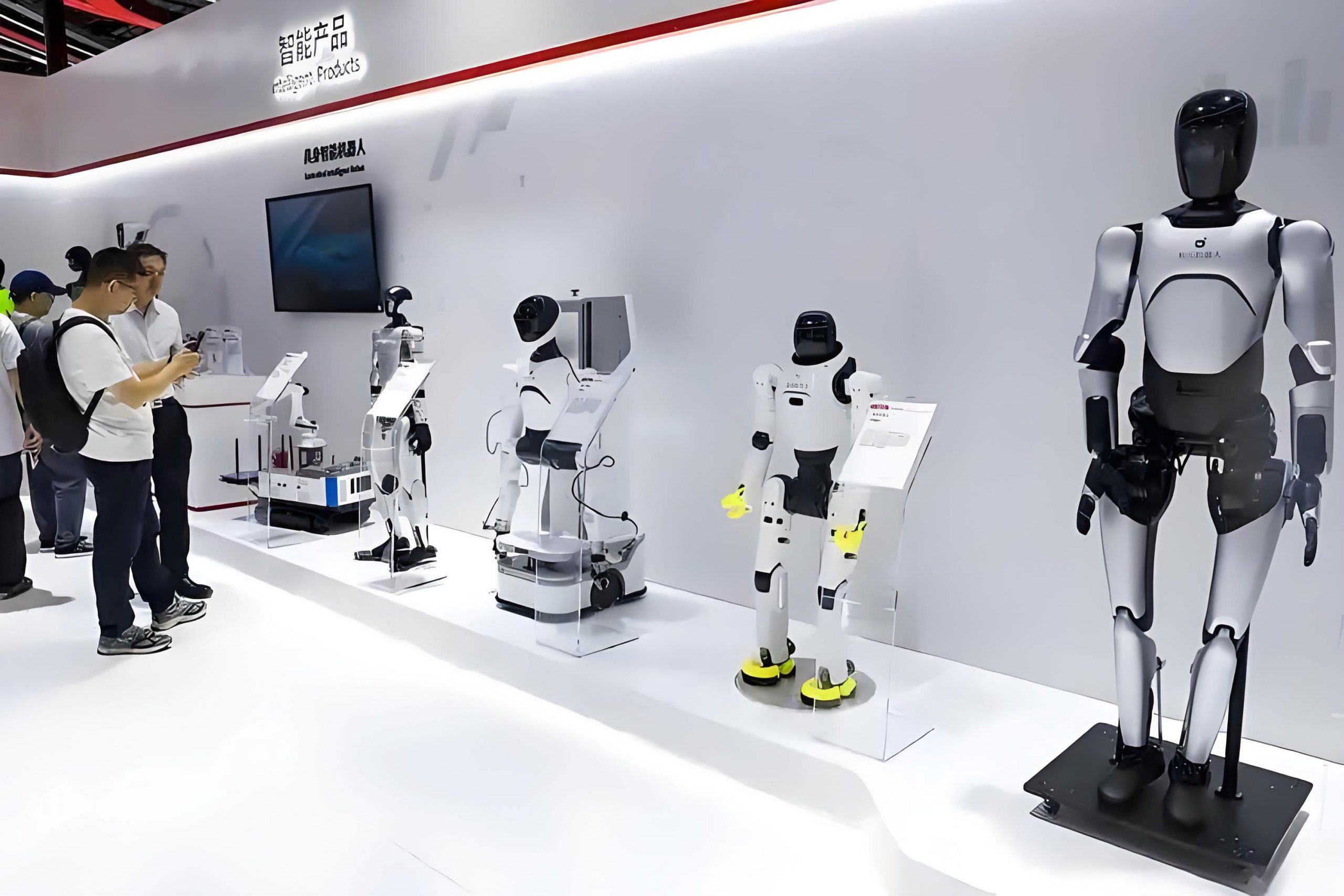
From a technical standpoint, I believe that AI robot competitions are essential for rigorous testing and iterative improvement. Take, for instance, a half-marathon event for humanoid AI robots covering 21 kilometers. This distance, fraught with obstacles like uneven terrain, sharp turns, and steep inclines, demands approximately 250,000 precise joint movements from each AI robot. Such an environment subjects the AI robot to extreme tests of its adaptive capabilities, motion control accuracy, endurance, and resistance to communication interference. The performance metrics, such as running speed, obstacle avoidance agility, and battery swap efficiency, offer tangible indicators of an AI robot’s maturity. For example, when an AI robot stumbles and recovers during a race, it might seem like a failure, but in reality, it exposes weaknesses in the motion control algorithms when dealing with complex landscapes, providing clear directions for enhancement. This process mirrors the early days of automobile development; back in 1894, French car races saw vehicles that were less stable and slower than horse-drawn carriages, yet those competitions spurred continuous technological progress. Similarly, today’s AI robot events foster iterative upgrades through trial and error, enabling AI robots to evolve from hesitant steps to confident strides.
To quantify the technical challenges, consider the following formula for motion control in an AI robot: $$ \tau = J^T F + M(\theta)\ddot{\theta} + C(\theta, \dot{\theta}) + G(\theta) $$ where \(\tau\) represents the joint torques, \(J\) is the Jacobian matrix, \(F\) is the external force, \(M\) is the mass matrix, \(\theta\) denotes joint angles, \(\dot{\theta}\) and \(\ddot{\theta}\) are velocity and acceleration, \(C\) accounts for Coriolis and centrifugal forces, and \(G\) represents gravitational effects. This equation highlights the complexity of ensuring stable movement for an AI robot in dynamic environments. Additionally, the energy efficiency of an AI robot can be modeled as: $$ E_{\text{total}} = \sum_{i=1}^{n} P_i \cdot t_i + E_{\text{idle}} $$ where \(E_{\text{total}}\) is the total energy consumption, \(P_i\) is the power for each joint motor, \(t_i\) is the time active, and \(E_{\text{idle}}\) accounts for standby energy. Such formulas underscore the need for optimized design in AI robots to enhance performance during competitions.
| Event Type | Key Challenges for AI Robot | Typical Metrics Measured | Improvement Areas for AI Robot |
|---|---|---|---|
| Marathon (21 km) | Terrain adaptation, battery life | Speed (m/s), completion time | Joint precision, energy management |
| Combat Tournament | Balance, impact resistance | Stability algorithms, material durability | |
| Soccer Match | Team coordination, object tracking | Goal success rate, pass accuracy | AI decision-making, sensor integration |
In terms of industrial impact, I see that frequent AI robot competitions generate significant positive effects. On one hand, these events attract widespread attention, elevating public awareness and acceptance of AI robots. This, in turn, lays the groundwork for future integration of AI robots into households and workplaces. By demonstrating skills like running, fighting, or playing soccer, AI robots break free from the sci-fi stereotypes and showcase their practical value in real-world scenarios. On the other hand, participating companies reap tangible benefits. For instance, after a recent marathon, the runner-up firm saw its AI robot model attract nearly 40,000 views on an online auction platform, eventually selling at a premium. Within a month, pre-orders for that AI robot exceeded 1,000 units. Another company, which placed third, secured capital investment and signed onto a major embodied AI project. These examples illustrate how competitions not only boost market visibility but also foster collaborations across the supply chain, accelerating industrial growth for AI robots.
To illustrate the economic benefits, here is a table summarizing investment trends and market responses for AI robots:
| Year | Global Investment in AI Robots (USD billions) | Growth Rate (%) | Notable Market Outcomes |
|---|---|---|---|
| 2024 | 15.2 | — | Base year for comparison |
| 2025 | 22.8 | 50 | Surge in pre-orders and partnerships |
The relationship between investment and innovation in AI robots can be expressed as: $$ I = k \cdot R^2 $$ where \(I\) is the investment amount, \(k\) is a constant representing market confidence, and \(R\) denotes the rate of technological breakthroughs in AI robots. This formula suggests that as AI robots demonstrate capabilities in competitions, investment grows exponentially, fueling further advancements.
From a capital perspective, I observe that the excitement around AI robot competitions has ignited fervor in financial markets. These events allow investors to witness firsthand the potential and prospects of AI robot technology, leading to substantial capital inflows. This funding supports various stages of development, including research, production, and market expansion for AI robots. With increased financial resources, companies can ramp up R&D efforts, attract top talent, and accelerate the innovation cycle. For example, after a recent funding round, one AI robot firm achieved a valuation of $12 billion, with major players from industries like telecommunications and tech joining in. This influx of capital provides the momentum needed for AI robots to evolve from prototypes to practical solutions.
However, I must acknowledge that the path for AI robots in competitions is not without obstacles. Despite visible progress, AI robots still fall short of widespread practical application. Challenges persist in areas like autonomous decision-making in complex environments and generalizability across different tasks. For instance, an AI robot might struggle to switch efficiently between scenarios, such as from a marathon to a manipulation task, due to limitations in its AI algorithms. Moreover, the hype surrounding these events could encourage short-term speculative behaviors, where some investors chase trends without focusing on long-term technological growth. This might introduce risks, such as bubbles or misallocation of resources, that could hinder the sustainable development of AI robots.
To analyze the performance gaps, consider the formula for autonomous decision-making in an AI robot: $$ D = \int_{0}^{T} \alpha \cdot S(t) + \beta \cdot E(t) \, dt $$ where \(D\) represents the decision quality, \(S(t)\) is the sensor input over time, \(E(t)\) denotes environmental factors, and \(\alpha\) and \(\beta\) are weighting coefficients. This integral highlights how an AI robot’s ability to adapt depends on continuous learning and integration of data, areas that still require refinement.
| Challenge Category | Specific Issues for AI Robot | Potential Impact | Mitigation Strategies |
|---|---|---|---|
| Technical Limitations | Poor autonomy in unstructured environments | Delayed adoption in real-world applications | Enhanced AI training, sensor fusion |
| Capital Risks | Speculative investments without focus | Market volatility, wasted resources | Regulatory frameworks, long-term planning |
| Industrial Gaps | Lack of standardization in AI robot components | Inefficiencies in production | Collaborative industry standards |
In conclusion, I am convinced that the frequent participation of AI robots in competitions is a result of synergistic forces from technology, industry, and capital. This phenomenon provides a practical platform for testing and refining AI robot capabilities, drives market opportunities, and attracts essential funding. As I reflect on this, I urge a balanced approach: while embracing the excitement, we must remain mindful of the current limitations and avoid盲目 following trends. By doing so, we can ensure that the development of AI robots progresses sustainably, ultimately empowering various sectors and benefiting humanity. The journey of AI robots is just beginning, and through continued innovation and rational investment, I am optimistic about their potential to transform our world.
Throughout this discussion, I have emphasized the importance of AI robots in shaping technological frontiers. The formulas and tables presented here not only summarize key aspects but also underscore the complexity and promise of AI robot evolution. As we move forward, it is crucial to monitor these dynamics closely, fostering an environment where AI robots can thrive through collaboration and critical evaluation.