
At the 2026 World Robot Conference, the exhibition floor opened a series of lively and practical scenes: a living room, a pharmacy, a small shop and a kitchen were recreated as working environments, and different kinds of robots took up jobs inside them. They folded clothes, picked up waste, retrieved goods and cooked meals. The scenes were not distant visions of a future city. They were working demonstrations of how the humanoid robot and other embodied intelligent machines are being tested against the messy, changing and often unpredictable conditions of everyday life.
This year marked the 12th edition of the World Robot Conference. The robot, once a supporting performer in a technology show, is now going through a broader transformation. Machines are moving from executing simple movements to completing complex instructions. They are moving from high-end equipment on production lines to practical helpers embedded in daily life. The central questions at the conference were therefore not only about what robots can do next, but also about what must remain unchanged as their capabilities expand. Across the exhibition halls and forum stages, one answer appeared repeatedly: the humanoid robot may be approaching a critical window for scaled application, but its progress will depend on real-world reliability, data quality, safety and public trust.
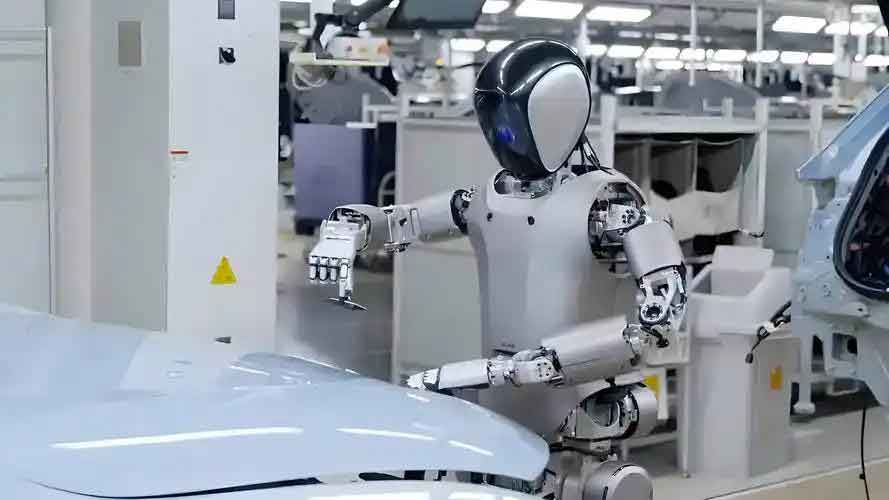
1. The exhibition floor shows the humanoid robot moving into everyday settings
The conference did not present the humanoid robot as a single isolated product. Instead, it placed robots inside recognizable environments where work has clear boundaries, repeated tasks and immediate human needs. In the recreated living room, a humanoid robot attempted household chores. In the pharmacy and small shop, robots retrieved goods and supported service tasks. In the kitchen, a robot cooked. These demonstrations matter because they show the direction of application: the humanoid robot is being prepared not only for factories and laboratories, but also for homes, shops, public services and other everyday spaces.
The shift is visible in the language used by companies and researchers. The humanoid robot is no longer described only as a platform for demonstrating balance, walking or grasping. It is increasingly described as a worker, a helper or a service interface. That change in description reflects a change in expectations. A humanoid robot that can fold clothes in a controlled demonstration is interesting; a humanoid robot that can fold different kinds of clothes supplied by different users is useful. A humanoid robot that can pick up a known object is a technical achievement; a humanoid robot that can retrieve goods in a busy shop, adapt to changed lighting and avoid obstacles is a product.
In a keynote report at the main forum, Xu Xiaolan, chairman of the Chinese Electronics Society, said that embodied intelligence has entered a critical window for large-scale application. She described embodied intelligent products as being at an important turning point from small-batch trial use to large-scale deployment. The statement applied broadly to embodied intelligence, but it carried special weight for the humanoid robot. The humanoid robot is one of the most visible expressions of embodied intelligence because it combines perception, decision-making, movement and interaction in a form that is intended to work alongside people.
The conference floor also showed that the humanoid robot is not developing in isolation. It is part of a wider ecosystem that includes quadruped robots, service robots, industrial robotic arms, bionic robots and specialized machines for dangerous environments. The humanoid robot benefits from advances in large models, motion control, sensors, actuators and simulation. At the same time, the humanoid robot helps push those technologies toward higher levels of generalization and human-centered interaction. The result is a more integrated view of robotics: the humanoid robot is one part of a larger move toward machines that can understand instructions, adapt to environments and complete multi-step work.
2. Public service and special operations reveal urgent demand for embodied machines
Among the most visible demonstrations at the conference were several robot traffic officers. The robot stood on a steering wheel-like base, monitored road conditions and made hand signals according to changing traffic lights, guiding pedestrians and vehicles. A company representative said the robot, known as the “Zhi Jing” robot, does not need remote control. It can navigate autonomously from a police station to a work site and can meet a duty requirement of four to five hours. The company has already cooperated with traffic management departments in multiple places, and the robot has been put into operation in Beijing, Ordos, Hefei and Wuhu.
The reason for introducing intelligent robots into traffic management is practical. Many areas still face a shortage of police personnel, and the problem is especially acute in remote areas. Traffic police work outdoors in severe cold and extreme heat, and their duties require continuous presence. A robot that can navigate independently, perform repeated guidance tasks and sustain several hours of duty can help address these gaps. The humanoid robot may not yet replace every task in this setting, but the same logic applies: repetitive, physically demanding or dangerous work creates a strong pull for embodied machines.
A quadruped machine horse also attracted attention. Visitors sat on its back, held the handles and rode it across the conference floor. The machine is an all-terrain quadruped platform with a dynamic load capacity of up to 300 kilograms. Advanced algorithms and strong movement ability allow it to walk on complex terrain, including gravel roads. The machine horse has already demonstrated high reliability in extreme environments. It can carry out all-weather inspection tasks, participate in practical firefighting and rescue drills in super high-rise buildings, locate fire sources and support personnel search and rescue. It can also identify equipment damage and hidden dangers such as toxic gas leaks in high-temperature and corrosive environments.
These examples broaden the context for the humanoid robot. The future of embodied intelligence will not be limited to one form. A humanoid robot may be suited to human-centered spaces where stairs, doors, tools and interfaces are designed for people. A quadruped robot may be better suited to rough terrain, inspection and rescue. A wheeled robot may be more efficient on smooth factory floors. The common thread is the ability to perceive, decide and act in the real world. For the humanoid robot, the lesson is that application value depends on fitness for the task, not on appearance alone.
Xu Xiaolan summarized the deployment of embodied intelligent products through four characteristics. In the field of livelihood services, applications are leading the way. In industrial manufacturing, application scenarios are broad. In special operations, demand is urgent. In agricultural operations, potential is enormous. The humanoid robot sits at the intersection of these categories. It may serve people in homes and public spaces, support industrial tasks, take on dangerous assignments and eventually participate in agricultural work. The direction is clear, but the pace will be set by reliability, cost and safety.
3. Shipment data and conference signals point to a scale-up moment
Data presented at the conference offered a concrete measure of how quickly the humanoid robot sector is moving. In the first half of 2026, China’s humanoid robot shipments exceeded 40,000 units, and the country’s share of global shipments further rose to 97 percent. The figure does not by itself prove that every humanoid robot is performing complex work in an open environment. It does show that the humanoid robot is moving from tiny trial batches toward a more visible industrial and commercial presence. Shipments are a sign of supply-chain activity, investor confidence and growing deployment interest.
The humanoid robot is therefore entering a phase in which the central question is no longer whether a machine can be built and demonstrated. The question is whether the humanoid robot can be produced, deployed, maintained and trusted at scale. That shift explains why this year’s conference placed so much emphasis on application scenarios. A humanoid robot that remains in a laboratory may attract attention, but a humanoid robot that works in a shop, factory, pharmacy or public service setting must survive the tests of daily operation. Those tests include changing light, variable objects, human behavior, system integration, maintenance and cost control.
| Indicator | Reported figure or fact | What it signals for the humanoid robot sector |
|---|---|---|
| China’s humanoid robot shipments in the first half of 2026 | More than 40,000 units | The humanoid robot is moving beyond small-batch trial use toward broader deployment. |
| China’s share of global humanoid robot shipments | 97 percent | The humanoid robot supply chain and deployment base are highly concentrated and active. |
| Edition of the World Robot Conference | 12th | The humanoid robot is being discussed within a mature, long-running robotics platform. |
| Duty requirement of the “Zhi Jing” traffic robot | Four to five hours | Public service robots must meet sustained operational requirements, not only short demonstrations. |
| Dynamic load capacity of the quadruped machine horse | 300 kilograms | Embodied machines are being designed for heavy-duty and extreme-environment tasks. |
| Supporters of the Intelligent Robots Upward and Good Development Initiative | 268 international institutions and companies | Ethics and safety for the humanoid robot are becoming a multi-stakeholder concern. |
The table shows why the humanoid robot conversation has changed. The sector now has scale signals, public-service trials, heavy-duty platforms and governance initiatives moving at the same time. The humanoid robot is no longer only a research topic. It is becoming a test of industrial capacity, application design and social acceptance. The humanoid robot must prove that it can work beyond the demonstration stage, and the wider robotics ecosystem must prove that it can support that transition with standards, data and safety mechanisms.
4. The hardest gap is between laboratory performance and real-world work
During interviews at the conference, many company representatives described a common problem: robots often perform excellently in the laboratory but disappoint when they enter real scenes. The problem was visible on the exhibition floor as well. A household robot that could fold clothes quickly and neatly in a prepared demonstration sometimes froze when asked to handle different types of clothing provided by visitors. The humanoid robot may understand the instruction, but the variation in fabric, shape, lighting and arrangement can break the chain between perception and action.
Why is it so difficult for the humanoid robot to work well? At the “application-driven” main forum, Wang Xingxing, founder and chairman of Unitree Robotics, said that the biggest bottleneck in moving a robot from exhibit to product remains efficiency, generalization ability and precise alignment between models and the real world. These three issues are closely connected. Efficiency affects how quickly and reliably a humanoid robot can complete a task. Generalization affects whether the humanoid robot can handle new objects, new environments and new instructions. Precise alignment affects whether the humanoid robot’s internal model of the world matches what is actually happening around it.
One company displayed a robot continuously grabbing goods. Behind it, a screen showed numbers jumping clearly, recording working hours and the number of items retrieved. A company representative said the robot had already been put to work in a factory and had received positive feedback from its “employer.” But the representative also acknowledged that there is still a large distance between reaching 99 percent in the laboratory and reaching 99 percent in a factory. Real factories have continuously changing lighting, temperature and environmental conditions. The humanoid robot must also deal with the influence of large equipment and the engineering work of connecting to factory systems. These are key issues on the last mile of embodied intelligence.
The representative said the company therefore needs to carry out much adaptation work on the robot’s “cerebellum” and “brain,” including algorithm and engineering optimization. The goal is to make the humanoid robot’s brain more intelligent and its cerebellum more stable. In general terms, the brain of a robot is responsible for decision-making: it uses large models to understand and analyze tasks. The cerebellum is responsible for movement: it responds to tasks, controls actions and avoids obstacles. For the humanoid robot, both parts must work together. A strong brain without stable movement cannot complete physical work. Stable movement without intelligent decision-making cannot handle complex instructions.
Many companies at the conference highlighted the long-duration working ability of their robots. A short instruction is given, and the humanoid robot analyzes the logic, breaks the task into steps and carries them out. Even when unexpected situations appear, the humanoid robot’s judgment and execution should not be disrupted. This is a higher bar than repeating a fixed motion. It requires the humanoid robot to maintain context, monitor progress, detect errors and recover from interruptions. The humanoid robot must behave less like a scripted machine and more like a reliable worker who can adapt without constant supervision.
“One brain, multiple machines” has also become an industry trend. Under this approach, one large model can adapt to robots of different brands and different forms to complete tasks in different scenarios. A “general brain” could effectively reduce the cost of deploying robots across multiple scenarios and improve enterprise competitiveness. For the humanoid robot, this is significant. If every humanoid robot required a separate model, a separate data set and a separate integration effort, deployment would remain expensive and slow. A general brain could allow the humanoid robot to share capabilities with other embodied machines while still adapting to its specific body and task.
5. Data, simulation and closed-loop evaluation become the foundation for progress
Wang Xingxing suggested that the industry needs massive amounts of high-quality human and real-machine data. It also needs to establish a self-evolution closed loop composed of large-model programming, simulation training, real-machine testing and human-machine evaluation. This recommendation captures the practical path for the humanoid robot. Data from the real world is necessary because the real world contains variation that simulation cannot fully reproduce. Simulation is necessary because real-world testing is expensive and slow. Human-machine evaluation is necessary because the humanoid robot must ultimately satisfy human needs, not only engineering metrics.
The humanoid robot cannot be improved by hardware alone. It needs continuous learning from deployment. Every grasp, every navigation decision and every interaction can produce information about what works and what fails. The challenge is to turn that information into reliable improvements without creating new risks. A self-evolution closed loop offers a structured way to do this. Large-model programming can generate task plans and behaviors. Simulation training can test those behaviors across many conditions. Real-machine testing can validate performance in actual environments. Human-machine evaluation can assess whether the humanoid robot is safe, useful and acceptable to the people it serves.
Xu Xiaolan said that application should be used as the牵引—the driving force—for product iteration and optimization. In practical terms, this means the humanoid robot should be developed through real deployment rather than waiting for a perfect laboratory result. Production and demand should be deeply integrated and mutually empowered. The humanoid robot should be pushed to accelerate deployment and cross the threshold of “real-scene operation.” Only then can embodied intelligence quickly empower thousands of industries and everyday services.
This application-driven approach does not mean rushing the humanoid robot into unsafe settings. It means designing deployment so that the humanoid robot can learn under controlled conditions while delivering measurable value. A factory can provide structured tasks and clear performance metrics. A shop can provide repeated retrieval tasks with human oversight. A public service setting can provide bounded duties with remote monitoring. Each setting can generate data and feedback that improve the humanoid robot. The key is to match the humanoid robot’s current capability to the task, then expand the boundary as reliability improves.
6. Ethics and safety move to the center of the humanoid robot agenda
While robots displayed their capabilities and worked busily in the exhibition halls, a deeper issue was repeatedly raised: as embodied intelligence evolves quickly, will it remain controllable? Can it always move in a direction beneficial to human civilization? These questions are especially important for the humanoid robot because its form invites human-like expectations. People may interact with a humanoid robot as if it were a social being, even when its understanding remains limited. That gap between expectation and capability creates ethical and safety challenges.
At the conference, the Chinese Electronics Society and the World Robot Cooperation Organization, together with 268 international institutions and companies, jointly released the “Intelligent Robots Upward and Good Development Initiative.” The initiative gives a clear answer: intelligent robots should aim to improve public well-being, safeguard social safety and respect individual rights. It calls for promoting the development of ethical guidelines and safety standards through multi-party participation and internationally recognized mechanisms, ensuring that intelligent robots always develop in a direction conducive to the progress of human civilization. For the humanoid robot, this is a governance framework as much as a technical one.
Bionic robots have long been a focus of public attention at the World Robot Conference. A company representative said that compared with a steel exterior, a bionic robot with a human face appears warmer and is easier for users to accept. However, when training the model, the company deliberately avoided deep emotional links or “lover-oriented” functions. This is an expression of the “technology for good” concept in application. The humanoid robot may become more acceptable through human-like design, but human-like appearance must not be used to manipulate emotion or create false expectations.
Many companies have also invested considerable effort in making robots appear more human. The skin and hair of some robots are finely produced and highly realistic, with pores and textures clearly visible. When discussing boundaries and safety awareness, a company representative said that bionic robots must be designed, produced and used within the framework of laws, regulations and standards. The humanoid robot thus faces a double requirement: it must be useful and acceptable, but it must also be clearly governed. Appearance can support trust, but trust must be backed by safety, transparency and accountability.
At the main forum, experts offered further recommendations. Liang Zheng, professor at the School of Public Policy and Management at Tsinghua University and vice dean of the Institute for AI International Governance at Tsinghua University, said that technology red lines should not be determined only by engineering indicators. They should also come from social consensus and be implemented through standards, evaluation, law, policy and corporate responsibility. For the humanoid robot, this means that safety cannot be reduced to a checklist of motor limits or sensor accuracy. It must include social expectations about privacy, autonomy, employment, care and human dignity.
Zhang Jianwei, foreign academician of the Chinese Academy of Engineering and academician of the German National Academy of Science and Engineering, suggested that safety and ethics should be embedded from the stages of institution, perception, interaction and model training. For example, a robot should learn the hazard boundaries of tool use, force control rules and responsible operation. Before entering a home, a humanoid robot should receive moral safety training similar to school education and qualification certification. The humanoid robot therefore needs more than a capable body and a powerful model. It needs a governance architecture that shapes what it learns, how it acts and when it must stop.
7. The humanoid robot future depends on usefulness, trust and shared standards
The 2026 World Robot Conference showed a humanoid robot sector that is more practical than before. The humanoid robot is being tested in homes, shops, pharmacies, kitchens, factories and public service settings. It is being supported by quadruped platforms, specialized rescue machines and general-purpose models. It is being measured by shipments, working hours, retrieval counts and duty requirements. At the same time, the humanoid robot is being questioned more seriously than before. Can it generalize? Can it be efficient? Can it align its model with the real world? Can it be trusted around people? Can it be governed across borders and cultures?
These questions do not weaken the promise of the humanoid robot. They clarify the conditions for that promise to be realized. The humanoid robot will not succeed simply because it looks human or because it can perform a striking demonstration. It will succeed because it can do useful work reliably, because its costs and maintenance can be managed, because its behavior can be evaluated and because people can trust it in their spaces. The humanoid robot must be more than a symbol of technological ambition. It must become a dependable participant in human activity.
The conference’s emphasis on application, data and ethics points to a balanced path. Application generates value and feedback. Data and simulation improve capability. Evaluation and standards build trust. Ethics and safety define boundaries. The humanoid robot can then move from small-batch trial use to broader deployment without losing public confidence. The same logic applies to the wider field of embodied intelligence. The humanoid robot is a leading indicator, but it is not the whole story. The goal is a robotics ecosystem in which different machines are matched to different tasks and governed by shared principles.
When technology moves upward in capability and toward good in purpose, the vision of human-machine symbiosis and deep integration between production and demand can become more than a slogan. It can become a practical reality that benefits individuals, communities and industries. The humanoid robot will be judged by that standard. The humanoid robot must work well, work safely and work for people. The humanoid robot must earn its place in the everyday scenes it is now beginning to enter. The humanoid robot, in other words, must become useful before it becomes ordinary.