
TIANJIN, Oct. 17, 2026 — The Unitree Technology Exhibition Center has opened in the Tianjin Economic-Technological Development Area, adding a dedicated venue for the display of advanced robotics products and application scenarios. The center is located in Building No. 3 of the TEDA Science and Technology Development Center and has been positioned as a specialized product showcase for Unitree robots, bringing together multiple robot products in one setting and presenting front-line technology achievements in a direct and visible way.
The opening gives industry visitors, public audiences, and technology observers a structured view of how the humanoid robot and quadruped robot product lines are being presented alongside self-developed core components. It also places the humanoid robot at the center of a broader exhibition narrative that connects hardware, application scenarios, and the practical translation of embodied intelligence technology into consumer, industrial, power, and entertainment settings.
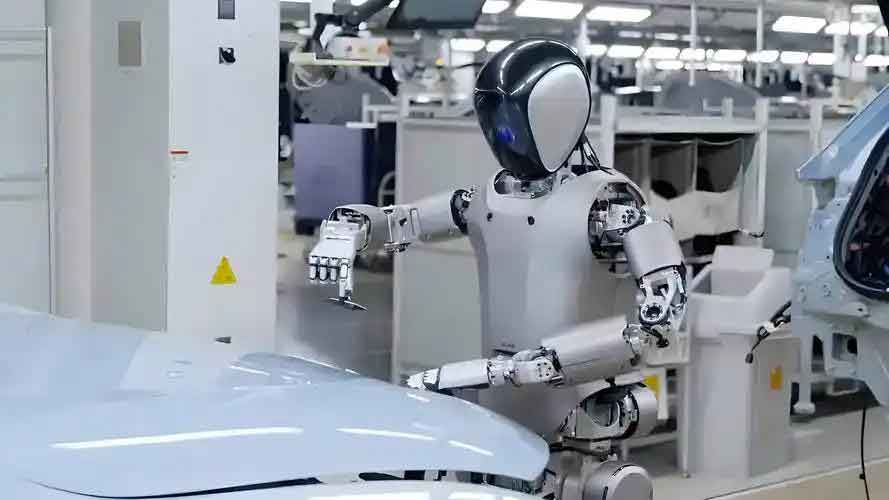
The exhibition center is arranged over two floors. The first floor serves as the main exhibition hall, while the second floor is devoted to office and meeting areas. The first-floor exhibition hall covers an area of 1,189.04 square meters and is divided into two major sections: a static display area and six functional experience zones. This layout allows the center to present both the technology foundation behind the humanoid robot and quadruped robot products and the application-oriented demonstrations that show how those products perform in simulated real-world environments.
- Dedicated showcase for humanoid robot and quadruped robot technologies
The center has been established as a dedicated display阵地 for Unitree robot products, with the humanoid robot and quadruped robot families forming a central part of the exhibition. Rather than limiting the presentation to static hardware, the venue combines product displays with dynamic demonstration areas. The result is a showcase that allows visitors to examine the humanoid robot as a technology platform while also observing how related robotics systems are applied in practical scenarios.
The display strategy reflects a broader trend in robotics communication: the humanoid robot is no longer presented only as a laboratory prototype or a conceptual platform, but as part of an integrated product and application ecosystem. At the same time, the quadruped robot is shown in mobility-focused scenarios, while the humanoid robot is linked to interaction, manipulation, industrial operation, inspection, and entertainment applications. This dual emphasis gives the center a broader technical scope and helps illustrate the complementarity of different robot forms.
The static display area sets out the company’s development history and brand culture through a dedicated wall. It also presents complete humanoid robot and quadruped bionic robot exhibits, together with self-developed core components such as servo joints and dexterous hands. By combining complete robot systems with key components, the exhibition traces the technology iteration path and highlights the company’s research and development strength. The humanoid robot display therefore serves not only as a product presentation but also as a visible entry point for understanding the hardware foundations that support advanced robotic motion, manipulation, and interaction.
- Two-floor layout combines exhibition, office, and meeting functions
The two-floor structure gives the center a clear functional division. The main exhibition activity is concentrated on the first floor, where the humanoid robot and quadruped robot displays are arranged in the static section and the six functional experience zones. The second floor provides office and meeting space, supporting the operational and business functions that accompany a dedicated exhibition and presentation venue.
The first-floor exhibition hall’s 1,189.04 square meters of space is organized to support both close observation and scenario-based demonstration. The static display area introduces the company’s development path, brand culture, complete robot exhibits, and core components. The functional experience zones then extend the presentation into application contexts. For the humanoid robot, this means moving from hardware display toward demonstrations involving interaction, combat-style movement, industrial handling, inspection work, and entertainment performance. For the quadruped robot, the experience zones emphasize mobility, obstacle crossing, and climbing.
This combination of static and dynamic presentation is important for a technology such as the humanoid robot, because the value of a humanoid robot platform is often found in the relationship between mechanical design, control systems, perception, and task execution. A static exhibit can show form, structure, and components, while a functional demonstration can show motion, balance, interaction, and application logic. The center uses both approaches to create a more complete picture of the humanoid robot as an evolving product category.
- Static display area presents complete robots and self-developed core components
In the static display area, the exhibition places complete humanoid robot and quadruped bionic robot products alongside self-developed core components. The inclusion of servo joints and dexterous hands is particularly relevant to the humanoid robot narrative, because these components are closely associated with motion control, dexterity, and the ability to perform tasks that require precision and coordination. The display thus gives visitors a view of the humanoid robot not only as an assembled product but also as a system built on a chain of specialized technologies.
The development history and brand culture wall adds a chronological and organizational dimension to the exhibition. It allows the center to present the technology iteration path in a structured way, showing how product generations and technical capabilities have evolved. For the humanoid robot, this kind of presentation can help audiences understand that progress is not limited to a single breakthrough but is the result of continued work across mechanics, electronics, control, and software.
The static display also supports the center’s role as a product showcase. Complete humanoid robot exhibits provide a physical reference for visitors, while the component displays offer a closer look at the underlying engineering. This layered presentation is useful for industry visitors who may be interested in supply chains and component development, as well as for general visitors who want to understand what makes a humanoid robot function.
| Exhibition element | Content presented | Presentation role |
|---|---|---|
| Development history and brand culture wall | Company development history and brand culture | Introduces the technology iteration path and organizational background |
| Complete robot exhibits | Humanoid robot and quadruped bionic robot products | Shows product form and system-level integration |
| Core component display | Servo joints, dexterous hands, and other self-developed components | Highlights research and development strength and hardware foundations |
The table above summarizes the static display area without adding information beyond the exhibition content. It shows how the center combines history, complete products, and core components into a single presentation layer. For the humanoid robot, this layering is especially important because the product category depends on the integration of many subsystems. A dexterous hand, for example, is not simply an accessory; it represents a convergence of mechanical design, actuation, sensing, and control that directly affects what a humanoid robot can do.
- Six functional experience zones create scenario-based demonstrations
The six functional experience zones are designed to create real-world application scenarios. They present quadruped robot obstacle crossing and climbing, smart home simulated life applications, humanoid robot boxing and combat interaction, industrial material intelligent sorting, power equipment inspection operations, and robot comedy entertainment performance. These zones move the exhibition from product display toward application demonstration, allowing visitors to observe dynamic operation and gain a more immersive understanding of embodied intelligence technology in consumer, industrial, power, and entertainment fields.
For the humanoid robot, the functional experience zones provide a way to show the platform in different roles. In a smart home simulation, the humanoid robot can be associated with daily-life interaction and service scenarios. In boxing and combat demonstrations, the focus shifts toward movement, balance, response, and physical interaction. In industrial material sorting, the humanoid robot is connected to manipulation and task execution. In power equipment inspection, the emphasis moves toward operational reliability and inspection work. In entertainment performance, the humanoid robot becomes part of a public-facing experience that combines technology with performance.
| Functional experience zone | Demonstration focus | Application context |
|---|---|---|
| Quadruped robot obstacle crossing and climbing | Obstacle crossing and climbing performance | Mobility and terrain adaptability |
| Smart home simulated life applications | Simulated daily-life interaction | Consumer and home scenarios |
| Humanoid robot boxing and combat interaction | Movement, balance, and physical interaction | Humanoid robot dynamic demonstration |
| Industrial material intelligent sorting | Material recognition and sorting demonstration | Industrial operation scenarios |
| Power equipment inspection operations | Inspection-oriented operation demonstration | Power equipment inspection scenarios |
| Robot comedy entertainment performance | Public-facing entertainment performance | Entertainment and visitor engagement |
The table provides a concise view of the six zones and their demonstration emphasis. It also shows how the humanoid robot appears across multiple contexts rather than being confined to a single use case. The same humanoid robot platform can be presented as an interactive system, a moving system, a manipulation system, an inspection-related system, and an entertainment system. This multi-context presentation helps visitors understand that the humanoid robot is a general-purpose robotics platform with application potential across different domains.
- Humanoid robot demonstrations link hardware to embodied intelligence
The functional experience zones are not isolated attractions. They are part of a broader effort to show how embodied intelligence technology can be applied in practical settings. For the humanoid robot, embodied intelligence involves the integration of perception, movement, interaction, and task execution in a physical system. The exhibition allows visitors to see this integration through demonstrations that combine robot hardware with scenario design.
In the boxing and combat demonstration, the humanoid robot is presented in a dynamic context that requires movement and physical interaction. This kind of demonstration draws attention to balance, control, and responsiveness. In the smart home simulation, the humanoid robot is placed in a daily-life setting, which shifts attention toward interaction and service potential. In industrial material sorting, the humanoid robot is linked to manipulation and workflow-oriented tasks. In power equipment inspection, the humanoid robot is connected to operational inspection scenarios. In the entertainment performance, the humanoid robot becomes part of a public experience that can communicate technology to a wider audience.
By presenting the humanoid robot across these different settings, the center avoids a one-dimensional display. It shows that the humanoid robot can be understood through multiple lenses: as a product, as a research platform, as an application enabler, and as a public-facing technology. This approach is consistent with the exhibition center’s role as a dedicated product showcase and with its effort to present front-line technology achievements in a visible and accessible manner.
- Project coordination supports timely delivery and exhibition readiness
The establishment of the exhibition center involved coordinated project support. Since the project was launched, the Tianjin Economic-Technological Development Area service team carried out activities focused on responsibility, problem-solving, service quality, and efficiency. A special working group was formed promptly, and the project was followed through the entire process. The team actively engaged with the company, established a regular communication mechanism, and efficiently completed floor planning, exhibition layout arrangements, and a full set of design drawings.
To maintain project progress, the special working group adopted an innovative working model, optimized process connections, and streamlined approval steps. These measures helped ensure rapid construction entry. The team also coordinated with relevant parties to resolve on-site difficulties and bottlenecks, while strictly managing project quality and time nodes. The result was delivery on schedule and with quality, meeting the conditions required for the company to enter and arrange the exhibition.
This project coordination is part of the broader service environment that supports industrial and technology projects in the Tianjin Economic-Technological Development Area. For a humanoid robot exhibition center, timely delivery is important because the venue is not merely a construction project; it is a platform for product display, industry communication, and public engagement. The ability to complete planning, design, approval, construction, and exhibition readiness in a coordinated manner therefore contributes directly to the center’s function as a showcase for humanoid robot and quadruped robot technologies.
- Center revitalizes existing space and creates replicable experience
The completion and opening of the Unitree Technology Exhibition Center effectively revitalizes existing carrier space in the TEDA Science and Technology Development Center. It enhances the value of the site’s resources and demonstrates the comprehensive service capability of the Tianjin Economic-Technological Development Area in investment promotion, operations, and engineering support. The project also accumulates replicable practical experience for similar initiatives, including the development of industrial exhibition halls and the upgrading and renovation of science and technology innovation carriers.
The revitalization dimension is significant because it shows how existing space can be adapted to support high-technology exhibition and application demonstration functions. The humanoid robot exhibition is not separated from the surrounding innovation environment; it becomes part of a carrier space that is being repositioned to support technology display, industry exchange, and public understanding. This connection between space utilization and technology presentation gives the project value beyond the exhibition itself.
For future projects, the experience gained from this center can inform how exhibition spaces are planned, how approval and construction processes are coordinated, and how product displays are combined with functional experience zones. The humanoid robot element is central to this experience because it requires a presentation environment that can support both static hardware display and dynamic scenario demonstration. The center’s layout and delivery process therefore provide a practical reference for similar humanoid robot and robotics-focused exhibition projects.
- Humanoid robot ecosystem gains a visible application platform
The opening of the center gives the humanoid robot ecosystem a visible application platform in the Tianjin Economic-Technological Development Area. The exhibition brings the humanoid robot together with the quadruped robot, core components, and application scenarios in a single venue. This arrangement supports product communication, industry observation, and public education. It also allows the humanoid robot to be presented as part of a wider robotics landscape rather than as an isolated category.
For industry audiences, the center offers a way to observe product integration and application logic. For public audiences, it provides an opportunity to see the humanoid robot in action and to understand how embodied intelligence technology is being applied in consumer, industrial, power, and entertainment contexts. For the regional innovation environment, the center adds a specialized venue that can support exchange, demonstration, and future collaboration around humanoid robot and related technologies.
The repeated presence of the humanoid robot across the static display area and the functional experience zones reinforces its role as a focal point. Visitors can see the humanoid robot as a complete product, examine components linked to its performance, and observe demonstrations that place the humanoid robot in different application settings. This layered presentation helps build a more complete understanding of the humanoid robot as a technology platform that combines mechanical design, control, perception, and application-oriented functionality.
- Visitor experience combines close observation with immersive demonstration
The center is designed to allow visitors to observe robot operations at close range and to experience embodied intelligence technology in an immersive manner. In the static display area, visitors can examine complete humanoid robot and quadruped robot exhibits and view self-developed components such as servo joints and dexterous hands. In the functional experience zones, visitors can watch dynamic demonstrations involving obstacle crossing, smart home simulation, boxing and combat interaction, industrial sorting, power equipment inspection, and entertainment performance.
This combination of close observation and immersive demonstration is especially effective for communicating the humanoid robot. A humanoid robot is a complex system, and its capabilities are often difficult to convey through static display alone. Dynamic demonstrations allow visitors to see how the humanoid robot moves, interacts, and performs tasks. At the same time, the static display provides the technical context that helps visitors understand what they are watching. The result is an exhibition experience that connects visible performance with underlying technology.
The humanoid robot’s presence in entertainment performance also gives the center a public-facing dimension. By placing the humanoid robot in a performance context, the exhibition can communicate technology in a way that is accessible to a broader audience. This does not replace the industrial or power-related demonstrations; rather, it complements them by showing that the humanoid robot can operate across different domains and audience contexts.
- Application scenarios reflect cross-domain potential
The six functional experience zones reflect cross-domain potential. The quadruped robot obstacle crossing and climbing zone emphasizes mobility. The smart home simulated life application zone connects robotics to daily-life settings. The humanoid robot boxing and combat zone highlights dynamic physical interaction. The industrial material intelligent sorting zone links robotics to industrial workflows. The power equipment inspection zone connects robotics to operational inspection. The robot comedy entertainment performance zone brings robotics into public entertainment.
For the humanoid robot, this cross-domain presentation is particularly relevant because the humanoid robot is often discussed as a general-purpose platform. The exhibition does not reduce the humanoid robot to a single task or a single industry. Instead, it shows the humanoid robot in multiple scenarios, allowing visitors to consider how the same platform might support different applications. This approach is consistent with the center’s broader goal of presenting front-line technology achievements and demonstrating the practical reach of embodied intelligence technology.
The humanoid robot’s connection to industrial material sorting and power equipment inspection is especially important for understanding its potential role in operational environments. These scenarios require structured task execution and reliable performance. The humanoid robot’s connection to smart home simulation and entertainment performance, meanwhile, shows its potential in interactive and public-facing settings. By presenting these scenarios together, the center provides a more balanced view of the humanoid robot’s application landscape.
- Exhibition center strengthens regional technology display capacity
The Unitree Technology Exhibition Center strengthens the technology display capacity of the Tianjin Economic-Technological Development Area. It provides a dedicated venue for robot product display and application demonstration, and it uses the humanoid robot as a key element in communicating advanced robotics capabilities. The center’s location in the TEDA Science and Technology Development Center places it within an innovation-oriented environment, where exhibition, office, and meeting functions can support different forms of engagement.
The project also demonstrates how investment promotion, operations, and engineering support can come together to deliver a specialized technology venue. The service team’s full-process follow-up, regular communication, planning and design work, approval streamlining, construction coordination, and quality control all contributed to the center’s readiness. These elements are part of the project’s practical value and are relevant to future science and technology carrier upgrades.
For the humanoid robot sector, the center offers a dedicated space where the humanoid robot can be displayed alongside related products and components. This kind of venue can support product communication and public understanding, and it can help connect the humanoid robot to concrete application scenarios. The center therefore contributes to the visible development of the humanoid robot ecosystem in the region.
- Humanoid robot and quadruped robot displays complement each other
The exhibition places the humanoid robot and the quadruped robot in a shared presentation environment. The humanoid robot represents a platform oriented toward interaction, manipulation, and human-centered tasks, while the quadruped robot represents a platform oriented toward mobility and terrain adaptability. By displaying both, the center shows the diversity of robotics development and the different technical priorities associated with different robot forms.
The quadruped robot obstacle crossing and climbing zone highlights mobility and environmental adaptability. The humanoid robot zones highlight interaction, movement, sorting, inspection, and performance. Together, these displays create a broader picture of how robotics systems can be adapted to different tasks. The humanoid robot remains a central part of this picture because its multi-domain presentation connects hardware, software, interaction, and application scenarios in a single platform.
The complementary display also helps visitors understand that robotics development is not limited to a single form factor. The humanoid robot and quadruped robot each have distinct technical characteristics and application emphases. The exhibition center uses these differences to create a richer visitor experience while maintaining a clear focus on product display and application demonstration.
- Opening marks a practical step in robotics application communication
The opening of the Unitree Technology Exhibition Center marks a practical step in robotics application communication in the Tianjin Economic-Technological Development Area. The center combines a static display of complete robots and core components with six functional experience zones that present dynamic application scenarios. The humanoid robot appears throughout this structure, from the complete product exhibits to the boxing and combat demonstration, industrial sorting demonstration, power equipment inspection demonstration, and entertainment performance.
The center’s layout supports a narrative that moves from technology foundations to application experiences. Visitors can first see the development history, brand culture, complete humanoid robot and quadruped robot products, and self-developed components. They can then move into the functional experience zones and observe how robotics systems operate in simulated scenarios. This sequence helps connect the humanoid robot’s hardware and components with its visible capabilities and application potential.
The project also shows how exhibition space can be used to support technology communication and industry engagement. By revitalizing existing carrier space and delivering a dedicated robot showcase, the center adds a new platform for displaying advanced robotics and for presenting the humanoid robot in a structured, application-oriented environment. The experience gained from the project can be applied to future industrial exhibition halls and science and technology innovation carrier upgrades.
- Humanoid robot remains a central keyword in the exhibition narrative
Across the exhibition center, the humanoid robot remains a central keyword in the presentation. The static display introduces the humanoid robot as a complete product and as a system supported by servo joints, dexterous hands, and other self-developed components. The functional experience zones then place the humanoid robot in dynamic settings that demonstrate movement, interaction, sorting, inspection, and performance. This repeated presence helps ensure that the humanoid robot is not treated as a secondary exhibit but as a core part of the center’s technology story.
The humanoid robot is also connected to the broader theme of embodied intelligence technology. The exhibition shows how the humanoid robot can be applied in consumer, industrial, power, and entertainment fields, and it allows visitors to observe dynamic operations at close range. By linking the humanoid robot to multiple scenarios, the center communicates both the versatility of the platform and the practical direction of robotics development.
The exhibition center’s completion and opening therefore provide a new venue for understanding the humanoid robot and related robotics technologies. It combines product display, component presentation, scenario demonstration, and project delivery experience in a single project. For the Tianjin Economic-Technological Development Area, it adds a specialized technology showcase; for the robotics sector, it adds a visible platform for humanoid robot and quadruped robot applications; and for visitors, it adds an opportunity to observe how embodied intelligence technology is being translated into practical scenarios.
The center’s first-floor exhibition hall, with its static display area and six functional experience zones, creates a clear structure for presenting the humanoid robot alongside other robot products. The second-floor office and meeting area supports the center’s operational functions. The project’s delivery process, coordinated by a special working group and supported through planning, design, approval, and construction coordination, ensured that the venue was ready for exhibition arrangement. The revitalization of existing carrier space and the accumulation of replicable experience further extend the project’s value beyond the opening itself.
As a dedicated product showcase, the center presents the humanoid robot in a way that connects hardware, components, dynamic demonstration, and application context. It allows the humanoid robot to be seen as a complete product, as a technology platform, and as part of a wider robotics ecosystem. The exhibition center thus adds a practical and visible dimension to the development and communication of humanoid robot technology in the region.