
LimX Dynamics, a robotics company founded in 2022 and headquartered in Qianhai, Shenzhen, is placing the humanoid robot at the center of its effort to move embodied intelligence from laboratory demonstrations toward commercial and everyday use. The company has developed a portfolio that includes the fully autonomous humanoid robot LimX Oli, the interactive humanoid robot LimX Luna, and the modular robot TRON 2. Together, these products illustrate a strategic bet: the next stage of humanoid robot development will depend not only on stronger hardware, but also on closer integration between the humanoid robot’s “brain” and its “cerebellum,” allowing the humanoid robot to convert thought into physical motion and act autonomously in real environments.
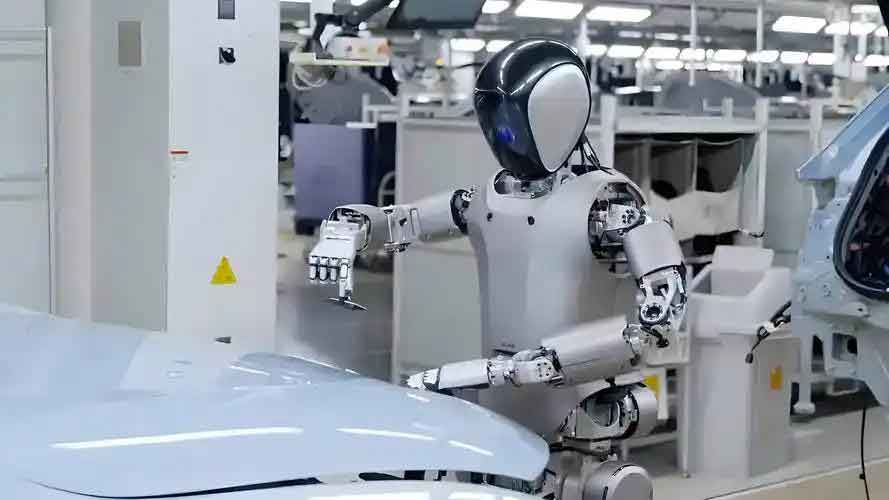
During a recent visit by an industry research delegation to the company’s global headquarters experience center, LimX Dynamics presented a live view of how its humanoid robot systems are being positioned for commercial services, home services, industrial inspection, patrol work, and other scenarios. The demonstrations underscored a central theme in the humanoid robot sector: physical agility is important, but the more decisive capability is the humanoid robot’s ability to understand instructions, assess its surroundings, plan tasks, and execute them through coordinated whole-body motion. For LimX Dynamics, that capability is being pursued through a combination of original hardware design and manufacturing, humanoid robot “brain–cerebellum” integration technology, and the company’s COSA humanoid brain system.
1. A Humanoid Robot Demonstration Highlights Agility, Balance, and Autonomous Task Execution
The experience center presentation placed the humanoid robot in motion. As music played, LimX Oli performed a dance routine that included hip movements, turns, and coordinated body shifts. The significance of such a demonstration is not simply entertainment. For a humanoid robot, dance-like movement requires balance control, joint coordination, timing, and the ability to translate a planned motion into stable physical action. Those same capabilities underpin more practical tasks in commercial and home environments, where a humanoid robot must move safely around people, handle objects, and adapt to changes in its surroundings.
The demonstration also included TRON 2, a modular robot platform designed to move across complex terrain, including gravel paths, grass, and steps. The ability to move stably and quickly across uneven ground is a foundational requirement for a humanoid robot or modular robot intended for outdoor patrol, inspection, follow-up filming, and other field operations. In the case of TRON 2, the platform can switch among dual-arm, bipedal, and wheeled-bipedal forms, and it can connect to external devices such as robotic arms, lidar, and cameras. That modularity extends the humanoid robot and modular robot ecosystem beyond a single fixed body configuration, allowing the platform to be adapted to different operational needs.
The live presentation offered a practical view of where the humanoid robot industry is heading. A humanoid robot that can dance is visually compelling, but a humanoid robot that can combine perception, planning, and motion control in unstructured environments is far more valuable for commercial deployment. LimX Dynamics is using its demonstrations to show that the humanoid robot can be more than a showcase platform. The company is presenting the humanoid robot as a general-purpose machine whose value will grow as its “brain” becomes better at understanding tasks and its “cerebellum” becomes better at executing them.
2. LimX Dynamics Builds a Humanoid Robot Portfolio Around Three Distinct Products
LimX Dynamics has introduced three main products, each addressing a different part of the humanoid robot and modular robotics market. LimX Oli and LimX Luna are positioned for commercial and home service scenarios, while TRON 2 is a modular robot platform that supports multiple forms and external attachments. The product structure reflects a practical approach to commercialization: rather than relying on a single humanoid robot design for every use case, the company is building a portfolio that can address different environments, tasks, and customer requirements.
LimX Oli is described as a fully autonomous humanoid robot and has become a flagship product for the company. LimX Luna is described as an interactive humanoid robot. Both are aimed at service environments where a humanoid robot must interact with people, understand instructions, and carry out tasks in spaces designed for humans. TRON 2, by contrast, is a modular robot that can be configured in different ways and equipped with external sensors and tools. Its flexibility makes it relevant to applications such as follow-up filming, police patrol support, and unmanned inspection of mountainous photovoltaic bases.
| Product | Primary positioning | Key capabilities described by the company |
|---|---|---|
| LimX Oli | Fully autonomous humanoid robot for commercial and home service scenarios | Flagship humanoid robot; designed to perform autonomous tasks through the company’s humanoid brain system and brain–cerebellum integration technology |
| LimX Luna | Interactive humanoid robot for commercial and home service scenarios | Focused on interaction and service contexts in which a humanoid robot works alongside people |
| TRON 2 | Modular robot platform for field and specialized applications | Supports rapid switching among dual-arm, bipedal, and wheeled-bipedal forms; can connect to robotic arms, lidar, cameras, and other devices for patrol, inspection, and follow-up filming scenarios |
The portfolio strategy is important for the humanoid robot market because different customers require different levels of autonomy, mobility, and interaction. A humanoid robot deployed in a commercial service setting may need to recognize people, respond to spoken instructions, and navigate crowded spaces. A humanoid robot or modular robot used for outdoor inspection may need to handle rough terrain, carry sensors, and operate for extended periods. By developing multiple products, LimX Dynamics is attempting to match the humanoid robot’s capabilities to the actual demands of each scenario.
The company’s product direction also shows how the humanoid robot sector is maturing. Early humanoid robot demonstrations often focused on isolated actions, such as walking or grasping. The current phase places greater emphasis on complete tasks: a humanoid robot must understand what needs to be done, plan a sequence of actions, and execute those actions reliably. The humanoid robot’s commercial value depends on that full loop. LimX Dynamics is positioning its product line around that loop, with LimX Oli and LimX Luna representing service-oriented humanoid robot applications and TRON 2 representing a modular platform for field operations.
3. The Humanoid Robot “Brain” and “Cerebellum” Operate Through Three Coordinated Layers
According to Zhang Wei, founder of LimX Dynamics and a professor at the Southern University of Science and Technology, the key to bringing the humanoid robot into home environments lies not in hardware alone, but in the integration of the humanoid robot’s “brain” and “cerebellum.” The goal is to let the “brain” drive the “body,” turning thought into physical movement and enabling the humanoid robot to act autonomously. This integration is not a single technical feature. It is a coordinated system that spans high-level reasoning, task planning, skill generation, and whole-body motion control.
The company describes its humanoid robot brain–cerebellum integration technology as a three-layer system. Each layer has a distinct role, and each must work closely with the others to produce reliable autonomous behavior. For a humanoid robot, the challenge is not merely to generate a single action, but to combine perception, reasoning, and motion in a continuous loop. The humanoid robot must understand an instruction, assess the environment, plan a task, generate the appropriate skills, and control its joints to carry out the task safely and accurately.
-
Whole-body motion control layer: This layer coordinates the humanoid robot’s joints, maintains body stability, and ensures that actions are executed precisely. For a humanoid robot, whole-body control is essential because almost every meaningful task involves the entire body. Reaching for an object may require the humanoid robot to adjust its feet, shift its center of mass, stabilize its torso, and coordinate its arm movements. Without robust whole-body control, higher-level intelligence cannot be translated into reliable physical action.
-
High-level skill layer: This layer receives task plans from the humanoid robot’s “brain” and combines them with the immediate environment to generate action strategies such as bending, reaching, and grasping. The skill layer acts as a bridge between abstract plans and concrete movement. A humanoid robot may be instructed to organize a room, but the skill layer must determine how to approach an object, where to place a hand, how to avoid obstacles, and how to sequence the necessary motions. This layer is central to making the humanoid robot’s behavior adaptable rather than scripted.
-
“Brain” layer: This layer relies on large models to provide reasoning capability. It understands instructions, analyzes the environment, decomposes tasks, and plans actions. In the future, the company expects the humanoid robot’s “brain” to use world models to predict environmental changes and support decision-making. For the humanoid robot, this layer represents the higher-order intelligence that allows the machine to interpret goals and decide what to do next, rather than merely executing a fixed routine.
The three-layer architecture is designed to create a complete closed loop from thought and judgment to physical action. The humanoid robot’s “brain” interprets the task, the skill layer translates the task into actionable strategies, and the whole-body control layer executes those strategies through coordinated motion. This closed loop is what allows a humanoid robot to move beyond demonstration and toward autonomy. It also explains why LimX Dynamics emphasizes integration rather than isolated advances. A powerful humanoid robot “brain” without reliable motion control cannot act; a capable motion system without task understanding cannot decide what to do. The humanoid robot’s usefulness emerges from the combination.
For the broader humanoid robot industry, this layered approach reflects a wider recognition that embodied intelligence requires close coupling between cognition and action. A humanoid robot operating in a real environment cannot rely on pre-programmed movements alone. It must respond to changes, recover from errors, and adapt its behavior to the situation at hand. The three-layer system described by LimX Dynamics is an attempt to organize those requirements into a coherent architecture. The humanoid robot’s “brain” provides direction, the skill layer provides flexibility, and the motion control layer provides stability and precision.
4. For Humanoid Robot Adoption in Homes, Integration Matters More Than Hardware Alone
The company’s focus on brain–cerebellum integration is particularly relevant to the home environment. A home is one of the most difficult settings for a humanoid robot because it is unstructured, unpredictable, and filled with objects that were not designed for machines. A humanoid robot in a home must navigate rooms, avoid people and pets, handle delicate items, and understand instructions that may be incomplete or context-dependent. Hardware alone cannot solve these challenges. The humanoid robot must be able to interpret its surroundings and translate high-level goals into safe physical actions.
Zhang Wei’s view is that the humanoid robot’s entry into the home will depend on the integration of the “brain” and “cerebellum.” The “brain” must understand what the user wants, while the “cerebellum” must ensure that the humanoid robot’s body can carry out the task without losing balance or causing damage. This integration is what allows the humanoid robot to turn a request such as “organize the toys” into a sequence of movements: approach the toys, identify each item, reach for it, grasp it, move it to a storage area, and place it safely. Each step requires coordination between perception, planning, and motion.
The humanoid robot’s home adoption also depends on trust. A humanoid robot that moves unpredictably or fails frequently will not be accepted in a domestic setting. The humanoid robot must be stable, safe, and reliable. The three-layer integration approach is intended to support those qualities by separating high-level planning from low-level execution while maintaining close coordination between them. The humanoid robot’s “brain” can focus on understanding and planning, while the motion control layer can focus on stability and precise execution. The skill layer connects the two, generating actions that are appropriate for the environment.
This emphasis on integration does not diminish the importance of hardware. The humanoid robot still requires original hardware design and manufacturing, robust joints, reliable sensors, and a body capable of interacting with the physical world. However, LimX Dynamics is arguing that hardware is only one part of the equation. The humanoid robot’s value will increase when its body and intelligence are designed to work together. The humanoid robot must not only be able to move; it must be able to move with purpose. That is the core of the company’s message about brain–cerebellum integration.
5. A Three-Minute Humanoid Robot Video Shows End-to-End Autonomy
In July, LimX Dynamics released a three-minute video that presented a continuous, one-shot demonstration of LimX Oli performing tasks autonomously under the drive of the company’s COSA humanoid brain system. The video showed the humanoid robot organizing clothing and storing toys. The significance of the demonstration lies in the continuous, end-to-end nature of the tasks. Rather than showing isolated movements, the video presented the humanoid robot completing a sequence of actions that required understanding, planning, and execution.
The humanoid robot demonstration attracted industry attention and also received praise from a Chinese Foreign Ministry spokesperson. For the humanoid robot sector, such attention is valuable because it helps communicate the difference between a staged robot performance and an autonomous humanoid robot completing practical tasks. The video did not rely on a scripted sequence of separate clips; it presented a continuous view of the humanoid robot’s behavior. That format is important because it highlights the humanoid robot’s ability to maintain continuity across tasks, recover from small variations, and coordinate its body over time.
The COSA humanoid brain system is described as a core technology behind this capability. Together with the company’s original hardware design and manufacturing and its brain–cerebellum integration technology, COSA forms part of the technical foundation that LimX Dynamics is using to pursue commercial deployment. The humanoid robot’s ability to organize clothing and store toys may appear simple from a human perspective, but it requires the humanoid robot to identify objects, understand spatial relationships, plan movements, and control its body with precision. Each of these capabilities depends on the integration of perception, reasoning, and motion.
The demonstration also illustrates why the humanoid robot industry is paying increasing attention to complete tasks rather than isolated capabilities. A humanoid robot that can pick up an object in a controlled setting is not yet a humanoid robot that can operate in a home. The humanoid robot must be able to handle variation, avoid mistakes, and complete a task from start to finish. The three-minute video was notable because it showed the humanoid robot engaging in a sustained sequence of autonomous activity. For LimX Dynamics, the video served as a public signal that its humanoid robot development is focused on practical autonomy rather than only visual spectacle.
6. Modular Humanoid Robot Design Extends Use Cases Across Forms and Attachments
While LimX Oli and LimX Luna focus on service scenarios, TRON 2 demonstrates a different direction in the humanoid robot and modular robotics landscape. TRON 2 is a modular robot that supports rapid switching among dual-arm, bipedal, and wheeled-bipedal forms. It can also connect to external devices such as robotic arms, lidar, and cameras. This design allows the platform to be adapted to different tasks and environments, from follow-up filming to police patrol support and unmanned inspection of mountainous photovoltaic bases.
The modular approach is relevant to the humanoid robot market because not every application requires the same body configuration. A humanoid robot designed for a home may prioritize human-like interaction and safe movement around people. A modular robot used for outdoor inspection may prioritize stability, payload capacity, and sensor integration. TRON 2’s ability to switch forms means that a single platform can address multiple operational needs. For the humanoid robot sector, this flexibility suggests that the future of embodied intelligence may include a range of body designs rather than a single universal humanoid robot form.
TRON 2’s ability to move across gravel roads, grass, and steps also highlights the importance of mobility in real-world deployment. A humanoid robot or modular robot operating outdoors must contend with uneven surfaces, weather conditions, and obstacles. Stable and fast movement across complex terrain is a prerequisite for many field applications. The platform’s external device support further extends its utility. By connecting robotic arms, lidar, cameras, and other equipment, TRON 2 can be configured for tasks that require manipulation, perception, or data collection. This modularity is an important part of the humanoid robot and embodied intelligence ecosystem because it allows hardware to be adapted to the task rather than forcing every task to fit a single design.
The company’s product strategy therefore combines service-oriented humanoid robot development with modular robotics for specialized applications. LimX Oli and LimX Luna represent the humanoid robot’s push into commercial and home environments, where interaction and autonomy are central. TRON 2 represents a flexible platform approach for field operations, where mobility and sensor integration are critical. Together, the products show how LimX Dynamics is positioning itself across multiple segments of the embodied intelligence market while keeping the humanoid robot at the center of its long-term vision.
7. Commercial Traction Gives Humanoid Robot Development a Clearer Market Signal
LimX Dynamics states that it has secured orders at the thousand-unit level, with more than half coming from overseas markets. This commercial traction is significant for the humanoid robot sector because it suggests that demand is beginning to move beyond curiosity and early experimentation. Orders at this scale do not mean that the humanoid robot market has reached maturity, but they do indicate that customers are willing to engage with humanoid robot and modular robot platforms for real applications. For a humanoid robot company, early commercial orders provide valuable feedback that can inform product development and deployment.
The fact that more than half of the orders come from overseas markets also points to global interest in the humanoid robot and embodied intelligence sector. Humanoid robot development is not confined to a single region. Customers in different markets are exploring how humanoid robot systems can be used in services, inspection, patrol, and other applications. For LimX Dynamics, overseas demand creates opportunities to test its humanoid robot platforms in diverse environments and to learn from a broader set of operational requirements. That feedback loop is important for improving the humanoid robot’s reliability and adaptability.
Commercial orders also impose discipline on humanoid robot development. A demonstration can be carefully staged, but a deployed humanoid robot must operate under real conditions. Customers expect the humanoid robot to be stable, safe, and useful. They expect the humanoid robot to perform tasks reliably and to be supported by a robust technical foundation. The company’s emphasis on original hardware design, brain–cerebellum integration, and the COSA humanoid brain system reflects an awareness that commercial deployment requires more than a compelling prototype. The humanoid robot must be engineered for repeatable use.
At the same time, the humanoid robot market remains at an early stage. Orders at the thousand-unit level are a meaningful signal, but they do not guarantee long-term success. The humanoid robot industry must continue to improve autonomy, safety, and cost-effectiveness. Customers must see clear value in adopting a humanoid robot or modular robot platform. LimX Dynamics’ commercial progress should therefore be viewed as an early market indicator rather than a final destination. The humanoid robot sector is still in a phase of learning, iteration, and ecosystem building, and companies that can translate early orders into reliable deployments will be better positioned for the next stage.
8. Shenzhen’s Industrial Ecosystem Supports Humanoid Robot Commercialization
Zhang Wei has highlighted the importance of Shenzhen’s embodied intelligence ecosystem to the company’s development. Before founding LimX Dynamics, he taught for an extended period at overseas universities. He chose to return to China and join the Southern University of Science and Technology because he was drawn to Shenzhen’s vibrant innovation environment. With support from the university’s talent pool and Shenzhen’s complete industrial chain, he founded LimX Dynamics and pushed the humanoid robot toward commercial application. His assessment is direct: without Shenzhen, there would be no LimX Dynamics.
This connection between the humanoid robot company and the regional ecosystem is important because humanoid robot development requires a wide range of capabilities. A humanoid robot involves mechanical design, electronics, control systems, sensors, artificial intelligence, software, manufacturing, and testing. No single company can easily master every element in isolation. A strong industrial ecosystem provides access to suppliers, manufacturing expertise, engineering talent, and application partners. For a humanoid robot company, proximity to these resources can accelerate development and reduce the time required to move from prototype to product.
Shenzhen’s industrial chain supports the humanoid robot sector in several ways. It provides hardware suppliers and manufacturing capabilities that are essential for building reliable humanoid robot platforms. It offers a dense network of technology companies and research institutions that can contribute to software, sensors, and artificial intelligence. It also creates an environment in which humanoid robot companies can collaborate with customers and test applications in real settings. For LimX Dynamics, this ecosystem has helped the company pursue both original hardware design and advanced humanoid robot intelligence.
The role of the Southern University of Science and Technology is also significant. Universities can supply talent, research expertise, and a culture of experimentation. For a humanoid robot company, academic collaboration can support fundamental research in control, perception, and learning. It can also help train engineers who understand both the theoretical and practical challenges of building a humanoid robot. Zhang Wei’s background as a professor and founder illustrates how university talent and industrial resources can combine to support humanoid robot innovation. The humanoid robot sector benefits when research institutions and companies work closely together.
9. University Talent and Regional Supply Chains Feed Humanoid Robot Innovation
The humanoid robot industry is talent-intensive. Building a humanoid robot requires expertise in mechanics, electronics, control theory, machine learning, computer vision, natural language processing, and systems engineering. It also requires people who can integrate these disciplines into a working product. LimX Dynamics’ connection to the Southern University of Science and Technology reflects the importance of talent pipelines for the humanoid robot sector. A strong university ecosystem can help companies recruit skilled researchers and engineers, while also supporting collaborative research that advances humanoid robot capabilities.
Regional supply chains are equally important. A humanoid robot contains many components, including actuators, sensors, joint modules, computing units, and structural parts. Reliable suppliers and manufacturing partners are essential for producing humanoid robot platforms at scale. Shenzhen’s industrial base provides access to a broad range of suppliers and manufacturing services, which can help a humanoid robot company iterate quickly and improve product quality. For LimX Dynamics, this access supports the company’s ability to design and manufacture its humanoid robot hardware while focusing on integration and autonomy.
The combination of talent and supply chains creates a reinforcing cycle for humanoid robot innovation. Skilled engineers can design better humanoid robot systems; strong suppliers can turn those designs into reliable hardware; real-world deployments generate feedback; and that feedback informs the next round of development. In this cycle, the humanoid robot improves not only through advances in artificial intelligence but also through better mechanical design, more reliable components, and more efficient manufacturing. The humanoid robot’s progress is therefore a system-level achievement, not merely a software or hardware breakthrough.
For the broader humanoid robot market, regions with strong research institutions and industrial ecosystems are likely to play an important role in commercialization. The humanoid robot is a complex product that requires collaboration across disciplines and sectors. Companies that can draw on local talent, suppliers, and application partners may be able to move faster from demonstration to deployment. LimX Dynamics’ experience illustrates how a humanoid robot company can benefit from being embedded in an ecosystem that supports both innovation and manufacturing.
10. The Humanoid Robot Road Ahead: Stable, Safe, and Scalable Embodied Intelligence
Looking ahead, LimX Dynamics says it will continue to focus on making its technology practical and its products reliable. The company aims to provide more stable and safe technical support for the large-scale deployment of embodied intelligence, allowing robots to enter various industries and households. This goal reflects the next challenge for the humanoid robot sector: moving from impressive demonstrations to dependable everyday operation. The humanoid robot must be safe around people, stable in different environments, and scalable in production and support.
Stability is a foundational requirement for the humanoid robot. A humanoid robot that loses balance or fails to complete tasks reliably will struggle to gain acceptance. Stability applies not only to physical movement but also to software and system behavior. The humanoid robot’s “brain” must make reasonable decisions; the skill layer must generate appropriate actions; and the motion control layer must execute those actions safely. The three-layer integration approach described by LimX Dynamics is designed to support this kind of system-level stability. The humanoid robot’s intelligence must be matched by reliable execution.
Safety is equally important. A humanoid robot operating in a home or commercial environment must avoid harming people, damaging property, or creating hazardous situations. Safety requires careful design at every level, from hardware to perception to decision-making. The humanoid robot must be able to detect obstacles, understand human presence, and respond appropriately. It must also be designed so that failures are handled safely. For the humanoid robot industry, safety is not an optional feature; it is a precondition for widespread adoption.
Scalability is the third requirement. A humanoid robot company must be able to manufacture, deploy, and support its products at scale. That means reliable supply chains, efficient manufacturing, robust software updates, and effective customer support. The humanoid robot market will not mature unless customers can adopt humanoid robot systems with confidence. LimX Dynamics’ emphasis on original hardware design and manufacturing, combined with its focus on brain–cerebellum integration, reflects an understanding that scalability depends on both product quality and operational capability. The humanoid robot must be more than a technology demonstration; it must be a dependable product.
11. Industry Implications for the Humanoid Robot Sector
The LimX Dynamics case offers several implications for the humanoid robot sector. First, the humanoid robot’s value is increasingly tied to complete task execution rather than isolated capabilities. A humanoid robot that can understand an instruction and complete a multi-step task is more useful than a humanoid robot that can perform a single impressive movement. This shift toward end-to-end autonomy is likely to shape humanoid robot development priorities across the industry. Companies will need to invest in integration, not only in individual components.
Second, the humanoid robot’s “brain” and “cerebellum” must be developed together. High-level reasoning without reliable motion control cannot produce useful behavior. Conversely, advanced motion control without task understanding cannot decide what to do. The humanoid robot’s progress depends on closing the loop between thought and action. LimX Dynamics’ three-layer architecture illustrates one approach to this challenge. Other humanoid robot companies may develop different architectures, but the underlying principle is likely to remain: the humanoid robot must integrate cognition, skill, and motion.
Third, product diversification can help humanoid robot companies address multiple markets. LimX Oli and LimX Luna target commercial and home service scenarios, while TRON 2 addresses modular field applications. This portfolio approach allows a humanoid robot company to explore different use cases and generate early commercial traction. It also recognizes that the humanoid robot market is not monolithic. Different customers have different needs, and a successful humanoid robot strategy may require multiple product forms and configurations.
Fourth, regional ecosystems matter for humanoid robot commercialization. The humanoid robot is a complex system that depends on talent, suppliers, manufacturing, and application partners. Regions with strong industrial and research ecosystems can provide advantages for humanoid robot companies. Shenzhen’s role in LimX Dynamics’ development illustrates how local resources can support a humanoid robot company’s growth. For the humanoid robot industry, ecosystem development is likely to be as important as individual technological breakthroughs.
Fifth, commercial orders provide valuable signals but do not eliminate the challenges facing the humanoid robot sector. Early demand can validate market interest, but long-term success depends on reliable deployment, customer satisfaction, and continuous improvement. The humanoid robot industry must continue to improve safety, autonomy, and cost-effectiveness. Companies that can turn early orders into sustained commercial relationships will be better positioned to lead the next phase of humanoid robot development.
12. Conclusion: Humanoid Robot Progress Depends on the Full Loop From Thought to Motion
The LimX Dynamics experience center presentation, product portfolio, and technical approach all point to a common conclusion: the humanoid robot’s next stage will be defined by integration. The humanoid robot must be able to understand, plan, and act. It must convert thought into motion. It must operate safely and reliably in real environments. The humanoid robot’s “brain” and “cerebellum” must work together as a coordinated system. For LimX Dynamics, this integration is the key to moving the humanoid robot from demonstration to commercial and home deployment.
The company’s three main products illustrate different dimensions of this effort. LimX Oli represents the pursuit of fully autonomous humanoid robot behavior in service scenarios. LimX Luna represents interactive humanoid robot capabilities for commercial and home environments. TRON 2 represents a modular approach that extends embodied intelligence across different forms and applications. Together, they show how LimX Dynamics is building a humanoid robot and modular robotics portfolio around the needs of real-world deployment.
The company’s three-layer brain–cerebellum integration technology provides a framework for connecting high-level reasoning with low-level motion control. The “brain” understands instructions and plans tasks; the skill layer generates appropriate actions; and the whole-body control layer executes those actions with stability and precision. This closed loop from thought to motion is central to the humanoid robot’s ability to act autonomously. It is also central to the humanoid robot’s commercial value. A humanoid robot that can complete tasks reliably is more useful than a humanoid robot that can only perform isolated movements.
Commercial traction, including orders at the thousand-unit level and significant overseas demand, suggests that the humanoid robot market is beginning to engage with real applications. At the same time, the humanoid robot sector remains at an early stage. Stability, safety, and scalability will determine how quickly the humanoid robot moves into broader use. The support of Shenzhen’s industrial ecosystem and the Southern University of Science and Technology’s talent pool provides LimX Dynamics with resources to pursue these goals. The company’s stated commitment to making its technology practical and its products reliable reflects the broader challenge facing the humanoid robot industry.
Ultimately, the humanoid robot’s future will depend on the full loop from thought to motion. The humanoid robot must be able to think, act, and adapt. It must combine intelligence with physical capability. It must be designed for real environments and real users. LimX Dynamics is positioning its humanoid robot development around this integrated vision. As the humanoid robot sector continues to evolve, the ability to close the loop between the “brain” and the “cerebellum” is likely to remain one of the defining challenges and opportunities for companies seeking to bring the humanoid robot into industries and households at scale.