
In early September 2026, a batch of full-size K15 humanoid robots from Unbounded Dynamics (Beijing) Technology R&D Co., Ltd. arrived in France. The humanoid robots are scheduled to begin deployment at Envision AESC’s battery gigafactory in France, where they are expected to perform precision loading and unloading, bin handling and long-range autonomous tasks. For Shen Mingda, general manager of product solutions at Unbounded Dynamics, the delivery brought only temporary relief. For months, his schedule had been crowded with site visits to Jiangyin in Jiangsu, Cangzhou in Hebei and Jinchang in Gansu, as the team selected industrial scenarios suitable for humanoid robot deployment and carried out repeated proof-of-concept work for overseas operations.
The company spent eight months and more than RMB 1 million to obtain an industrial-grade full-domain CE certification, often described in the industry as a “European industrial visa.” Shen said the process was anxiety from beginning to end. The arrival of the first K15 humanoid robots in France does not mean that every problem has been solved. The humanoid robots can fully handle safe operation within a defined range, but long-distance cross-workshop operation still raises questions. If a humanoid robot encounters a person on the road, should it slow down or stop? Resolving such questions requires further study of European Union regulations.
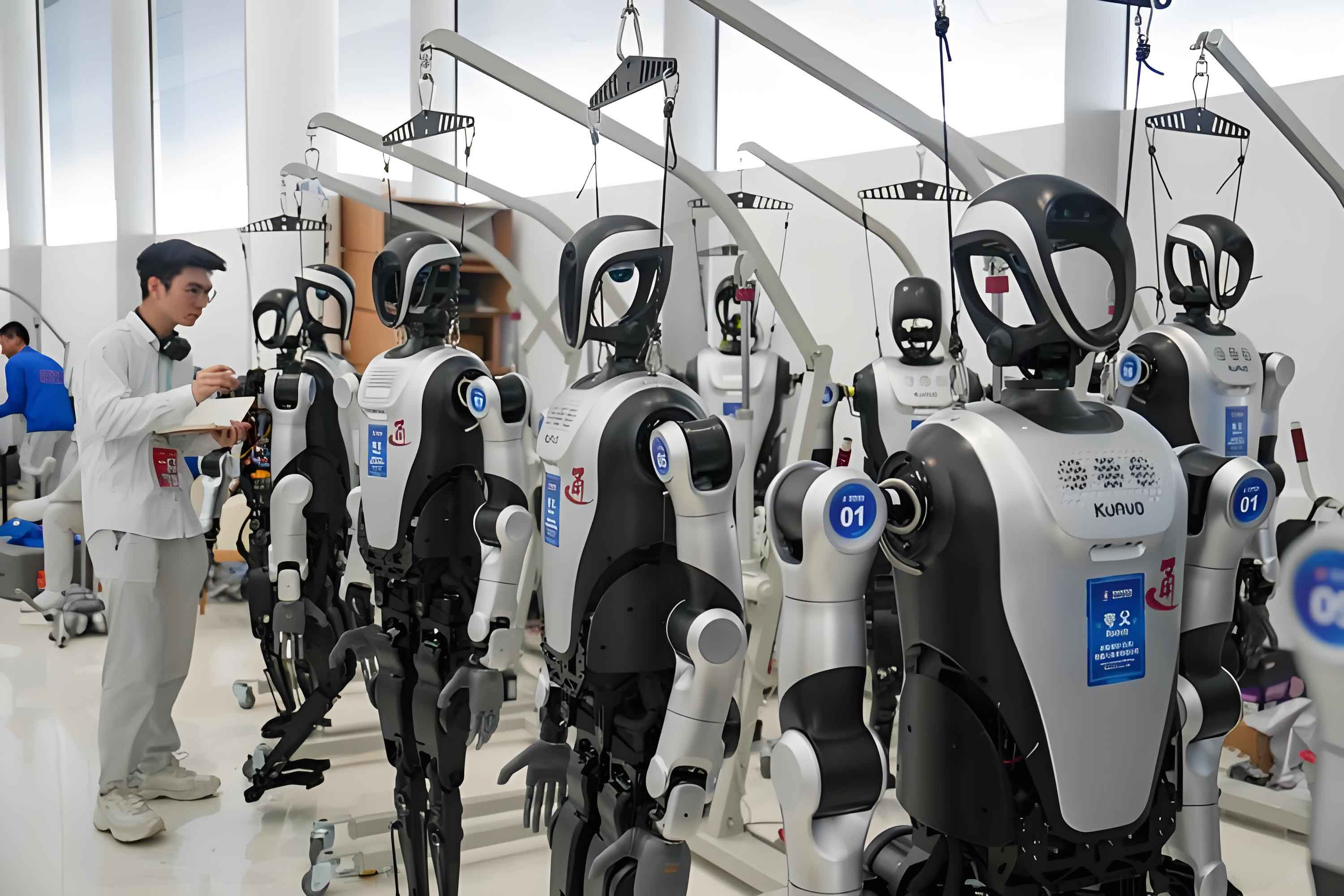
This cycle of clearing hurdles, upgrading systems and clearing new hurdles is a realistic portrait of Chinese embodied AI companies going global. The year 2026 has become an important node for Chinese embodied intelligence enterprises seeking overseas markets. Data from the first quarter showed that China’s humanoid robot exports rose 210% year on year. A humanoid robot factory built in Serbia through cooperation with Chinese companies has officially started mass production. Yet beneath the high-profile momentum, humanoid robot developers still face challenges in technology iteration and commercialization routes.
Unlike the electric vehicle path of first cultivating the domestic market and then expanding overseas, Chinese humanoid robot and embodied intelligence companies are moving into international markets at an early stage. The question is how this overseas journey, which carries both opportunity and risk, should proceed. The humanoid robot sector is not simply exporting hardware. It is testing whether companies can adapt technology to real scenes, comply with fragmented rules and build trust with customers in distant markets.
1. Ecosystem Positioning: Seizing the Early Window for Humanoid Robot Markets
“Go global or be left out” is a consensus that took shape in the electric vehicle industry, and it appears to have arrived even earlier in the humanoid robot and embodied intelligence race. The domestic market for this emerging track is becoming crowded. Data show that in 2025, the number of domestic humanoid robot original equipment manufacturers exceeded 140, and more than 330 humanoid robot products were released. According to a report from market research firm SAG, in the first half of 2026, Chinese humanoid robot manufacturers accounted for more than 97% of global shipments.
Among them, Unitree Robotics and Zhiyuan accounted for about 75% of the share, leaving most other companies to compete for the remaining portion. An industry insider said that because commercial scenarios have not yet been truly proven, most embodied intelligence companies are not yet profitable and many rely on financing to keep going. Later entrants face particularly heavy pressure. Unlike the domestic market, overseas markets are still in a “trial” stage for humanoid robots, and even entertainment and consumer fields offer considerable space.
Lu Xizhe, head of marketing and public relations at Youliqi Robot Technology (Suzhou) Co., Ltd., said that going global is not about chasing a hot topic but about doing the math. In some countries, hiring is difficult and labor costs are high, making the demand for labor substitution more urgent and customers more willing to pay. An industry insider told reporters that a humanoid robot sells for RMB 200,000 in China, while in some countries it can sell for RMB 400,000 or even RMB 800,000.
Early overseas expansion is not only about short-term high-margin orders. At present, the global humanoid robot track has not yet produced a monopolistic international leading brand, and the international market is in a brand blank period. Pei Xuan, a researcher at the Center for Business Ethics and Social Responsibility at the University of International Business and Economics, argued that if the early window is missed, overseas technology giants may rely on computing resources, algorithm advantages and local scenarios to complete a global ecosystem closed loop first, creating a generational gap that suppresses China’s industry. By setting up overseas distributors, experience centers and flagship projects as early as possible, companies can lock in brand recognition, build localized service networks and form first-mover channel advantages.
In recent years, a group of embodied intelligence companies, including Unitree Robotics, Zhiyuan, Dobot, Fourier, Booster Robotics and Robot Era, have actively positioned themselves in global markets. For companies such as Unbounded Dynamics, overseas business contribution has exceeded 50%. The collective overseas push of Chinese humanoid robot companies rests on two “trump cards”: supply chain advantages and scenario resource advantages.
“The advantage of China’s supply chain is at a knockout level,” said Xu Chunshan, founder and chairman of Zhejiang Lingqiao Intelligent Technology Co., Ltd. The young company, founded in 2024, took less than 10 months to build China’s first mass-produced high-degree-of-freedom five-finger dexterous hand and won an overseas cooperation project. Xu said that putting thousands of components into the palm of a hand cannot be completed without industrial ecosystem coordination. It requires joint efforts from companies across the industrial chain, including motors, tendons and sensors, to tackle the goal of a one-million-cycle service life.
Multiple interviewees said that in the humanoid robot field, China has formed a complete manufacturing system from motors, reducers, sensors and controllers to complete machines, which can support rapid product iteration. Moreover, electric vehicles and humanoid robots share highly similar underlying technologies, and many electric vehicle component suppliers are crossing over to supply humanoid robot parts. The New York Times reported that China’s robot industry once depended on Japan and other foreign suppliers for sensors and joints, but these components are now also manufactured in China. The report said it is “almost impossible to make a humanoid robot without using Chinese-made components.”
Scenario resources are equally critical. From the landing of a group of national artificial intelligence application pilot bases to the launch of the 2026 special action for real-scene training of humanoid robots and embodied intelligence, the large number of innovation scenarios released in China is pushing humanoid robots to accelerate into an “operation mode.” Pei Xuan said that massive domestic industrial scenarios bring data iteration advantages and mature mass production capacity, and China’s humanoid robot industry as a whole has the foundation to seize early opportunities in international markets.
2. Path Reconstruction: From Selling Prototypes to Selling Productivity
Yet beneath the busy wave of overseas expansion, concerns about a structural imbalance in the market are emerging. International Data Corporation statistics show that in 2025, global actual shipments of humanoid robots were only about 18,000 units. More than 85% went to entertainment performances, education and research, guided tours and shopping guides, and other scenarios focused on technical verification and display interaction. Industrial manufacturing and warehouse logistics remain mainly at the pilot stage.
For example, according to Unitree Robotics’ prospectus, revenue from outside China accounts for more than 40% of its total. Public information shows that Unitree Robotics’ overseas sales mainly go to universities and research institutions. At the 2026 World Robot Conference, an overseas agent for Unitree Robotics told reporters that in Indonesia, more than 90% of current customer inquiries come from entertainment performances, education and research and other fields. A Swedish industrial figure said in an interview that Chinese humanoid robots are progressing quickly, but many remain at the level of “showing off skills” and are still some distance from truly working on production lines.
The overseas research and education market is “low-hanging fruit,” but it cannot support true industry-level growth. Pei Xuan analyzed that if companies only sell humanoid robot bodies to universities and overseas laboratories, they will eventually encounter a growth ceiling. The way out is to quickly shift toward business-to-business scenarios such as industrial manufacturing and special operations, moving from selling prototypes to selling productivity.
However, a huge gap remains between future technological imagination and industrial reality. At present, after sufficient training in fixed scenarios, a humanoid robot’s task success rate can approach 100%. But once the object being handled is changed or the environment is slightly altered, the success rate drops sharply. This means that the problem of humanoid robots performing long-term work in complex environments remains unresolved. In Lu Xizhe’s words, the embodied intelligence robot market lacks neither demand nor customers; what it lacks is technology. Overall, humanoid robots in industrial scenarios still have insufficient stability, insufficient speed and weak generalization ability, and the technology is still “one breath short.”
That missing “breath” mainly lies in the “brain.” China’s humanoid robots have made significant progress in the “cerebellum” and “body” layers, but “brain” capabilities still face many challenges. Pei Xuan believes that hardware manufacturing capability determines the foundation for mass production, while core “brain” technology is the key to commercial value, large-scale commercial use and global expansion. If substantive breakthroughs in “brain” technology cannot be achieved quickly, China’s strong hardware production capacity will be difficult to fully release, and the industry could easily fall into a dilemma of large prototype export volumes but weak commercial deployment.
More data means more intelligence. Making the “brain” smarter ultimately requires data. Data show that by early 2026, the total amount of globally compliant and usable real physical interaction data was only about 500,000 hours, while training a general embodied large model requires at least 10 million hours. How can such a large gap be filled? Deploying humanoid robots at customer sites to collect scenario data is key.
Pei Xuan argued that humanoid robots are highly non-standard products, and domestic scenarios cannot cover the differentiated working conditions of global manufacturing and service industries. Real deployment across multiple overseas regions and industries can quickly accumulate heterogeneous physical-world data and reverse-optimize multimodal perception and general task planning algorithms, solving the industry pain point of laboratory prototypes being disconnected from real working conditions. Compared with companies that rely only on domestic scenarios for iteration, manufacturers that go overseas earlier can complete reliability, payload and human-robot interaction validation faster and shorten the cycle from prototype to mass-produced models.
Shen Mingda deeply agrees. In his view, the most important thing is not to pursue extreme model performance before landing, but to “move forward in the mud of real scenarios.” Beautiful prototype demonstrations are far from a commercial closed loop. “Sleeping in the factory” and working with customers to solve down-to-earth problems is important. It is difficult to deliver a perfect humanoid robot from the beginning. Shen gave an example: the K15 humanoid robot initially failed to meet customer requirements in production cycle and operation accuracy. The team and the customer worked together on the real production line and achieved rapid performance improvement. Only through repeated scenario validation, hardware modification and algorithm adaptation can the “brain” and “body” evolve together.
“In the process of going global, companies should not flood the market with products at the first step but should first prove sample scenarios,” Lu Xizhe said. He believes that tasks such as supermarket shelf stocking, hotel cleaning, building inspection, front-warehouse sorting and reception delivery are highly repetitive, relatively fixed in process and high in labor cost. For overseas customers, as long as a humanoid robot can stably complete part of the task, it has actual value. He suggested that humanoid robot companies go abroad together with other Chinese companies. In fields such as hotels, property management, retail and park operations, many Chinese companies already have overseas projects, and humanoid robot companies can land alongside real scenarios.
At the same time, using simulation to build a “training ground” for humanoid robots is crucial to breakthroughs in “brain” technology. However, a real dilemma is that many Chinese humanoid robot companies are highly dependent on overseas simulation systems and find it difficult to form an autonomous and controllable research and development loop, which drags down progress in “brain” capability.
“This problem cannot be treated lightly,” said Yang Haibo, co-founder and president of Guanglun Intelligent Technology (Beijing) Co., Ltd. He believes that simulation dependence is more hidden and more fundamental than computing power dependence. Computing power determines whether a model can run, while simulation determines where a humanoid robot learns, under what physical laws it learns and by what standards it is evaluated. In the past, China long relied on overseas systems in the field of industrial simulation. In the physical AI era, if Chinese companies still use only simulation tools, data formats and evaluation systems defined by others, then even if China’s humanoid robot industry has stronger hardware and richer manufacturing scenarios and application demand, it will be difficult to gain the initiative in the next generation of physical AI infrastructure.
Yang Haibo said that China needs full-stack self-developed simulation capabilities to participate in the co-construction of global physical AI infrastructure rules and provide more autonomous and collaborative underlying support for training and evaluation for Chinese humanoid robot companies going overseas. He further explained that whoever can use high-confidence simulation to complete task adaptation, stress testing and risk identification before a humanoid robot enters a real site, and can pre-validate its stability, safety and deployability, will be more likely to reduce overseas deployment costs, shorten delivery cycles and seize the initiative. Chinese companies need to prove before going overseas that their humanoid robots can work stably.
3. Collaborative Breakthroughs: Building Genuine Global Delivery Capacity for Humanoid Robots
The overseas expansion of humanoid robots is a long obstacle race that tests wisdom, endurance and perseverance, and it requires crossing many barriers. Compliance is an unavoidable threshold. One company took its humanoid robot to a professional institution for overseas market compliance certification. After testing item by item according to the standards, too many non-compliant points were found, but by that time the humanoid robot had already been finalized and could not be modified. “We have seen this situation too many times,” said Shan Ming, general manager of industrial machines in the solar and commercial products service department of TUV Rheinland Greater China.
Using European Union standards as an example, Shan Ming said that a humanoid robot not only needs certification for the complete machine in areas such as machinery directives and regulations, radio directives, cybersecurity and electromagnetic compatibility, but components such as power boards, joint modules, lithium batteries and safety controllers also need separate certification. The “tightening band” is becoming tighter. Huang Yu, senior manager in the electronic and electrical products service department of TUV Rheinland Greater China, reminded companies that the vulnerability disclosure obligations of the European Union’s Cyber Resilience Act are about to formally take effect. The act requires manufacturers of products with digital elements to proactively report exploited security vulnerabilities and security incidents to EU authorities. Companies in violation may face fines of up to 2.5% of global turnover or EUR 15 million, significantly raising the compliance cost for global digital products entering the EU market.
“At present, the overall scale of humanoid robot exports is still relatively small, and compliance issues have not yet become particularly prominent. But once volume grows, overseas regulators will certainly take notice,” Shan Ming said. He suggested that companies going global should put compliance requirements first, thoroughly study the regulations and technical requirements of destination countries, and integrate relevant rules from the design source to avoid detours later.
Liu Zhufu, deputy general manager and co-founder of Dobot, has deep experience with this. Dobot has ranked first in China’s collaborative robot export volume for eight consecutive years, with products sold to more than 100 countries and regions. “None of our orders came from low prices,” Liu said. Certification systems in Europe and the United States are extremely strict. Dobot’s experience is to pave the way with certifications in advance and use dozens of international certifications to open the door to overseas markets.
At the same time, multiple interviewed experts called for promoting mutual recognition of international standards at the national level to reduce duplicate testing costs. Pei Xuan analyzed that when electric vehicles went global, the global vehicle safety and energy consumption standard systems had basically taken shape, and China could only passively benchmark and adapt. At present, international standards for humanoid robot safety, performance and human-robot interaction are still in the drafting stage. Relevant departments should actively encourage Chinese companies and research institutions to participate deeply in standard-setting in international organizations such as the International Organization for Standardization, the International Electrotechnical Commission and the International Telecommunication Union, integrate China’s engineering practices and industrial chain technical parameters into global rules, and enhance standard discourse power.
Localization is another major challenge. “The overseas expansion of humanoid robots is not simply selling equipment but providing long-term service,” Lu Xizhe said. He believes that humanoid robots will not simply copy the overseas path of electric vehicles. The electric vehicle scenario is relatively simple: it solves the problem of travel. But humanoid robots face different specific tasks, and each scenario must be re-adapted. After a robot is sold, remote diagnosis, software upgrades, spare parts replacement and on-site training are still needed. What customers really care about is who will solve the problem and how long it will take. Without a localized operations team, once a robot needs repair, the customer must either send the product back or the company must fly staff to fix it, which is costly in time and money.
At present, intensifying international technological competition has further amplified the importance of localization. Recently, an order from the U.S. Federal Communications Commission blocked the future channel for humanoid robots, quadruped robots and other advanced robots to enter the U.S. market. Pei Xuan analyzed that the overseas expansion of humanoid robots is related to competition for global dominance in future industries, and trade protection barriers will only become normalized. In the early stage of going global, companies should simultaneously position themselves in diverse markets such as Europe, Southeast Asia, the Middle East and Latin America, and form a buffer system for bidirectional technology flows through overseas localized research and development and joint projects, reducing the systemic risk of core technologies and market demand being highly tied to a single market.
Fourier’s major order in Malaysia provides an example of localized operations. In June this year, in Ipoh, Perak, Malaysia, the Sultan Nazrin Shah Rehabilitation Centre built by Malaysia’s Social Security Organization, PERKESO, was officially opened. It is the largest rehabilitation center in Southeast Asia and can accommodate 700 patients at the same time. Fourier landed a major order there involving an intelligent rehabilitation port, the Galileo system and clinical application validation projects for humanoid robots.
Winning this major order was not easy. Fourier and PERKESO went through a four-year period of adjustment and磨合. Behind this was the support of a local team. “We recruited Malaysians and local Chinese and built a local team of dozens of people capable of rapid pre-sales consultation and after-sales response,” said Gu Jie, founder and chief executive officer of Fourier. He said that attracting outstanding talent to identify with the development philosophy of a Chinese embodied intelligence company and truly integrate into the company’s strategy and culture is a long-term process. Only by building an international team capable of cross-cultural collaboration and continuous customer service can a company truly take root locally and achieve sustainable development.
The overseas expansion of humanoid robots can reuse the supply chain and manufacturing foundation built by electric vehicles, but the road ahead is more rugged. It tests technological breakthroughs, scenario adaptation, rule adaptation and trust accumulation. As Lu Xizhe said, for Chinese humanoid robots to “go global” like new energy vehicles, what matters is not short-term heat but truly building global delivery capacity. From “product going global” to “ecosystem going global,” the overseas journey of China’s humanoid robot industry has only just begun.
4. Key Indicators Shaping the Humanoid Robot Overseas Debate
| Indicator | Reported Figure | Context for the Humanoid Robot Sector |
|---|---|---|
| China humanoid robot export growth | 210% year on year in the first quarter of 2026 | Early overseas demand is expanding quickly, but the base and commercial mix remain important for humanoid robot deployment. |
| Domestic humanoid robot original equipment manufacturers in 2025 | More than 140 | A crowded domestic humanoid robot market is pushing companies to seek overseas orders and scenarios. |
| Humanoid robot products released in China in 2025 | More than 330 | Product variety is rising, increasing pressure on differentiation and commercial proof for each humanoid robot platform. |
| Chinese share of global humanoid robot shipments in the first half of 2026 | More than 97% | China’s humanoid robot supply chain and manufacturing base are central to global shipment volumes. |
| Combined share of Unitree Robotics and Zhiyuan | About 75% | Concentration is high, leaving most humanoid robot companies to compete for a smaller remaining market. |
| Global actual humanoid robot shipments in 2025 | About 18,000 units | The market remains small relative to expectations, and most humanoid robot use is still display and verification oriented. |
| Share of shipments going to entertainment, education, research and guided interaction | More than 85% | Industrial manufacturing and warehouse logistics for humanoid robots remain largely at the pilot stage. |
| Unitree Robotics’ overseas revenue share | More than 40% | Overseas sales are significant, but public information indicates they mainly flow to universities and research institutions. |
| Customer inquiries from entertainment and education in Indonesia | More than 90% | This illustrates the current demand structure for humanoid robots in at least one overseas market. |
| Globally compliant usable real physical interaction data by early 2026 | About 500,000 hours | Data scarcity is a core constraint on humanoid robot “brain” development and generalization. |
| Data needed to train a general embodied large model | At least 10 million hours | The gap highlights why real-world overseas deployment matters for humanoid robot learning. |
| Unbounded Dynamics’ CE certification effort | Eight months and more than RMB 1 million | Compliance is a material cost and time factor for humanoid robot market entry in Europe. |
| Unbounded Dynamics’ overseas business contribution | More than 50% | For some humanoid robot companies, overseas revenue is already central rather than marginal. |
| Illustrative humanoid robot price difference | RMB 200,000 in China; RMB 400,000 to RMB 800,000 in some countries | Price premiums overseas can support early humanoid robot exports, but long-term value depends on productivity. |
| Dobot’s collaborative robot export record | Eight consecutive years as China’s top exporter; products sold to more than 100 countries and regions | Certification and channel experience from adjacent robot categories can inform humanoid robot globalization. |
| Fourier’s Malaysia rehabilitation center project | A four-year period of adjustment with PERKESO; a center accommodating 700 patients | Local teams and long-term service relationships are essential for humanoid robot and rehabilitation robotics deployment. |
The table above reflects figures and examples cited in the reporting. For the humanoid robot industry, the numbers point to a dual reality. China’s humanoid robot supply chain, manufacturing capacity and export momentum are strong. At the same time, the humanoid robot market is still small, concentrated and heavily weighted toward demonstration, education and research. The next stage of growth depends on whether humanoid robot companies can move into real production, logistics, service and special-operation scenarios and prove stable productivity rather than one-time novelty.
For Chinese humanoid robot companies, the overseas market is not a shortcut around domestic commercialization challenges. It is a testing ground that exposes those challenges more sharply. A humanoid robot that can perform in a controlled demonstration may still struggle with a changed object, a altered route, a new safety rule or a customer’s maintenance request. A humanoid robot that can win a headline order may still face certification costs, local service obligations and regulatory changes. The experience of Unbounded Dynamics, Dobot, Fourier and others shows that global delivery capacity is built through certification, local teams, scenario proof, data collection and long-term customer work.
The humanoid robot sector also faces a rules competition. European Union standards for machinery, radio, cybersecurity and electromagnetic compatibility are already demanding for complete machines and components. The Cyber Resilience Act’s vulnerability reporting obligations add another layer of compliance risk. In the United States, regulatory barriers are also rising. For humanoid robot exporters, market diversification is not only a growth strategy but a risk-management strategy. Europe, Southeast Asia, the Middle East and Latin America may each require different adaptation, different partners and different service models.
At the same time, the humanoid robot industry needs to address its simulation and data foundations. If humanoid robot companies rely on overseas simulation systems, they may face hidden constraints in training, testing and evaluation. If they cannot collect enough real physical interaction data, their “brain” capabilities will remain limited. Overseas deployment can help fill the data gap, but only if companies treat overseas sites as learning environments rather than simple sales destinations. The humanoid robot that works with a customer on a real production line, encounters real exceptions and receives real feedback is more valuable than a humanoid robot that only performs on a stage.
The supply chain advantage remains a powerful foundation. China’s humanoid robot industry can draw on motors, reducers, sensors, controllers and complete-machine manufacturing. Electric vehicle suppliers are crossing over into humanoid robot components. The dexterous hand example shows how thousands of components can be integrated through industrial ecosystem coordination. But supply chain strength alone does not guarantee commercial success. The humanoid robot industry must convert hardware capability into reliable productivity, and it must do so under different regulations, customer expectations and labor conditions.
The scenario advantage is equally important. China’s large industrial base, pilot bases and real-scene training initiatives create opportunities for humanoid robot iteration. Yet domestic scenarios cannot cover every overseas working condition. Overseas deployment across multiple regions and industries can generate heterogeneous data and help humanoid robots adapt to different environments. This is why early overseas expansion may offer learning benefits beyond immediate revenue. Companies that deploy humanoid robots in real overseas sites can validate reliability, payload and human-robot interaction earlier and shorten the path from prototype to mass production.
Still, the humanoid robot industry should not confuse early market interest with mature demand. Entertainment, education and research can provide revenue and visibility, but they are not the final destination. Industrial manufacturing, warehouse logistics, special operations, hotel cleaning, supermarket stocking, building inspection and rehabilitation care are harder scenarios, but they are closer to the productivity promise of the humanoid robot. Customers in these fields will judge humanoid robots by uptime, safety, speed, service response and cost per task, not by the elegance of a demonstration.
The localization challenge is especially demanding for humanoid robots. Unlike a simple machine, a humanoid robot may need software updates, spare parts, on-site training and remote diagnosis. Customers want to know who will solve problems and how quickly. A local team is therefore not a secondary expense but a core part of global delivery capacity. Fourier’s experience in Malaysia shows that a four-year relationship and a local team of dozens of people can be as important as the technology itself. For humanoid robot companies, building cross-cultural teams and long-term service networks will take time.
Compliance must also move upstream. Humanoid robot companies should study destination-market rules before finalizing designs. Certification should not be an afterthought once a humanoid robot has already been fixed in hardware. The experience of companies that discovered too many non-compliant points after finalization shows the cost of late compliance work. Industry experts also call for greater participation in international standards for humanoid robot safety, performance and human-robot interaction. If Chinese companies and research institutions can help shape those standards, the humanoid robot industry may reduce repeated testing costs and improve its position in global rules.
Trade protection and geopolitical competition add uncertainty. The U.S. Federal Communications Commission order affecting advanced robots is a reminder that market access can change quickly. For humanoid robot exporters, a multi-market strategy and localized research and development can provide a buffer. Joint projects and overseas teams can also support bidirectional technology flows. The goal is not merely to ship more humanoid robot units but to build a global delivery system that can adapt to different regulatory regimes and customer needs.
In the end, the humanoid robot overseas journey is a test of patience. The early export growth figures are striking, and the supply chain is strong. The K15 humanoid robot arriving in France, the Serbian humanoid robot factory starting mass production and the overseas orders won by Chinese companies all show momentum. But the humanoid robot industry still needs to prove that it can move from prototypes to productivity, from demonstrations to daily operations and from product exports to ecosystem exports. The companies that succeed will be those that combine technology, compliance, local service and real-world data into a durable global delivery capability.
For China’s humanoid robot sector, the overseas challenge has just begun. The opportunity is real, but so are the gaps. The humanoid robot that can work safely in a French battery plant, respond to a Malaysian rehabilitation need, meet European certification requirements and learn from real customer sites will be more than an export product. It will be evidence that the humanoid robot industry can build trust across borders. That is the harder and more important test for the next stage of global growth.