
JIUJIANG, Sept. 19, 2026 — A signing ceremony and a stock exchange listing, separated by only seven days, have placed Jiujiang Robot Town at the center of a fast-forming artificial intelligence and robotics cluster in Jiangxi. On Sept. 2, Jiangxi Luyou Robotics Joint Venture held its signing ceremony in Jiujiang, launching the construction of Jiangxi’s first independent humanoid robot brand. The project is located in Jiujiang Robot Town in the Poyang Lake Eco-Tech City. One week later, on Sept. 9, Udi Robot was listed on the Main Board of the Hong Kong Stock Exchange. The two events, one a contract and the other a market debut, sent a clear signal that Jiujiang Robot Town is becoming an important pole of the artificial intelligence industry in Jiangxi.
The cluster has already introduced more than 100 artificial intelligence-related projects. Annual robot production capacity in the park has exceeded 40,000 units. Products are widely used in more than ten segmented fields, including logistics delivery, medical disinfection, industrial inspection, and commercial services. In 2025, the park shipped 13,000 intelligent robot complete units and generated revenue of more than 1.8 billion yuan. The town is not only the site of the province’s first humanoid robot production line, but also the starting point for the service robotsYoubao and Cruzer as they move into the national market. The rise of the humanoid robot sector, the expansion of service robot applications, and the clustering of embodied intelligence enterprises are together reshaping the industrial landscape around Poyang Lake.
-
A Seven-Day Rhythm: From Humanoid Robot Brand Launch to Public Listing
The timing has drawn widespread attention. On Sept. 2, Jiangxi Luyou Robotics Joint Venture was formally established through a signing ceremony, marking the start of Jiangxi’s first independent humanoid robot brand. The project takes independent-brand complete machine manufacturing as its leading direction and focuses on research, development, and production of humanoid robot products suitable for industrial use, government services, cultural tourism and health care, park operations, ecological governance, and other scenarios. The initiative fills a gap in large-scale manufacturing and independent branding of humanoid robots in Jiangxi.
Seven days later, on Sept. 9, Udi Robot (Wuxi) Co., Ltd. was listed on the Main Board of the Hong Kong Stock Exchange, becoming the first Hong Kong-listed stock focused on full-scenario commercial service robots. Jiujiang is not only an important capacity carrier for Udi Robot but also deeply tied to the company through capital links, allowing the city to share in its growth. For Jiujiang Robot Town, the listing is more than a financial event. It is evidence that the town’s humanoid robot and service robot ecosystem has begun to produce companies capable of reaching capital markets and expanding across the country.
The sequence also reflects a broader pattern. A humanoid robot brand launch demonstrates the town’s move toward independent innovation and brand building. A public listing demonstrates the market recognition earned by enterprises rooted in the town’s manufacturing and application base. Together, the two events show that Jiujiang Robot Town is no longer only a destination for production lines. It is becoming a place where humanoid robot technology, service robot applications, capital, and industrial policy converge. The humanoid robot supply chain is being strengthened, the service robot market is being expanded, and the town’s brand is being lifted.
The rise of Jiujiang Robot Town is not an isolated case of one company or one project. It is the result of a chain of decisions that began with a focus on humanoid robots and embodied intelligence, continued with the introduction of leading enterprises, and now extends to independent brand creation. The town has moved from attracting investment to building an ecosystem, and from building production capacity to building a brand. For a city without a long-standing robot industry base, this path is notable. It shows how a humanoid robot cluster can be cultivated when computing power, manufacturing capacity, application scenarios, and institutional support are combined in a coordinated way.
In the humanoid robot sector, scale matters, but so does the ability to train, test, and iterate. Jiujiang Robot Town has placed both dimensions at the center of its development. The town’s humanoid robot production line provides manufacturing capacity. Its data collection and training center provides the data and scenarios needed for humanoid robot learning. Its computing infrastructure provides the processing power required for artificial intelligence models. Its open application scenarios provide real-world testing grounds. The combination is designed to shorten the distance between humanoid robot prototypes and industrial deployment.
-
Inside the Town: Humanoid Robot Scenarios and a Fast-Expanding Training Base
Walking into Jiujiang Robot Town, the sense of a technology-driven future is immediate. In the exhibition hall of the Jiujiang Robot Innovation Center, humanoid robots are moving materials. Collaborative robots are precisely grasping and sorting objects. Harvesting robots are identifying fruits and vegetables and completing non-destructive picking. The robotic arm of a smart coffee master is skillfully brewing coffee. Delivery robots are moving independently to transfer supplies. Different types of robots perform their own tasks, recreating diverse application scenarios in industrial production, smart agriculture, and lifestyle services.
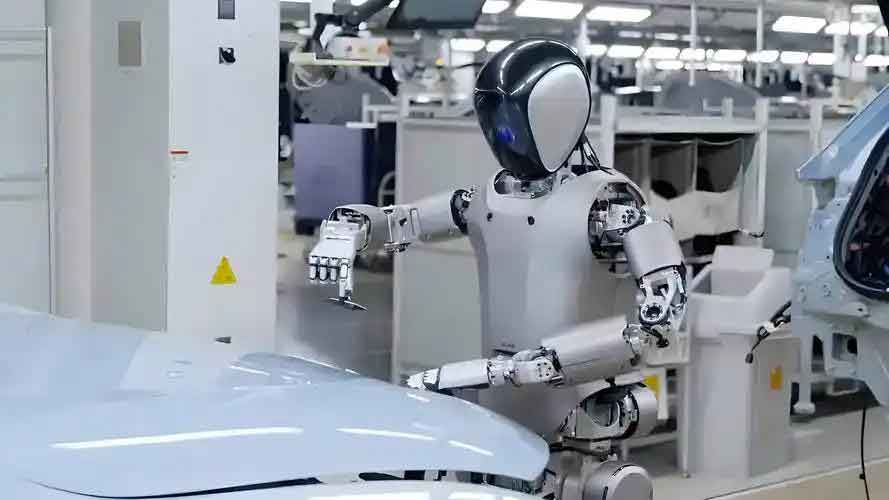
Not far away, in Jiangxi’s first humanoid robot and data collection center, more than 100 UBTECH WakerS2 humanoid robots are running at full speed. Some are precisely grasping parts in simulated industrial scenarios. Some are practicing serving tea and water in home scenarios. Others are being taught new skills by engineers. Nearly 100 scenarios cover industrial manufacturing, home services, commercial reception, and other fields. Every movement and every interaction of the humanoid robots is accurately recorded. Under the plan, the center will train no fewer than 1,500 small models and collect no fewer than 15 million pieces of test data, building a key bridge for humanoid robots to move toward industrialization.
The data collection center illustrates why Jiujiang Robot Town is attracting attention in the humanoid robot field. Humanoid robot development depends not only on hardware, but also on data. The ability to collect high-quality data across industrial, household, and commercial scenarios is a core resource. By combining more than 100 humanoid robots with nearly 100 scenarios, the center creates a structured environment for humanoid robot training. The humanoid robot is no longer only a display item. It is a worker in training, a learner in a simulated factory, and a service provider in a mock household. The data generated in these environments can support model training and product iteration.
Here, from research and development to manufacturing, and from training to application, a complete humanoid robot industrial chain is accelerating into shape. The town has already introduced more than 100 artificial intelligence-related projects. Annual robot production capacity has exceeded 40,000 units. Products are used in logistics delivery, medical disinfection, industrial inspection, commercial services, and more than ten segmented fields. In 2025, the town shipped 13,000 intelligent robot complete units and achieved revenue of more than 1.8 billion yuan. These figures show that the humanoid robot cluster is not only expanding in scale but also deepening in application.
The humanoid robot and data collection center adds a new layer to the town’s industrial system. The production line provides complete machines. The data center provides training data. The innovation center provides testing and display scenarios. The application sites provide feedback. This closed loop is important for humanoid robot commercialization. In many places, humanoid robot development is limited by a lack of real-world data and a lack of scenarios for iteration. Jiujiang Robot Town is addressing both by building a dedicated humanoid robot data collection environment and by opening the park itself as a testing ground.
The presence of service robots such as Youbao and Cruzer also shows how the town’s robot ecosystem has evolved. Service robots have already moved into national markets, while humanoid robots are being trained for more complex tasks. The two categories are not isolated. They share supply chains, manufacturing processes, testing facilities, and application experience. The humanoid robot sector benefits from the town’s accumulated experience in service robot production and deployment. At the same time, the humanoid robot program raises the technological level of the entire cluster and attracts new talent, suppliers, and capital.
-
From One Production Line to an Ecosystem: The Humanoid Robot Supply Chain Takes Shape
Jiujiang began targeting the humanoid robot sector as early as 2022. The city made a major move by introducing UBTECH and investing 650 million yuan to build an artificial intelligence industrial park. On Dec. 3, 2022, the city’s first robot production project started trial production in the eco-tech city, and the first robot, Cruzer, rolled off the line. That early step gave Jiujiang a first-mover position in the humanoid robot race and laid the foundation for later cluster development.
With the UBTECH project, Jiujiang started early and moved quickly. By the end of 2025, the province’s first humanoid robot production line was completed. In the first half of 2026, about 5,000 complete humanoid robot units were shipped. Thirteen embodied intelligence above-scale enterprises generated revenue of more than 798 million yuan, up 47.6 percent year on year. These figures reflect the growth of the humanoid robot manufacturing base and the expanding contribution of embodied intelligence enterprises to the local economy.
The arrival of a leading enterprise brought more than production capacity. It brought a complete industrial chain. Udi Robot is a vivid example. At the end of 2022, the Jiujiang municipal government and Udi Robot signed a strategic cooperation agreement in the eco-tech city. The eco-tech city, together with the municipal industrial guidance fund, used capital links to promote the landing of Udi Robot’s Jiujiang intelligent manufacturing base. The project has a total investment of about 800 million yuan and is being built in two phases. After production began in September 2024, Udi Robot continued to strengthen its position in unmanned delivery, smart hotel delivery robots, and other fields, growing into a benchmark enterprise in Jiujiang’s embodied intelligence sector.
On Sept. 9, 2026, Udi Robot (Wuxi) Co., Ltd. was listed on the Main Board of the Hong Kong Stock Exchange, becoming the first Hong Kong-listed stock focused on full-scenario commercial service robots. Jiujiang is not only an important capacity carrier for the company but also deeply bound to it through capital links, sharing in its growth dividends. For the humanoid robot cluster, Udi’s listing demonstrates that enterprises nurtured in the town’s ecosystem can reach broader capital markets. It also strengthens the town’s ability to attract suppliers, talent, and further investment.
The industrial clustering effect is becoming increasingly evident. The eco-tech city has adopted an investment-driven approach to attract leading enterprises such as UBTECH. In recent years, it has also landed a group of emerging industry players, including Udi Technology, Bomingwei, and Stardust Intelligence. Annual robot production capacity in the park has exceeded 40,000 units. In 2025, revenue grew rapidly by 40 percent. The eco-tech city now has 38 above-scale enterprises and 12 high-tech enterprises. It has been recognized as one of the first batch of provincial digital economy clusters and as a provincial “5G + Industrial Internet” application demonstration zone. The influence of the Jiujiang Robot Town brand continues to rise, and a virtuous development path of coordinated progress among projects, enterprises, and industries is taking shape.
This path is important for the humanoid robot sector. A humanoid robot supply chain requires precision components, sensors, actuators, control systems, software, data services, and testing capabilities. No single enterprise can build the entire chain alone. By attracting leading enterprises and then supporting upstream and downstream suppliers, Jiujiang Robot Town is creating an environment where humanoid robot companies can source, test, and iterate locally. The town’s annual robot production capacity of more than 40,000 units provides scale. Its 38 above-scale enterprises and 12 high-tech enterprises provide industrial depth. Its 40 percent revenue growth in 2025 shows momentum. The humanoid robot cluster is moving from a single production line to a broader ecosystem.
Reported indicator Reported figure or status Artificial intelligence-related projects introduced More than 100 Annual robot production capacity in the park More than 40,000 units Intelligent robot complete units shipped in 2025 13,000 units Revenue in 2025 More than 1.8 billion yuan Humanoid robot complete units shipped in the first half of 2026 About 5,000 units Revenue of 13 embodied intelligence above-scale enterprises in the first half of 2026 More than 798 million yuan, up 47.6 percent year on year Above-scale enterprises in the eco-tech city 38 High-tech enterprises in the eco-tech city 12 UBTECH artificial intelligence industrial park investment 650 million yuan Udi Robot Jiujiang intelligent manufacturing base investment About 800 million yuan Humanoid robots in the humanoid robot and data collection center More than 100 Scenarios in the humanoid robot and data collection center Nearly 100 Planned small models for training No fewer than 1,500 Planned test data collection No fewer than 15 million pieces China Telecom Central Cloud Computing and Big Data Center investment 2 billion yuan Total computing power of the China Telecom central cloud and big data center 1.2 million cores Storage capacity of the China Telecom central cloud and big data center More than 110PB First-phase computing power of the Poyang Lake Intelligent Computing Center 300P Planned mixed computing power in three years 2,500P Sci-Tech Innovation Center Phase II investment 365 million yuan Sci-Tech Innovation Center Phase II site 75 mu Sci-Tech Innovation Center Phase II space More than 130,000 square meters -
Building an Independent Humanoid Robot Brand: From Manufacturing Base to Brand Creator
With leading enterprises in place and an ecosystem gathering, Jiujiang has begun to move toward a higher goal. On Sept. 2, with the signing of an agreement, Jiangxi Luyou Robotics Joint Venture was formally established, and the construction of Jiangxi’s first independent humanoid robot brand was officially launched. The project takes independent-brand complete machine manufacturing as its leading direction and focuses on research, development, and production of humanoid robot products adapted to multiple scenarios, including industry, government services, cultural tourism and health care, park operations, and ecological governance.
The launch of the Luyou project fills a gap in Jiangxi’s local humanoid robot large-scale manufacturing and independent brand building. It also marks a shift in Jiujiang’s role. In the early stage, Jiujiang attracted leading enterprises, brought in complete machine production lines and technical capabilities, and quickly formed production capacity. In the next stage, it built an ecosystem by introducing upstream and downstream supporting enterprises around the leaders and gathering dozens of related companies. Now, it has reached the stage of brand creation. With the right timing, state capital has taken an equity stake to jointly build a local brand. This is a path from attracting leaders to building an ecosystem, and from building an ecosystem to creating a brand.
For the humanoid robot sector, independent brand building is a significant step. It means the town is not satisfied with being a manufacturing base or an original equipment manufacturer. It aims to master product definition, brand value, and market channels. The humanoid robot is a complex product that integrates mechanics, electronics, software, artificial intelligence, and human-machine interaction. Building an independent humanoid robot brand requires deep integration of research and development, supply chain management, quality control, and application development. The Luyou project is designed to integrate these capabilities and to produce humanoid robot products for industrial, government service, cultural tourism, health care, park operation, and ecological governance scenarios.
The transition from “original equipment manufacturer” to “brand creator” is not simply a change in label. It reflects a change in the industrial structure. A manufacturing base can create jobs and output. A brand creator can capture more value, set product standards, and build long-term customer relationships. In the humanoid robot field, brand building also requires continuous investment in data, algorithms, and scenario development. Jiujiang Robot Town has already built a humanoid robot production line, a humanoid robot data collection center, and a growing ecosystem of artificial intelligence enterprises. These assets provide a foundation for independent humanoid robot brand development.
The Luyou project also strengthens the town’s ability to coordinate with the broader Jiangxi economy. The humanoid robot brand is positioned for multiple scenarios, including industry, government services, cultural tourism and health care, park operations, and ecological governance. These scenarios are closely connected to local economic and social development. By developing humanoid robot products for these fields, the project can help expand application demand and create a local market for humanoid robot technology. At the same time, it can use Jiujiang Robot Town’s manufacturing capacity and testing environment to accelerate product iteration.
The humanoid robot brand launch is therefore part of a larger industrial upgrade. The town first attracted leading enterprises to build production lines and technical capacity. It then built an ecosystem by bringing in upstream and downstream enterprises. Now it is creating an independent brand with state capital participation. Each stage builds on the previous one. The result is a more complete humanoid robot industrial system that includes manufacturing, research and development, data collection, scenario testing, and brand building. The humanoid robot cluster is moving from scale expansion to value creation.
-
Computing Power as the Foundation: An Early Strategic Bet on Artificial Intelligence Infrastructure
As the brand grows, a question deserves attention: why Jiujiang? Why has a city without a robot industry base been able to build such an industrial chain in a few short years? The answer lies in earlier布局? No, the answer lies in earlier strategic arrangements. In the artificial intelligence era, computing power is a core foundation. From the beginning, the eco-tech city has focused on this hard logic and treated computing power as a strategic move for industrial cultivation.
In the eco-tech city, the China Telecom Central Cloud Computing and Big Data Center is processing massive amounts of information day and night. The center, with a total investment of 2 billion yuan, began construction as early as 2019. It is the only national green data center in the provincial communications field. Its total computing power reaches 1.2 million cores, and its storage capacity exceeds 110PB. This infrastructure provides a foundation for artificial intelligence model training, data processing, and robot software development. For humanoid robot companies, access to large-scale computing and storage is essential for training models, processing sensor data, and running simulations.
In 2024, the China Telecom Poyang Lake Intelligent Computing Center and the Xirang Jiangxi computing scheduling platform were launched in the eco-tech city. The platform became the province’s first cross-regional heterogeneous computing scheduling platform. Its first phase of 300P computing power has been put into use. In the next three years, a mixed computing power scale of 2,500P will be built. This will support Jiujiang in creating a provincial green intelligent computing industry base that radiates to central China. Together with research platforms such as the testing center, the robot innovation center, and the CAICT Jiangxi Research Institute Jiujiang Innovation Center, the eco-tech city is building a full-chain supporting service system covering computing power, data, research and development, and talent. This system has become a solid foundation for Jiujiang’s digital economy.
The computing power foundation is particularly important for humanoid robots. A humanoid robot must perceive its environment, plan movements, maintain balance, interact with humans, and adapt to changing conditions. These tasks require large-scale model training, real-time data processing, and simulation. The humanoid robot and data collection center in Jiujiang Robot Town generates large volumes of training data. The computing center provides the capacity to process that data. The combination of data and computing power is a key advantage for humanoid robot development. It allows companies to train models faster, test scenarios more efficiently, and iterate products more quickly.
The Sci-Tech Innovation Center Phase II project is also under construction. With a total investment of 365 million yuan and a site of 75 mu, it can provide more than 130,000 square meters of innovation industry space. Once completed, it will become the core carrier of the Poyang Lake Intelligent Computing Center, directly strengthening the intelligent computing foundation of Jiujiang and the province. It is designed to undertake the spillover effects of the East Data West Computing initiative, meet regional computing coordination needs, and accelerate the improvement of the radiation capacity of the Yangtze River middle reaches computing hub. For the humanoid robot cluster, this project will provide more space for artificial intelligence enterprises, data services, and research teams.
The early bet on computing power helps explain why Jiujiang Robot Town has been able to attract humanoid robot and embodied intelligence enterprises. Computing power is not a visible product like a robot, but it is a foundational resource. It supports model training, data annotation, simulation testing, and cloud services. It also signals to enterprises that the local government understands the needs of artificial intelligence and is prepared to invest in long-term infrastructure. The humanoid robot industry requires patience and continuous investment. The computing power infrastructure in the eco-tech city provides that long-term support.
At the same time, the computing power base is connected to the town’s broader innovation system. The testing center, robot innovation center, and CAICT Jiangxi Research Institute Jiujiang Innovation Center provide services that complement computing power. Talent development, data services, and research collaboration are part of the same system. For humanoid robot companies, this means access to more than land and factories. It means access to a service system that can support the full lifecycle of humanoid robot development, from algorithm research to product testing and market application.
-
Institutional Innovation and Open Scenarios: Helping Enterprises Move Faster
Exploring the rise of Jiujiang Robot Town, reform and innovation are key themes throughout. The eco-tech city has consistently adhered to reform-led development and has deeply grasped the characteristics of its “municipal-level coordination, city-district co-construction” management system. Through municipal-level support in strategic planning, investment, and financing, together with district-level support in social affairs and factor guarantees, the eco-tech city has been able to move with a lighter burden and concentrate resources on industrial cultivation and technological innovation. Today, the idea that artificial intelligence and robotics development should go to the eco-tech city has gradually become a consensus among various parties.
For artificial intelligence enterprises, real application scenarios are core development resources. The eco-tech city has turned key projects such as the smart park and the industrial internet into testing grounds for enterprises. Demonstration scenarios including L4 autonomous driving, smart cleaning, unmanned supermarkets, and smart logistics have been fully opened. Robot exhibition space and application plazas have been built. “Many of our technology products have completed testing and iteration in the park’s scenarios, greatly accelerating the speed of landing,” said Zhou Tao, head of the UBTECH Jiujiang project. Relying on the rich local scenarios, enterprise products have matured quickly and expanded to markets both inside and outside the province. In the future, Jiujiang Robot Town will continue to open more application scenarios, continuously injecting nutrients into enterprise growth.
Open scenarios are especially valuable for humanoid robots. A humanoid robot must operate in unstructured environments, interact with people, and handle complex tasks. Real-world scenarios provide the variability and unpredictability that laboratories cannot fully reproduce. By opening the smart park, industrial internet projects, L4 autonomous driving, smart cleaning, unmanned supermarkets, and smart logistics, the eco-tech city offers humanoid robot and service robot companies opportunities to test their products in everyday operations. The feedback from these tests can be used to improve algorithms, hardware, and user experience. For humanoid robot companies, this is a practical advantage that can shorten development cycles.
Business environment optimization does not stop. The eco-tech city has carried out a special action called “officials enter enterprises, service reaches hearts.” Since the action began, more than 100 enterprise visits have been made, and dozens of demands have been collected and resolved. The “Fanglan Talks” government-enterprise exchange brand has become increasingly prominent, building a bridge of communication between government and enterprises. When enterprises reported power supply issues, the eco-tech city coordinated power supply upgrades. When employees faced inconvenient transportation, bus routes in the park were optimized and adjusted. When living facilities lagged behind, unmanned supermarkets and express delivery stations moved in. These may seem like small matters, but together they create a comfortable environment in which enterprises can “start work upon landing and produce upon completion.”
The institutional arrangement is important for the humanoid robot cluster. Humanoid robot companies often need long development cycles, specialized testing space, stable power, high-speed data connections, and access to talent. A supportive business environment can reduce non-technical burdens and allow companies to focus on technology and products. The “municipal-level coordination, city-district co-construction” system allows the eco-tech city to combine municipal-level strategic planning and investment with district-level social affairs and factor guarantees. This division of responsibilities helps the eco-tech city concentrate on industrial cultivation and innovation while ensuring that enterprises receive support in daily operations.
The open scenario strategy also creates a market for humanoid robot products. When the park itself uses robots for cleaning, delivery, security, and logistics, it becomes a customer as well as a testing ground. This dual role can help companies refine their products and understand user needs. The humanoid robot and data collection center further strengthens this model by recording data from real and simulated scenarios. The combination of open scenarios, data collection, and computing power creates a loop that supports humanoid robot development. Enterprises can test, collect data, train models, and deploy improved products in a continuous cycle.
The humanoid robot cluster also benefits from the town’s broader service ecosystem. The testing center, robot innovation center, and research platforms provide technical support. The business environment action provides administrative support. The open scenarios provide application support. The computing center provides infrastructure support. Together, these form a comprehensive environment for humanoid robot and embodied intelligence companies. The town’s ability to coordinate these elements is a key reason why it has been able to attract and retain enterprises in a competitive field.
-
A Humanoid Robot Cluster With Growing Influence and a Clearer Industrial Path
From one production line to an ecosystem, and from attracting enterprises to creating an independent brand, Jiujiang Robot Town has followed a clear industrial path. The town first attracted leading enterprises such as UBTECH, built production lines, and formed manufacturing capacity. It then built an ecosystem by bringing in upstream and downstream enterprises and gathering dozens of related companies. It is now creating an independent humanoid robot brand with state capital participation. This path is not based on a single breakthrough but on the coordinated development of projects, enterprises, and industries.
The humanoid robot cluster in Jiujiang is still young, but its momentum is evident. More than 100 artificial intelligence-related projects have been introduced. Annual robot production capacity has exceeded 40,000 units. In 2025, 13,000 intelligent robot complete units were shipped, generating more than 1.8 billion yuan in revenue. In the first half of 2026, about 5,000 humanoid robot complete units were shipped, and 13 embodied intelligence above-scale enterprises generated more than 798 million yuan in revenue, up 47.6 percent year on year. The eco-tech city now has 38 above-scale enterprises and 12 high-tech enterprises. These figures show that the humanoid robot cluster is building scale and depth at the same time.
The humanoid robot and data collection center adds a distinctive capability. With more than 100 humanoid robots and nearly 100 scenarios, the center is designed to train no fewer than 1,500 small models and collect no fewer than 15 million pieces of test data. This is a significant resource for humanoid robot development. It provides data for model training, scenarios for testing, and a structured environment for evaluating humanoid robot performance. The center also strengthens Jiujiang’s position in the humanoid robot supply chain by attracting companies that need data, testing, and training services.
Computing power remains a foundational advantage. The China Telecom Central Cloud Computing and Big Data Center, with an investment of 2 billion yuan, 1.2 million cores, and more than 110PB of storage, provides large-scale infrastructure. The Poyang Lake Intelligent Computing Center and the Xirang Jiangxi computing scheduling platform have added 300P of first-phase computing power, with a plan to build 2,500P of mixed computing power in three years. The Sci-Tech Innovation Center Phase II, with an investment of 365 million yuan, a site of 75 mu, and more than 130,000 square meters of space, will further strengthen the computing foundation. For humanoid robot companies, this infrastructure reduces the cost and difficulty of model training and data processing.
The humanoid robot brand launch adds a new dimension. Jiangxi Luyou Robotics Joint Venture is positioned as an independent-brand complete machine manufacturer. It will focus on humanoid robot products for industry, government services, cultural tourism and health care, park operations, ecological governance, and other scenarios. The project fills a gap in Jiangxi’s local humanoid robot large-scale manufacturing and independent brand building. It also marks a shift from being a manufacturing base to being a brand creator. For the humanoid robot cluster, this shift can increase value capture, strengthen market influence, and create a local brand that can compete beyond the province.
The town’s model also has implications for other regions. It shows that a humanoid robot cluster can be built by combining early strategic planning, leading enterprise introduction, computing infrastructure, open application scenarios, and institutional innovation. The sequence matters. Attracting a leading enterprise can bring production lines and technical capability. Building an ecosystem can bring suppliers and related enterprises. Creating a brand can capture more value and build long-term competitiveness. Each stage requires different resources and policies. Jiujiang Robot Town has moved through these stages in a relatively short period, demonstrating a practical path for humanoid robot industrialization.
At the same time, the humanoid robot sector remains challenging. It requires continuous technological breakthroughs, large-scale data, patient capital, and close collaboration between industry, academia, and research. Jiujiang Robot Town has laid a foundation in manufacturing, data, computing power, and scenarios. It has attracted leading enterprises and emerging companies. It has launched an independent humanoid robot brand. It has opened application scenarios and improved its business environment. These elements provide a platform for further growth. The next stage will depend on how effectively enterprises use this platform to develop products, expand markets, and build sustainable competitive advantages.
For now, the signals are clear. The signing of Jiangxi Luyou Robotics Joint Venture and the listing of Udi Robot, separated by seven days, have drawn attention to Jiujiang Robot Town. The town’s humanoid robot production line, humanoid robot data collection center, computing infrastructure, and open scenarios have created a distinctive ecosystem. The town’s annual robot production capacity of more than 40,000 units, its 13,000 intelligent robot complete units shipped in 2025, its more than 1.8 billion yuan in revenue, and its 47.6 percent growth in embodied intelligence enterprise revenue all point to a cluster in motion. On the shores of Poyang Lake, an industrial town centered on artificial intelligence and humanoid robots is accelerating into view.