
In the era of intelligent manufacturing, industrial robots are increasingly employed for continuous contact operations such as polishing, grinding, deburring, and assembly. As a critical component enabling hybrid force/position control in these tasks, the end effector with force control significantly impacts operation quality and application scope. We have extensively studied existing robotic end effectors with force control, analyzing their performance characteristics and key technologies to guide future development. This review aims to consolidate current knowledge and highlight directions for advancing high-performance end effector systems.
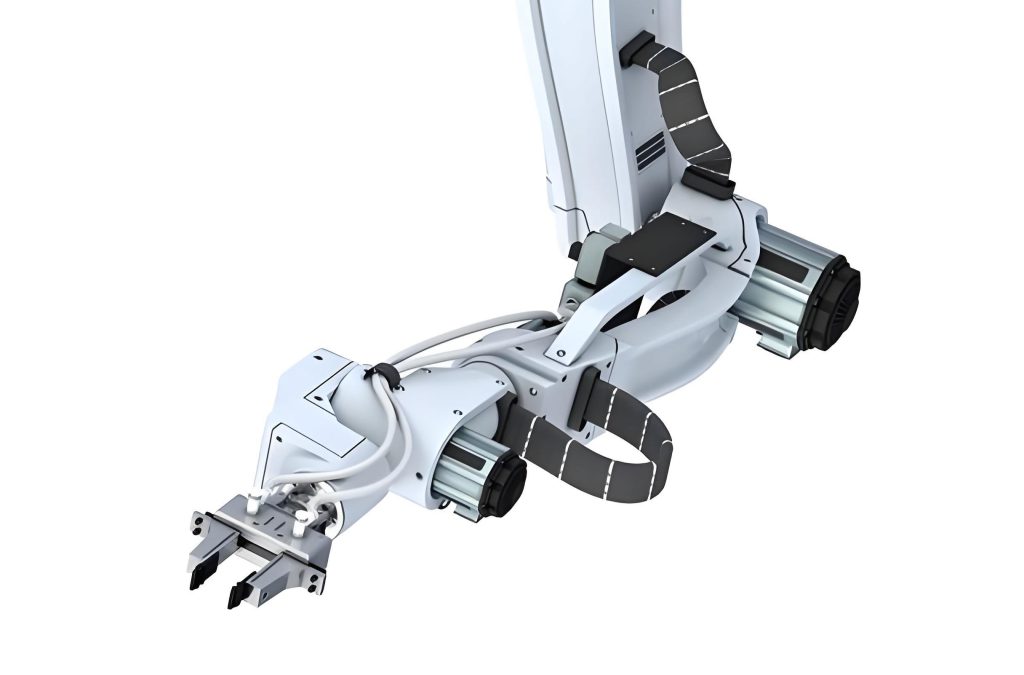
We begin by introducing the background and significance of end effectors with force control. Traditionally, force control in robots is achieved either through direct joint torque control or indirectly via附加的 end effectors. While direct control requires accurate dynamic models and robust algorithms, indirect control using an end effector offers decoupled force/position control with better dynamic performance and generality, especially for heavy-duty robots. Thus, the end effector with force control has become a pivotal element in robotic systems for contact-intensive applications.
The composition of a modern end effector with force control typically includes several key components. We can summarize these as follows:
| Component | Function |
|---|---|
| Constant-force compensatory actuator | Drives the tool head to adjust motion and contact force based on control signals. |
| Sensors | Detect real-time contact force magnitude and direction between tool head and workpiece. |
| Controller | Processes user commands and feedback signals to output control signals to the actuator. |
| Upper/lower interface parts | Connect the end effector to the robot arm and tool head. |
| Power unit | Provides power for the tool head’s operation. |
We classify end effectors with force control based on several criteria. Firstly, by activity level: passive end effectors operate in open-loop without online force adjustment, suitable for low-precision tasks; active end effectors use closed-loop control for precise force regulation. Secondly, by drive mode: mechanical, pneumatic, electrically driven, or electromagnetic. Thirdly, by degrees of freedom (DOF): single-DOF or multi-DOF. Each type has distinct advantages and limitations, which we will explore in detail.
The working mode of an end effector with force control during continuous contact operations involves several stages: approach, collision,贴合, and retraction. We outline the requirements for each stage:
| Stage | Contact Status | Control Mode | Objective |
|---|---|---|---|
| Approach | No contact | Position control | Fast and smooth movement toward the workpiece. |
| Collision | Transition from non-contact to contact | Position to force control切换 | Smooth transition to prevent impact damage. |
| Conformity | Continuous contact | Force control | Maintain constant normal contact force for quality. |
| Retraction | No contact | Position control | Fast and smooth movement away from the workpiece. |
The operational principle of an end effector with force control hinges on feedback control. For a single-DOF end effector, the controller compares force feedback from sensors (e.g., force sensors, displacement sensors, accelerometers) with a desired force setpoint. After compensating for gravitational and inertial forces using mass parameters, it drives the actuator to minimize error. The control law can be expressed as:
$$ u(t) = K_p e(t) + K_i \int e(t) dt + K_d \frac{de(t)}{dt} $$
where \( u(t) \) is the control signal to the actuator, \( e(t) = F_{desired} – F_{measured} \) is the force error, and \( K_p, K_i, K_d \) are PID gains. For multi-DOF end effectors, decoupling control is essential due to coupled chains. The dynamics of a multi-DOF end effector can be modeled as:
$$ \mathbf{M}(\mathbf{q})\ddot{\mathbf{q}} + \mathbf{C}(\mathbf{q}, \dot{\mathbf{q}})\dot{\mathbf{q}} + \mathbf{G}(\mathbf{q}) = \boldsymbol{\tau} – \mathbf{J}^T \mathbf{F}_{ext} $$
where \( \mathbf{q} \) is the generalized coordinate vector, \( \mathbf{M} \) is the inertia matrix, \( \mathbf{C} \) represents Coriolis and centrifugal forces, \( \mathbf{G} \) is gravitational force, \( \boldsymbol{\tau} \) is the actuator torque vector, \( \mathbf{J} \) is the Jacobian matrix, and \( \mathbf{F}_{ext} \) is the external force vector. The controller must solve for \( \boldsymbol{\tau} \) to achieve desired force \( \mathbf{F}_{desired} \) at the tool tip.
Key technologies in developing advanced end effectors with force control include:
- Parallel mechanism configuration synthesis and optimization: Parallel structures offer high stiffness, precision, and load capacity. We employ screw theory and evolutionary algorithms to design optimal configurations. For instance, the mobility of a parallel mechanism is given by:
$$ F = \lambda (n – j – 1) + \sum_{i=1}^{j} f_i $$
where \( F \) is degrees of freedom, \( \lambda \) is the order of the screw system (e.g., 6 for spatial motion), \( n \) is number of links, \( j \) is number of joints, and \( f_i \) is DOF of joint i. Optimization objectives often minimize mass while maximizing stiffness, formulated as:
$$ \min_{\mathbf{x}} \left( w_1 \cdot m(\mathbf{x}) + w_2 \cdot \frac{1}{k(\mathbf{x})} \right) $$
subject to constraints on workspace and stress, where \( \mathbf{x} \) is design variable vector, \( m \) is mass, \( k \) is stiffness, and \( w_1, w_2 \) are weights.
- Design of constant-force compensatory actuators: Actuators like voice coil motors, pneumatic cylinders, or electromagnetic coils must exhibit low friction, high precision, and fast response. We model actuator dynamics as:
$$ \tau_a = K_t i – B \dot{\theta} – \tau_{fric} $$
for electric motors, where \( \tau_a \) is output torque, \( K_t \) is torque constant, \( i \) is current, \( B \) is damping coefficient, \( \dot{\theta} \) is angular velocity, and \( \tau_{fric} \) is friction torque. For pneumatic actuators, force output relates to pressure difference:
$$ F = P \cdot A – F_{spring} $$
where \( P \) is pressure, \( A \) is piston area, and \( F_{spring} \) is spring force in some designs.
- Mass force compensation technique: To improve force control accuracy, we compensate for gravitational and inertial forces of moving parts. Using accelerometers, the compensation force is computed as:
$$ F_{comp} = m (\mathbf{g} + \mathbf{a}) $$
where \( m \) is mass of tool head and moving components, \( \mathbf{g} \) is gravity vector, and \( \mathbf{a} \) is acceleration measured. This is integrated into control loop to isolate contact force.
- Flexible collision technology: During collision phase, we implement impedance control to soften impact. The desired impedance is:
$$ M_d \ddot{e} + B_d \dot{e} + K_d e = F_{ext} $$
where \( e = x – x_d \) is position error, \( M_d, B_d, K_d \) are desired inertia, damping, and stiffness matrices, and \( F_{ext} \) is external force. By tuning \( K_d \) low during collision and high during conformity, we achieve adaptive stiffness.
- Decoupling control technology: For multi-DOF end effectors, we use linearization and feedback linearization. The control law often involves:
$$ \boldsymbol{\tau} = \mathbf{M}(\mathbf{q}) \mathbf{u} + \mathbf{C}(\mathbf{q}, \dot{\mathbf{q}})\dot{\mathbf{q}} + \mathbf{G}(\mathbf{q}) + \mathbf{J}^T \mathbf{F}_{desired} $$
where \( \mathbf{u} \) is a new control input designed via PID or adaptive methods for each decoupled channel.
- Force fluctuation suppression technique: Nonlinearities like friction and backlash cause force ripples. We employ disturbance observers and adaptive friction compensation. The LuGre friction model is common:
$$ \tau_{fric} = \sigma_0 z + \sigma_1 \dot{z} + \sigma_2 \dot{\theta} $$
$$ \dot{z} = \dot{\theta} – \frac{|\dot{\theta}|}{g(\dot{\theta})} z $$
$$ g(\dot{\theta}) = \tau_c + (\tau_s – \tau_c) e^{-(\dot{\theta}/\dot{\theta}_s)^2} $$
where \( z \) is internal state, \( \sigma_0, \sigma_1, \sigma_2 \) are parameters, \( \tau_c \) is Coulomb friction, \( \tau_s \) is static friction, and \( \dot{\theta}_s \) is Stribeck velocity. Compensating this reduces force波动.
Now, we survey the state-of-the-art in end effectors with force control, categorized by DOF and drive mode. We present this in detailed tables to summarize research advancements.
Single-DOF End Effectors with Force Control
These end effectors provide compliance primarily along one axis, often the tool’s axial direction. We review mechanical, pneumatic, and electrically driven types.
| Drive Mode | Key Features | Advantages | Disadvantages | Representative Examples |
|---|---|---|---|---|
| Mechanical | Uses springs or flexible structures for passive compliance. | Simple, low cost, robust. | Low force control precision, fixed stiffness, poor adaptability. | Spring-based compliant tool holders; RAD company products. |
| Pneumatic | Employs cylinders or airbags for active force control. | Good compliance, moderate cost, shock absorption. | Hysteresis, slow response, lower precision, requires air supply. | Cylinder-driven axial compensators; airbag polishing tools; PushCorp, FerRobotics products. |
| Electrically Driven | Utilizes voice coil motors or linear motors for precise actuation. | High precision, fast response, easy maintenance, quiet operation. | Complex structure, larger volume, higher cost. | Voice coil motor-based恒力 devices; hybrid pneumo-electric end effectors. |
In mechanical end effectors, the force is typically given by Hooke’s law: \( F = k x \), where \( k \) is spring stiffness and \( x \) is displacement. This limits adjustability. Pneumatic end effectors often use PID control on pressure: \( F = A (P_{set} + \Delta P) \), where \( \Delta P \) is adjusted via valves. Electrically driven end effectors enable direct force control with current: \( F = K_f i \), where \( K_f \) is force constant. We have developed models for each to optimize performance.
Multi-DOF End Effectors with Force Control
These end effectors offer compliance in multiple directions, enhancing adaptability for complex surfaces. We categorize them similarly.
| Drive Mode | Key Features | Advantages | Disadvantages | Representative Examples |
|---|---|---|---|---|
| Mechanical | Uses springs and universal joints for passive multi-axis compliance. | Lightweight, simple, no external power needed. | Low precision, limited adjustability,专用性强. | RCC wrists; multi-DOF flexible终端执行器 with ball joints and springs. |
| Pneumatic | Employs multiple cylinders or air springs for active multi-DOF control. | Good柔顺性, able to handle impacts. | Slow response, hysteresis, complex pneumatic circuits. | Pneumatic 6-DOF compliant end effectors; axial-radial恒力浮动 systems. |
| Electrically Driven | Uses parallel mechanisms with electric actuators (e.g., voice coil motors, servo motors). | High precision, fast response, stiffness tunable, good decoupling. | High cost, complex control, heavier structure. | 3-DOF parallel active end effectors; direct-drive compliant wrists. |
| Electromagnetic | Utilizes magnetic forces for pressure and compliance, often with永久 magnets. | Non-contact force application, high precision for magnetic materials. | Limited to ferromagnetic workpieces, specialized applications. | Magnetically pressed polishing tools; magnetic brush polishers. |
For multi-DOF end effectors, kinematics and dynamics are crucial. The forward kinematics of a parallel end effector can be expressed as:
$$ \mathbf{x} = f(\mathbf{q}) $$
where \( \mathbf{x} \) is tool tip pose (position and orientation), and \( \mathbf{q} \) is actuator displacements. The inverse kinematics is often easier: \( \mathbf{q} = f^{-1}(\mathbf{x}) \). Force mapping relates actuator forces \( \boldsymbol{\tau} \) to tool tip force \( \mathbf{F} \):
$$ \boldsymbol{\tau} = \mathbf{J}^T \mathbf{F} $$
where \( \mathbf{J} \) is the Jacobian matrix. We optimize these mappings to minimize coupling and maximize workspace.
We further elaborate on research trends. In pneumatic multi-DOF end effectors, we model each cylinder as a force generator with dynamics:
$$ \dot{P} = \frac{RT}{V} ( \dot{m}_{in} – \dot{m}_{out} ) $$
where \( P \) is pressure, \( R \) is gas constant, \( T \) is temperature, \( V \) is volume, and \( \dot{m} \) is mass flow rate. Control involves regulating flow valves to achieve desired forces. In electrically driven parallel end effectors, we often use Stewart-Gough platforms or 3-PPS configurations. The dynamics in task space is:
$$ \mathbf{M}_x \ddot{\mathbf{x}} + \mathbf{C}_x \dot{\mathbf{x}} + \mathbf{G}_x = \mathbf{F}_{act} – \mathbf{F}_{ext} $$
where \( \mathbf{M}_x, \mathbf{C}_x, \mathbf{G}_x \) are transformed matrices, and \( \mathbf{F}_{act} \) is actuator force vector in task space.
To quantify performance, we define key metrics for end effectors with force control:
| Metric | Definition | Typical Range for Advanced End Effectors |
|---|---|---|
| Force Control Accuracy | Error between desired and actual force, often as RMS error. | ±0.1 N to ±5 N, depending on application. |
| Force Control Bandwidth | Frequency up to which force can be tracked within -3 dB. | 10 Hz to 100 Hz for electric; 1 Hz to 20 Hz for pneumatic. |
| Stiffness | Ratio of force change to displacement change in conformity mode. | 10 N/mm to 1000 N/mm, tunable in active systems. |
| Workspace | Volume of tool tip positions and orientations achievable. | For multi-DOF: translations ±10 mm, rotations ±10°. |
| Payload Capacity | Maximum mass of tool head and附加 load without performance degradation. | 5 kg to 50 kg for heavy-duty end effectors. |
These metrics guide design trade-offs. For instance, higher stiffness often reduces compliance during collision, so we implement variable impedance control.
Looking ahead, we identify several发展趋势 for end effectors with force control:
- High Precision and Frequency Response: Demand for tighter tolerances drives development of end effectors with sub-newton accuracy and bandwidth over 50 Hz. We are exploring high-resolution sensors and robust control algorithms like adaptive sliding mode control:
$$ u = -K \text{sgn}(s) – \Phi s $$
where \( s \) is sliding surface defined as \( s = e + \lambda \int e \), and \( \Phi, \lambda \) are parameters tuned online.
- Electrification: Shift from pneumatic to electrically driven end effectors due to better controllability and energy efficiency. We model power consumption as:
$$ P_{elec} = \sum_{i=1}^{n} \left( \frac{\tau_i^2}{K_t^2 R} + \tau_i \dot{\theta}_i \right) $$
for n actuators, where \( R \) is motor resistance. This favors electric drives in long operations.
- Multi-DOF Compliance: Increasing need for end effectors with 5 or 6 DOF to handle complex曲面. We synthesize novel parallel mechanisms using Grassmann line geometry or group theory. The compliance matrix \( \mathbf{C} \) in operational space is designed as:
$$ \mathbf{C} = \mathbf{J} \mathbf{K}_q^{-1} \mathbf{J}^T $$
where \( \mathbf{K}_q \) is joint stiffness matrix. By shaping \( \mathbf{K}_q \), we achieve anisotropic compliance.
- Heavy-Duty Capability: For large parts, end effectors must output forces up to 500 N while supporting heavy tools. We use high-torque actuators and reinforced structures. Stress analysis via finite element method ensures safety:
$$ \sigma_{max} \leq \frac{\sigma_y}{SF} $$
where \( \sigma_{max} \) is maximum stress, \( \sigma_y \) is yield strength, and \( SF \) is safety factor.
- High Integration: Miniaturization of components to reduce mass and size. We integrate sensors, actuators, and controllers into compact modules. The overall mass m is minimized subject to performance constraints:
$$ \min m = \sum \rho_i V_i $$
where \( \rho_i \) is density and \( V_i \) is volume of component i.
- Intellectualization: Incorporating AI for self-tuning and fault diagnosis. We employ machine learning for parameter identification:
$$ \hat{\boldsymbol{\theta}} = \arg \min_{\boldsymbol{\theta}} \sum (y(t) – \hat{y}(t|\boldsymbol{\theta}))^2 $$
where \( \boldsymbol{\theta} \) are system parameters, \( y \) is measured output, and \( \hat{y} \) is model output. Neural networks can also predict wear and schedule maintenance.
In conclusion, the end effector with force control is a vital enabler for robotic continuous contact operations. Current widely used end effectors are often mechanical or pneumatic, but they suffer from hysteresis, slow response, and limited precision, typically offering only single-DOF恒力 control. We emphasize that developing intelligent, electrically driven, multi-DOF end effectors with high precision and frequency response will significantly enhance force control accuracy, surface adaptability, and processing quality. Such advancements will propel工厂机器人智能化作业水平 to new heights. We continue to research and innovate in this field, focusing on the key technologies outlined to overcome existing limitations and meet future manufacturing demands.
To further illustrate, we present a comparative analysis of control strategies for end effectors with force control:
| Control Strategy | Mathematical Formulation | Suitable for End Effector Type | Pros and Cons |
|---|---|---|---|
| PID Control | \( u = K_p e + K_i \int e dt + K_d \dot{e} \) | All types, especially simple single-DOF. | Simple, but may not handle nonlinearities well. |
| Impedance Control | \( M_d \ddot{e} + B_d \dot{e} + K_d e = F_{ext} \) | Active end effectors with multi-DOF. | Good for contact transitions, but requires accurate model. |
| Force/Position Hybrid Control | Decompose task into force-controlled and position-controlled subspaces via selection matrix S: \( \dot{x} = S \dot{x}_f + (I-S) \dot{x}_p \). | Multi-DOF end effectors for complex tasks. | Effective decoupling, but design of S is critical. |
| Adaptive Control | \( u = \hat{\boldsymbol{\theta}}^T \boldsymbol{\phi} + K e \), with update law \( \dot{\hat{\boldsymbol{\theta}}} = \Gamma \boldsymbol{\phi} e \). | End effectors with varying parameters or loads. | Robust to uncertainties, but computationally intensive. |
| Disturbance Observer-Based Control | Estimate disturbance \( d = \tau – \hat{\tau} \), compensate via \( u = u_{nom} – \hat{d} \). | High-precision electric end effectors. | Rejects disturbances effectively, adds complexity. |
We also note that the design of an end effector with force control often involves trade-offs. For example, increasing stiffness improves tracking but reduces compliance. We model this as a multi-objective optimization problem:
$$ \min_{\mathbf{x}} [f_1(\mathbf{x}), f_2(\mathbf{x})]^T $$
$$ f_1(\mathbf{x}) = \text{force error RMS}, \quad f_2(\mathbf{x}) = \text{mass} $$
subject to: \( g_j(\mathbf{x}) \leq 0, j=1,\ldots,m \)
where \( \mathbf{x} \) includes geometric and control parameters. Pareto fronts are used to select optimal designs.
In terms of future research, we are investigating novel materials like shape memory alloys for actuators in end effectors, which offer high force density and compactness. The constitutive model is:
$$ \sigma = E(\epsilon – \epsilon_L \xi) + \Omega \xi $$
$$ \dot{\xi} = \frac{1}{\tau} ( \xi_{eq} – \xi ) $$
where \( \sigma \) is stress, \( \epsilon \) is strain, \( \xi \) is martensite fraction, \( E \) is modulus, \( \epsilon_L \) is transformation strain, \( \Omega \) is transformation constant, and \( \tau \) is time constant. Integrating such smart materials could revolutionize end effector design.
Moreover, the integration of end effectors with robot perception systems, such as 3D vision, enables adaptive force control for unknown surfaces. We combine force control with visual servoing:
$$ \mathbf{v} = \mathbf{J}_v^+ ( \mathbf{K} \mathbf{e}_v ) + \mathbf{J}_f^+ ( \mathbf{K}_f \mathbf{e}_f ) $$
where \( \mathbf{v} \) is tool velocity, \( \mathbf{J}_v \) is image Jacobian, \( \mathbf{e}_v \) is visual error, \( \mathbf{J}_f \) is force Jacobian, \( \mathbf{e}_f \) is force error, and \( \mathbf{K}, \mathbf{K}_f \) are gains. This fusion enhances the end effector’s autonomy.
In summary, the field of robotic end effectors with force control is dynamic and evolving. We have covered fundamental aspects, key technologies, current research, and future trends. By focusing on electrification, multi-DOF compliance, and intellectualization, we believe next-generation end effectors will unlock new possibilities in智能制造. Continuous innovation in this area is essential for advancing robotic capabilities and meeting the growing demands of modern industry.