
In the field of robotics, replicating the dexterity and versatility of the human hand has long been a formidable challenge. The human hand, evolved over millions of years, exhibits unparalleled flexibility and adaptability, making it a gold standard for robotic manipulation. Despite advances in robotics, achieving similar precision and agility in a dexterous robotic hand remains difficult due to the complexity of hand mechanics, diverse motion patterns, and unique structural features. This paper addresses these challenges by focusing on tendon-driven humanoid dexterous robotic hands, which mimic human tendon anatomy and offer advantages such as compact size, lightweight design, and inherent compliance. However, the elastic and flexible nature of tendons, combined with complex routing, makes accurate modeling and control problematic. I propose a novel adaptive motion control strategy based on a Hole-Tendon Approximation Model (HTAM) to enhance the performance of tendon-driven dexterous robotic hands, particularly those with rolling joints that deepen human-like characteristics. The goal is to improve control accuracy, reduce response lag, and enable robust manipulation tasks.
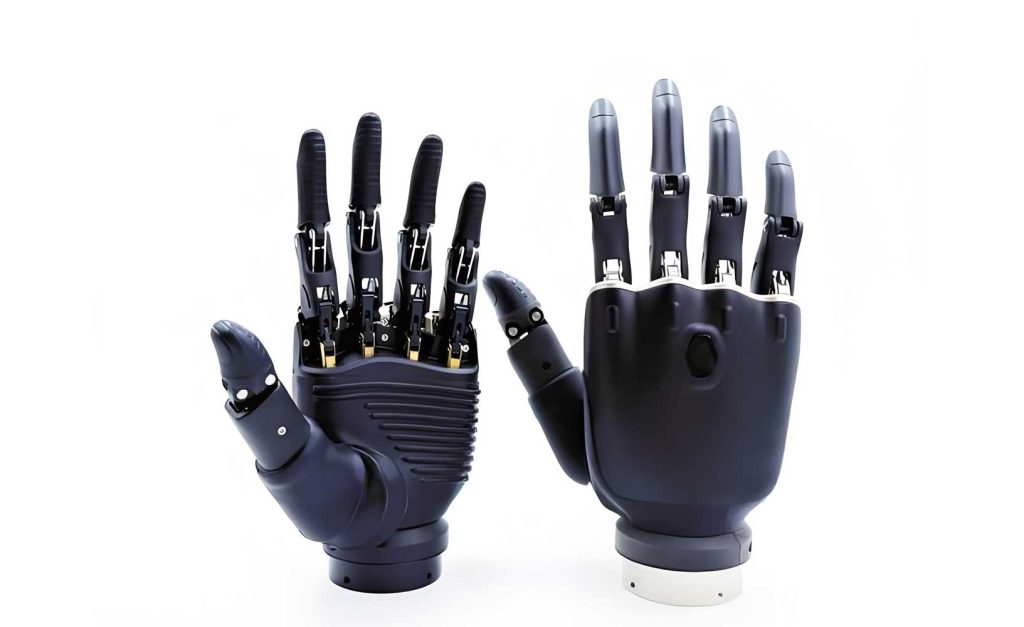
The human hand is controlled by multiple muscles, including the flexor digitorum profundus (FDP), flexor digitorum superficialis (FDS), extensor digitorum communis (EDC), interosseous (IN), and lumbrical (LU). It features three main joints per finger: metacarpophalangeal (MCP), proximal interphalangeal (PIP), and distal interphalangeal (DIP). Inspired by this anatomy, the dexterous robotic hand discussed here incorporates rolling joints instead of conventional hinges, with coupled PIP and DIP joints to simplify actuation while maintaining functionality. The hand has 15 degrees of freedom (DOFs), driven by 15 servo motors via tendon ropes, and employs a hierarchical control architecture. This design aims to balance flexibility and control complexity, but it introduces modeling difficulties due to the rolling motion and tendon elasticity. To tackle this, I develop an HTAM-based approach that decouples joint space from tendon space, enabling precise kinematic modeling and adaptive control. This work contributes to the ongoing efforts to create more human-like dexterous robotic hands capable of sophisticated tasks.
Modeling is a critical step for controlling a dexterous robotic hand. The rolling joints in this hand mimic human finger motion through a combination of rotation and translation, which can be approximated by equivalent hinge joints with coupled relationships. Using a modified Denavit-Hartenberg (D-H) method, I establish coordinate frames along the finger segments, from the metacarpal base to the fingertip. For a finger with rolling joints, the transformation matrices between frames are derived to compute the fingertip position relative to the base. Let the joint angles be denoted as $\theta_{\text{MCP}}$, $\theta_{\text{PIP}}$, and $\theta_{\text{ROLL}}$, with the PIP and DIP coupling given by $\theta_{\text{DIP}} = \mu \theta_{\text{PIP}}$, where $\mu$ is a proportionality constant (e.g., $\mu = 2/3$ for this hand). The rolling joint angle $\theta$ is related to the rotational angle $\theta_r$ by $\theta / \theta_r = (r_1 + r_2) / r_2$, where $r_1$ and $r_2$ are radii of the rolling surfaces. The fingertip position $\mathbf{x} = [x_d, y_d, z_d]^T$ is expressed as:
$$ \begin{bmatrix} x_d \\ y_d \\ z_d \\ 1 \end{bmatrix} = {}^0_1T \, {}^1_2T \, {}^2_3T \, {}^3_4T \, {}^4_5T \, {}^5_6T \, {}^6_7T \, {}^7_8T \, \begin{bmatrix} 0 \\ 0 \\ 0 \\ 1 \end{bmatrix} $$
where ${}^i_{i+1}T$ represents the homogeneous transformation matrix between consecutive frames. This kinematic model forms the basis for mapping joint angles to Cartesian space, essential for control of the dexterous robotic hand.
The Hole-Tendon Approximation Model (HTAM) is introduced to address tendon length variations and tension dynamics. Tendons are routed through holes on finger segments and anchored to bones, similar to human anatomy. By approximating tendon length as the vector distance between hole points and anchor points, I derive relationships between tendon displacement and joint angles. For instance, consider a tendon driving the MCP joint: let ${}^{t3}_3\mathbf{P} = [x_3, y_3, z_3]^T$ and ${}^{t4}_4\mathbf{P} = [x_4, y_4, z_4]^T$ be position vectors of the hole and anchor in local frames ${3}$ and ${4}$, respectively. Transforming to the base frame yields ${}^{t3}_0\mathbf{P}$ and ${}^{t4}_0\mathbf{P}$. The tendon length change for the MCP joint is:
$$ L_{\text{MCP}} = \| {}^{t3}_{t4}\mathbf{P}(\theta_{\text{MCP}}/2) – {}^{t3}_{t4}\mathbf{P}(\theta^0_{\text{MCP}}) \| $$
where ${}^{t3}_{t4}\mathbf{P} = {}^{t4}_0\mathbf{P} – {}^{t3}_0\mathbf{P}$, and $\theta^0_{\text{MCP}}$ is the initial angle. Similarly, for other tendons:
$$ L_{\text{ROLL}} = \| {}^{t1}_{t2}\mathbf{P}(\theta_{\text{ROLL}}/2) – {}^{t1}_{t2}\mathbf{P}(\theta^0_{\text{ROLL}}) \| $$
$$ L_{\text{PIP}} = \| {}^{t5}_{t6}\mathbf{P}(\theta_{\text{PIP}}/2) – {}^{t5}_{t6}\mathbf{P}(\theta^0_{\text{PIP}}) \| $$
These equations decouple joint space into tendon space, providing inverse kinematics for tendon-driven dexterous robotic hands. To model tendon tension state, I define a function $S_i$ for tendon $i$ (where $i \in \{\text{left}, \text{center}, \text{right}\}$):
$$ S_i = L^0_i + \Delta L_i – L_i – L^{\text{re}}_i $$
Here, $L^0_i$ is the initial tendon length, $\Delta L_i$ is elastic deformation, $L_i$ is driven displacement, and $L^{\text{re}}_i$ is residual length. The deformation $\Delta L_i$ depends on tension $T_i$, elastic modulus $EA$, and strain $\epsilon$:
$$ \Delta L_i = \left( \frac{T_i}{EA} \right) L^0_i + L^0_i \epsilon $$
For high-strength fishing lines used in this dexterous robotic hand, $\epsilon \approx 0$, so:
$$ S_i = L^0_i + \left( \frac{T_i}{EA} \right) L^0_i – L_i – L^{\text{re}}_i $$
The tension state satisfies $S_i \geq 0$, $T_i \geq 0$, and $S_i T_i = 0$, indicating whether a tendon is slack ($S_i > 0, T_i = 0$) or taut ($S_i = 0, T_i > 0$). This model is crucial for adaptive control to prevent slack-induced errors.
Jacobian kinematics links tendon velocity to joint and Cartesian velocities. From the HTAM, tendon displacements for a finger are:
$$ L_{\text{left}} = L_{\text{MCP}} + L_{\text{ROLL}}, \quad L_{\text{center}} = L_{\text{PIP}}, \quad L_{\text{right}} = L_{\text{MCP}} – L_{\text{ROLL}} $$
Differentiating gives the tendon Jacobian matrix $\mathbf{A}$:
$$ \dot{\mathbf{L}} = \mathbf{A} \dot{\boldsymbol{\theta}} $$
where $\dot{\mathbf{L}} = [\dot{L}_{\text{left}}, \dot{L}_{\text{center}}, \dot{L}_{\text{right}}]^T$ and $\dot{\boldsymbol{\theta}} = [\dot{\theta}_{\text{MCP}}, \dot{\theta}_{\text{PIP}}, \dot{\theta}_{\text{ROLL}}]^T$. The Cartesian Jacobian $\mathbf{J}$ is derived from the kinematic model:
$$ \dot{\mathbf{x}} = \mathbf{J} \dot{\boldsymbol{\theta}} $$
Combining these, tendon velocity relates to fingertip velocity as:
$$ \dot{\mathbf{L}} = \mathbf{A} \mathbf{J}^{-1} \dot{\mathbf{x}} $$
This relationship enables control based on desired trajectories in Cartesian space. For the dexterous robotic hand, precise Jacobian computation is vital due to rolling joints and tendon coupling.
Control of the dexterous robotic hand employs an HTAM-based model reference adaptive controller to handle model uncertainties and disturbances. Given the redundancy and complexity, traditional PID control is insufficient. The controller uses the HTAM to compute required tendon lengths from desired fingertip positions. Let $\mathbf{x}_d$ be the desired position, $\mathbf{x}$ the actual position, and $\mathbf{e}_1 = \mathbf{x}_d – \mathbf{x}$ the tracking error. The tendon velocity command is:
$$ \dot{\mathbf{L}} = \mathbf{J} (\dot{\mathbf{x}}_d + \mathbf{K}_p \mathbf{e}_1) $$
where $\mathbf{K}_p \in \mathbb{R}^{3 \times 3}$ is an adaptive gain matrix. Integrating over time yields the tendon length $\mathbf{L}(t)$ for the trajectory. To adapt to uncertainties, $\mathbf{K}_p$ is updated as:
$$ \mathbf{K}_p = \int_0^t \gamma_a |\mathbf{e}_2^T \tilde{\mathbf{x}}| \, dt $$
Here, $\gamma_a$ is an adaptation rate, $\tilde{\mathbf{x}}$ is a reference model output, and $\mathbf{e}_2 = \mathbf{x} – \tilde{\mathbf{x}}$ is the error between actual and reference responses. The tendon tension state model $S_i$ is incorporated to ensure tendons remain taut, avoiding control instability. The overall control system is summarized in Table 1, which outlines key components and equations.
| Component | Description | Equation |
|---|---|---|
| Kinematic Model | Rolling joint transformation | $\mathbf{x} = f(\theta_{\text{MCP}}, \theta_{\text{PIP}}, \theta_{\text{ROLL}})$ |
| HTAM Decoupling | Tendon length from joint angles | $L_{\text{MCP}} = \| {}^{t3}_{t4}\mathbf{P}(\theta_{\text{MCP}}/2) – {}^{t3}_{t4}\mathbf{P}(\theta^0_{\text{MCP}}) \|$ |
| Tension State | Slack/taut condition | $S_i = L^0_i + \left( \frac{T_i}{EA} \right) L^0_i – L_i – L^{\text{re}}_i$ |
| Jacobian | Velocity mapping | $\dot{\mathbf{L}} = \mathbf{A} \mathbf{J}^{-1} \dot{\mathbf{x}}$ |
| Adaptive Control | Tendon velocity command | $\dot{\mathbf{L}} = \mathbf{J} (\dot{\mathbf{x}}_d + \mathbf{K}_p \mathbf{e}_1)$ |
| Gain Adaptation | Update rule | $\mathbf{K}_p = \int_0^t \gamma_a |\mathbf{e}_2^T \tilde{\mathbf{x}}| \, dt$ |
Experiments validate the proposed modeling and control for the dexterous robotic hand. The first scenario involves single-finger position control, focusing on the index finger with joints commanded to follow specific angle trajectories. The results, shown in Table 2, indicate high accuracy with position errors within 0.198 mm after impact, demonstrating robustness. Tendon velocities and tensions are monitored: during large-angle changes, tendons respond quickly but show slight lag due to friction and elasticity, while small changes exhibit minimal hysteresis. The tendon tension remains positive, confirming tautness throughout motion. These findings highlight the effectiveness of the HTAM controller for precise manipulation in dexterous robotic hands.
| Metric | Value | Notes |
|---|---|---|
| Max Position Error | 0.198 mm | After external impact |
| Average Error | ~1% of displacement | Stable over 20 trials |
| Tendon Tension | Always > 0 | No slack observed |
| Response Lag | Minor for small angles | Due to system dynamics |
The second scenario evaluates multi-finger coordination through grasping tasks. Using Feix et al.’s grasp taxonomy, six representative gestures are tested: enveloping grasps (e.g., cylinder, cup), pinch grasps (e.g., hex wrench, scissors), and lateral grasps (e.g., book, tool box). The dexterous robotic hand successfully executes all gestures, showcasing its flexibility and adaptability. This versatility is essential for real-world applications where dexterous robotic hands must handle diverse objects. The HTAM controller enables smooth transitions between gestures by adjusting tendon lengths based on real-time kinematics, proving its practical utility.
In conclusion, this paper presents an HTAM-based adaptive control framework for tendon-driven humanoid dexterous robotic hands with rolling joints. The HTAM provides accurate kinematic modeling by decoupling joint and tendon spaces, while the model reference adaptive controller compensates for uncertainties and disturbances. Experiments confirm precise position control and robust grasping capabilities. However, limitations exist, such as the lack of force sensing for delicate objects. Future work will integrate force sensors to achieve force-position hybrid control and explore advanced grasp planning algorithms. The advancements here contribute to the development of more human-like dexterous robotic hands, pushing the boundaries of robotic manipulation.
The mathematical formulations and control laws are summarized below for clarity. The overall system dynamics can be expressed as a set of differential equations incorporating tendon elasticity and joint kinematics. For a tendon $i$, the state equation is:
$$ \dot{S}_i = \dot{L}^0_i + \frac{\dot{T}_i}{EA} L^0_i – \dot{L}_i – \dot{L}^{\text{re}}_i $$
Assuming constant initial length and negligible residual changes, this simplifies to $\dot{S}_i \approx \frac{\dot{T}_i}{EA} L^0_i – \dot{L}_i$. The control input $\dot{L}_i$ is computed from the adaptive law, and tension $T_i$ is derived from motor torque readings. The stability of the adaptive system can be analyzed using Lyapunov theory, considering the error dynamics $\dot{\mathbf{e}}_1 = -\mathbf{K}_p \mathbf{e}_1 + \mathbf{d}$, where $\mathbf{d}$ represents disturbances. With proper adaptation, the controller ensures bounded errors, enhancing the reliability of dexterous robotic hands.
In summary, the HTAM approach offers a promising solution for modeling and controlling complex tendon-driven dexterous robotic hands. By bridging anatomy-inspired design with advanced control theory, it paves the way for more agile and responsive robotic manipulators. The continued evolution of dexterous robotic hands will rely on such integrative methods to overcome longstanding challenges in robotics.