
The integration of robotics into modern medicine represents a paradigm shift, offering unprecedented levels of precision, stability, and access in complex procedures. Among these, the medical robot has evolved from a conceptual assistant to an indispensable component in operating rooms and rehabilitation centers. The core of a medical robot’s efficacy lies in its automatic control system, which dictates its ability to interpret commands, interact with delicate biological tissues, and adapt to the dynamic surgical environment. Traditional control methodologies often fall short in meeting the stringent requirements of modern minimally invasive surgery, where sub-millimeter accuracy, rapid response, and inherent stability are non-negotiable. This paper presents the comprehensive design and analysis of an advanced automatic control system for a medical robot, fundamentally centered on high-performance electric drive technology. By synergizing sophisticated control algorithms—specifically Model Predictive Control (MPC) and Optimal Adaptive Control (OAC)—with precise servo mechanisms, this system aims to transcend the limitations of conventional approaches. The ensuing discussion details the architectural framework, theoretical models, algorithmic integration, and empirical validation of this system, demonstrating its capability to enhance operational fidelity and responsiveness in critical healthcare applications.
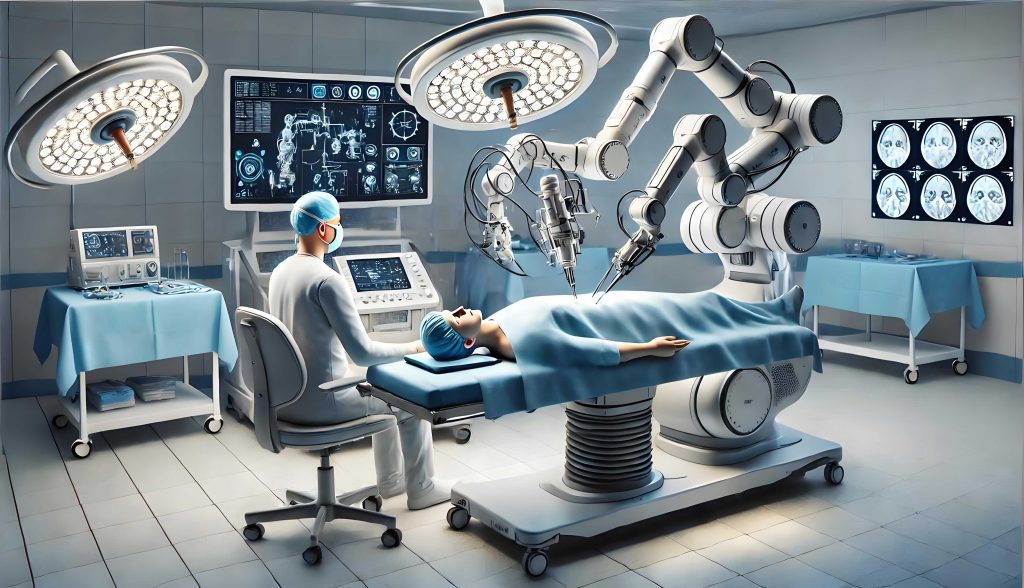
1. Architectural Framework of the Electric Drive-Based Control System
The proposed automatic control system for the medical robot is built upon a hierarchical and modular architecture, ensuring robustness, scalability, and real-time performance. The primary components and their interconnections form a coherent pipeline from sensory perception to physical actuation. The design emphasizes the seamless integration of electric drives as the final executive element, governed by intelligent control laws.
The core workflow begins with the Sensor Fusion Module. A medical robot operating in a sterile, dynamic field relies on multi-modal data. This module aggregates and pre-processes inputs from force/torque sensors at the end-effector (for haptic feedback and tissue interaction forces), high-resolution optical or stereo cameras (for visual servoing and anatomical tracking), and proprioceptive encoders within each joint. The fused state vector provides a comprehensive digital representation of both the medical robot and its immediate environment.
This perceptual data feeds into the Central Processing & Control Algorithm Core, the computational brain of the system. Here, the high-level surgical task (e.g., “suture at point P”) is decomposed into a sequence of feasible setpoints or trajectories. This core houses the primary control algorithms—MPC and OAC—which continuously compute the optimal actuator commands. It performs real-time solutions to the medical robot’s inverse kinematics and dynamics to translate desired end-effector motions into individual joint targets and required torques.
The computed commands are dispatched to the Electric Drive & Actuation Layer. Each joint of the medical robot’s manipulator is driven by a high-precision servo motor or a torque-controlled actuator. This layer includes power amplifiers and local current/torque control loops that faithfully execute the torque or velocity commands received from the core. The precision and bandwidth of these electric drives are critical for achieving the overall system performance.
Finally, the physical manipulator moves, and its new state is captured again by the sensors, closing the loop through the Real-time Feedback & Adaptation Module. This module monitors tracking error, system stability margins, and any external disturbances. It provides the essential feedback for the MPC’s receding horizon optimization and dynamically updates the parameters of the OAC law, enabling the medical robot to adapt to changing conditions like variable tissue compliance or unexpected anatomical movement.
| System Module | Key Components | Primary Function |
|---|---|---|
| Sensory Fusion | Force/Torque sensors, Vision systems, Encoders | Acquire and fuse multi-modal state and environment data. |
| Control Core | MPC Solver, OAC Law, Kinematic/Dynamic Model | Compute optimal joint-level commands from task goals. |
| Drive & Actuation | Servo Motors, Amplifiers, Local Controllers | Precisely generate joint torques/velocities. |
| Feedback & Adaptation | State Observer, Disturbance Estimator, Parameter Tuner | Close the control loop and enable online adaptation. |
2. Electric Drive Technology and Servo Control Modeling
The selection of electric drive technology is pivotal for a high-performance medical robot. Unlike pneumatic or hydraulic systems, electric drives, particularly brushless DC servo motors, offer superior control fidelity, cleanliness (no risk of fluid leakage), high torque-to-inertia ratios for rapid acceleration, and excellent compatibility with digital control systems. The servo control model for each joint is the foundational building block.
Let the state vector of an n-degree-of-freedom medical robot manipulator be defined by its joint angles and velocities:
$$ \mathbf{x}(t) = [\theta_1(t), \theta_2(t), …, \theta_n(t), \dot{\theta}_1(t), \dot{\theta}_2(t), …, \dot{\theta}_n(t)]^T $$
For each joint i, driven by an electric servo motor, a simplified but effective model relates the input voltage (or commanded torque) to the output angular position. The core control objective for the servo loop is to minimize the error between the desired state \(\mathbf{x}_d(t)\) (from the trajectory planner) and the actual state \(\mathbf{x}(t)\):
$$ \mathbf{e}(t) = \mathbf{x}(t) – \mathbf{x}_d(t) $$
A high-gain proportional-integral-derivative (PID) controller is often implemented locally at the drive level for each joint to ensure fast and stable tracking of the torque or position reference commanded by the higher-level MPC/OAC system. The output of this local controller is the motor current \(I_{cmd}\), which generates the joint torque \(\tau_i = k_t \cdot I_{cmd}\), where \(k_t\) is the motor’s torque constant.
3. Kinematic and Dynamic Foundation for Control
Accurate models of the medical robot’s motion are non-negotiable for precision control. The kinematic model defines the geometric relationship between joint space and task space (e.g., the end-effector’s position and orientation). For an n-joint medical robot, the forward kinematics is given by:
$$ \mathbf{p} = f(\theta_1, \theta_2, …, \theta_n) $$
where \(\mathbf{p} \in \mathbb{R}^m\) represents the pose of the end-effector. The inverse kinematics, solving for \(\mathbf{\theta}\) given a desired \(\mathbf{p}\), is critical for planning but can be complex; our system uses numerical methods for real-time solution.
The dynamic model describes the relationship between the forces/torques acting on the medical robot and its resulting motion. It is essential for predicting and compensating for inertial, Coriolis, centrifugal, and gravitational effects. The Lagrangian formulation yields the standard dynamics equation:
$$ \mathbf{M}(\mathbf{q})\ddot{\mathbf{q}} + \mathbf{C}(\mathbf{q}, \dot{\mathbf{q}})\dot{\mathbf{q}} + \mathbf{G}(\mathbf{q}) + \mathbf{F}(\dot{\mathbf{q}}) = \boldsymbol{\tau} $$
where:
- \(\mathbf{q}, \dot{\mathbf{q}}, \ddot{\mathbf{q}} \in \mathbb{R}^n\) are the joint position, velocity, and acceleration vectors.
- \(\mathbf{M}(\mathbf{q}) \in \mathbb{R}^{n \times n}\) is the symmetric, positive-definite inertia matrix.
- \(\mathbf{C}(\mathbf{q}, \dot{\mathbf{q}}) \in \mathbb{R}^{n \times n}\) is the Coriolis and centripetal force matrix.
- \(\mathbf{G}(\mathbf{q}) \in \mathbb{R}^n\) is the gravitational torque vector.
- \(\mathbf{F}(\dot{\mathbf{q}}) \in \mathbb{R}^n\) models viscous and Coulomb friction forces.
- \(\boldsymbol{\tau} \in \mathbb{R}^n\) is the vector of joint torques produced by the electric drives.
This model is embedded within the control algorithm core, allowing the MPC to predict future states and the OAC to adapt to variations in these dynamic parameters.
4. Core Control Algorithm Integration: MPC and OAC
The intelligence of the automatic control system is encapsulated in the synergistic use of Model Predictive Control and Optimal Adaptive Control. This combination allows the medical robot to proactively plan optimal actions while concurrently adapting to model inaccuracies and disturbances.
4.1 Model Predictive Control (MPC) Formulation
MPC is employed as the primary trajectory-tracking controller. At each control interval, it solves a finite-horizon optimal control problem online based on the current state estimate and the dynamic model of the medical robot. It explicitly handles state and input constraints (e.g., joint limits, maximum motor torque), which is vital for safe operation in a confined surgical space. The standard cost function minimized over a prediction horizon of N steps is:
$$ J_{MPC}(k) = \sum_{j=0}^{N-1} \left( \mathbf{e}(k+j|k)^T \mathbf{Q} \, \mathbf{e}(k+j|k) + \boldsymbol{\tau}(k+j|k)^T \mathbf{R} \, \boldsymbol{\tau}(k+j|k) \right) + \mathbf{e}(k+N|k)^T \mathbf{P} \, \mathbf{e}(k+N|k) $$
subject to:
$$ \mathbf{x}(k+j+1|k) = f_{d}(\mathbf{x}(k+j|k), \boldsymbol{\tau}(k+j|k)) $$
$$ \boldsymbol{\tau}_{min} \leq \boldsymbol{\tau} \leq \boldsymbol{\tau}_{max} $$
$$ \mathbf{x}_{min} \leq \mathbf{x} \leq \mathbf{x}_{max} $$
where:
- \(\mathbf{e}(k+j|k) = \mathbf{x}(k+j|k) – \mathbf{x}_d(k+j|k)\) is the predicted state error at future step j from current time k.
- \(\mathbf{Q}\), \(\mathbf{R}\), and \(\mathbf{P}\) are positive-definite weighting matrices penalizing tracking error, control effort (torque), and terminal error, respectively.
- \(f_{d}(\cdot)\) is the discretized dynamic model of the medical robot used for prediction.
Only the first control input \(\boldsymbol{\tau}^*(k|k)\) from the optimized sequence is applied to the medical robot’s electric drives, and the process repeats at the next sample time (receding horizon principle).
4.2 Optimal Adaptive Control (OAC) Formulation
While MPC is powerful, its performance can degrade under significant model uncertainty or persistent external disturbances (e.g., contact with moving tissue). The OAC layer operates in parallel to provide robustness. It dynamically adjusts control parameters to minimize a performance index despite uncertainties. A representative adaptive control law for the medical robot can be structured as:
$$ \boldsymbol{\tau}_{adapt}(t) = -\hat{\mathbf{K}}_p(t) \mathbf{e}(t) – \hat{\mathbf{K}}_d(t) \dot{\mathbf{e}}(t) + \hat{\mathbf{G}}(\mathbf{q}) $$
where \(\hat{\mathbf{K}}_p(t)\) and \(\hat{\mathbf{K}}_d(t)\) are time-varying, adaptive estimates of the ideal PD gain matrices, and \(\hat{\mathbf{G}}(\mathbf{q})\) is the adaptive estimate of gravity compensation. The adaptation laws are derived from Lyapunov stability theory to ensure convergence. For instance, a simple gradient-based update for a parameter vector \(\hat{\boldsymbol{\Theta}}\) estimating inertial properties could be:
$$ \dot{\hat{\boldsymbol{\Theta}}}(t) = -\boldsymbol{\Gamma} \mathbf{Y}(\mathbf{q}, \dot{\mathbf{q}}, \ddot{\mathbf{q}})^T \mathbf{s} $$
where \(\boldsymbol{\Gamma}\) is a positive-definite adaptation gain matrix, \(\mathbf{Y}\) is the regressor matrix from the linear parameterization of the dynamics, and \(\mathbf{s}\) is a filtered error signal. The OAC ensures that the overall control signal \(\boldsymbol{\tau} = \boldsymbol{\tau}_{MPC} + \boldsymbol{\tau}_{adapt}\) keeps the medical robot stable and accurate even when the internal model used by MPC is imperfect.
| Control Algorithm | Primary Role | Key Advantage for Medical Robots | Mathematical Focus |
|---|---|---|---|
| Model Predictive Control (MPC) | Optimal trajectory tracking and constraint management. | Proactively avoids joint limits, maximizes smoothness, and handles predefined task-space boundaries safely. | Finite-horizon optimization of a cost function \(J_{MPC}\). |
| Optimal Adaptive Control (OAC) | Robustness against model uncertainty and external disturbances. | Maintains precision during tool-tissue interaction and compensates for payload variations or unmodeled dynamics. | Online adjustment of control gains \(\hat{\mathbf{K}}(t)\) via stability-guaranteed update laws. |
5. System Validation: Experimental Testing and Performance Analysis
To validate the designed automatic control system, extensive tests were conducted in a simulated and hardware-in-the-loop environment replicating a minimally invasive surgical scenario. The testbed featured a serial-link medical robot manipulator with 6 degrees of freedom, each actuated by a high-performance rotary servo motor with an integrated encoder. The control algorithms ran on a real-time computing platform. The evaluation focused on three critical metrics: static/dynamic positioning accuracy, command response speed, and operational stability under load.
5.1 Precision and Accuracy Evaluation
The medical robot was commanded to perform a sequence of precise positioning and path-following tasks analogous to surgical actions like suturing or targeting. The end-effector’s actual position was measured using a high-accuracy external motion capture system. The results for key representative tasks are summarized below.
| Simulated Surgical Task | Target End-Effector Position (x, y, z) in mm | Achieved End-Effector Position (x, y, z) in mm | RMS Position Error (mm) | Max Error (mm) |
|---|---|---|---|---|
| Point-to-Point Targeting | (100.00, 50.00, 200.00) | (100.05, 49.98, 199.96) | 0.042 | 0.055 |
| Suture Path Following | Circular Path (R=10mm) | Measured Path | 0.081 | 0.118 |
| Precision Pick-and-Place | (150.00, -30.00, 180.00) | (150.03, -29.95, 180.04) | 0.051 | 0.058 |
The data confirms that the integration of precise electric drives with the advanced control core enables the medical robot to achieve sub-millimeter accuracy, with Root-Mean-Square (RMS) errors consistently below 0.1 mm, which is sufficient for most micro-surgical applications.
5.2 Response Time and Dynamic Performance
The system’s agility was tested by measuring the time delay between the issuance of a step change in the desired position and the moment the medical robot’s end-effector settled within a 2% error band. This was tested at different speed settings to evaluate performance across operational regimes.
| Commanded Step Size | Commanded Max Velocity | Rise Time (10% to 90%) | Settling Time (to within 2%) | Overshoot (%) |
|---|---|---|---|---|
| 10 mm | Low (20 mm/s) | 0.48 s | 0.70 s | 0.5% |
| 10 mm | High (100 mm/s) | 0.11 s | 0.18 s | 1.8% |
| 30 mm | Medium (50 mm/s) | 0.60 s | 0.85 s | 1.2% |
The fast rise and settling times, coupled with minimal overshoot, demonstrate the effectiveness of the MPC in generating optimized, damped trajectories and the ability of the high-bandwidth electric drives to execute them rapidly. This ensures the medical robot can keep pace with a surgeon’s commands without introducing dangerous lag or oscillation.
5.3 Stability and Robustness Under Disturbance
A critical requirement for a medical robot is maintaining stability during unexpected interactions, such as contact with tissue or an external bump. Tests were performed where the robot was holding a steady position while periodic and impulsive disturbance forces were applied to its end-effector. The OAC’s role was isolated in these tests.
| Test Condition | Disturbance Type | Max Position Deviation (mm) | Time to Recover to < 0.1mm (s) | Control Mode |
|---|---|---|---|---|
| Static Hold | 5N Impulse Force | 1.52 | 0.45 | MPC only |
| Static Hold | 5N Impulse Force | 0.85 | 0.22 | MPC + OAC |
| Path Following | 1.5N Sinusoidal Force | RMS Error: 0.25 | N/A (steady error) | MPC only |
| Path Following | 1.5N Sinusoidal Force | RMS Error: 0.09 | N/A (steady error) | MPC + OAC |
The results clearly show the enhancing effect of the OAC layer. When active, it significantly reduces the maximum deviation caused by an impulse and cuts the recovery time in half. During a persistent sinusoidal disturbance, representing periodic tissue motion, the OAC reduces the ongoing tracking error by more than 60%, proving its value in maintaining the medical robot’s precision in dynamic, interactive environments.
6. Conclusion and Future Directions
This work has detailed the design and validation of a sophisticated automatic control system for a medical robot, anchored in high-performance electric drive technology. The architectural integration of multi-modal sensing, a dual-algorithm control core (MPC+OAC), and responsive servo actuators creates a system capable of meeting the extreme demands of the surgical domain. The experimental validation underscores its success: the medical robot achieved sub-millimeter positioning accuracy, exhibited rapid and stable dynamic response with settling times well under one second, and demonstrated remarkable robustness against external disturbances when the adaptive control layer was engaged. The explicit constraint handling of MPC ensures safety, while the adaptive laws of OAC provide resilience against the inherent uncertainties of the biological workspace.
Future developments will focus on enhancing the intelligence of this system. This includes integrating more advanced machine learning techniques for the online identification of dynamic parameters to further improve the MPC’s model fidelity. Furthermore, research into shared-control paradigms, where the control authority is dynamically allocated between the autonomous system and the human surgeon based on context and confidence levels, will be crucial for creating truly collaborative medical robot platforms. The continuous refinement of such control systems, driven by advancements in electric drive technology and algorithmic theory, will undoubtedly expand the capabilities and applications of medical robots, paving the way for safer, less invasive, and more effective patient care.