
The field of robotics is continuously evolving, with mobile robots being a prominent area of research. Among these, legged robots offer significant advantages over wheeled or tracked counterparts in navigating unstructured and rough terrains. Common configurations include bipedal, quadrupedal, and hexapod robots, each with distinct characteristics and application scopes. While bipedal robots mimic human locomotion, they often suffer from stability issues, poor dynamic characteristics, low load capacity, and limited terrain adaptability. Hexapod robots offer superior stability due to their multi-legged support polygon but are more complex in terms of mechanical design and control due to the higher number of actuators. The quadrupedal configuration presents a balanced compromise, offering good stability, manageable control complexity, and efficient locomotion, making it a highly practical and widely studied platform for a bionic robot.
This project is dedicated to the design and implementation of a quadruped bionic robot inspired by the locomotion of quadrupedal animals like dogs or cats. The core philosophy is to leverage principles from biology and biomechanics to create a machine capable of stable, adaptive, and efficient walking. The primary control unit is based on the STC IAP15F2K61S2 microcontroller, chosen for its enhanced capabilities over traditional 8051 cores. Actuation is achieved using digital servo motors, providing precise joint angle control. The entire system’s software is developed in the C programming language and downloaded to the microcontroller, enabling coordinated movement. The ultimate goal is to develop a versatile bionic robot platform that could assist humans in various tasks, contributing to the trend of automation in work and daily life.
Mechanical Design and Kinematics
The mechanical design of a bionic robot is paramount, as it dictates its mobility, payload capacity, and energy efficiency. Our design philosophy emphasizes a lightweight yet robust structure, simple kinematic chains for reliable motion transmission, and sufficient degrees of freedom for flexible movement.
Chassis and Material Selection: The robot’s body (chassis) serves as the central frame connecting all four legs and housing the electronic components. We constructed the chassis primarily from Polyvinyl Chloride (PVC) sheets. PVC offers an excellent balance of strength, low weight, and ease of fabrication. Critical joints and load-bearing connections are reinforced with aluminum alloy brackets to enhance structural integrity and durability without significantly increasing mass. This composite approach ensures the chassis is both lightweight and capable of withstanding the dynamic loads during locomotion.
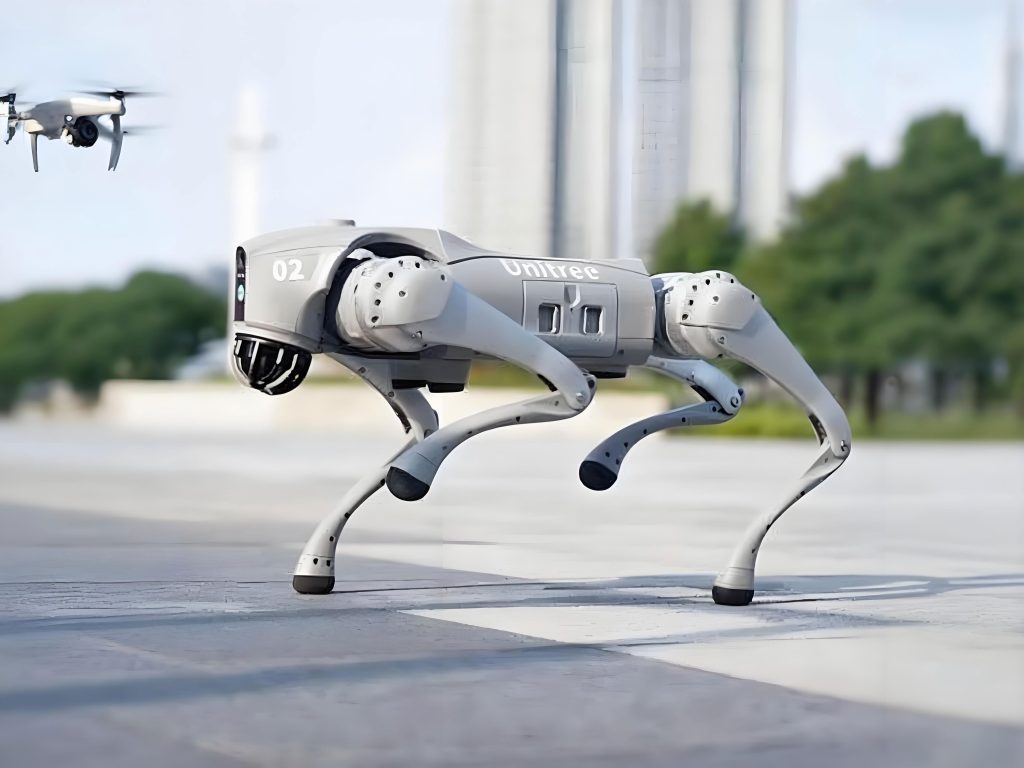
Leg Architecture and Joint Configuration: Each leg of our quadruped bionic robot is modeled as a 3-degree-of-freedom (3-DOF) serial kinematic chain. This configuration is common in quadruped robotics as it provides a good balance between workspace size and control complexity. Each leg incorporates three digital servo motors acting as joints:
- Joint 0 (Abduction/Adduction): Located at the hip, this servo controls the forward/backward swinging motion of the leg in the horizontal plane. It is primarily responsible for the propulsive phase of the step.
- Joint 1 (Thigh Flexion/Extension): This servo moves the upper leg (thigh) segment up and down.
- Joint 2 (Knee Flexion/Extension): This servo controls the lower leg (shank) segment, effectively acting as the knee.
The coordinated movement of Joints 1 and 2 manages the vertical lifting and placement of the foot, ensuring the swinging leg clears the ground during its transfer phase. The combination of all three joints allows the foot to be positioned accurately within its reachable workspace.
Kinematic Modeling: To control the foot’s position in Cartesian space (X, Y, Z coordinates relative to the hip), we employ forward kinematics. Each leg segment is treated as a rigid link with a specific length. The position of the foot is calculated based on the three joint angles ($\theta_0$, $\theta_1$, $\theta_2$) and the link lengths ($L_1$ for the thigh, $L_2$ for the shank). Using the Denavit-Hartenberg (D-H) convention or simple geometric relations, the forward kinematics can be derived. For a leg with the configuration described, the foot position relative to the hip joint can be approximated as:
$$
\begin{aligned}
X &= L_1 \cos(\theta_1) + L_2 \cos(\theta_1 + \theta_2) \\
Z &= L_1 \sin(\theta_1) + L_2 \sin(\theta_1 + \theta_2) \quad \text{(in the leg’s sagittal plane)} \\
Y &= \text{Function of } \theta_0 \quad \text{(lateral movement)}
\end{aligned}
$$
Inverse kinematics, which calculates the required joint angles for a desired foot position, is more complex for a 3-DOF planar chain but essential for trajectory planning. It often involves trigonometric solutions or numerical methods.
| Parameter | Specification |
|---|---|
| Configuration | Quadruped, 12 DOF total |
| Leg DOF | 3 per leg (Abduction, Hip, Knee) |
| Actuator | Digital Servo Motor (e.g., CDS5516) |
| Control Unit | STC IAP15F2K61S2 Microcontroller |
| Main Power Source | 7.4V Rechargeable Lithium Battery |
| Logic Voltage | 5V (regulated via 7805) |
| Chassis Material | PVC with Aluminum Alloy reinforcements |
| Programming Language | C |
Hardware System Architecture
The reliable operation of the bionic robot depends on a robust and well-designed hardware system. The main components are the power supply module, the control module, and the actuator network.
Power Supply Module: Servo motors are power-hungry devices, especially when multiple move simultaneously under load. A power supply capable of delivering high current bursts is crucial. We selected a 7.4V, high-capacity Lithium Polymer (LiPo) rechargeable battery as the primary power source. This voltage is suitable for many digital servos which often operate between 6V and 8.4V. However, the microcontroller and other logic circuits require a stable 5V supply. A linear voltage regulator (7805) is used to step down the battery voltage to a stable 5V rail. It is important to note that the high current draw of the servos is isolated from this regulated 5V line. The servos are powered directly from the filtered 7.4V battery line through a separate circuit with adequate capacitor filtering to smooth out voltage spikes caused by motor startup and braking. This architecture prevents noise on the servo power line from destabilizing the sensitive control electronics.
Control Module – The Microcontroller: The brain of our bionic robot is the STC IAP15F2K61S2 microcontroller. While classic 8051 microcontrollers are simple, they often lack the computational power, memory, and peripheral features needed for complex multi-servo control. The IAP15F2K61S2 is an enhanced 8051-core microcontroller with significant advantages:
- High-speed core (1T instruction cycle compared to the classic 12T).
- Ample memory (61KB Flash, 2KB SRAM) for storing complex gait tables and control algorithms.
- Multiple hardware PWM (Pulse Width Modulation) timers capable of generating the control signals for up to 12 servos independently.
- Enhanced I/O port drive capability.
- Built-in RC oscillator, simplifying the circuit.
These features make it an ideal, cost-effective choice for implementing the real-time control sequences required for a walking bionic robot.
Actuator Network – Digital Servos: We employ digital servo motors like the CDS5516 as joint actuators. Digital servos differ from analog servos by having a microcontroller inside that processes the control signal at a higher frequency. This results in:
- Faster response and higher holding torque.
- More precise positioning and reduced dead band.
- Programmable parameters (e.g., maximum speed, PID constants).
The servos are typically controlled via a serial bus protocol (like TTL or RS-485) or individual PWM signals. In our design, the microcontroller generates 12 independent PWM signals, one for each servo. The control pulse width, usually between 500µs and 2500µs, corresponds to the commanded angular position from 0 to 180 degrees.
| Parameter | Typical Value / Range |
|---|---|
| Control Signal | Pulse Width Modulation (PWM) |
| Pulse Period | ~20 ms (50 Hz) |
| Pulse Width Range | 500 µs to 2500 µs |
| Corresponding Angle | 0° to 180° (approximate linear mapping) |
| Operating Voltage | 6.0V – 8.4V (from 7.4V LiPo) |
| Communication | Point-to-point PWM from MCU |
Gait Generation and Control Algorithm
The essence of a walking bionic robot lies in its gait—the coordinated, rhythmic pattern of leg movements. A stable and efficient gait is generated through careful planning and sequencing of joint angles over time.
Gait Patterns: For a slow-moving, statically stable quadruped robot, the crawl gait is often used. In this gait, only one leg is lifted off the ground at any time, while the other three provide a stable triangular support polygon. This ensures the robot’s center of mass (CoM) always lies within the support polygon, guaranteeing static stability. The legs are lifted in a sequence, such as: Rear Left → Front Left → Rear Right → Front Right. More dynamic gaits like the trot (diagonal pairs move together) can be implemented for higher speed but require dynamic balancing strategies.
Trajectory Planning for a Single Leg: The movement of each leg during its step cycle is broken into two phases:
- Swing Phase: The leg is lifted, moved forward (or backward for reverse), and lowered to a new foothold. The trajectory of the foot during this phase is typically a curve that lifts it clear of the ground. A simple model for the foot’s Z-coordinate (height) during swing can be a parabolic or cycloidal trajectory to ensure smooth start and stop.
- Support (Stance) Phase: The leg is on the ground, supporting the body and pushing it forward relative to the foothold. The foot moves backward relative to the body, providing propulsion.
The timing and duration of these phases are defined by the gait’s duty factor ($\beta$), the fraction of the total cycle time a leg is in the support phase. For a crawl gait, $\beta = 3/4$.
Mathematical Formulation of a Simple Gait: We can define a periodic function for each leg’s state. Let $T$ be the full gait cycle period. The phase offset $\phi_i$ for leg $i$ determines when it begins its swing phase. For a crawl gait with the sequence above, typical phase offsets (in fractions of $T$) might be: $\phi_{RL}=0$, $\phi_{FL}=0.25$, $\phi_{RR}=0.5$, $\phi_{FR}=0.75$. The foot position in the body-forward direction (X) during a cycle can be simplified as a piecewise function. During stance, it moves from a forward limit $X_{f}$ to a rear limit $X_{r}$ linearly over time $T_{stance} = \beta T$:
$$ X_{stance}(t) = X_{f} – \frac{(X_{f} – X_{r})}{\beta T} \cdot t_{rel} $$
where $t_{rel}$ is the time elapsed since the start of the stance phase. During swing, it moves from $X_{r}$ back to $X_{f}$ over time $T_{swing} = (1-\beta)T$, following a planned curve for the Y (lift) coordinate.
Control Loop: The high-level control algorithm involves:
- Gait Scheduler: A timer interrupt triggers the main control cycle every few milliseconds. The scheduler updates the current phase of the gait cycle for all legs based on elapsed time and the selected gait pattern.
- Trajectory Generator: For each leg, based on its current phase (swing or stance), the desired foot position in Cartesian space $(X_d, Y_d, Z_d)$ is calculated using the trajectory equations.
- Inverse Kinematics Solver: The desired foot position is converted into the three target joint angles $(\theta_{0_d}, \theta_{1_d}, \theta_{2_d})$ for that leg using inverse kinematics.
- Servo Command Output: The target joint angles are converted into corresponding PWM pulse widths and updated on the microcontroller’s output pins, commanding the servos to move to the new positions.
This cycle repeats continuously, creating the illusion of smooth, coordinated motion for the bionic robot.
| Time Fraction (t/T) | Leg in Swing Phase | Supporting Legs (Stance) | Support Polygon |
|---|---|---|---|
| 0.00 – 0.25 | Rear Left (RL) | FL, RR, FR | Triangle (stable) |
| 0.25 – 0.50 | Front Left (FL) | RL, RR, FR | Triangle (stable) |
| 0.50 – 0.75 | Rear Right (RR) | RL, FL, FR | Triangle (stable) |
| 0.75 – 1.00 | Front Right (FR) | RL, FL, RR | Triangle (stable) |
Software Architecture and Implementation
The intelligence of the bionic robot is embedded in its software. We developed the control firmware in C language due to its efficiency, portability to microcontrollers, and rich operator set which allows for concise expression of control logic.
Program Structure: The software is structured modularly:
- Main Routine: Initializes hardware (I/O ports, timers, PWM modules), loads default gait parameters, and enters a low-power idle state waiting for a start command (e.g., from a button press).
- Initialization Function: Sets all servos to a predefined “neutral” standing position, ensuring the robot starts from a known, stable configuration.
- Timer Interrupt Service Routine (ISR): The core of real-time control. A hardware timer is configured to trigger an interrupt at a fixed frequency (e.g., 50-100 Hz). Inside the ISR:
- The global cycle timer is incremented.
- The phase for each leg is computed based on the timer and its offset.
- For each leg, the target foot trajectory point is computed.
- Inverse kinematics is performed (can be precomputed and stored in a lookup table for speed).
- New PWM compare values are set for the servo control registers.
- Gait Library: Contains functions and data tables for different gaits (crawl, turn-in-place, etc.). Each gait is defined by parameters like step length, step height, cycle time, and phase offsets.
- Kinematics Library: Houses the forward and inverse kinematics functions for a single leg.
Key Code Logic Snippet (Conceptual): The inverse kinematics for a leg in its sagittal plane (ignoring abduction for simplicity) can be solved geometrically. Given desired foot coordinates $(X_d, Z_d)$ relative to the hip:
$$ L = \sqrt{X_d^2 + Z_d^2} $$
Using the law of cosines on the triangle formed by the two links:
$$ \theta_2 = \pi – \cos^{-1}\left( \frac{L_1^2 + L_2^2 – L^2}{2 L_1 L_2} \right) \quad \text{(or its negative for “elbow down” configuration)} $$
$$ \theta_1 = \atan2(Z_d, X_d) – \atan2\left( L_2 \sin(\theta_2), L_1 + L_2 \cos(\theta_2) \right) $$
These calculations, while involving trigonometry, are computed once per leg per control cycle or precomputed for a trajectory.
System Integration, Testing, and Performance
After designing and fabricating the mechanical structure, assembling the electronic hardware, and developing the control software, the subsystems were integrated to form the complete bionic robot prototype.
Integration Process: The PVC chassis was assembled with servo brackets securely mounted. The 12 servos were installed and connected to their respective limbs. The control board, featuring the STC microcontroller, voltage regulators, and connectors, was mounted centrally. The 7.4V LiPo battery was securely attached. All servo PWM cables and power lines were connected. Special attention was paid to cable management to prevent snagging during movement.
Testing and Calibration: Initial testing proceeded stepwise:
- Power-Up Test: Verifying stable 5V and 7.4V rails without excessive voltage drop.
- Servo Homing: Running a calibration routine to move all servos to their mechanical zero point, ensuring the kinematic model aligns with physical reality.
- Single Leg Test: Commanding individual legs through simple motions to verify correct servo wiring and joint direction.
- Static Pose Test: Commanding all legs to a calculated “standing” pose to check if the robot stands level and stable.
- Gait Testing: Slowly implementing the crawl gait sequence, initially with very small step heights and lengths to prevent falls. Parameters like step height, step length, and cycle period were tuned empirically to achieve smooth, stable locomotion.
Performance Observations: The final integrated bionic robot successfully demonstrated basic locomotion capabilities:
- Forward/Backward Walking: Achieved by phasing the leg swings appropriately. The robot moved at a slow, steady pace characteristic of a statically stable crawl gait.
- In-Place Turning: Implemented by having legs on one side of the body step backward while legs on the other side step forward, or by differentially steering the abduction joints.
- Stability: The crawl gait maintained a stable support triangle at all times. The low center of mass and relatively wide stance contributed to robustness against small disturbances.
- Limitations: As observed, the primary limitations were related to the power system’s current delivery under high load and the lack of sensory feedback (like foot contact sensing or inertial measurement) which would enable adaptive walking on uneven terrain.
The project successfully validated the core concepts of designing and controlling a multi-legged bionic robot using off-the-shelf components and embedded C programming.
Applications and Future Perspectives
The development of this quadruped bionic robot platform is not an end in itself but a step towards more advanced and practical machines. Robots are increasingly integral to military, industrial, and domestic spheres, performing tasks ranging from bomb disposal and logistics to welding, painting, and cleaning. The advantages of employing a bionic robot are manifold: they can operate in hazardous environments unsuitable for humans, work tirelessly without fatigue-related performance degradation or safety risks, and execute tasks with superhuman precision or strength.
The presented platform, while basic, serves as a foundation for numerous enhancements and applications. Future work could focus on:
- Sensor Integration: Adding an Inertial Measurement Unit (IMU) for balance and attitude control, force-sensitive resistors (FSRs) on feet for ground contact detection, and proximity or vision sensors (e.g., cameras, LiDAR) for environmental perception and autonomous navigation.
- Advanced Control Algorithms: Implementing dynamic gaits like the trot or pace for higher speed and efficiency. This requires more sophisticated control strategies, potentially using techniques like Central Pattern Generators (CPGs) or model predictive control (MPC) to maintain dynamic stability. The control law for a balanced trot might involve actively adjusting leg placement based on torso orientation $\phi$ measured by the IMU:
$$ \Delta X_{placement} = k_p \phi + k_d \dot{\phi} $$
where $k_p$ and $k_d$ are controller gains. - Enhanced Mobility: Designing legs with passive or active compliance (using springs or variable stiffness actuators) to improve energy efficiency and shock absorption, mimicking the tendons and muscles in biological systems.
- Specific Application Modules: Equipping the robot with a manipulator arm for object handling, making it capable of performing simple domestic chores. In disaster response scenarios, a ruggedized version with thermal cameras and communication relays could navigate rubble to locate survivors, truly fulfilling the potential of a bionic robot as a life-saving tool.
The overarching trend in industry is towards greater automation—replacing human labor with robots, mechanical setups with automated ones, and single machines with integrated systems. Research and promotion of advanced robotic and automation technologies, including versatile platforms like the quadruped bionic robot, are key to solving challenges such as labor shortages, high operational costs, and inconsistent product quality. They pave the way for personalized “robotic application” solutions and the broader adoption of smart manufacturing equipment.