
AgiBot, a fast-rising humanoid robot company, has launched a large-scale campus recruitment campaign as it accelerates shipments, expands its commercial footprint, and moves toward a Hong Kong listing. On September 7, the company opened its campus recruitment tour at the University of Electronic Science and Technology of China in Chengdu, the alma mater of its two founders, Deng Taihua and Peng Zhihui. Peng, who is widely known online as “Zhihui Jun,” addressed students remotely as a senior alumnus and urged them to turn from online followers into colleagues in the humanoid robot business.
The recruitment message was ambitious. Management told students that the best career choice is to join the “infant form” of a future giant, and it presented AgiBot as exactly such a company. The claim is backed by rapid growth. In the first quarter, AgiBot’s revenue reached 1 billion yuan, matching its revenue for the entire previous year. Peng’s team has set a target of exceeding 10 billion yuan in revenue by 2027. The company has also confirmed that it has started the process for a Hong Kong listing, with cornerstone investors giving a target valuation of HK$40 billion to HK$50 billion. Revenue growth, listing preparations, and aggressive hiring are now moving forward together, placing the humanoid robot maker at a critical stage of scaling.
1. A Humanoid Robot Company Built by Former Huawei Leaders
AgiBot’s leadership team has deep roots in Huawei. Deng Taihua joined Huawei immediately after graduation and spent more than two decades there, holding management roles across communications and AI computing businesses. He is now chairman and CEO of AgiBot. Peng Zhihui was a Huawei “genius youth” and became well known as an internet technologist under the name “Zhihui Jun,” building nearly 3 million followers through hardcore technology videos. The combination of Deng’s large-scale management experience and Peng’s public technology profile has helped AgiBot attract attention in the humanoid robot sector.
Under their leadership, AgiBot initially focused on humanoid robots and later added robot dogs to its portfolio. The company now has five product lines: Yuanzheng, Lingxi, Jingling, Shangqing, and Kutu. The first four have reached mass production and cover industrial manufacturing, commercial services, scientific research, and education. This product structure reflects a broader strategy in the humanoid robot industry: rather than relying on a single form factor or a single use case, AgiBot is trying to build a portfolio that can serve research labs, factories, public venues, and eventually households.
The humanoid robot market is still young, but AgiBot’s early positioning has given it a visible role in commercialization. The company is not only building humanoid robot hardware; it is also trying to create channels, data collection systems, rental platforms, and supply chain investments around the humanoid robot business. That wider ecosystem approach is important because humanoid robot deployment depends on more than a single machine. It requires sensors, dexterous hands, servo motors, software training, service networks, and customer education. AgiBot is attempting to build all of these elements at once.
2. Humanoid Robot Shipments Climb to 15,000 Units
AgiBot’s shipment growth has been rapid in 2026. In March, the company had just passed 10,000 cumulative units. By June, cumulative shipments had reached 15,000 units. Industry data cited in the report shows that AgiBot shipped 8,400 humanoid robots in the first half of the year, capturing about 40% of the global market and overtaking Unitree Robotics. These figures are significant because they show that humanoid robot shipments are no longer only laboratory demonstrations or one-off pilots. They are beginning to move through structured product lines and into repeatable deployment channels.
The shipment numbers also reveal which humanoid robot products are finding earlier traction. The Lingxi series, a lightweight bipedal humanoid robot, has been the largest volume contributor. It mainly provides cultural and entertainment performances, exhibition services, and elderly care companionship. It has also appeared on a Spring Festival gala stage. By June, Lingxi shipments reached 6,726 units. This suggests that public-facing and service-oriented humanoid robot applications can generate earlier demand than more complex industrial deployments, even if the long-term value of industrial humanoid robot work remains larger.
The Jingling series has been moving into industrial and commercial settings. The Jingling G2 is designed for 3C manufacturing, warehouse sorting, and other industrial scenarios. It has entered factories operated by Longcheer Technology and Joyson Electronics. Between March and June, shipments of the Jingling series rose from 2,909 units to 4,763 units. The Yuanzheng series, a full-size humanoid robot, focuses on commercial service scenarios such as exhibition hall explanations, hotel reception, and venue guidance. Its cumulative shipments reached 3,547 units. The Yuanzheng A3, launched in April, can perform actions such as punching and backflips. Deng has said that the A3 has a chance to become the first full-size humanoid robot hit product.
| Humanoid robot metric | Figure | Detail |
|---|---|---|
| Cumulative humanoid robot shipments by June | 15,000 units | Up from just over 10,000 units in March |
| First-half humanoid robot shipments | 8,400 units | About 40% global share, surpassing Unitree Robotics |
| Lingxi series cumulative shipments | 6,726 units | Lightweight bipedal humanoid robot for entertainment, exhibitions, and care |
| Jingling series shipments by June | 4,763 units | Up from 2,909 units between March and June; used in 3C manufacturing and warehouse sorting |
| Yuanzheng series cumulative shipments | 3,547 units | Full-size humanoid robot for commercial service scenarios |
3. Product Lines Target Different Humanoid Robot Use Cases
AgiBot’s five product lines show how the company is trying to match different humanoid robot forms to different commercial needs. Yuanzheng is the full-size humanoid robot line for commercial service, including exhibition hall guidance, hotel reception, and venue tours. Lingxi is the lightweight bipedal humanoid robot line, aimed at cultural performances, entertainment, exhibitions, and elderly care companionship. Jingling is aimed at industrial manufacturing, especially 3C manufacturing and warehouse sorting. Shangqing and Kutu extend the portfolio into other commercial and specialized applications, while the robot dog line broadens the company’s offering beyond humanoid robot form factors.
The industrial path is particularly important for the humanoid robot industry because factories offer structured environments, repeatable tasks, and measurable productivity gains. AgiBot’s Jingling G2 has already entered factories operated by Longcheer Technology and Joyson Electronics, according to the report. These deployments are still early, but they provide real-world data and operational experience. For any humanoid robot company, factory work is a test of reliability, safety, maintenance, and integration with existing production systems. It is also a test of whether the humanoid robot can justify its cost through uptime and task completion.
The commercial service path is different. Yuanzheng’s use in exhibition halls, hotels, and venues places the humanoid robot in public-facing environments where interaction quality, stability, and appearance matter. The Lingxi series has found more volume in performances and exhibitions, which suggests that the humanoid robot can be sold or rented as an attention-driving platform before it becomes a general-purpose productivity tool. This sequence is consistent with the company’s commercialization framework: first let humanoid robots work in research institutes and performances, then move them into factories, and later deploy them broadly across manufacturing, logistics, and services.
Deng has said that the Yuanzheng A3 could become the first full-size humanoid robot hit product. That claim reflects both the ambition and the uncertainty of the humanoid robot market. A hit product would require not only technical capability but also a clear use case, reliable service, acceptable pricing, and a channel that can reach customers. AgiBot is working on all four fronts, but the humanoid robot market is still testing which applications can generate sustained demand rather than short-term novelty.
4. Consumer Channels Test Humanoid Robot Demand
Beyond performances and factory work, AgiBot is trying to find consumer-facing work for its robots. The company has opened online flagship stores on Tmall and JD.com and opened a physical store in Shanghai in May. These channels are important because they give the company direct contact with end users and reveal what customers actually want from a humanoid robot. However, the early sales data shows that consumer demand remains modest and price-sensitive.
On JD.com, the best-selling item in AgiBot’s store is a 199-yuan robot model that comes with Peng Zhihui’s signature. On Tmall, the best-selling robot product is a 14,000-yuan quadruped robot dog, with 26 units sold. A 100,000-yuan Lingxi Youth Edition humanoid robot has sold 3 units. These numbers do not mean the humanoid robot market is failing, but they do show that high prices and limited consumer education are still barriers. A humanoid robot costing tens of thousands or hundreds of thousands of yuan is a major purchase for most households, and the value proposition must be extremely clear.
One user who bought a robot dog offered three suggestions: improve product packaging, abandon the remote-control handle used for the humanoid robot and design a one-handed controller for daily operation, and provide official accessories. These suggestions may sound like product details, but they point to a broader challenge in the humanoid robot industry. Consumer-facing robots must be easy to operate, well packaged, and supported by accessories and services. A humanoid robot that is technically impressive but difficult to use will struggle in the home or small-business market.
AgiBot’s consumer push is therefore not only a sales experiment; it is also a product-feedback loop. The company can learn from packaging, controls, accessories, setup, maintenance, and user expectations. For the humanoid robot business, these lessons matter because the path to mass adoption will require products that non-specialists can operate safely and confidently. The early consumer channel data suggests that AgiBot still needs to refine product details before a humanoid robot can become a mainstream consumer product.
5. Rental Platform Lowers the Humanoid Robot Adoption Barrier
Because humanoid robots are expensive, AgiBot is also using rental to lower the adoption threshold. The company has incubated Qingtian Rental, a platform led by CEO Li Yiyan. Li has described the platform as the largest channel outlet for AgiBot’s product series. For example, the first batch of several thousand Yuanzheng A3 humanoid robots has all been placed on the Qingtian Rental platform, using its national channel network to reach the market.
Zhang Yi, CEO and chief analyst of iiMedia Research, explained that Qingtian Rental lowers the user threshold through leasing and helps absorb humanoid robot production capacity. This model is important in a market where a humanoid robot can cost tens of thousands or even hundreds of thousands of yuan. Rental allows customers to test a humanoid robot in real scenarios without committing to a full purchase. It also allows AgiBot to keep utilization rates high while customers evaluate whether a humanoid robot fits their operations.
The rental model does not solve every problem. Customers still need training, maintenance, insurance, and clear service terms. A rented humanoid robot must be reliable enough to justify recurring fees. But leasing can accelerate market education and generate usage data. For a humanoid robot company trying to move from demonstration projects to repeatable deployment, rental can be a bridge between early adopters and mainstream buyers. Qingtian Rental’s rapid development and its reported valuation of 7 billion yuan show that investors see potential in this channel model.
For AgiBot, the rental platform also supports the company’s broader goal of scaling shipments. If a customer is not ready to buy a humanoid robot outright, leasing can still put a unit into service. That unit can collect data, demonstrate value, and create a reference case. In the humanoid robot industry, reference cases are valuable because many customers are still unsure what a humanoid robot can do reliably. Rental lowers the risk of being an early customer.
6. Scale Before Profit in the Humanoid Robot Race
Deng Taihua has been clear that AgiBot is not rushing to achieve positive net profit. At this stage, scale is the priority. He has said that the turning point for profitability will come when sufficiently large sales volume amortizes unit research and development costs. This is a common pattern in deep technology industries: early units carry high development costs, and profitability depends on spreading those costs across a much larger installed base. For a humanoid robot company, the challenge is that scale must be achieved without compromising reliability or service quality.
Deng has outlined a commercialization timetable based on three curves: X, Y, and Z. The X curve corresponds to the 2022-2025 “development and early adoption period,” when robots were used in research institutes or on stages. The Y curve corresponds to the 2026-2030 “deployment growth period,” when humanoid robots enter factories and become a productivity tool. The Z curve corresponds to the period after 2030, the “deployment popularization period,” when humanoid robots are expected to be widely deployed in manufacturing, logistics, and services.
The company’s plan is to pass through the X curve in three years with 1 billion yuan in revenue, which has already been achieved. It aims to drive the Y curve within five years, complete a 10,000-unit deployment, and cross 10 billion yuan in revenue. Over eight years, it aims to welcome the Z curve and target 100 billion yuan in revenue. These are ambitious goals, but they give the humanoid robot business a clear sequence: prove the product, build deployment volume, and then pursue broad market penetration.
| Curve | Period | Humanoid robot phase | Stated goal |
|---|---|---|---|
| X curve | 2022-2025 | Development and early adoption; research institutes and performances | 1 billion yuan in revenue over three years; already achieved |
| Y curve | 2026-2030 | Deployment growth; humanoid robots enter factories as productivity tools | 10,000-unit deployment and 10 billion yuan in revenue within five years |
| Z curve | After 2030 | Deployment popularization; broad use in manufacturing, logistics, and services | 100 billion yuan in revenue over eight years |
The timetable is useful because it connects humanoid robot development to concrete commercial milestones. However, it also exposes the scale of the challenge. Moving from 15,000 cumulative units to a 10,000-unit deployment in the Y curve may sound incremental, but it requires a much larger service network, stronger product reliability, and deeper customer integration. Moving from 10 billion yuan to 100 billion yuan would require the humanoid robot to become a general-purpose platform across multiple industries. That is a much longer journey than the early shipment numbers alone suggest.
7. Data Collection Supports Humanoid Robot Skill Development
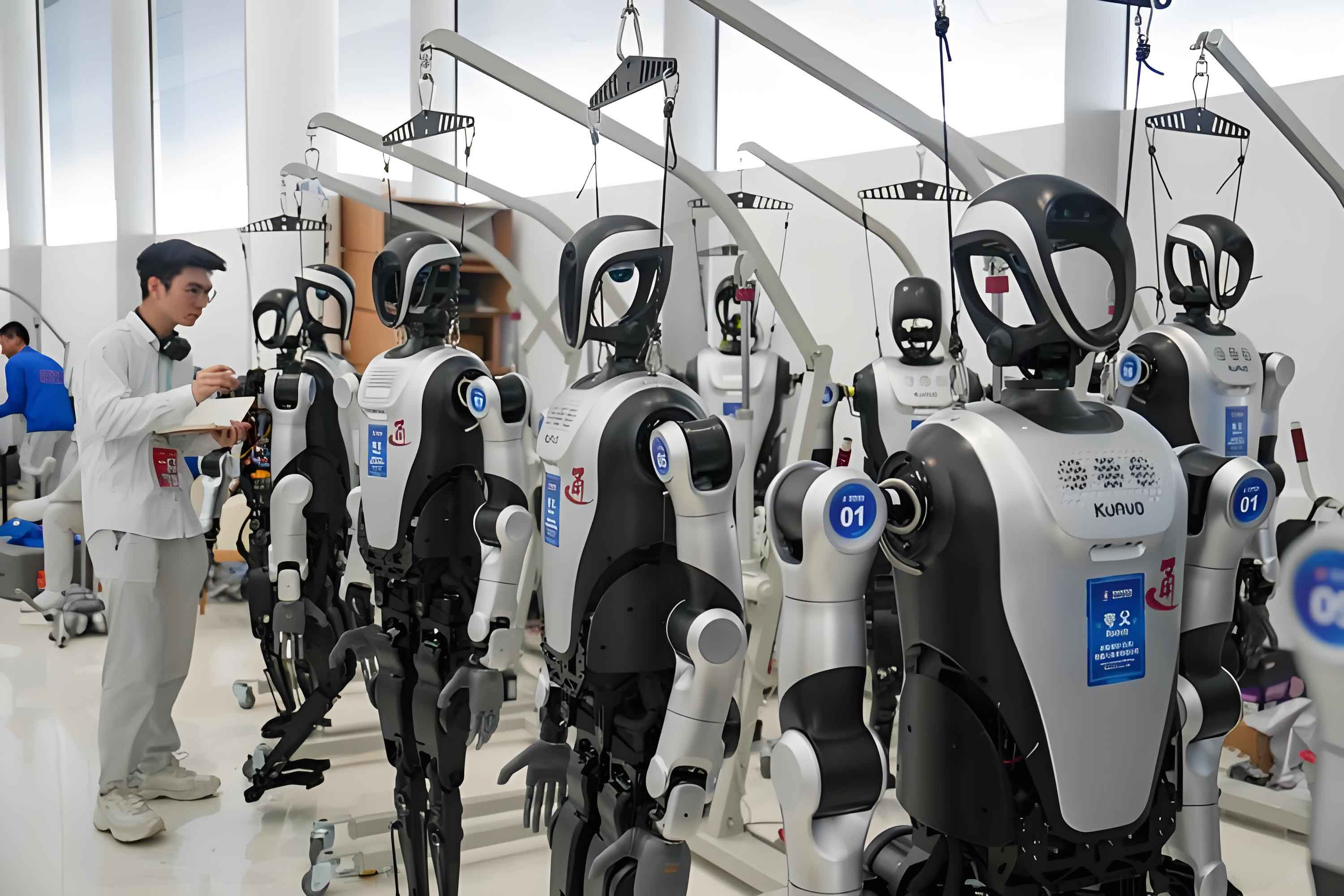
To achieve its humanoid robot goals, AgiBot needs more high-quality data and better deployment scenarios. In Zhangjiang, Shanghai, the company operates a 4,000-square-meter data collection factory. The facility is divided into different scenarios, and hundreds of humanoid robots are trained there. They learn skills such as folding clothes, brewing coffee, and scrubbing toilets. These tasks may appear simple, but they involve perception, manipulation, planning, and adaptation in unstructured environments.
The data collected in this factory is intended to serve as “nutrients” for AgiBot’s humanoid robot systems. The data can help expand application scenarios and prepare the humanoid robot for future home use. This is important because home environments are far more complex than factories. A factory can be designed around a robot, but a home is already organized around people. A humanoid robot that can operate in a home must understand messy spaces, fragile objects, unpredictable human behavior, and safety constraints.
The data factory also reflects a broader truth about the humanoid robot industry: hardware alone is not enough. A humanoid robot becomes useful through software, data, and repeated training. AgiBot’s investment in data collection shows that it understands the need to build a data flywheel. The more humanoid robots it deploys, the more data it can collect, and the more capable its models can become. That flywheel is central to the long-term humanoid robot competition.
However, data collection is expensive and time-consuming. It requires trained operators, standardized tasks, and careful quality control. The value of the data depends on whether it can be transferred from one humanoid robot to another and from one scenario to another. AgiBot’s ability to turn raw data into reliable skills will be a key test of its humanoid robot strategy.
8. An Ecosystem Around the Humanoid Robot Supply Chain
AgiBot’s ambition extends beyond building humanoid robot bodies. The company is investing in and incubating a network of businesses across the humanoid robot supply chain. Qingtian Rental, founded at the end of 2025, is one example. It uses a rent-instead-of-buy model to lower the application threshold for humanoid robots and has grown quickly. Its valuation has reached 7 billion yuan. Another example is Mifeng Data, which focuses on solving the data supply challenge for embodied intelligence training. In just half a year, it has completed three financing rounds.
Critical Point is another incubated company. It specializes in dexterous hands, a critical component for humanoid robot manipulation. Its first-quarter shipment volume is reported to be leading in its segment. Deng has said that with funding support from various parties, these businesses will accelerate and hopefully become leaders in their respective niche markets as early as possible. This ecosystem approach can help AgiBot secure key components, reduce development bottlenecks, and capture value beyond the humanoid robot body itself.
In the upstream and downstream supply chain, AgiBot has invested in more than 20 companies within one and a half years. These investments include Qianjue Robotics, Mogan Technology, and Fuxing Motor, among others. Through these deals, AgiBot has locked in key components such as tactile sensors, electronic skin, and servo motors. For a humanoid robot company, supply chain security matters because humanoid robots require a large number of precision components, and performance differences in sensors or motors can directly affect the robot’s capabilities.
The ecosystem strategy also creates potential synergies. A dexterous hand company can benefit from AgiBot’s humanoid robot deployments, while AgiBot can gain earlier access to specialized manipulation technology. A data company can help train humanoid robot models, while a rental platform can generate real-world usage data. This interconnected structure is designed to accelerate both AgiBot and its partners. The risk is that managing a complex ecosystem requires significant capital and management attention, especially while the core humanoid robot business is still scaling.
9. Listed Platform and Consumer Brand Add Capital Reach
One of AgiBot’s most closely watched moves has been its control of the listed company Shangwei New Materials. The company originally produced wind turbine blade materials. In 2025, AgiBot acquired 63.6% of the company for total consideration of 2.1 billion yuan. Deng became the actual controller, and Peng was elected chairman. Before AgiBot took control, Shangwei New Materials had a market capitalization of only 3.1 billion yuan. Its market value has since risen to 56.5 billion yuan.
Under the leadership of the AgiBot team, Shangwei New Materials’ subsidiary Qiyuan Innovation operates independently and has launched its own brand, Qiyuan Robotics, targeting the consumer segment. In the first half of the year, its robot business reported 210 million yuan in advance payments from customers. This shows that there is commercial interest in consumer-oriented robot products, even if the humanoid robot market is still immature. The listed platform gives AgiBot additional access to capital markets and public-company resources.
In the short term, large-scale deployment of humanoid robots in real scenarios remains difficult, and the profit path for both Qiyuan and AgiBot is not yet clear. The humanoid robot industry requires heavy investment in research, manufacturing, service, and data. Revenue growth does not automatically translate into profit. AgiBot’s ability to manage costs, improve reliability, and build recurring revenue models will determine whether its listed platform becomes a strategic advantage or a financial burden.
If AgiBot successfully lists on the Hong Kong Stock Exchange, Deng and Peng would helm two listed companies and be able to allocate more resources. That could strengthen the company’s humanoid robot development, supply chain investments, and global market expansion. But capital alone will not decide the outcome. Whether AgiBot can grow into a giant depends not only on fundraising but also on technical depth and the ability to make money. The humanoid robot market rewards companies that can turn demonstrations into dependable products and dependable products into profitable operations.
10. Talent, Capital, and Execution Are Tested
AgiBot’s campus recruitment campaign shows that the company understands the importance of talent in the humanoid robot race. The first stop at the University of Electronic Science and Technology of China was symbolic because both founders studied there. Peng’s remote video address urged students to become colleagues rather than remain online followers. Management’s message that AgiBot is the “infant form” of a future giant was designed to attract students who want to join an early-stage company with large ambitions.
The humanoid robot industry needs talent across mechanical engineering, electronics, control systems, artificial intelligence, manufacturing, supply chain, and service operations. A company that wants to scale from 15,000 cumulative units to much larger deployment must build teams that can handle reliability engineering, customer support, data operations, and international expansion. Recruitment is therefore not a side activity; it is part of the humanoid robot commercialization plan.
At the same time, AgiBot is testing a difficult balance. It is spending heavily on research, data collection, supply chain investments, and market development while aiming for rapid revenue growth. It is asking investors to support a target valuation of HK$40 billion to HK$50 billion while the humanoid robot market is still young. It is asking customers to adopt humanoid robots before the products are fully mature. And it is asking employees to join a company that describes itself as an “infant form” of a future giant.
Execution will be decisive. The humanoid robot market has many entrants, and technical demonstrations are not enough. AgiBot must show that its humanoid robot products can operate reliably, that its service network can support customers, that its data factory can improve performance, and that its rental and sales channels can generate repeat demand. The company’s early shipment leadership is an advantage, but it is not a guarantee of long-term success.
11. Key Humanoid Robot Metrics at a Glance
| Category | Metric | Figure |
|---|---|---|
| Financial | First-quarter revenue | 1 billion yuan, matching the full previous year |
| Financial | 2027 revenue target | More than 10 billion yuan |
| Listing | Target valuation from cornerstone investors | HK$40 billion to HK$50 billion |
| Humanoid robot shipments | Cumulative shipments by June | 15,000 units |
| Humanoid robot shipments | First-half shipments and global share | 8,400 units and about 40% global share |
| Ecosystem | Qingtian Rental valuation | 7 billion yuan |
| Listed platform | Shangwei New Materials acquisition | 63.6% stake for 2.1 billion yuan |
| Listed platform | Shangwei New Materials market capitalization | From 3.1 billion yuan to 56.5 billion yuan |
| Consumer robot business | Qiyuan Innovation first-half advance payments | 210 million yuan |
| Supply chain | Investments in upstream and downstream companies | More than 20 companies within one and a half years |
12. Conclusion: Humanoid Robot Growth Story Meets Profitability Test
AgiBot has assembled many of the ingredients that a leading humanoid robot company is expected to have: founders with deep technology and management experience, a rapidly growing shipment base, multiple product lines, consumer and industrial channels, a rental platform, a data collection facility, supply chain investments, and a path toward public markets. Its humanoid robot shipment growth from just over 10,000 units in March to 15,000 units by June is a strong signal that the company can move products out of the lab and into customer hands.
But the humanoid robot business is still in an early stage. Consumer sales remain modest, profitability is uncertain, and large-scale deployment in real scenarios is difficult. AgiBot’s plan to reach 10 billion yuan in revenue by 2027 and 100 billion yuan over eight years is ambitious. The company’s ability to scale will depend on product reliability, service capability, data-driven improvement, supply chain control, and customer adoption. Capital and hiring can accelerate the journey, but they cannot replace execution.
The humanoid robot market is watching AgiBot closely because its trajectory reflects the broader promise and challenge of the industry. If AgiBot can turn its early shipment lead into repeatable deployments and a sustainable business model, it could become a major humanoid robot platform company. If it cannot, the gap between humanoid robot demonstrations and profitable mass adoption will remain wide. For now, AgiBot is moving aggressively on multiple fronts: recruiting talent, expanding humanoid robot shipments, building channels, investing in the ecosystem, and preparing for a Hong Kong listing. The next phase will test whether that momentum can be converted into durable commercial success.