
In my study of vocational education for intelligent manufacturing, I have focused on a central challenge: how to reform the industrial robot operation and maintenance course so that students not only master technical skills but also develop strong innovation capabilities. The rapid growth of intelligent manufacturing has made the industrial robot a key technology in production systems. Enterprises increasingly expect graduates to understand programming, debugging, maintenance, system integration, and continuous improvement. However, traditional course delivery often emphasizes repetition, standardized procedures, and basic operation, while innovation ability remains weakly integrated into learning outcomes. I designed this research to examine the current state of innovation cultivation in the industrial robot course, identify the causes of weakness, and propose a practical reform model that can be implemented in vocational education.
My starting point is that innovation capability is not an isolated personal trait. It grows from knowledge, practice, motivation, environment, assessment, and professional identity. In an industrial robot course, innovation may appear as a new fixture design, an optimized motion path, an improved fault-warning module, a new vision-communication scheme, or a more flexible scheduling logic. These outcomes require students to connect theory with real production tasks. Therefore, I treat course reform as a systematic design problem rather than a single teaching-method change. The reform must adjust curriculum content, teaching methods, faculty capacity, practical platforms, assessment mechanisms, and industry collaboration.
In the following sections, I present the research context, the data sources I used, the current problems I identified, the reform strategies I developed, a detailed case study of the industrial robot operation and maintenance course, the effects of implementation, and future directions. I use tables and formulas to summarize the logic of the reform and to make the relationships among innovation capability, learning activities, and assessment more explicit.
Research Context and Rationale
The intelligent manufacturing environment is changing the role of the industrial robot. In earlier stages, an industrial robot was often treated as a programmable machine for repetitive tasks. Today, it is part of a networked production system that includes sensors, vision systems, conveyors, programmable logic controllers, digital twins, and manufacturing execution systems. The industrial robot must adapt to varied products, handle exceptions, communicate with other devices, and support traceability. This shift means that graduates need more than operational familiarity. They need the ability to diagnose problems, propose improvements, and create new solutions under constraints.
My rationale for focusing on the operation and maintenance course is that it sits at the intersection of core technical skills and real production scenarios. It includes robot installation, coordinate systems, teaching pendant programming, motion path design, end-effector selection, fault diagnosis, preventive maintenance, and system debugging. These activities offer natural opportunities for innovation. For example, students can design an adaptive gripper for parts of different sizes, optimize a path to reduce cycle time, add a fault-warning module, or improve a vision-based sorting process. If the course is reorganized around such opportunities, innovation capability can be developed through ordinary learning tasks rather than added as an extracurricular activity.
I also recognize that innovation capability in vocational education must be defined in a practical way. It is not limited to invention or research. It includes the ability to identify an improvement point, analyze a technical process, propose a feasible solution, test the solution, evaluate the result, and communicate the value. In the context of the industrial robot, innovation capability therefore has strong procedural and collaborative dimensions. It depends on technical knowledge, hands-on skill, problem-solving attitude, teamwork, safety awareness, and professional responsibility.
I use the following general model to describe the formation of innovation capability in an industrial robot course:
$$
IC = \alpha K + \beta S + \gamma M + \delta E + \varepsilon
$$
In this equation, \(IC\) represents innovation capability, \(K\) represents domain knowledge, \(S\) represents technical skill, \(M\) represents motivation and engagement, \(E\) represents the learning and practice environment, and \(\varepsilon\) represents unobserved factors. The coefficients \(\alpha\), \(\beta\), \(\gamma\), and \(\delta\) express the relative contribution of each dimension. This model guided my diagnosis because it shows that weak innovation outcomes may come from weak knowledge, insufficient practice, low motivation, or an unsupportive environment. A course reform that addresses only one dimension is unlikely to produce durable improvement.
Methods and Data Sources
To understand the current state of innovation capability cultivation in the industrial robot course, I used multiple data sources. I combined enterprise research, classroom observation, student and teacher interviews, questionnaires, competition records, project outcomes, and employment feedback. This mixed-method design allowed me to compare what enterprises expect, what teachers intend, what students experience, and what learning outcomes actually appear.
I paid particular attention to the alignment between course activities and real industrial robot work tasks. I asked whether students had opportunities to make decisions, propose alternatives, test improvements, and reflect on failure. I also examined whether assessment rewarded innovation or merely rewarded memorization and standardized operation.
| Data Source | Purpose | Focus | Use in Analysis |
|---|---|---|---|
| Enterprise research | Identify industry expectations for innovation | Industrial robot positions, maintenance tasks, system integration needs | Compare course content with enterprise requirements |
| Classroom observation | Observe teaching behavior and student response | Innovation guidance, practice design, student questioning | Identify gaps in teaching methods |
| Student questionnaire | Measure innovation awareness and participation | Motivation, satisfaction, perceived opportunity | Explain low engagement and weak practice |
| Teacher interviews | Understand instructional constraints | Faculty experience, resources, assessment pressure | Identify capacity and resource problems |
| Competition and project records | Evaluate innovation outputs | Project quality, originality, feasibility | Assess before-and-after reform effects |
| Employment feedback | Examine graduate performance | Problem-solving, adaptability, teamwork | Validate the practical value of reform |
Through this multi-source approach, I found a persistent gap. Enterprises wanted graduates who could improve industrial robot applications, but the course often asked students to reproduce fixed procedures. Teachers recognized the importance of innovation, but many felt constrained by time, equipment, assessment requirements, and their own lack of recent enterprise project experience. Students were interested in technology, but they did not always see how innovation related to their daily learning or future career.
Current State of Innovation Capability Development
My analysis revealed three major weaknesses in the current industrial robot operation and maintenance course: weak innovation awareness, insufficient innovation practice, and low participation in innovation activities. These weaknesses are connected. When students do not see innovation as part of their role, they do not seek practice. When practice opportunities are limited, they cannot build confidence. When assessment does not reward innovation, participation remains low.
The first weakness is weak innovation awareness. Many students are accustomed to passive learning. They wait for the teacher to explain the correct procedure and then repeat it. They rarely ask why a particular industrial robot path is chosen, whether a gripper can be improved, or how a fault could be prevented. Their understanding of innovation is often vague. Some believe that innovation belongs only to engineers in research departments. Others believe that meeting the basic job requirement is enough. This mindset limits their willingness to explore alternative solutions.
The second weakness is insufficient innovation practice. Although the course includes practical training, many tasks are standardized and closed. Students follow step-by-step instructions to complete a known result. They do not have enough opportunities to define a problem, design a solution, test it, and revise it. In an industrial robot course, this is especially problematic because innovation depends on iterative experimentation. If students only repeat a known program, they may become proficient operators but not reflective problem solvers.
The third weakness is low participation in innovation activities. Innovation projects, competitions, and open-ended tasks often require extra time and effort. When these activities are not integrated into the course and not recognized in assessment, students tend to prioritize basic tasks that guarantee credit. The result is a cycle of low exposure, low confidence, and low participation. The following table summarizes these findings.
| Dimension | Observed Problem | Typical Student Behavior | Consequence for Industrial Robot Learning |
|---|---|---|---|
| Innovation awareness | Weak understanding of innovation value | Focuses only on basic operation and correct answers | Misses improvement opportunities in programming and maintenance |
| Innovation practice | Limited open-ended tasks | Repeats fixed procedures without variation | Cannot transfer skills to new industrial robot scenarios |
| Participation | Low engagement in competitions and projects | Chooses minimum required work for credit | Reduces experience with real innovation cycles |
| Team collaboration | Limited shared problem-solving | Divides tasks without joint reflection | Weakens system-level understanding of industrial robot integration |
| Assessment recognition | Innovation not central in grading | Invests little effort in creative improvement | Prevents innovation from becoming a course habit |
Causes of Current Limitations
I traced the above weaknesses to four main causes: curriculum and content constraints, teaching method limitations, faculty and resource shortages, and incomplete assessment and incentive mechanisms. These causes interact. For example, a rigid curriculum reduces the space for project-based learning, while a traditional assessment system discourages teachers from trying open-ended tasks. A lack of enterprise experience among faculty also limits the quality of innovation guidance.
The first cause is curriculum and content constraint. The course content has not always kept pace with industrial robot technology. It may emphasize basic programming and traditional maintenance while giving limited attention to vision systems, collaborative robots, digital monitoring, industrial internet, and intelligent fault diagnosis. In addition, practical tasks are often standardized rather than inquiry-based. The course lacks a dynamic update mechanism that links content to new industrial applications.
The second cause is teaching method limitation. Lecture-based instruction still dominates in many sessions. Case teaching and project teaching may be mentioned, but their implementation is sometimes shallow. Teachers may present a case without asking students to redesign it. They may assign a project without providing enough time for iteration. In such conditions, students do not experience the full innovation process. They may learn facts about an industrial robot but not learn how to improve its application.
The third cause is faculty and resource shortage. Some teachers have strong theoretical knowledge but limited recent enterprise practice. They may not have participated in real industrial robot integration projects, so they find it difficult to guide students through messy, open-ended problems. At the same time, equipment updates may be slow. Advanced devices such as vision systems, force sensors, collaborative robots, and digital twin platforms may be unavailable or insufficient for large-group innovation work.
The fourth cause is assessment and incentive weakness. Traditional assessment often focuses on theoretical tests and basic operation. Innovation is not a core indicator. Students who spend extra time on an improved fixture or an optimized path may not receive additional recognition. Teachers who invest in innovation teaching may also lack incentives. Without assessment and incentive alignment, reform efforts are difficult to sustain.
| Cause | Specific Limitation | Effect on Innovation Capability | Reform Response |
|---|---|---|---|
| Curriculum content | Slow update, standardized tasks | Weak connection to real industrial robot innovation | Modularize content and embed innovation points |
| Teaching method | Teacher-centered delivery | Low student inquiry and reflection | Adopt project, blended, and flipped learning |
| Faculty capacity | Limited enterprise project experience | Weak guidance for open-ended problems | Build layered training and enterprise co-teaching |
| Resources | Outdated or insufficient equipment | Few chances to test advanced solutions | Create three-level practice platform |
| Assessment | Innovation not weighted | Low motivation for creative work | Build innovation-centered assessment system |
| Incentive | Limited recognition for effort | Innovation remains optional | Introduce rewards, showcases, and incubation support |
Reform Strategies
Based on the diagnosis, I designed a reform framework with four connected strategies: optimizing curriculum content, innovating teaching methods, strengthening faculty capability, and improving practical teaching platforms. The framework aims to make innovation a normal part of learning in the industrial robot course. It does not treat innovation as an extra topic. Instead, it embeds innovation into content, instruction, practice, and assessment.
Optimizing Curriculum Content
I reorganized the course content around modules that combine technical skills with innovation opportunities. Each module includes core knowledge, basic operation, a real or simulated production task, and an innovation extension. The innovation extension asks students to improve an existing solution, design an alternative, or propose a preventive measure. This structure helps students see that innovation is connected to the industrial robot tasks they already perform.
I also developed a case library based on industry needs. The cases cover the full lifecycle of an industrial robot application, including requirement analysis, selection, installation, programming, debugging, maintenance, and optimization. In case discussions, students examine how engineers identify problems, compare alternatives, and work in teams. They then apply similar thinking to their own projects. The case library is not a fixed set of stories; it is updated as technology and industry practices change.
| Course Module | Core Technical Content | Basic Practice | Innovation Extension |
|---|---|---|---|
| Robot system foundation | Structure, coordinates, safety, control principles | Manual jogging and coordinate setting | Propose safety interlock improvements for an industrial robot cell |
| Programming and motion | Teaching pendant programming, motion instructions, path design | Write a basic pick-and-place program | Optimize path to reduce cycle time and energy use |
| End effector and grasping | Gripper types, sensors, vacuum systems | Select and install a gripper | Design an adaptive gripper for multiple part sizes |
| System integration | PLC, conveyor, sensor communication | Connect robot with conveyor and sensor | Design priority scheduling for multi-station collaboration |
| Fault diagnosis | Common faults, signal analysis, maintenance流程 | Diagnose a simulated fault | Build a fault library and add warning logic |
| Vision application | Image acquisition, recognition, communication | Complete a simple sorting task | Improve recognition under complex lighting |
| Maintenance management | Preventive maintenance, records, reliability | Create a maintenance checklist | Optimize maintenance plan for high-frequency faults |
In my design, each module uses an innovation point as a bridge between knowledge and practice. The following formula expresses the intended relationship:
$$
M_i = K_i + S_i + I_i + R_i
$$
Here, \(M_i\) is the learning outcome of module \(i\), \(K_i\) is knowledge, \(S_i\) is skill, \(I_i\) is innovation activity, and \(R_i\) is reflection. This formula reminds me that a module is incomplete if it only includes knowledge and skill. Innovation activity and reflection must be designed into the module from the beginning.
Innovating Teaching Methods
I introduced project-based learning as the main instructional approach. In this approach, students work in teams on realistic industrial robot tasks. Each project includes a problem statement, constraints, deliverables, and an innovation requirement. Students must analyze the task, plan the solution, implement it, test it, and present it. This process develops technical skill and innovation capability at the same time.
I also used blended learning. Online resources provide technical background, industry news, and demonstration videos. Classroom time is then used for discussion, debugging, and project review. This shift allows students to prepare before class and use face-to-face time for higher-order activities. I further adopted flipped classroom techniques. Students study basic concepts before class, and class time focuses on project展示, peer review, and teacher coaching. In this way, the classroom becomes a place for active problem solving rather than passive listening.
I integrated ideological and professional elements into project guidance. When students study advanced industrial robot applications, I connect the technical content with innovation spirit, craftsmanship, safety responsibility, teamwork, and contribution to intelligent manufacturing. This integration is not an added lecture. It appears naturally in project tasks and reflection. For example, a project on fault prevention can highlight responsibility for production safety. A project on domestic technology can encourage confidence and long-term commitment.
The effect of teaching methods can be modeled as follows:
$$
\Delta IC = \beta_0 + \beta_1 PBL + \beta_2 BL + \beta_3 FL + \beta_4 X + \varepsilon
$$
In this equation, \(\Delta IC\) is the change in innovation capability, \(PBL\) is project-based learning intensity, \(BL\) is blended learning intensity, \(FL\) is flipped learning intensity, and \(X\) includes control variables such as prior achievement and team composition. The coefficients estimate the contribution of each method. This formula helped me monitor whether the reform was actually changing learning conditions rather than only changing course documents.
| Teaching Method | Implementation Form | Innovation Mechanism | Evidence of Effect |
|---|---|---|---|
| Project-based learning | Team projects based on real industrial robot tasks | Requires problem definition, design, testing, and revision | More student-generated improvements and prototypes |
| Blended learning | Online resources plus classroom practice | Provides flexible access to advanced knowledge | Better preparation and more classroom discussion |
| Flipped classroom | Pre-class study and in-class project review | Shifts class time toward inquiry and feedback | Increased questioning and peer evaluation |
| Case teaching | Real or simulated enterprise cases | Shows how engineers improve systems | Students transfer case logic to new tasks |
| Competition integration | Course tasks linked to innovation contests | Adds challenge and external feedback | Higher participation and stronger outputs |
| Reflective review | Project reports and post-task discussions | Converts experience into transferable knowledge | Improved ability to explain and generalize solutions |
Strengthening Faculty Capability
Faculty capability is a decisive factor in course reform. I designed a layered training system for teachers. The first layer focuses on basic technical更新 in industrial robot programming, maintenance, and integration. The second layer focuses on innovation teaching methods, including project design, open-ended questioning, and assessment of creativity. The third layer focuses on enterprise practice and collaborative curriculum development. Teachers are encouraged to work on real industrial robot projects and bring those experiences back to the classroom.
I also proposed a multi-dimensional incentive mechanism. Teachers who develop high-quality innovation projects, guide student competitions, or publish teaching cases receive recognition through awards, professional development opportunities, and workload recognition. The purpose is to make innovation teaching a valued part of professional practice rather than an extra burden.
Enterprise co-teaching is another important element. I invite enterprise engineers to join selected teaching sessions, review student projects, and provide feedback based on production standards. This collaboration helps students understand the gap between classroom solutions and industrial requirements. It also helps teachers update their knowledge of current industrial robot applications.
| Faculty Development Layer | Target Capability | Activity | Expected Outcome |
|---|---|---|---|
| Technical foundation | Up-to-date industrial robot knowledge | Workshops, certification courses, equipment training | Accurate and current instruction |
| Innovation pedagogy | Project design and creative assessment | Teaching seminars, peer observation, case development | Better guidance for open-ended tasks |
| Enterprise practice | Real production experience | Enterprise attachment, joint projects, co-teaching | More authentic cases and feedback |
| Research and reflection | Evidence-based reform | Action research, data analysis, publication | Continuous improvement of the course |
| Incentive and recognition | Sustained motivation | Awards, workload recognition, showcases | Stronger commitment to innovation teaching |
Improving Practical Teaching and Platforms
I designed a three-level practical teaching system for the industrial robot course: basic training, innovation workshop, and industrial base. The first level builds core operation skills. The second level provides open space for experimentation and improvement. The third level connects students with enterprise-like production environments. This structure allows students to move from guided practice to independent innovation.
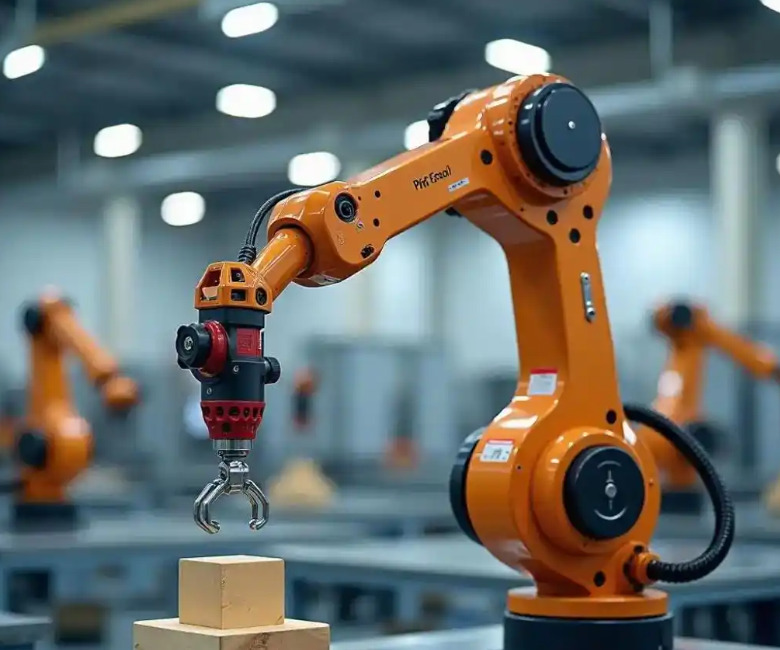
The three-level platform supports different stages of innovation capability. At the basic level, students learn safe operation and standard programming of the industrial robot. At the innovation workshop level, they test alternative fixtures, path strategies, vision parameters, and fault-warning logic. At the industrial base level, they work with real production constraints such as cycle time, quality traceability, and system reliability. The platform contribution can be expressed as:
$$
P_{platform} = \sum_{i=1}^{3} \omega_i L_i
$$
Here, \(P_{platform}\) is the total platform contribution to innovation learning, \(L_i\) is the learning value of level \(i\), and \(\omega_i\) is the weight of that level. This formula highlights that the three levels are complementary. Basic training without innovation space limits creativity. Innovation space without basic skill leads to unrealistic designs. Industrial context without reflection may become simple imitation. All three levels are necessary.
| Practice Level | Main Function | Typical Industrial Robot Activity | Innovation Focus |
|---|---|---|---|
| Basic training | Build core skills and safety awareness | Jogging, coordinate setting, basic programming, maintenance | Understanding constraints and standard procedures |
| Innovation workshop | Encourage experimentation and design | Fixture modification, path optimization, vision debugging | Generating and testing alternative solutions |
| Industrial base | Simulate real production and teamwork | Assembly line collaboration, fault diagnosis, traceability | Solving system-level problems with production standards |
| Project incubation | Support transfer and application | Prototype development, competition preparation | Turning course ideas into demonstrable outcomes |
| Feedback loop | Improve future learning | Case collection, fault library updates, peer review | Building cumulative innovation knowledge |
I also included an incentive mechanism for practical outcomes. Student projects with strong innovation value can receive incubation support, exhibition opportunities, and recognition. This mechanism helps students see that their ideas can have impact beyond the classroom. It also strengthens the connection between the industrial robot course and the broader innovation ecosystem.
Case Study: Industrial Robot Operation and Maintenance Course
I selected the industrial robot operation and maintenance course as the main case for reform because it is a core course with strong technical and practical characteristics. The course includes robot system setup, programming, debugging, maintenance, and fault handling. It also has natural links to innovation because students must adapt solutions to different workpieces, layouts, sensors, and production requirements.
Reform Design
I designed the reform around real work scenarios. Instead of teaching isolated commands and procedures, I organized the course into integrated projects. Each project includes an industrial robot application scenario, a set of technical requirements, a deliverable, and an innovation direction. Students work through the full process from system setup to programming, debugging, and optimization. This approach helps them understand not only how to operate an industrial robot but also why a particular solution is effective and how it can be improved.
I adopted an integrated theory-practice model. When a concept is difficult to understand, students immediately practice it with the industrial robot. For example, when learning programming instructions, they observe a demonstration, write a program, run it, debug it, and compare results. This cycle strengthens understanding and encourages active exploration. It also creates opportunities for innovation because students see the effects of their choices.
I emphasized safety and professional responsibility throughout the projects. Students learn safety procedures, risk identification, and standard operation. They also discuss cases of equipment accidents and quality problems. These discussions help them understand that innovation in the industrial robot field must be responsible, reliable, and safe. The course connects technical learning with professional ethics and long-term commitment to intelligent manufacturing.
The project design also integrates multiple elements such as job roles, course content, competitions, certifications, and innovation. This integration aims to align learning with career development. The following table summarizes the main projects.
| Project Name | Core Objective | Practice Task | Innovation Direction |
|---|---|---|---|
| Automatic part handling | Master basic programming, end-effector selection, and handling logic | Select gripper or vacuum cup, program path, debug precision, optimize cycle | Adaptive gripper, path optimization, abnormal condition detection |
| Assembly line collaboration | Understand robot, conveyor, and sensor coordination | Build assembly scenario, write closed-loop program, complete station tasks | Priority scheduling, quality traceability, flexible adaptation |
| Fault diagnosis and maintenance | Develop troubleshooting and maintenance ability | Simulate faults, follow diagnosis process, write fault report | Fault library, warning module, optimized maintenance plan |
| Visual sorting | Combine vision and industrial robot operation | Build vision system, debug parameters, write communication program | Lighting adaptation, communication scheme improvement |
| Flexible production cell | Integrate multiple devices and product variants | Configure cell, program changeover, test different models | Rapid changeover strategy, modular fixture design |
| Predictive maintenance | Use data to prevent equipment failure | Collect operating parameters, analyze trends, design warning rules | Condition monitoring, early warning logic, maintenance scheduling |
In each project, students must document their process. They describe the original problem, the constraints, the solution, the test results, and the improvement. This documentation is not only a record. It is a tool for reflection. When students explain why their first solution failed and how they revised it, they build innovation capability that can transfer to new industrial robot tasks.
Innovation-Centered Assessment System
I constructed an assessment system that places innovation at the center while still evaluating theoretical knowledge and practical skill. The assessment includes theoretical understanding, practical operation, innovation performance, collaboration, and reflection. The weighting is designed to signal that innovation is a core learning outcome, not an optional bonus.
The total score can be represented as:
$$
Score = 0.25 T + 0.25 P + 0.20 I + 0.15 C + 0.15 R
$$
In this formula, \(T\) is theoretical knowledge, \(P\) is practical skill, \(I\) is innovation performance, \(C\) is collaboration, and \(R\) is reflection. The weights can be adjusted for different course levels, but the principle remains the same: innovation must have substantial weight if it is to influence student behavior.
| Assessment Dimension | Weight | Evidence | Evaluation Focus |
|---|---|---|---|
| Theoretical knowledge | 25% | Quizzes, concept explanations, design rationale | Understanding of industrial robot principles |
| Practical skill | 25% | Operation, programming, debugging, maintenance | Accuracy, safety, efficiency, and independence |
| Innovation performance | 20% | Improvement proposal, prototype, optimization result | Originality, feasibility, and actual effect |
| Collaboration | 15% | Team contribution, communication, task coordination | Shared problem solving in industrial robot projects |
| Reflection | 15% | Project report, presentation, post-task review | Ability to explain, generalize, and improve |
I also introduced multiple evaluation subjects. Teacher evaluation focuses on professional knowledge, skill, innovation, and teamwork. Student self-evaluation and peer evaluation encourage reflection and mutual learning. Enterprise evaluation provides an industry perspective. This combination makes assessment more comprehensive and more connected to real industrial robot work.
| Evaluation Subject | Role | Focus | Benefit |
|---|---|---|---|
| Teacher | Professional assessor and coach | Knowledge, skill, innovation, safety, teamwork | Standards and technical accuracy |
| Student self | Reflective learner | Effort, participation, learning progress, improvement | Self-awareness and responsibility |
| Peer group | Collaborative evaluator | Contribution, communication, cooperation, idea sharing | Mutual learning and accountability |
| Enterprise expert | Industry reviewer | Feasibility, production value, reliability, cost awareness | Real-world relevance |
| Competition judge | External evaluator | Originality, presentation, technical difficulty | Broader benchmark for innovation |
To monitor innovation growth over time, I used a course innovation index:
$$
CII = \frac{1}{n} \sum_{i=1}^{n} \left( \frac{I_i – I_{i0}}{I_{i0}} \right)
$$
Here, \(CII\) is the course innovation index, \(I_i\) is the innovation score of student \(i\) after the reform, \(I_{i0}\) is the baseline score, and \(n\) is the number of students. This index provides a simple summary of relative improvement. It can be used together with qualitative evidence such as project reports and teacher observations.
Implementation Process
The implementation followed a cyclical process. First, I analyzed the industrial robot work tasks and defined the innovation points for each project. Second, I designed learning activities and assessment rubrics. Third, I prepared teachers, equipment, and digital resources. Fourth, I implemented the projects with students. Fifth, I collected evidence from reports, presentations, tests, and feedback. Sixth, I reviewed the results and revised the design. This cycle supports continuous improvement.
During implementation, I observed that students needed time to become comfortable with open-ended tasks. At the beginning, many asked for a single correct answer. They were not used to choosing among alternatives or justifying their design. As the projects progressed, they became more willing to test ideas. They began to compare cycle times, discuss gripper design, and propose fault-warning rules. The change was gradual but visible.
I also observed that team composition mattered. Diverse teams with different strengths in programming, mechanical assembly, electrical connection, and presentation produced stronger projects. Teams with unclear roles often struggled. Therefore, I added role rotation and team contracts to help students manage collaboration. This change improved both project quality and peer evaluation.
Case Effects
After implementing the reform, I analyzed its effects in three areas: student innovation capability, student professional quality, and teaching feedback. The results were encouraging, although they also revealed areas for further improvement.
Student Innovation Capability
More than sixty percent of students were able to propose at least one practical optimization or innovation in their projects. In the automatic part handling project, some students designed an adaptive gripper for multiple part sizes. They added elastic buffer structures and adjustable clamping devices. The adjustment time for changing workpieces was reduced by more than forty percent, and handling flexibility improved. Other students optimized the industrial robot motion path, reduced empty travel time, and improved handling efficiency by about twenty-five percent while lowering energy consumption.
In the assembly line collaboration project, students designed a priority scheduling program. The program adjusted the industrial robot task order according to station progress and urgency. This reduced congestion caused by fixed sequences. Some teams added a QR code scanning module to support quality traceability. In the fault diagnosis and maintenance project, students added a warning module that monitored operating parameters and predicted common faults such as motor overheating and sensor abnormality. This reduced downtime by about twenty percent in the simulated environment. In the visual sorting project, students repeatedly adjusted vision parameters to improve recognition under complex lighting. Some teams designed a communication scheme between the industrial robot and the vision system that improved stability and anti-interference capability.
I summarize the main quantitative effects in the following table.
| Indicator | Before Reform | After Reform | Change |
|---|---|---|---|
| Students proposing at least one innovation | Low | More than 60% | Substantial increase |
| Adaptive gripper adjustment time | Baseline | Reduced by over 40% | Higher flexibility |
| Handling efficiency through path optimization | Baseline | Improved by about 25% | Lower cycle time |
| Simulated fault downtime with warning module | Baseline | Reduced by about 20% | Better prevention |
| Participation in innovation competitions | Limited | Increased | Stronger motivation |
| Quality of project reports | Basic description | Detailed analysis and reflection | Improved reasoning |
The efficiency gain from path optimization can be illustrated with a simple formula:
$$
E_{robot} = \frac{T_{new} – T_{old}}{T_{old}} \times 100\%
$$
Here, \(E_{robot}\) is the percentage change in industrial robot task time, \(T_{new}\) is the optimized cycle time, and \(T_{old}\) is the original cycle time. When \(E_{robot}\) is negative, the new solution is faster. This formula helped students quantify the value of their improvements instead of relying only on subjective judgment.
Student Professional Quality
Student professional quality also improved. In team projects, students communicated more actively and divided tasks more clearly. Peer feedback showed that more than ninety percent of students believed their teamwork ability was effectively trained. They reported stronger responsibility and collective identity. In safety and professional conduct, violation rates during practical operation decreased. Students became more conscious of safety procedures, quality standards, and equipment care.
Through industry cases and stories of technological progress, students expressed stronger interest in intelligent manufacturing and a greater willingness to contribute to industrial development. This change is important because innovation capability is sustained by professional identity and purpose. When students see their learning as connected to real production and national development, they invest more effort in improvement.
| Professional Quality Dimension | Observed Change | Evidence | Link to Innovation |
|---|---|---|---|
| Teamwork | Stronger communication and role clarity | Peer feedback, team contracts | Innovation often requires shared problem solving |
| Safety awareness | Lower violation rate | Operation records, teacher observation | Responsible innovation in industrial robot systems |
| Quality awareness | More attention to precision and traceability | Project reports, inspection results | Improvements must meet production standards |
| Professional identity | Stronger interest in intelligent manufacturing | Course reflections, interviews | Motivation for long-term innovation |
| Responsibility | Greater ownership of tasks | Self-evaluation, team evaluation | Commitment to reliable solutions |
Teaching Feedback and Evaluation
Student feedback indicated that the integrated theory-practice model helped them understand technical concepts. They found project-based learning closer to enterprise needs than isolated exercises. Teachers observed higher classroom participation, more active questioning, and stronger exploration. Enterprise reviewers rated students more positively in problem solving, innovation thinking, and professional quality.
I used the following learning growth model to interpret feedback:
$$
G = \frac{1}{1 + e^{-(\theta_0 + \theta_1 IC + \theta_2 X)}}
$$
Here, \(G\) represents the probability or likelihood of positive learning growth, \(IC\) is innovation capability, and \(X\) includes supporting conditions such as teacher guidance, platform access, and team collaboration. This logistic form reflects the idea that growth is not linear. Supportive conditions can amplify the effect of innovation capability, while poor conditions can suppress it.
| Feedback Area | Student Response | Teacher Observation | Enterprise Comment |
|---|---|---|---|
| Theory-practice integration | Helps understanding and memory | More active application of concepts | Better readiness for industrial robot tasks |
| Project-based learning | Closer to real work | Stronger engagement and persistence | More practical problem-solving ability |
| Innovation assessment | Encourages improvement efforts | More diverse project outcomes | Better awareness of production value |
| Team collaboration | Improves communication | More peer teaching and shared debugging | Better adaptability to team roles |
| Safety and responsibility | Recognizes importance | Fewer risky behaviors | Stronger professional attitude |
Discussion
The reform experience shows that innovation capability can be developed within a regular industrial robot course when the course design connects knowledge, practice, motivation, environment, and assessment. The most important lesson I learned is that innovation cannot be added as a separate topic at the end of a course. It must be embedded in the tasks that students already perform. When students optimize a path, redesign a gripper, or improve a fault-warning rule, they are practicing innovation in a concrete and meaningful way.
Another lesson is that assessment strongly shapes student behavior. When innovation was not weighted, students treated it as optional. When innovation became a core assessment dimension, they invested more effort. However, assessment must be designed carefully. If innovation is evaluated only by the novelty of an idea, students may propose unrealistic solutions. Therefore, I combined originality, feasibility, technical effect, safety, and production value in the rubric. This balance helps students understand that innovation in the industrial robot field must be both creative and reliable.
Faculty capability is also critical. A reform document cannot compensate for limited teacher experience. Teachers need opportunities to work with real industrial robot systems, learn new integration methods, and practice innovation pedagogy. Enterprise co-teaching and joint project development are effective ways to update faculty knowledge and connect the classroom with production. At the same time, incentives are needed to sustain teacher engagement.
The three-level practice platform provides a useful structure. Basic training ensures safety and technical foundation. The innovation workshop provides space for experimentation. The industrial base provides realistic constraints. When these levels are connected, students experience a progression from guided operation to independent improvement. The following formula summarizes the relationship between platform quality and innovation output:
$$
Q = f(P, S, T, C)
$$
In this expression, \(Q\) is the quality of innovation output, \(P\) is platform support, \(S\) is student skill, \(T\) is teacher guidance, and \(C\) is collaboration quality. This formula is intentionally general, but it captures the multi-factor nature of innovation in an industrial robot course. Improving only one factor may not be enough.
I also found that student motivation is influenced by visible impact. When students see that their adaptive gripper reduces adjustment time or their path optimization improves efficiency, they become more confident. When their work is reviewed by enterprise experts or presented in competitions, they take it more seriously. Therefore, showcasing outcomes and providing incubation support are valuable. They turn course projects into meaningful achievements.
Future Directions
The future of industrial robot education will be shaped by digitalization, intelligence, and system integration. As intelligent manufacturing develops, the industrial robot will be increasingly connected with artificial intelligence, machine vision, digital twins, cloud platforms, and industrial internet. Course reform should therefore continue to evolve. The goal is not only to teach current equipment but also to develop the ability to learn, adapt, and innovate as technology changes.
I plan to explore blended learning further. Online platforms can deliver前沿 technology content, virtual demonstrations, and interactive simulations. Classroom time can then focus on project design, debugging, and peer review. Virtual reality, augmented reality, and artificial intelligence can create interactive learning environments. For example, virtual reality can simulate complex industrial robot work scenarios, allowing students to test solutions without equipment risk. Artificial intelligence can provide personalized feedback and help students analyze performance data.
I also intend to strengthen the integration of digital design, intelligent manufacturing system integration, and industrial internet knowledge. These areas are becoming part of the industrial robot professional role. Students should learn how to collect data from robots, analyze equipment condition, design predictive maintenance rules, and connect robots with manufacturing execution systems. The following formula can be used to describe future readiness:
$$
R_{future} = \alpha D + \beta A + \gamma I + \delta H
$$
Here, \(R_{future}\) is future readiness, \(D\) is digital design capability, \(A\) is intelligent application capability, \(I\) is innovation capability, and \(H\) is human-centered professional quality such as ethics, safety, and collaboration. The coefficients reflect the relative importance of each dimension. This model can guide curriculum updates as industry requirements change.
| Future Direction | Technology or Method | Expected Learning Outcome | Connection to Innovation |
|---|---|---|---|
| Digital twin | Virtual modeling and simulation | Predict industrial robot behavior before deployment | Faster and safer experimentation |
| Artificial intelligence | Data analysis and intelligent decision support | Optimize parameters and detect anomalies | Data-driven innovation |
| Virtual reality and augmented reality | Immersive training and remote guidance | Practice complex tasks without risk | Expanded creative exploration |
| Industrial internet | Equipment connectivity and cloud monitoring | Understand system-level industrial robot data | Integration innovation |
| Collaborative robotics | Human-robot interaction and safety | Design flexible human-robot work cells | Human-centered innovation |
| Predictive maintenance | Condition monitoring and fault prediction | Reduce downtime and improve reliability | Service and maintenance innovation |
I believe future research should also examine how to assess innovation capability more accurately. Innovation is complex and context-dependent. A single test score cannot capture it. I plan to combine project evidence, longitudinal performance, peer evaluation, enterprise review, and reflection records. I will also study how different student groups respond to the reform. For example, students with different prior achievement, learning styles, and team experiences may need different levels of scaffolding. Understanding these differences will help make the reform more inclusive.
Another direction is deeper industry collaboration. Joint curriculum development, real project participation, and co-assessment can make learning more authentic. Enterprises can provide real problems, data, and constraints. Students can propose solutions and receive feedback. Teachers can update their knowledge. This collaboration creates a cycle in which education and industry improve each other. In the industrial robot field, such a cycle is essential because technology changes quickly and production requirements continue to rise.
Conclusion
In my research and practice, I examined how to reform the industrial robot operation and maintenance course to strengthen innovation capability. I found that traditional course design often limits innovation through rigid content, teacher-centered methods, insufficient faculty experience, outdated resources, and assessment that does not value creativity. To address these problems, I developed a reform framework that includes modularized content, project-based and blended teaching, faculty development, a three-level practice platform, and an innovation-centered assessment system.
The case study showed positive effects. Students proposed more improvements, designed practical solutions, and demonstrated stronger teamwork and professional quality. They optimized industrial robot paths, designed adaptive grippers, built fault-warning modules, improved vision sorting, and created scheduling and traceability solutions. These outcomes indicate that innovation capability can be cultivated through carefully designed course activities. The key is to connect innovation with real technical tasks, assess it seriously, support it with platforms and teachers, and recognize student effort.
I conclude that course reform for innovation capability is not a one-time project. It is a continuous process of design, implementation, observation, and revision. As industrial robot technology advances, the course must continue to update its content and methods. The goal is to prepare students who can operate, maintain, integrate, and improve intelligent manufacturing systems. Such students need strong technical skills, creative problem-solving ability, safety awareness, teamwork, and a commitment to responsible innovation. My reform experience provides a practical reference for advancing vocational education in the industrial robot field and for building a curriculum that supports both immediate employment and long-term professional growth.