
As an observer of technological advancements, I have witnessed the rapid evolution of AI human robots, which are poised to revolutionize various aspects of human life. These robots, designed with human-like appearances and behaviors, leverage artificial intelligence and robotics to perform tasks across diverse scenarios. The potential of AI human robots is immense, with projections indicating a market value exceeding hundreds of billions of dollars in the coming decades. However, the industry is still in its nascent stages, facing challenges in core technologies, commercialization, and ethical regulations. In this article, I will delve into the developments, trends, and recommendations for AI human robots, incorporating data, formulas, and tables to provide a comprehensive analysis.
The concept of AI human robots revolves around four key technological pillars: perception, intelligent decision-making, human-robot interaction, and motion control. Perception involves the use of sensors to gather environmental data, such as visual, auditory, and tactile inputs. For instance, visual perception can be modeled as $$ P_v = \int S_i \cdot f(I) \, di $$ where \( P_v \) represents visual perception, \( S_i \) denotes sensor inputs, and \( f(I) \) is the image processing function. Intelligent decision-making relies on machine learning, deep learning, and neural networks, enabling autonomous choices based on contextual tasks. A simplified decision model can be expressed as $$ D = \arg \max_a Q(s,a) $$ where \( D \) is the decision, \( Q(s,a) \) is the value function for state \( s \) and action \( a \). Human-robot interaction focuses on natural communication, including speech and emotion recognition, while motion control ensures dynamic balance and precise movements through algorithms and hardware components like reducers and encoders.
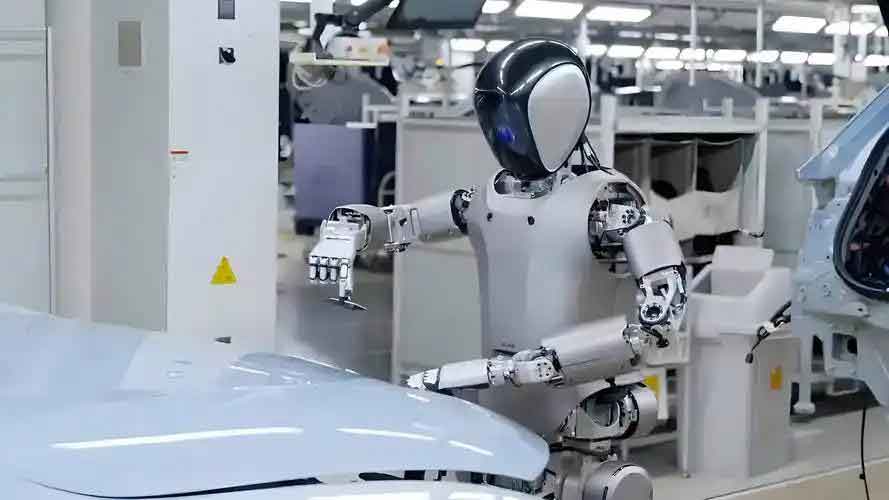
The development of AI human robots has progressed through several phases. Initially, in the 1970s to 2000s, robots like WABOT-1 and ASIMO focused on basic walking and simple hand movements, with limited intelligence. From 2001 to 2011, integration improved with enhanced perception and interaction capabilities, as seen in robots like Pepper. The period from 2012 to 2020 saw a surge in participants, with advancements in dynamic motion and interaction, exemplified by Boston Dynamics’ Atlas. Since 2020, the era of heightened intelligence has begun, with models like Tesla’s Optimus and GPT-integrated systems pushing the boundaries of AI human robots. This evolution underscores the growing importance of AI human robots in shaping future technologies.
The strategic significance of AI human robots cannot be overstated. They enhance national competitiveness by driving innovation in AI, sensors, and materials, while fostering high-end manufacturing clusters. Moreover, AI human robots optimize labor divisions and mitigate aging population issues by taking over repetitive or hazardous tasks. In social domains, they advance fields like healthcare and education, improving quality of life. Economically, AI human robots represent a new growth engine, attracting global investments and creating jobs. The potential economic impact is modeled by $$ G = A \cdot e^{rt} $$ where \( G \) is the market growth, \( A \) is the initial market size, \( r \) is the growth rate, and \( t \) is time.
Currently, the market for AI human robots is expanding rapidly. Estimates suggest global revenues could reach billions of dollars by 2035, with manufacturing and domestic services as primary applications. Investment activity is robust, as shown in the table below, which summarizes recent funding trends. The competition is intensifying, with giants like Tesla and startups like Ubtech leading the charge. Patent filings have surged, particularly in China, though quality gaps remain in advanced areas like multi-sensor fusion. Talent development is crucial, with universities and companies collaborating to build a skilled workforce for AI human robots.
| Year | Number of Deals | Total Investment (Billions USD) | Key Focus Areas |
|---|---|---|---|
| 2018 | 25 | 1.5 | Perception Systems |
| 2019 | 30 | 2.0 | Motion Control |
| 2020 | 35 | 2.8 | AI Decision-Making |
| 2021 | 40 | 3.5 | Human-Robot Interaction |
| 2022 | 45 | 4.2 | Commercial Applications |
Policy and regional layouts play a pivotal role in nurturing the AI human robot industry. Globally, initiatives like the U.S. National Robotics Plan and EU’s Horizon Europe provide funding and support. In China, policies such as the “Guidelines for Humanoid Robot Innovation” outline targets for technological breakthroughs and ecosystem development. Regionally, clusters in the Yangtze River Delta, Pearl River Delta, and Beijing-Tianjin-Hebei area leverage local advantages to foster innovation. The table below compares international policies, highlighting their focus on AI human robots.
| Country/Region | Policy/Initiative | Key Objectives | Funding (Billions USD) |
|---|---|---|---|
| USA | National AI R&D Strategy | Lead in AI and robotics innovation | 0.93 |
| Japan | New Robot Strategy | Become top robot innovation hub | N/A |
| EU | Horizon Europe | Boost competitiveness and jobs | |
| Germany | High-Tech Strategy | Advance societal benefits from tech | 0.069 |
| South Korea | Third Intelligent Robot Plan | Develop core industry capabilities | 0.172 |
Trends indicate that large models are empowering AI human robots to become key carriers of embodied intelligence. For example, multimodal models like GPT-4V enhance environmental interaction, with potential applications in dynamic settings. The industrialization of AI human robots is accelerating, with 2024 poised as a landmark year for mass production. Projections show a compound annual growth rate (CAGR) of 25% from 2023 to 2030, driven by demand in manufacturing. The formula for market penetration can be expressed as $$ P = \frac{N_r}{N_t} \times 100\% $$ where \( P \) is penetration rate, \( N_r \) is the number of AI human robots, and \( N_t \) is the total addressable market. Initially, AI human robots will dominate industrial settings before expanding to consumer domains like home care and entertainment.
Despite the optimism, AI human robots face significant challenges. Technically, the integration of multiple disciplines remains immature, with gaps in sensor fusion and real-time responsiveness. For instance, the latency in decision-making can be modeled as $$ L = \frac{1}{f_s} \cdot \log(\Delta t) $$ where \( L \) is latency, \( f_s \) is sampling frequency, and \( \Delta t \) is time delay. Data scarcity for training AI human robots poses another hurdle, unlike other AI fields with abundant datasets. Cost is a major barrier, with current prototypes costing hundreds of thousands of dollars, limiting widespread adoption. Ethical concerns, such as privacy and moral agency, require careful regulation to ensure responsible development of AI human robots.
Conversely, opportunities abound for AI human robots. Technological breakthroughs in vision, audio, and large models are enhancing capabilities, leading to products like Ameca and CyberOne. Domestic component suppliers stand to benefit early, as core parts like servos and controllers see increased demand. Automotive companies are leveraging their expertise in perception and algorithms to cross over into AI human robots, as seen with Tesla’s reuse of FSD systems. The synergy between electric vehicles and AI human robots can be described by $$ S = \alpha \cdot C_v + \beta \cdot A_r $$ where \( S \) is synergy, \( C_v \) is vehicle technology, \( A_r \) is robot technology, and \( \alpha, \beta \) are coefficients. This crossover accelerates innovation and cost reduction for AI human robots.
To capitalize on these opportunities, I recommend strengthening strategic guidance by refining roadmaps and fostering international collaboration on AI human robots. Regions should specialize based on their strengths, such as R&D in innovation hubs and manufacturing in industrial bases. Key technologies must be prioritized, with focused efforts on perception, interaction, control, and execution for AI human robots. For example, motion control can be optimized using $$ \min \int (x_d – x)^2 \, dt $$ where \( x_d \) is desired trajectory and \( x \) is actual trajectory. Innovation ecosystems should be optimized by supporting SMEs and open platforms, while standards and regulations ensure safety and ethical compliance for AI human robots.
In conclusion, AI human robots represent a transformative force with the potential to redefine industries and society. By addressing challenges and leveraging opportunities, we can unlock their full benefits. The journey ahead for AI human robots is filled with promise, and through collaborative efforts, they will become integral to our future. As I reflect on the progress, it is clear that AI human robots are not just machines but partners in advancing human potential.