
As a researcher in the field of robotics, I have always been fascinated by the versatility of bionic robots, especially those capable of operating across multiple domains. The natural world offers endless inspiration, with animals like frogs, birds, and turtles seamlessly transitioning between land, water, and air. In this article, I will delve into the current state and future prospects of amphibious bionic robots, which integrate capabilities from two or more of these environments. The development of such bionic robots is crucial for expanding robotic applications in complex, dynamic settings such as disaster response, environmental monitoring, and exploration. Throughout this discussion, I will emphasize the role of bionic design principles, using tables and formulas to summarize key insights, and ensure the keyword “bionic robot” is frequently highlighted to underscore its importance.
The concept of amphibious bionic robots stems from the need to overcome limitations in traditional robotics. Single-domain robots, whether ground-based, aerial, or aquatic, often fail in unpredictable terrains or multi-phase missions. For instance, ground robots struggle with obstacles like rubble or deep water, aerial robots are vulnerable to weather and have limited endurance, and underwater robots cannot access terrestrial or aerial spaces. By mimicking nature’s solutions, bionic robots offer a pathway to robust, adaptive systems. In this review, I categorize amphibious bionic robots into three types: land-air, water-air, and water-land systems. Each category presents unique challenges and opportunities, which I will explore in detail, drawing on research trends and technological advancements.
To begin, let’s consider the fundamental principles behind bionic robots. Bionic robots are designed by emulating biological mechanisms, such as locomotion strategies from animals. This approach not only enhances efficiency but also enables cross-domain functionality. For example, the dynamics of a bird’s flight or a fish’s swim can be modeled mathematically to guide robot design. In the following sections, I will use formulas to describe these dynamics, such as the lift and drag forces in aerial motion or the thrust and buoyancy in aquatic environments. Additionally, tables will compare different bionic robot designs, highlighting their strengths and weaknesses. The integration of these elements aims to provide a holistic view of the field, paving the way for future innovations in bionic robotics.
Land-Air Bionic Robots: Current Research and Analysis
Land-air bionic robots combine terrestrial and aerial mobility, offering advantages like extended endurance on ground and rapid access via flight. In my research, I have observed that early developments focused on simple integrations, such as attaching wheels to drones, but recent advances leverage bionic inspirations for more seamless transitions. For instance, some bionic robots mimic birds like the red-billed chough, which can run and fly, or insects like bees that exhibit hover-and-perch behaviors. These bionic designs often involve morphing structures or hybrid propulsion systems.
A key aspect of land-air bionic robots is their ability to switch modes efficiently. This can be analyzed through dynamics models. Consider a bionic robot with both rotors for flight and legs for walking. The total force balance during transition can be expressed as:
$$ \sum F = m \frac{dv}{dt} = F_{\text{lift}} + F_{\text{thrust}} – F_{\text{gravity}} – F_{\text{drag}}, $$
where \( F_{\text{lift}} \) is the lift from rotors, \( F_{\text{thrust}} \) is the propulsion force, \( F_{\text{gravity}} \) is the gravitational force, and \( F_{\text{drag}} \) is the aerodynamic or ground friction drag. For bionic robots, these forces must be optimized across domains, often requiring adaptive control algorithms. I have compiled a table below summarizing notable land-air bionic robot types, based on their design and performance metrics.
| Bionic Robot Type | Inspiration Source | Key Features | Challenges |
|---|---|---|---|
| Rotary-wing with wheels | Birds and insects | Simple integration, good flight stability | Limited ground adaptability, high energy use |
| Morphing-wing designs | Bats and birds | Efficient aerodynamics, smooth transitions | Complex mechanics, weight penalties |
| Leg-rotor hybrids | Frogs and grasshoppers | Enhanced terrain negotiation, stable landing | Control complexity, payload limitations |
| Flapping-wing ground robots | Insects and small birds | Energy-efficient flight, bionic locomotion | Low speed, susceptibility to winds |
From this table, it is evident that bionic robots in the land-air category often trade off between specialization and versatility. For example, rotary-wing bionic robots excel in flight but may lack ground maneuverability, whereas leg-rotor hybrids offer better all-terrain performance at the cost of increased design complexity. In my analysis, future land-air bionic robots should focus on improving power-to-weight ratios and developing synergistic mode-switching strategies. The bionic robot community is exploring materials like lightweight composites and algorithms for autonomous transitions, which could revolutionize applications in search-and-rescue or surveillance.
Water-Air Bionic Robots: Current Research and Analysis
Water-air bionic robots are designed to operate both underwater and in the air, a capability inspired by animals like sea birds (e.g., puffins) or flying fish. These bionic robots face unique challenges due to the density and viscosity differences between water and air. In my work, I have studied various approaches to overcome these barriers, ranging from variable-density systems to morphing propulsion mechanisms. The bionic robot designs here often mimic biological adaptations, such as water-repellent surfaces or adjustable wing shapes.
The dynamics of water-air transitions involve complex fluid-structure interactions. For a bionic robot diving from air to water, the impact force can be modeled as:
$$ F_{\text{impact}} = \frac{1}{2} C_d \rho A v^2, $$
where \( C_d \) is the drag coefficient, \( \rho \) is the fluid density (air or water), \( A \) is the cross-sectional area, and \( v \) is the velocity. Bionic robots must minimize this force to prevent damage, often through streamlined shapes inspired by aquatic animals. Similarly, for takeoff from water, surface tension and buoyancy play critical roles, described by:
$$ F_{\text{buoyancy}} = \rho V g, $$
where \( V \) is the displaced volume and \( g \) is gravitational acceleration. By integrating these principles, bionic robots can achieve efficient cross-domain mobility. Below is a table categorizing water-air bionic robots based on their design philosophy.
| Bionic Robot Category | Design Approach | Advantages | Limitations |
|---|---|---|---|
| Fixed-wing amphibious | Inspired by seaplanes and birds | High speed in air, good payload capacity | Bulky for underwater use, slow transitions |
| Multi-rotor aquatic drones | Mimics insects and small aquatic birds | Vertical takeoff, hover capability, compact size | Limited underwater endurance, complex seals |
| Flapping-wing hybrids | Based on flying fish or aquatic insects | Energy-efficient, bionic motion patterns | Fragile structures, low thrust in water |
| Variable-buoyancy systems | Inspired by submarines and buoyant animals | Stealthy underwater, smooth depth control | Slow aerial performance, heavy components |
This table highlights that water-air bionic robots are still in early stages, with most prototypes focusing on proof-of-concept demonstrations. In my opinion, the key to advancement lies in enhancing material compatibility—for instance, using corrosion-resistant materials for aquatic parts and lightweight polymers for aerial components. The bionic robot field must also address control challenges during transitions; for example, adaptive algorithms that adjust propeller speeds or wing angles based on medium density. As research progresses, I anticipate water-air bionic robots will become vital for oceanography and aerial surveys, leveraging their dual-domain capabilities.
Water-Land Bionic Robots: Current Research and Analysis
Water-land bionic robots are perhaps the most directly inspired by amphibians like frogs, turtles, and salamanders. These bionic robots excel in environments where water and land intersect, such as marshes, shores, or flood zones. In my studies, I have examined various locomotion strategies, from undulatory swimming akin to snakes to legged walking similar to crabs. The bionic robot designs often incorporate flexible joints or variable stiffness mechanisms to adapt to different terrains.
The mechanics of water-land bionic robots involve trade-offs between swimming efficiency and walking stability. For instance, the power required for swimming in a viscous fluid can be expressed as:
$$ P_{\text{swim}} = C \mu L^2 v^2, $$
where \( C \) is a shape-dependent constant, \( \mu \) is the dynamic viscosity of water, \( L \) is a characteristic length, and \( v \) is the swimming velocity. On land, the power for legged locomotion might follow:
$$ P_{\text{walk}} = \frac{F_{\text{friction}} \cdot d}{t}, $$
with \( F_{\text{friction}} \) as the frictional force, \( d \) as distance, and \( t \) as time. Bionic robots that optimize these equations through bionic features, such as webbed feet or retractable limbs, can achieve better overall performance. The table below summarizes prominent water-land bionic robot types.
| Bionic Robot Type | Biological Inspiration | Locomotion Modes | Key Challenges |
|---|---|---|---|
| Snake-like undulatory robots | Eels and sea snakes | Swimming via body waves, crawling on land | Slow land speed, complex control systems |
| Frog-inspired legged robots | Frogs and toads | Jumping on land, kicking in water | Energy-intensive, limited payload |
| Turtle-shaped hybrids | Turtles and terrapins | Paddling in water, walking with limbs | Bulky design, mode-switching delays |
| Crab-like multi-legged robots | Crabs and lobsters | Walking on seabed, limited swimming | Poor aquatic agility, mechanical complexity |
From this analysis, I conclude that water-land bionic robots often prioritize one domain over the other, leading to compromises. For example, snake-like bionic robots are excellent swimmers but sluggish on land, while frog-inspired ones may excel in bursts of movement but lack endurance. Future developments should aim for more balanced designs, perhaps using modular components that reconfigure automatically. The bionic robot community is exploring smart materials, such as shape-memory alloys, to create adaptive limbs that change shape for water or land use. As these technologies mature, water-land bionic robots could revolutionize tasks like underwater infrastructure inspection or coastal monitoring.
In the broader context of bionic robots, the integration of cross-domain capabilities presents immense opportunities. Each category—land-air, water-air, and water-land—offers lessons that can be applied to others. For instance, morphing techniques from water-air bionic robots might inform land-air designs, or control algorithms from water-land systems could enhance aerial stability. To illustrate the progress in this field, I have included a visual representation below, showing a conceptual bionic robot that embodies these principles.
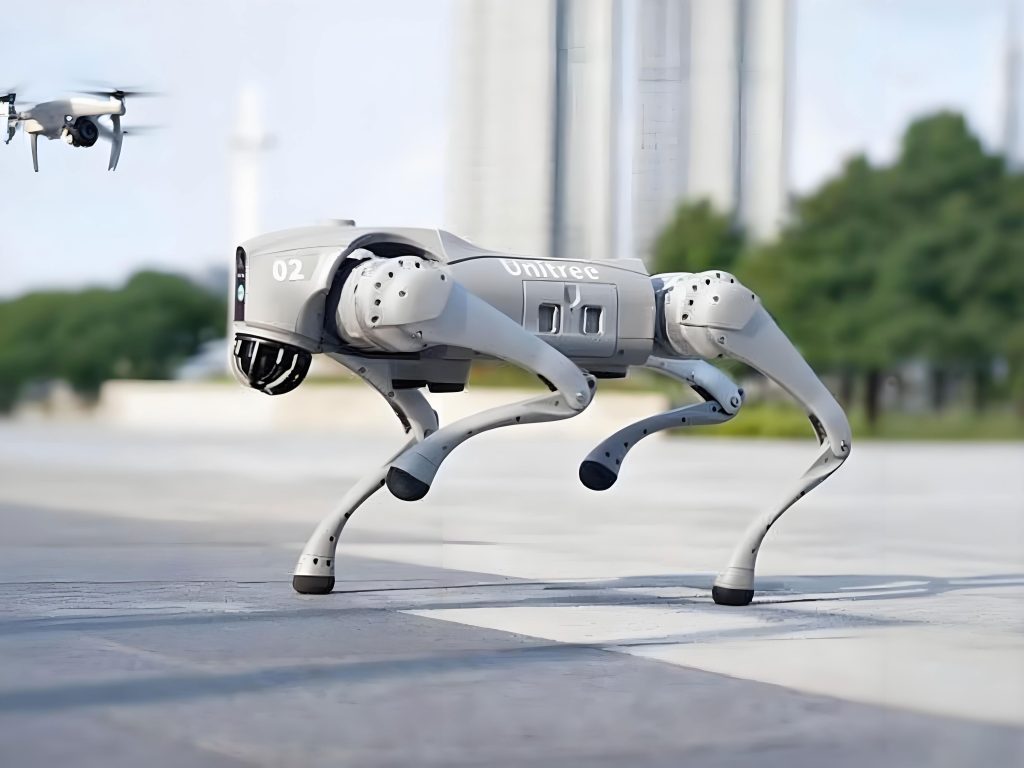
This image depicts a bionic robot with hybrid features, such as wing-like appendages for aerial gliding and fin-like structures for aquatic propulsion. It symbolizes the innovative spirit driving the bionic robot field forward. As we continue to draw inspiration from nature, such bionic robots will become more sophisticated, blurring the lines between biological and mechanical systems.
Future Prospects and Conclusion
Looking ahead, the future of amphibious bionic robots is bright, with potential breakthroughs on multiple fronts. In my view, key areas for advancement include energy efficiency, autonomy, and scalability. For example, bionic robots could incorporate bio-inspired energy harvesting, such as solar panels mimicking photosynthesis or piezoelectric materials that generate power from movement. Additionally, artificial intelligence and machine learning will enable bionic robots to make real-time decisions about mode switching, optimizing their behavior for complex environments.
To quantify these prospects, we can consider a generalized performance metric for bionic robots, defined as:
$$ \text{Performance Index} = \alpha \cdot \text{Efficiency} + \beta \cdot \text{Adaptability} + \gamma \cdot \text{Payload}, $$
where \( \alpha, \beta, \gamma \) are weighting factors based on mission requirements. This formula underscores the multi-objective nature of bionic robot design. As technology evolves, I anticipate that amphibious bionic robots will converge toward tri-domain capabilities—integrating land, water, and air mobility into a single platform. Such a bionic robot would be unparalleled in versatility, capable of, say, flying to a disaster zone, swimming through floodwaters, and walking over debris to deliver aid.
In conclusion, amphibious bionic robots represent a thrilling frontier in robotics, merging biological insights with engineering ingenuity. From land-air systems that mimic birds to water-land designs inspired by amphibians, each bionic robot type offers unique advantages and challenges. By leveraging tables and formulas, I have summarized the current state and highlighted pathways for improvement. The repeated emphasis on “bionic robot” throughout this article reflects its centrality to innovation. As researchers like myself continue to explore these concepts, I am confident that bionic robots will transform how we interact with our planet, enabling safer, more efficient exploration and intervention across all domains. The journey toward truly adaptive bionic robots is just beginning, and I look forward to contributing to this dynamic field.