
In modern aerospace manufacturing, the quality of aircraft skin connections critically impacts aerodynamic performance, weight requirements, and service life. Manual drilling operations often fail to meet the high precision and consistency demands, especially for composite materials like carbon fiber and aluminum alloy stacks. Automated drilling systems have emerged as a solution, but traditional systems such as C-frame automatic drilling machines or serial robotic setups face limitations in flexibility, stiffness, and cost-effectiveness. As a research team, we aim to develop an advanced drilling end effector that leverages parallel mechanisms to achieve high stiffness, accuracy, and rapid execution. This end effector is designed to integrate with a five-axis gantry system, enabling wide-range mobility and efficient hole-making processes. In this article, we present a detailed analysis of an improved three-degree-of-freedom (3-DOF) parallel mechanism for a drilling end effector, focusing on vibration reduction and stiffness enhancement through elastic constraints and auxiliary support structures.
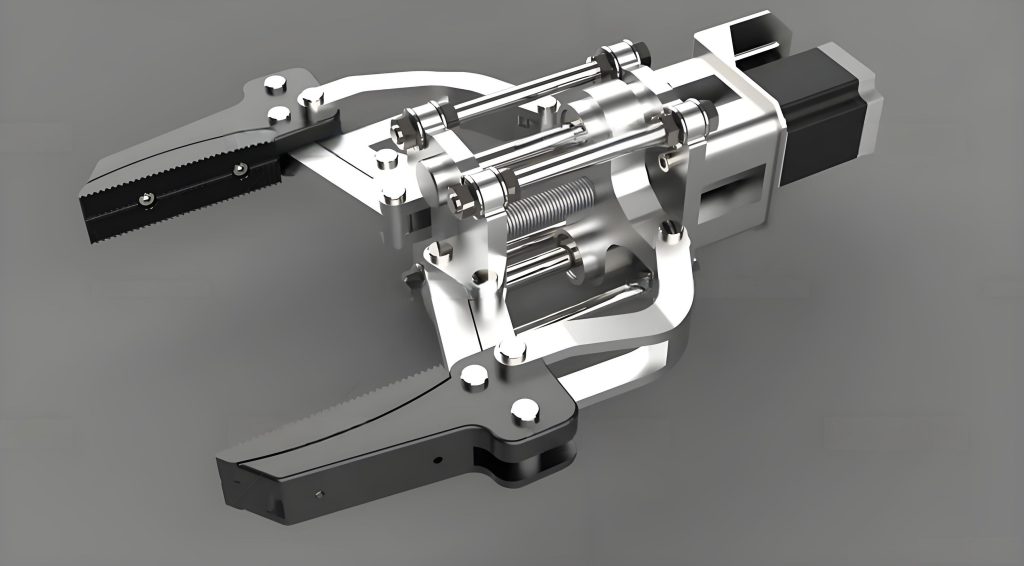
The core of our drilling end effector is a modified 3-RRR parallel mechanism, where “R” denotes revolute joints. This configuration offers advantages such as high speed, high acceleration, high load capacity, low energy consumption, and minimal cumulative error compared to serial mechanisms. To mitigate elastic vibrations inherent in parallel structures, we introduced spring constraints and auxiliary support rods. The end effector consists of a static platform base, three driving motors mounted on the base, driving rods connected via revolute joints, follower rods, and a moving platform that houses an electric spindle with a drill bit. Additionally, a rotating disk with wedge surfaces interacts with support rods to provide temporary three-point contact between the moving and static platforms during drilling, enhancing stability. The spring constraints are positioned along the follower rods to dampen vibrations. This design aims to optimize the end effector’s performance in dynamic drilling environments.
To understand the kinematic behavior of this end effector, we conducted an inverse kinematics analysis. Let the global coordinate system O-XYZ be fixed on the static platform, and the moving coordinate system p-xyz be attached to the moving platform. The joint coordinates are defined as A_i, B_i, and C_i for each limb i (i=1,2,3), where A_iB_i represents the driving rod of length a_i, and B_iC_i represents the follower rod of length b_i. The pose of the moving platform center is given by x, y, and θ (rotation). Given these parameters, the inverse kinematics solution for the driving joint angles α_i can be derived as follows. The position vectors are:
$$ \mathbf{r}_{B_i} = \mathbf{r}_{A_i} + a_i \begin{bmatrix} \cos \alpha_i \\ \sin \alpha_i \end{bmatrix} $$
$$ \mathbf{r}_{C_i} = \mathbf{r}_{B_i} + b_i \begin{bmatrix} \cos \beta_i \\ \sin \beta_i \end{bmatrix} = \mathbf{r}_{O_P} + \mathbf{R} \mathbf{r}_{P_{C_i}} $$
where \(\mathbf{r}_{O_P} = [x, y]^T\) is the vector of point P in the global frame, \(\mathbf{R} = \begin{bmatrix} \cos \theta & -\sin \theta \\ \sin \theta & \cos \theta \end{bmatrix}\) is the rotation matrix, and \(\mathbf{r}_{P_{C_i}}\) is the vector of C_i in the moving frame. Applying the constraint condition \(||\mathbf{r}_{C_i} – \mathbf{r}_{B_i}|| = b_i^2\), we obtain equations of the form \(e_{1i} \cos \alpha_i + e_{2i} \sin \alpha_i + e_{3i} = 0\), leading to:
$$ \alpha_i = 2 \arctan \left( \frac{-e_{1i} \pm \sqrt{e_{1i}^2 + e_{2i}^2 – e_{3i}^2}}{e_{3i} – e_{2i}} \right) $$
In practice, only one value is feasible due to small angular ranges. The Jacobian matrix, which maps velocities between the moving platform and driving joints, is derived as \(\mathbf{J} = \mathbf{P}^{-1} \mathbf{V}\), where \(\mathbf{P}\) and \(\mathbf{V}\) are matrices from the differentiation of the kinematic equations. This analysis ensures precise control of the end effector’s position and orientation during drilling operations.
For dynamic modeling, we considered the end effector as a flexible system with elastic components. Using the Euler-Bernoulli beam theory, the kinetic energy of the driving rods, follower rods, and moving platform was formulated. The driving rod A_iB_i has mass m_i1 and moment of inertia J_i1, with its center coordinates given by:
$$ X_{i1} = X_{A_i} + \frac{a_{i1}}{2} \cos \alpha_i, \quad Y_{i1} = Y_{A_i} + \frac{a_{i1}}{2} \sin \alpha_i $$
The kinetic energy T_1 for the driving rods is:
$$ T_1 = \frac{1}{2} \sum_{i=1}^{3} \sum_{j=1}^{2} m_{ij} (\dot{X}_{ij}^2 + \dot{Y}_{ij}^2) + \frac{1}{2} \sum_{i=1}^{3} J_{i1} \dot{\alpha}_i^2 $$
The follower rod B_iC_i, treated as a flexible beam, has a deformation vector including lateral deflection w. Its kinetic energy T_2 involves integration along the rod length b_i. The moving platform, with mass m_p and rotational inertia J_p, contributes kinetic energy T_3. The total kinetic energy T_total = T_1 + T_2 + T_3. The potential energy includes elastic energy from springs and strain energy from beam bending. For springs attached at distance d from joint B_i along the follower rod, the elastic potential energy V_1 is:
$$ V_1 = \frac{1}{2} \sum_{i=1}^{3} k_i (||\mathbf{r}_{D_i} – \mathbf{r}_{A_i}|| – L_0)^2 $$
where k_i is the spring stiffness and L_0 is the free length. The beam potential energy V_2 is based on axial and bending deformations. Applying Lagrange’s equation, we derive the vibration differential equation in matrix form:
$$ \mathbf{Q} = \mathbf{M} \ddot{\mathbf{q}} + \mathbf{C} \dot{\mathbf{q}} + \mathbf{K} \mathbf{q} $$
where \(\mathbf{M}\) is the mass matrix, \(\mathbf{C}\) is the damping matrix (assumed zero for undamped analysis), \(\mathbf{K}\) is the stiffness matrix, and \(\mathbf{Q}\) is the generalized force vector. For natural frequency analysis, we set \(\mathbf{C} = 0\) and \(\mathbf{Q} = 0\), leading to the eigenvalue problem:
$$ (\mathbf{K} – \omega_n^2 \mathbf{M}) \mathbf{q} = 0 $$
The stiffness matrix \(\mathbf{K}\) is related to the spring stiffness and Jacobian via \(\mathbf{K} = \mathbf{J} \mathbf{K}’ \mathbf{J}^T\), where \(\mathbf{K}’ = \text{diag}(k_1, k_2, k_3)\). Solving this equation yields the natural frequencies ω_n and mode shapes, which are critical for assessing the end effector’s vibration characteristics.
We performed a modal analysis using ADAMS/Vibration simulation to extract the natural frequencies and mode shapes of the end effector. The results for the first four modes are summarized in the table below, comparing simulation values with theoretical calculations. The end effector exhibits low-frequency modes primarily involving lateral swings of the follower rods, indicating areas for stiffness improvement.
| Mode Order | Simulated Natural Frequency (Hz) | Theoretical Natural Frequency (Hz) |
|---|---|---|
| 1 | 204.91 | 210.74 |
| 2 | 252.45 | 246.35 |
| 3 | 440.98 | 460.11 |
| 4 | 773.64 | 780.01 |
The relative error between simulation and theory is within 10%, validating our dynamic model. The first and second modes involve X-direction swings of the follower rods, the third and fourth modes involve Y-direction swings, and higher modes show Z-direction motions. These insights guide design modifications to enhance the end effector’s robustness against vibrations.
To evaluate the vibration damping effect of spring constraints, we conducted a frequency response analysis in ADAMS. An axial pulse excitation force was applied to the drill bit to simulate drilling conditions, using a step function: step(time, 1, 0, 1.1, 1000) + step(time, 1.1, 0, 1.2, -1000), representing a force rising to 1000 N in 0.1 s and then dropping to 0 N in another 0.1 s. A torque of 2 N·m was also applied. The displacement responses in X, Y, and Z directions were compared for the end effector with and without spring constraints. The results, plotted as displacement versus time curves, show that the spring-constrained system exhibits reduced amplitude oscillations, confirming effective vibration attenuation. For instance, the peak displacement in the X-direction decreased by approximately 30% with springs, demonstrating their role in stabilizing the end effector during dynamic loads.
Next, we analyzed the stiffness of the end effector to assess the impact of auxiliary support rods. The overall stiffness mapping matrix is given by \(\mathbf{K} = \mathbf{J} \mathbf{K}’ \mathbf{J}^T\). Using the principle of virtual work, the relationship between limb deformation and platform deformation is \(\tau \delta \mathbf{q} = \mathbf{G}^T \delta \mathbf{P}\), where \(\tau\) is the force vector in the limbs, \(\delta \mathbf{q}\) is the limb deformation, \(\mathbf{G} = [\mathbf{F}, \mathbf{M}]\) is the external force and moment, and \(\delta \mathbf{P}\) is the platform deformation. The maximum limb deformation is derived from the eigenvalues of \(\mathbf{K}’^{-T} \mathbf{K}’^{-1}\), with the maximum value representing the worst-case deformation. We performed finite element analysis (FEA) to simulate deformation under drilling loads: a 1000 N axial force and 2 N·m torque applied to the drill bit. The model was simplified by removing non-essential components like bearings and motors, and materials were assigned (alloy steel for the drill bit, aluminum for rods, and rigid bodies for support rods). The contact between support rods and the static platform was modeled with rolling friction (coefficient 0.05). Mesh was generated using a hybrid curvature-based approach. The results for maximum displacement in X, Y, and Z directions are compared in the table below, for cases with and without auxiliary support rods.
| Direction | Without Support Rods (mm) | With Support Rods (mm) | Theoretical Max Deformation (mm) |
|---|---|---|---|
| X | 0.391 | 0.073 | 0.412 |
| Y | 0.479 | 0.043 | 0.450 |
| Z | 4.027 | 0.097 | 4.320 |
| Total Displacement | 5.145 | 0.275 | 4.872 |
The data indicate significant reductions in displacement when auxiliary support rods are added, especially in the Z-direction (axial direction), where deformation drops from 4.027 mm to 0.097 mm. This validates that the support rods enhance the moving platform’s stiffness, preventing tilting or excessive deformation during drilling. The theoretical values align closely with simulations, supporting the stiffness model’s accuracy. In the workspace of the end effector, the stiffness is stronger near the boundaries due to the support mechanism, forming a ring-like high-stiffness region, while the interior remains relatively softer but within acceptable limits.
Further optimization of the end effector involved parameter studies on spring stiffness and support rod placement. We tested spring stiffness values ranging from 10 N/mm to 50 N/mm and found that 20 N/mm provided optimal vibration damping without over-constraining the mechanism. The spring installation position was set at one-third the length of the follower rod from the driving joint, as this minimized stress concentrations. For the support rods, the wedge angle on the rotating disk was designed to ensure smooth extension and retraction, with a cycle time of less than 0.5 seconds per hole, contributing to the end effector’s efficiency. Additionally, the driving and follower rods were designed as variable-cross-section beams to further improve stiffness-to-weight ratio, a key consideration for lightweight aerospace applications.
In terms of integration with the five-axis gantry system, the end effector is mounted on a connecting block attached to a U-shaped frame driven by rotary motors. This allows rotations about horizontal and vertical axes, complementing the X, Y, and Z linear motions from the gantry. The overall system achieves five degrees of freedom, enabling access to complex contours on aircraft skins. The end effector’s compact design, with dimensions including a static platform radius of 411 mm, moving platform radius of 125 mm, rod lengths of 252 mm, and moving platform mass of 176 kg, ensures compatibility with standard aerospace tooling. The use of smart cameras for real-time positioning and feedback enhances accuracy, making this end effector suitable for high-precision drilling tasks.
To summarize, our improved parallel mechanism-based drilling end effector demonstrates enhanced vibration resistance and stiffness through elastic constraints and auxiliary supports. The kinematic and dynamic models provide a foundation for control system development, while simulation results confirm the design’s effectiveness. Future work will involve experimental validation on physical prototypes and integration with advanced path-planning algorithms for autonomous drilling. This end effector represents a step toward cost-effective, flexible, and high-performance automated drilling systems in aerospace manufacturing, addressing challenges in composite material processing and precision hole-making.
Throughout this analysis, the term “end effector” has been emphasized to highlight its role as the critical interface between the robotic system and the workpiece. By optimizing its dynamic characteristics, we ensure reliable operation in demanding industrial environments. The incorporation of spring constraints and support rods not only mitigates vibrations but also boosts overall system robustness, making this end effector a promising solution for next-generation aircraft assembly lines.