
As a researcher in the field of healthcare technology, I have observed the increasing importance of medical robots in addressing challenges posed by infectious disease outbreaks. In this article, I will explore the application of medical robots in fever isolation clinics, focusing on various scenarios and future prospects. The integration of medical robots into healthcare settings, particularly in isolation environments, has shown significant potential in enhancing efficiency, reducing human contact, and protecting medical personnel. I will discuss this through a comprehensive analysis, incorporating tables and formulas to summarize key points.
The emergence of infectious diseases such as Middle East Respiratory Syndrome, Ebola, and COVID-19 has highlighted the need for innovative solutions in healthcare. Fever isolation clinics are critical points for screening and treating patients, but they pose high risks of cross-infection for healthcare workers. Medical robots, as a subset of artificial intelligence in medicine, offer a promising avenue for non-contact operations. In this context, I aim to delve into how medical robots can be applied across different stages of fever isolation clinics, from pre-examination to disinfection.
To begin, let me review the literature on medical robots. Based on studies from 2010 to 2020, research on medical robots has grown steadily, with a notable increase in publications. For instance, data from databases indicate a rising trend in articles related to medical robots and nursing robots. I have summarized this in Table 1 to provide a clear overview.
| Year | Number of Publications (Medical Robots) | Key Themes |
|---|---|---|
| 2010 | 50 | Robotics in surgery |
| 2011 | 65 | AI integration |
| 2012 | 80 | Service robots |
| 2013 | 95 | Rehabilitation applications |
| 2014 | 110 | Remote diagnostics |
| 2015 | 130 | Autonomous systems |
| 2016 | 150 | Precision medicine |
| 2017 | 170 | Wearable devices |
| 2018 | 190 | Teleoperation |
| 2019 | 210 | Pandemic response |
| 2020 | 250 | Isolation clinic applications |
This table illustrates the growing interest in medical robots, with a shift towards applications in isolation settings during recent years. The medical robot field encompasses various types, including surgical robots, rehabilitation robots, and service robots. In fever isolation clinics, the focus is often on service-oriented medical robots that can perform tasks without direct human intervention.
Moving to the application scenarios, medical robots can be deployed in multiple aspects of fever isolation clinics. I will break this down into four main areas: pre-examination triage, in-clinic diagnosis and treatment, item transportation, and clinic disinfection. Each of these areas benefits from the capabilities of medical robots, such as autonomous navigation, remote control, and sensor-based monitoring.
First, in pre-examination triage, medical robots equipped with natural language processing and touchscreen interfaces can assist patients in self-reporting symptoms. For example, a medical robot can guide patients through a series of questions to determine if they need to be directed to an isolation clinic. This reduces the workload on healthcare staff and minimizes contact. The efficiency of such a system can be modeled using a formula for triage accuracy. Let me propose a simple model: if a medical robot has a triage accuracy rate $$A_r$$, and the human triage accuracy is $$A_h$$, then the overall efficiency gain $$E$$ can be expressed as:
$$E = \frac{A_r – A_h}{A_h} \times 100\%$$
This formula highlights how medical robots can improve triage processes. In practice, medical robots have been implemented in pediatric clinics, where they use AI algorithms to simulate physician questioning, thereby speeding up the process and reducing queues.
Second, in-clinic diagnosis and treatment involves several sub-scenarios where medical robots play a role. For remote interrogation and visual examination, medical robots can be controlled remotely by healthcare providers to interact with patients. This allows for real-time communication while maintaining isolation. Additionally, medical robots can integrate wearable devices to monitor vital signs such as temperature, heart rate, and blood pressure. The data collected can be transmitted wirelessly, enabling continuous monitoring without physical contact. A mathematical representation of this monitoring system can be given by:
$$V(t) = \sum_{i=1}^{n} s_i(t) \cdot w_i$$
where $$V(t)$$ is the overall vital sign index at time $$t$$, $$s_i(t)$$ are individual sensor readings, and $$w_i$$ are weights assigned based on clinical importance. This emphasizes the role of medical robots in aggregating health data.
For cardiopulmonary auscultation, medical robots can utilize electronic stethoscopes with Bluetooth technology. The robot can position the stethoscope on the patient’s body, and the sounds are transmitted to a remote physician. With convolutional neural networks, these sounds can be analyzed for abnormalities. The accuracy of such a system can be quantified using a confusion matrix, as shown in Table 2.
| Prediction/Actual | Normal | Abnormal |
|---|---|---|
| Normal | TP (True Positive) | FP (False Positive) |
| Abnormal | FN (False Negative) | TN (True Negative) |
Here, TP, FP, FN, and TN represent the counts of correct and incorrect classifications by the medical robot’s AI system. The precision and recall can be calculated to assess performance.
Laboratory and imaging examinations also benefit from medical robots. For instance, robotic systems can automate sample collection, such as blood draws or swab tests, reducing exposure risks. In imaging, robots can assist with ultrasound scans by guiding probes autonomously. The feasibility of such systems has been demonstrated in research, where robotic arms perform repetitive tasks with high precision. The cost-effectiveness of deploying medical robots for these purposes can be evaluated using a formula:
$$C_{robot} = I + M \cdot t – S \cdot h$$
where $$C_{robot}$$ is the net cost, $$I$$ is the initial investment, $$M$$ is maintenance cost per time unit $$t$$, and $$S$$ is savings per hour $$h$$ from reduced human labor. This highlights the economic aspect of medical robot integration.
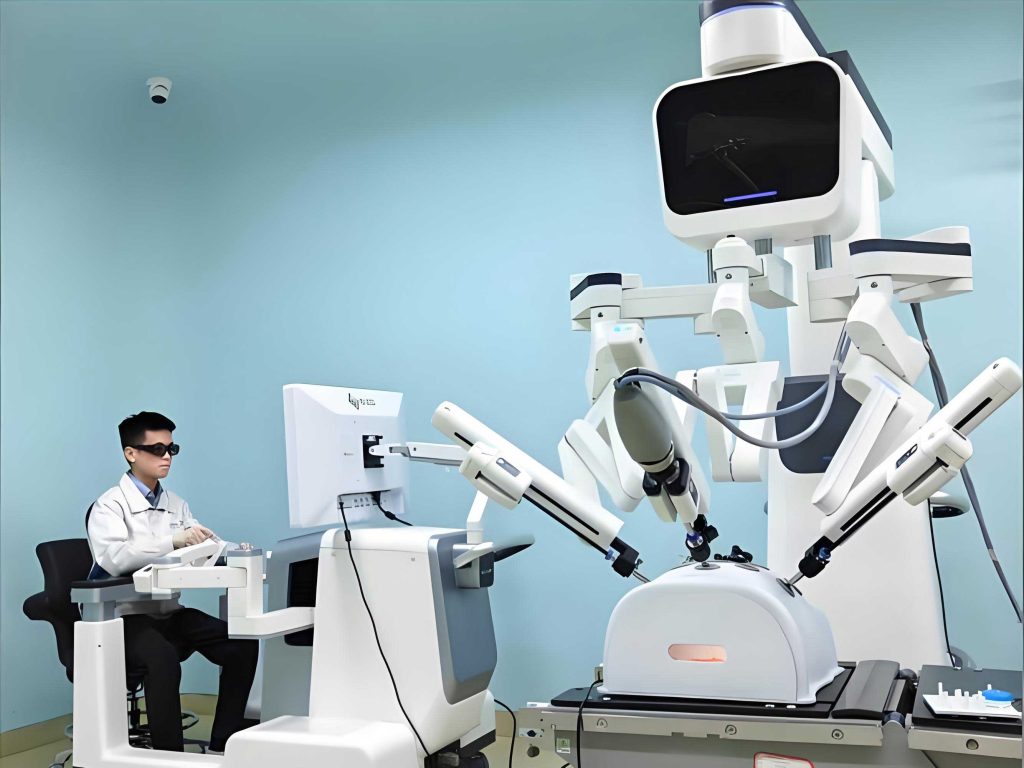
Third, item transportation is another critical area where medical robots excel. In fever isolation clinics, robots can deliver specimens, medications, and supplies autonomously. Using sensors and wireless networks, these medical robots navigate predefined routes, ensuring timely and contactless delivery. The navigation efficiency can be modeled with a path planning algorithm, such as:
$$P = \arg\min_{p \in \text{paths}} \sum_{i} d(p_i) + c(p_i)$$
where $$P$$ is the optimal path, $$d(p_i)$$ is distance, and $$c(p_i)$$ is collision risk. This ensures that medical robots operate safely and efficiently in crowded environments.
Fourth, clinic disinfection can be automated using medical robots equipped with ultraviolet light or disinfectant sprayers. These robots can cover large areas systematically, reducing the burden on cleaning staff. The effectiveness of disinfection can be expressed as a function of exposure time and intensity:
$$D = k \cdot I \cdot t$$
where $$D$$ is the disinfection level, $$k$$ is a constant, $$I$$ is intensity, and $$t$$ is time. Medical robots can optimize this by adjusting parameters based on room size and contamination level.
Now, let me discuss the broader implications and future directions. The market for medical robots is expanding rapidly, with projections indicating significant growth. According to estimates, the global medical robot market could reach billions of dollars by 2030, driven by advancements in AI and robotics. However, applications in outpatient settings, such as fever isolation clinics, are still under development. I believe that with policy support and technological breakthroughs, medical robots will become more prevalent.
Policy initiatives in various countries, such as the U.S., EU, and China, have outlined strategies for AI and robotics in healthcare. These policies encourage research and deployment of medical robots, particularly in response to pandemics. For instance, funding programs focus on developing intelligent diagnostic assistants and remote care systems. As a researcher, I advocate for increased investment in medical robot technologies that emphasize human-robot interaction, dexterity, and precision.
Technological barriers remain, including patent issues and core algorithm development. To overcome these, collaboration between academia and industry is essential. Medical robots should be designed with interoperability in mind, allowing seamless integration into existing healthcare infrastructure. Moreover, safety standards must be established to ensure reliability in clinical environments.
In terms of development strategy, medical robots should prioritize co-adaptation with humans. This means creating robots that can learn from interactions and adapt to dynamic situations. For example, a medical robot in a fever isolation clinic might adjust its triage questions based on real-time data from patients. This requires advanced machine learning models, such as reinforcement learning, where the robot optimizes its actions based on rewards:
$$R = \sum_{t=0}^{T} \gamma^t r_t$$
where $$R$$ is the total reward, $$\gamma$$ is a discount factor, and $$r_t$$ is the reward at time $$t$$. By applying such models, medical robots can improve their performance over time.
To summarize the application scenarios, I have compiled Table 3, which compares the roles of medical robots in different aspects of fever isolation clinics.
| Application Area | Key Functions of Medical Robot | Benefits | Challenges |
|---|---|---|---|
| Pre-examination Triage | Symptom assessment, guidance | Reduces wait times, minimizes contact | Accuracy of AI algorithms |
| Remote Diagnosis | Visual exam, vital sign monitoring | Enables remote care, continuous monitoring | Data transmission reliability |
| Item Transportation | Autonomous delivery of supplies | Lowers infection risk, efficient logistics | Navigation in complex environments |
| Clinic Disinfection | UV irradiation, spraying | Thorough cleaning, reduces manpower | Safety around humans |
This table underscores the versatility of medical robots in enhancing clinic operations. As I reflect on my research, it is clear that medical robots hold immense potential for transforming fever isolation clinics into safer and more efficient spaces.
Looking ahead, I propose several recommendations for advancing medical robot applications. First, healthcare institutions should pilot medical robot systems in isolation clinics to gather real-world data. This data can inform improvements in robot design and functionality. Second, researchers should focus on developing affordable medical robot solutions to ensure accessibility in resource-limited settings. Third, regulatory frameworks must be updated to address the unique aspects of medical robots, such as liability and ethics.
In conclusion, medical robots are poised to play a pivotal role in fever isolation clinics, offering solutions for pre-examination, diagnosis, transportation, and disinfection. Through continued innovation and collaboration, we can harness the power of medical robots to protect healthcare workers and improve patient outcomes. The journey towards widespread adoption of medical robots is ongoing, and I am optimistic about the future as we integrate these technologies into everyday healthcare practices.
To further elaborate, let me delve into some mathematical models that can optimize the deployment of medical robots. For instance, in resource allocation, we can use linear programming to determine the optimal number of medical robots needed in a clinic. Suppose we have a clinic with $$n$$ patients per day, and each medical robot can handle $$m$$ patients. The objective is to minimize cost while meeting demand. The problem can be formulated as:
$$\text{Minimize } Z = \sum_{j=1}^{k} c_j x_j$$
$$\text{subject to } \sum_{j=1}^{k} a_{ij} x_j \geq b_i \quad \forall i$$
where $$x_j$$ is the number of medical robots of type $$j$$, $$c_j$$ is cost, $$a_{ij}$$ is capacity, and $$b_i$$ is demand. This model helps in planning the integration of medical robots.
Another aspect is the learning curve for medical robots. As they are used more frequently, their efficiency may improve. This can be modeled using a learning curve equation:
$$T_n = T_1 \cdot n^{-b}$$
where $$T_n$$ is the time for the nth task, $$T_1$$ is the time for the first task, and $$b$$ is the learning rate. For medical robots, this implies that with more usage, they become faster at tasks like triage or disinfection.
Moreover, the reliability of medical robots is crucial. We can assess this using failure rate models, such as the exponential distribution:
$$R(t) = e^{-\lambda t}$$
where $$R(t)$$ is reliability over time $$t$$, and $$\lambda$$ is the failure rate. Ensuring high reliability for medical robots is essential for trust in clinical settings.
In terms of economic impact, the return on investment (ROI) for medical robots can be calculated. If a medical robot system costs $$C$$ and generates annual savings $$S$$, the ROI is:
$$\text{ROI} = \frac{S – C}{C} \times 100\%$$
This metric can justify the adoption of medical robots in healthcare facilities.
Finally, I want to emphasize the importance of interdisciplinary research. The development of medical robots requires expertise in robotics, AI, medicine, and ethics. By fostering collaborations, we can create medical robots that are not only technologically advanced but also socially acceptable. As I continue my work in this field, I am committed to exploring new frontiers for medical robots, particularly in response to global health challenges.
To recap, this article has explored the application of medical robots in fever isolation clinics from various angles. Through tables, formulas, and detailed analysis, I have highlighted how medical robots can enhance efficiency, safety, and care quality. The future of medical robots is bright, and with sustained effort, they will become integral components of modern healthcare systems.