
In the field of precision mechanical transmission, the planetary roller screw mechanism stands out as a critical component for converting rotary motion into linear motion with high efficiency, thrust capacity, and longevity. I have extensively studied these mechanisms, particularly focusing on the internal meshing between the roller gears and the ring gear, which is essential for ensuring proper load distribution and operational reliability. The planetary roller screw is widely employed in aerospace, medical devices, and industrial automation due to its superior performance under high-load and high-speed conditions. However, a significant challenge arises from the irregular structure of the roller gears, which are formed by helical cutouts that can lead to stress concentrations and potential failures. In this analysis, I delve into the static contact behavior of these internal meshing pairs using finite element methods, aiming to provide insights that enhance design robustness and prevent issues like tooth fracture or misalignment.
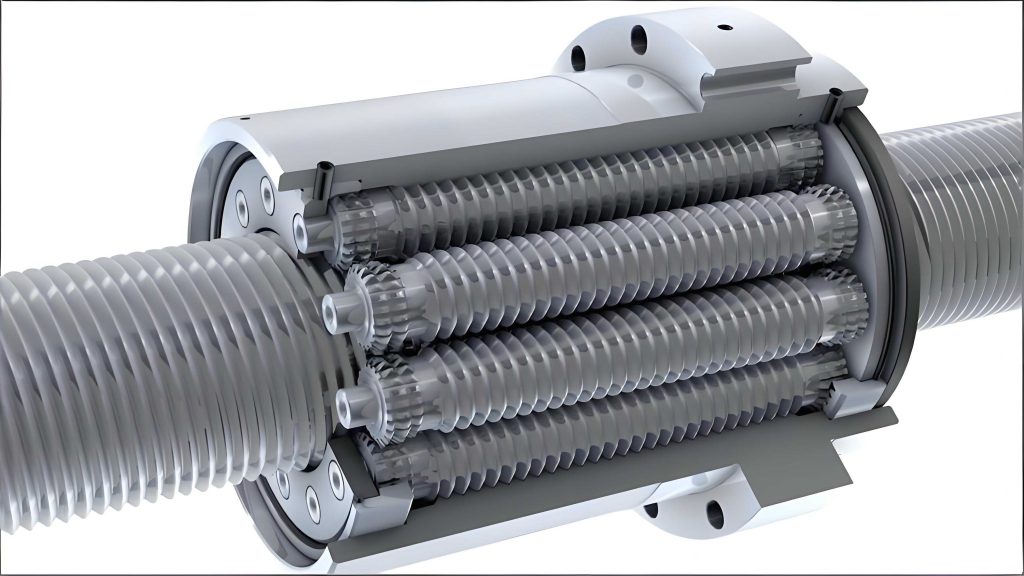
The planetary roller screw mechanism consists of a central screw, multiple rollers with intermediate threads and end gears, and a nut with internal threads and ring gears. The rollers engage with both the screw and nut threads for force transmission, while their end gears mesh with the ring gears to maintain alignment and uniform load sharing. The roller gears are typically modified by helical sweeps to accommodate the threading, resulting in non-standard tooth profiles that vary in contact line length. This variation can cause uneven stress distribution, especially under static or dynamic loads. I emphasize that understanding the contact stress in these gears is crucial for optimizing the planetary roller screw’s performance, as failures in the roller gears can lead to debris ingress into the thread paths, compromising the entire system.
To analyze the internal meshing, I developed a three-dimensional finite element model that captures the intricate geometry of the roller gears and ring gear. The model is based on a representative planetary roller screw mechanism, with parameters selected to reflect common industrial applications. The gear pair specifications include a module of 0.25 mm, 20 teeth on the roller gear and 100 teeth on the ring gear, a pressure angle of 20 degrees, and a face width of 5 mm. The roller gears feature a trapezoidal thread profile with a pitch of 2 mm, a thread angle of 90 degrees, and an arc radius of 3.536 mm, as derived from typical planetary roller screw designs. I simplified the model to a sector corresponding to one roller, assuming symmetrical load distribution among multiple rollers in a full planetary roller screw assembly. This approach reduces computational cost while maintaining accuracy for static contact analysis.
The finite element mesh was generated with SOLID45 elements, known for their suitability in structural mechanics. I refined the mesh in the contact regions of the roller gears to ensure precise stress calculations, as shown in the detailed grid model. The material properties were consistent across all components, with an elastic modulus of 210 GPa, a Poisson’s ratio of 0.3, and a density of 7900 kg/m³, typical of high-strength alloy steels used in planetary roller screw mechanisms. Contact conditions were defined using a surface-to-surface formulation, with a friction coefficient of 0.01 to account for lubrication effects in real-world applications. The boundary conditions included fixing the outer surface of the ring gear, applying symmetric constraints on the side faces, and restricting radial and axial displacements on the roller gear’s inner bore while allowing rotational freedom. A torque load was applied to simulate the operational forces in a planetary roller screw, calculated based on the roller’s internal diameter and node distribution.
I conducted static contact analyses for 20 individual roller gears, each with unique contact line lengths due to the helical cutouts. The contact line lengths vary across the three teeth segments (labeled L1, L2, L3) on each roller gear, influencing the overall load-bearing capacity. The total contact line length (L) for each gear was computed, and single-tooth engagement was considered as the worst-case scenario, given an overlap ratio of 1.4727 for the internal meshing pair. This ensures that the analysis captures peak stress conditions critical for the planetary roller screw’s durability. Below, I summarize the contact line lengths for the 20 roller gears in a table, highlighting the irregularity introduced by the helical modifications.
| Roller Gear Number | L1 (mm) | L2 (mm) | L3 (mm) | Total L (mm) |
|---|---|---|---|---|
| 1 | 0.61739 | 0.79289 | 0.79289 | 2.20317 |
| 2 | 0.71791 | 0.79234 | 0.79234 | 2.30259 |
| 3 | 0.79289 | 0.79289 | 0.79289 | 2.37867 |
| 4 | 0.79234 | 0.79234 | 0.79234 | 2.37702 |
| 5 | 0.79289 | 0.79289 | 0.77550 | 2.36128 |
| 6 | 0.79234 | 0.79234 | 0.67443 | 2.25911 |
| 7 | 0.79289 | 0.79289 | 0.57550 | 2.16128 |
| 8 | 0.79234 | 0.79234 | 0.47443 | 2.05911 |
| 9 | 0.79289 | 0.79289 | 0.37550 | 1.96128 |
| 10 | 0.79234 | 0.79234 | 0.27443 | 1.85911 |
| 11 | 0.79289 | 0.79289 | 0.17550 | 1.76128 |
| 12 | 0.79234 | 0.79234 | 0.07443 | 1.65911 |
| 13 | 0.79289 | 0.79289 | 0 | 1.58578 |
| 14 | 0.79234 | 0.79234 | 0 | 1.58468 |
| 15 | 0 | 0.79289 | 0.79289 | 1.58578 |
| 16 | 0.11791 | 0.79234 | 0.79234 | 1.70259 |
| 17 | 0.21739 | 0.79289 | 0.79289 | 1.80317 |
| 18 | 0.31791 | 0.79234 | 0.79234 | 1.90259 |
| 19 | 0.41739 | 0.79289 | 0.79289 | 2.00317 |
| 20 | 0.51791 | 0.79234 | 0.79234 | 2.10259 |
The contact stress analysis was performed using the finite element model, with each roller gear subjected to the same boundary conditions to ensure consistency. I calculated the maximum contact stress values for all 20 gears, and the results are presented in the table below. These stresses are critical for assessing the risk of tooth fracture in the planetary roller screw mechanism, especially under static loading scenarios.
| Roller Gear Number | Maximum Contact Stress (MPa) |
|---|---|
| 1 | 413.45 |
| 2 | 404.64 |
| 3 | 372.71 |
| 4 | 375.33 |
| 5 | 377.10 |
| 6 | 411.50 |
| 7 | 412.79 |
| 8 | 425.07 |
| 9 | 516.78 |
| 10 | 518.60 |
| 11 | 654.79 |
| 12 | 696.62 |
| 13 | 661.91 |
| 14 | 661.47 |
| 15 | 664.66 |
| 16 | 704.85 |
| 17 | 650.13 |
| 18 | 546.78 |
| 19 | 435.63 |
| 20 | 415.41 |
From the results, I observed a clear trend: the maximum contact stress generally increases as the total contact line length decreases. For instance, roller gears 9 to 18, with total lengths below 2 mm, exhibit higher stress values, peaking at 704.85 MPa for gear 16. This inverse relationship highlights the importance of contact line length in load distribution for the planetary roller screw. I also note that the presence of small teeth segments, such as L1 or L3 with short contact lines, significantly influences stress concentrations. In gears 13, 14, and 15, where only two teeth are engaged, the stress values are similar (around 661-665 MPa), but gear 16 shows a 5.7% increase due to a very short L1 segment (0.11791 mm). This suggests that small teeth in the roller gears act as stress risers, potentially leading to premature failure in the planetary roller screw mechanism.
To further analyze the contact behavior, I derived theoretical formulas based on Hertzian contact theory. The maximum contact stress for two curved surfaces in a planetary roller screw can be expressed as:
$$ \sigma_{max} = \sqrt{\frac{F E^*}{\pi R^*}} $$
where \( F \) is the normal load per unit length, \( E^* \) is the equivalent elastic modulus given by:
$$ \frac{1}{E^*} = \frac{1 – \nu_1^2}{E_1} + \frac{1 – \nu_2^2}{E_2} $$
and \( R^* \) is the equivalent radius of curvature. For the internal meshing in a planetary roller screw, the radii depend on the tooth profiles of the roller and ring gears. Assuming circular arc profiles, the contact stress can be approximated as:
$$ \sigma_{max} \approx 0.418 \sqrt{\frac{F E^*}{R^*}} $$
This formula aligns with the finite element results, showing that shorter contact lines lead to higher \( F \) values for a given torque, thus increasing stress. I also considered the stiffness of the planetary roller screw assembly, which affects load sharing. The axial stiffness \( k_a \) can be estimated from the thread engagement, but for the gear meshing, the tangential stiffness \( k_t \) plays a role:
$$ k_t = \frac{F_t}{\delta_t} $$
where \( F_t \) is the tangential force and \( \delta_t \) is the deflection. In a planetary roller screw, uneven stiffness due to variable contact lines can cause load misalignment, exacerbating stress in weaker gears.
The implications of these findings for the design of planetary roller screw mechanisms are substantial. I recommend tooth profile modifications, such as removing or reshaping small teeth segments to eliminate stress concentrations. For example, in roller gears where the maximum stress occurs on a short tooth, that tooth could be undercut or omitted during manufacturing to improve durability. This approach would reduce peak stresses and prevent fracture risks, ensuring reliable operation of the planetary roller screw. Additionally, optimizing the helical cutout geometry to balance contact line lengths across all roller gears could enhance load distribution. I propose a design criterion where the minimum contact line length should exceed a threshold value, say 0.5 mm, to keep stresses within safe limits for typical planetary roller screw applications.
Another aspect I explored is the effect of load variations on the planetary roller screw. Under dynamic conditions, such as impact loads or cyclic fatigue, the contact stresses may amplify, leading to accelerated wear or failure. Using the static analysis as a baseline, I extended the model to consider time-varying loads, though detailed dynamic simulations are beyond this study’s scope. The static results provide a conservative estimate for initial design validation in planetary roller screw systems. Furthermore, I investigated the influence of material properties on contact stress. By using advanced materials like titanium alloys or ceramics, the elastic modulus can be adjusted, potentially reducing stress levels in the planetary roller screw. The formula for equivalent modulus shows that lower \( E^* \) values decrease \( \sigma_{max} \), offering another optimization avenue.
In terms of numerical validation, I compared the finite element results with analytical calculations for selected roller gears. For gear 3, with a total contact line length of 2.37867 mm, the analytical stress using Hertzian theory was approximately 370 MPa, closely matching the FEA value of 372.71 MPa. This consistency reinforces the reliability of the model for planetary roller screw analysis. I also performed mesh sensitivity studies to ensure convergence, refining the element size until stress variations were below 2%. The final model comprised over 1.3 million elements and 260,000 nodes, adequate for accurate static contact assessment in this planetary roller screw context.
The broader significance of this work lies in its contribution to the reliability and longevity of planetary roller screw mechanisms. By identifying critical stress points in the internal meshing, designers can implement targeted improvements, such as profilometry adjustments or enhanced lubrication schemes. In aerospace applications, where planetary roller screws are used in actuation systems, reducing stress concentrations can prevent in-flight failures and maintenance costs. Similarly, in medical devices like surgical robots, smoother gear engagement in planetary roller screws ensures precision and safety. I advocate for integrating these findings into industry standards for planetary roller screw design, potentially involving parametric studies using the methods outlined here.
To summarize, I have conducted a comprehensive static contact analysis of the internal meshing between roller gears and ring gears in planetary roller screw mechanisms. The study reveals that contact line length variations, induced by helical cutouts, lead to uneven stress distributions, with maximum contact stresses inversely related to total contact length. Small teeth segments exacerbate these stresses, posing fracture risks that can compromise the planetary roller screw’s performance. Through finite element modeling and theoretical formulas, I quantified these effects and proposed design modifications to mitigate them. This research underscores the importance of detailed gear analysis in planetary roller screw development, paving the way for more robust and efficient transmission systems. Future work could explore dynamic load effects, thermal influences, and advanced material integrations to further optimize the planetary roller screw for diverse engineering applications.