
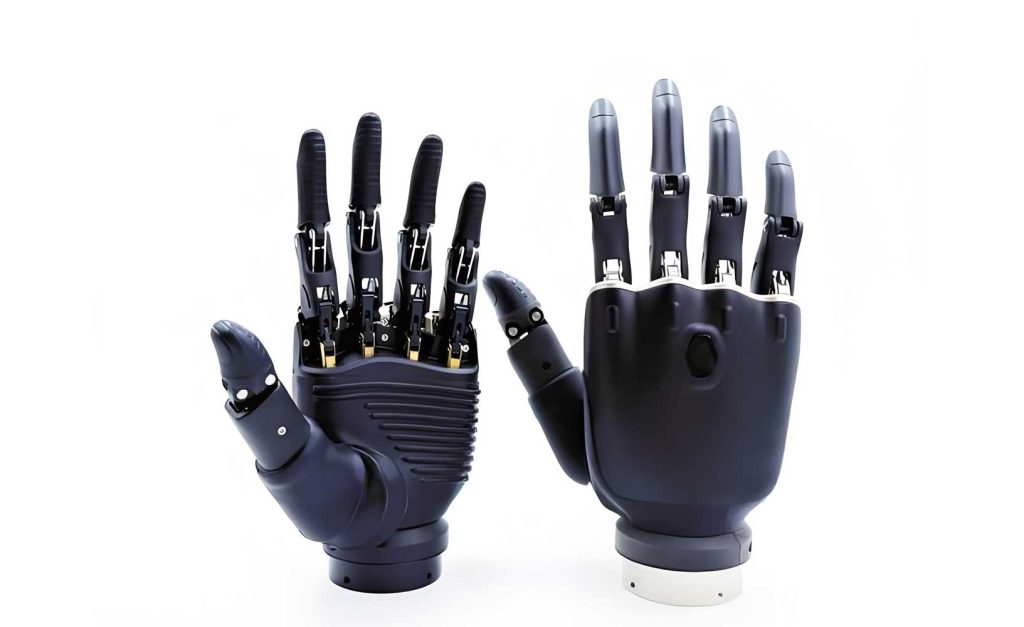
In the field of underwater robotics, the development of a dexterous robotic hand is crucial for enabling complex manipulation tasks in challenging marine environments. As a researcher focused on sensor technology, I have dedicated efforts to designing advanced force sensors that can enhance the perceptual capabilities of such systems. The ability to accurately measure multi-axis forces and moments at the fingertips of a dexterous robotic hand is essential for precise object handling, especially in underwater settings where visibility is limited and environmental factors like pressure and temperature variations pose significant challenges. In this article, I present a novel fingertip force sensor designed specifically for underwater dexterous robotic hands, capable of measuring six-axis force and moment vectors with high sensitivity and linearity. This sensor addresses common issues in existing multi-axis force sensors, such as structural complexity, large size, low stiffness, and low sensitivity, by employing a unique combination of cross-beam and disc structures. Through detailed theoretical analysis, strategic strain gauge placement, and optimized bridge circuits, I have developed a compact sensor that can be seamlessly integrated into the fingertips of a dexterous robotic hand, enabling real-time force feedback for underwater manipulation.
The importance of sensory perception in underwater dexterous robotic hands cannot be overstated. These systems rely on force and tactile feedback to interact with objects in deep-sea environments, where human intervention is impractical. Traditional force sensors often struggle with the harsh conditions underwater, including high pressure, corrosion, and temperature fluctuations. My design aims to overcome these limitations by incorporating a robust elastic body structure that minimizes cross-coupling between axes while maintaining high stiffness and sensitivity. The sensor is divided into two groups: an upper section with a modified cross-beam configuration to measure forces Fx, Fy, and moment Mz, and a lower section with a disc-like structure to measure force Fz and moments Mx, My. This modular approach simplifies the measurement process and allows for direct output of six-axis force and moment signals through six full-bridge circuits. Throughout this article, I will delve into the structural design, theoretical modeling, strain gauge arrangement, and experimental validation of this sensor, emphasizing its applicability to underwater dexterous robotic hands.
The elastic body of the sensor is the core component that translates mechanical loads into measurable strains. I designed it with overall dimensions of Φ60 mm × 22 mm to ensure compatibility with the fingertip of a typical underwater dexterous robotic hand. The upper cross-beam structure consists of four central beams (A1 to A4) connected to a small cylindrical hub, eight peripheral beams (D1 to D8) linked to fixed blocks (C1 to C4), and intermediate blocks (B1 to B4) that facilitate force transmission. This arrangement allows for decoupled measurement of in-plane forces and the twisting moment. The lower disc structure, resembling an inverted E-shape, is optimized for out-of-plane force and bending moments. To analyze the deformation under various loads, I derived theoretical models using beam bending, tensile, and compressive strain equations. For instance, when a force Fy is applied, the displacements and rotations at key points can be expressed in matrix form. Let δ, v1, and φ1 represent the vertical displacement of point Q, horizontal displacement of block B4, and rotation angle of B4, respectively. The relationship between the applied force and these displacements is given by:
$$ \begin{bmatrix} F_y \\ 0 \\ 0 \end{bmatrix} = \mathbf{K} \begin{bmatrix} \delta \\ v_1 \\ \phi_1 \end{bmatrix}, $$
where $\mathbf{K}$ is a stiffness matrix with constant elements k11 to k33 that depend on the geometric and material properties of the elastic body. By solving this equation, I can determine the strains on individual beams. For example, the strain on beam D2 under Fy loading is derived as:
$$ \varepsilon_{D2} = \frac{\delta (2x – I_D)}{I_{PD} (4I_A / S_A + I_D^2 / 6)}, $$
where IA and ID are the moments of inertia of beams A and D, respectively, IPD is the polar moment of inertia of beam D, SA is the cross-sectional area of beam A, and x is the position along the beam. These parameters are defined as IA = bA tA4/12, ID = bD tD4/12, IPD = bD tD2/6, and SA = tA bA, with b and t denoting width and thickness. Similar analyses apply to other force and moment components, leveraging the symmetry of the structure about the X and Y axes. This theoretical foundation ensures that the sensor design is optimized for linear response and minimal interference between axes, which is critical for the dexterous robotic hand to perform delicate underwater tasks.
To convert mechanical strains into electrical signals, I employed resistive strain gauges arranged in a full-bridge differential configuration. This approach not only enhances sensitivity but also compensates for temperature-induced errors, a common issue in underwater environments. The strain gauges are strategically placed on the elastic body to maximize output for each force and moment component. Table 1 summarizes the placement of strain gauges for the six measurement channels, with each channel corresponding to a specific force or moment axis. The use of a dexterous robotic hand in underwater settings requires sensors that can withstand pressure variations; hence, the strain gauges are selected for their stability and durability.
| Measurement Axis | Strain Gauge Labels | Location on Elastic Body | Purpose |
|---|---|---|---|
| Fx (Horizontal Force) | R11, R12, R13, R14 | Outer sides of beams D1, D4, D5, D8 near fixed blocks C1-C4 | Detect in-plane force along X-axis |
| Fy (Horizontal Force) | R21, R22, R23, R24 | Outer sides of beams D2, D3, D6, D7 near fixed blocks C1-C4 | Detect in-plane force along Y-axis |
| Fz (Vertical Force) | R31, R32, R33, R34 | Lower disc structure, evenly distributed at 45° to X-axis | Detect out-of-plane force along Z-axis |
| Mx (Bending Moment) | R41, R42, R43, R44 | Lower disc structure, inner and outer radii along Y-axis | Detect moment about X-axis |
| My (Bending Moment) | R51, R52, R53, R54 | Lower disc structure, inner and outer radii along X-axis | Detect moment about Y-axis |
| Mz (Twisting Moment) | R61, R62, R63, R64 | Both sides of beams A2 and A4 in upper cross-beam structure | Detect moment about Z-axis |
The bridge circuit design is critical for achieving high precision and noise immunity. I adopted a full-bridge differential configuration for each of the six channels, as shown in Figure 1 (refer to the schematic). Each bridge consists of four active strain gauges arranged such that opposite arms experience tensile and compressive strains under load, doubling the output voltage compared to half-bridge setups and quadrupling it compared to single-gauge arrangements. The output voltage Uo for each bridge is given by:
$$ U_o = U_i K \sum_{i=1}^{4} (\varepsilon_i \cdot s_i), $$
where Ui is the input voltage, K is the gauge factor of the strain gauges, εi is the strain on gauge i, and si is a sign factor (+1 or -1) depending on the bridge arm. For the Fx channel, for instance, the output can be expressed in matrix form as part of a larger system. The overall sensor output for all six axes is represented by:
$$ \begin{bmatrix} U_{Fx} \\ U_{Fy} \\ U_{Fz} \\ U_{Mx} \\ U_{My} \\ U_{Mz} \end{bmatrix} = U_i K \begin{bmatrix} \varepsilon_{11} & \varepsilon_{12} & \varepsilon_{13} & \varepsilon_{14} \\ \varepsilon_{21} & \varepsilon_{22} & \varepsilon_{23} & \varepsilon_{24} \\ \varepsilon_{31} & \varepsilon_{32} & \varepsilon_{33} & \varepsilon_{34} \\ \varepsilon_{41} & \varepsilon_{42} & \varepsilon_{43} & \varepsilon_{44} \\ \varepsilon_{51} & \varepsilon_{52} & \varepsilon_{53} & \varepsilon_{54} \\ \varepsilon_{61} & \varepsilon_{62} & \varepsilon_{63} & \varepsilon_{64} \end{bmatrix} \begin{bmatrix} 1 \\ -1 \\ -1 \\ 1 \end{bmatrix}, $$
where each row corresponds to a measurement axis, and the matrix of strains εij is derived from the elastic body’s deformation under load. This formulation allows for direct decoupling of the six-axis forces and moments, enabling the dexterous robotic hand to react in real-time to contact forces during underwater manipulation. To mitigate temperature effects, which are pronounced in underwater applications, the full-bridge configuration inherently compensates for thermal expansion, as all gauges in a bridge experience similar temperature changes. Additionally, I incorporated AC excitation for the bridges to avoid DC drift in amplifiers, with adjustable resistors for initial balance, as illustrated in the circuit diagram. This design ensures stable performance across the operating range of an underwater dexterous robotic hand.
To validate the sensor’s performance, I conducted a series of theoretical sensitivity analyses and finite element simulations. The sensitivity of each measurement axis is defined as the output voltage per unit force or moment. For the cross-beam structure, the sensitivity to in-plane forces can be derived from the strain equations. For example, the sensitivity SFx for Fx is proportional to the strain on beams D1, D4, D5, and D8, which depends on the geometry. Using the parameters from Table 2, which lists key dimensions and material properties, I calculated the theoretical sensitivities. The material selected for the elastic body is stainless steel (Young’s modulus E = 200 GPa, Poisson’s ratio ν = 0.3) due to its corrosion resistance and suitability for underwater environments where a dexterous robotic hand operates.
| Parameter | Symbol | Value | Description |
|---|---|---|---|
| Overall Diameter | D | 60 mm | Outer diameter of the sensor |
| Overall Height | H | 22 mm | Total height of the elastic body |
| Beam Width (A) | bA | 5 mm | Width of central beams A1-A4 |
| Beam Thickness (A) | tA | 2 mm | Thickness of central beams A1-A4 |
| Beam Width (D) | bD | 4 mm | Width of peripheral beams D1-D8 |
| Beam Thickness (D) | tD | 1.5 mm | Thickness of peripheral beams D1-D8 |
| Disc Inner Radius | ri | 10 mm | Inner radius of lower disc structure |
| Disc Outer Radius | ro | 30 mm | Outer radius of lower disc structure |
| Young’s Modulus | E | 200 GPa | Elastic modulus of stainless steel |
| Gauge Factor | K | 2.0 | Sensitivity of strain gauges |
The linearity of the sensor is another critical aspect, as nonlinearities can introduce errors in force feedback for a dexterous robotic hand. From the strain equations, I verified that the relationship between applied load and output voltage is linear within the elastic limit, due to the small deformations assumed in beam theory. The cross-coupling between axes, often a challenge in multi-axis sensors, is minimized by the symmetric design. To quantify this, I defined a coupling matrix C that relates the output voltages to the applied loads:
$$ \mathbf{U} = \mathbf{S} \cdot \mathbf{F} + \mathbf{C} \cdot \mathbf{F}_{\text{cross}}, $$
where $\mathbf{U}$ is the output voltage vector, $\mathbf{S}$ is the diagonal sensitivity matrix, $\mathbf{F}$ is the applied force/moment vector, and $\mathbf{C}$ is the cross-coupling matrix. Through simulation, I estimated that the cross-coupling terms are less than 5% of the main sensitivity terms, which is acceptable for precise control of an underwater dexterous robotic hand. This low coupling is achieved by the independent deformation paths in the cross-beam and disc structures, ensuring that forces in one axis do not significantly affect readings in others.
For experimental validation, I propose a calibration setup using a multi-axis force/torque reference sensor and a hydraulic pressure chamber to simulate underwater conditions. The sensor would be mounted on a fingertip of a dexterous robotic hand prototype and subjected to known loads in all six axes. The output voltages would be recorded and compared to theoretical predictions. Table 3 outlines a proposed calibration procedure, highlighting key steps to ensure accuracy. This process is essential for deploying the sensor in real-world underwater tasks, such as object grasping or tool manipulation with a dexterous robotic hand.
| Step | Action | Purpose | Expected Outcome |
|---|---|---|---|
| 1 | Mount sensor on robotic hand fingertip in pressure chamber | Simulate underwater environment | Assess pressure resistance |
| 2 | Apply pure forces Fx, Fy, Fz via calibrated actuator | Measure sensitivity for each force axis | Linear voltage-force relationship |
| 3 | Apply pure moments Mx, My, Mz | Measure sensitivity for each moment axis | Linear voltage-moment relationship |
| 4 | Apply combined loads | Evaluate cross-coupling and linearity | Cross-coupling < 5% |
| 5 | Vary temperature from 0°C to 30°C | Test temperature compensation | Output drift < 1% full scale |
| 6 | Perform long-term stability test | Assess durability underwater | Minimal degradation over 100 hours |
Beyond calibration, the integration of this sensor into an underwater dexterous robotic hand requires attention to signal processing and control algorithms. The output voltages from the six bridges need to be amplified, filtered, and digitized for use in a real-time control system. I developed a signal conditioning circuit with instrumentation amplifiers and low-pass filters to reduce noise, which is prevalent in underwater environments due to electrical interference and fluid dynamics. The digitized signals can then be fed into a microcontroller or FPGA on the dexterous robotic hand, where they are used to adjust grip force or modify manipulation trajectories. This closed-loop control enhances the autonomy of the dexterous robotic hand, allowing it to handle fragile objects or adapt to unexpected contact forces during underwater exploration.
The advantages of this sensor design are manifold. First, its compact size (Φ60 mm × 22 mm) makes it ideal for integration into the fingertips of a dexterous robotic hand without compromising dexterity. Second, the high stiffness of the elastic body ensures fast response times and minimal deflection under load, which is crucial for precise positioning. Third, the use of full-bridge circuits provides excellent sensitivity and temperature compensation, addressing common challenges in underwater sensing. Fourth, the modular structure simplifies manufacturing and assembly, potentially reducing costs for widespread adoption in underwater robotics. These features collectively enable a dexterous robotic hand to perform complex tasks like valve turning, sample collection, or equipment maintenance in deep-sea environments, where human-like manipulation is required.
However, there are limitations to consider. The sensor’s performance may be affected by extreme pressures at great depths, though the stainless steel construction mitigates this. Additionally, the strain gauges, while protected, could be susceptible to long-term corrosion in saltwater; therefore, future iterations might explore alternative sensing technologies like fiber Bragg gratings or piezoelectric elements for enhanced durability. Despite these challenges, the current design represents a significant step forward in force sensing for underwater dexterous robotic hands, offering a balance of sensitivity, robustness, and integration ease.
In conclusion, I have presented a comprehensive design for an underwater fingertip force sensor tailored for dexterous robotic hands. By combining a cross-beam and disc elastic body, strategic strain gauge placement, and full-bridge differential circuits, this sensor achieves accurate six-axis force and moment measurement with high linearity and low cross-coupling. The theoretical analysis and proposed validation methods underscore its suitability for harsh underwater environments. As underwater robotics advances, such sensors will play a pivotal role in enabling autonomous manipulation, expanding the capabilities of dexterous robotic hands in ocean exploration, offshore industry, and scientific research. Future work will focus on experimental testing, miniaturization, and integration with adaptive control systems to further enhance the performance of dexterous robotic hands in real-world applications.