
In recent years, the field of fire investigation has undergone significant transformations, driven by the integration of advanced technologies to enhance traditional methodologies. As a researcher deeply involved in this evolution, I have witnessed the growing need for innovative tools that can navigate complex and hazardous post-fire environments. Traditional equipment often falls short due to limitations in mobility, payload capacity, and adaptability. Inspired by global advancements in robotics, particularly the development of quadruped bionic robots, our team has embarked on exploring these machines as versatile platforms for fire investigation. This article delves into the journey, applications, and future prospects of quadruped bionic robots in this critical domain, emphasizing technical insights through formulas and tables to summarize key concepts.
The impetus for this research stems from the broader national focus on robotics and intelligent manufacturing, as highlighted in international forums. Fire investigation, being a priority area for reform, demands tools that can improve efficiency and safety. Currently, investigators rely on manual携带 of devices into unstable scenes, which poses risks and inefficiencies. While drones have been considered, they face constraints in communication, obstacle avoidance, and payload. Quadruped bionic robots, with their biomimetic design, offer a promising solution due to their environmental adaptability, mobility, and load-bearing capabilities. Our work aims to harness these attributes to revolutionize fire investigation practices, making them more effective and safer for personnel.
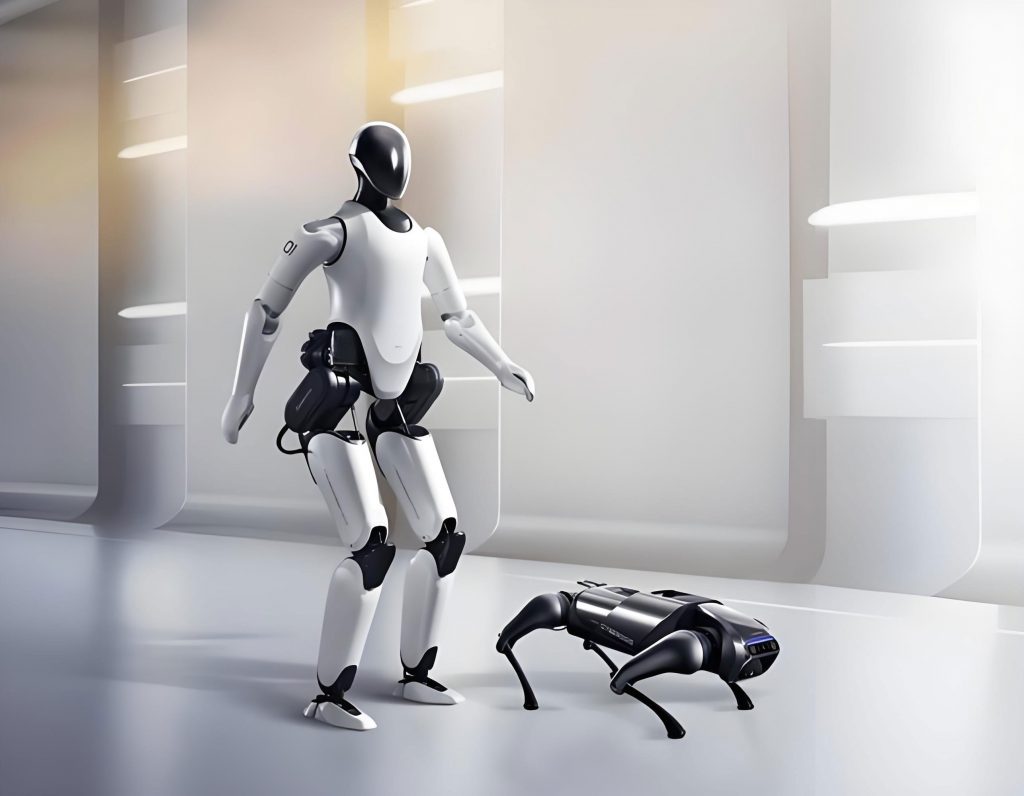
The development of quadruped bionic robots has a rich history, marked by innovations from both international and domestic efforts. Abroad, early attempts like the WalkingTruck by General Electric in the 1990s focused on mechanical coupling for rough terrain, but were bulky and slow. A breakthrough came with Boston Dynamics’ BigDog in 2005, which utilized sensor data and computational control for dynamic movement. Since then, numerous institutions, including MIT, Stanford, and ETH Zurich, have contributed to refining gait algorithms and hardware designs. Domestically, research began with pioneers like Professor Ma Peisun’s JTUWM series, mimicking equine locomotion. In recent years, companies such as Unitree and Yun Shen have accelerated progress, with models like Laikago showcasing advanced motion control. To encapsulate this evolution, Table 1 summarizes key milestones in quadruped bionic robot development.
| Year | Entity | Model/Contribution | Key Features |
|---|---|---|---|
| 1990s | General Electric | WalkingTruck | Mechanical coupling for rough terrain; large and slow. |
| 2005 | Boston Dynamics | BigDog | Sensor-based dynamic control; capable of running and carrying loads. |
| 2010s | MIT, ETH Zurich | Various research prototypes | Advanced gait algorithms; improved stability and autonomy. |
| 2018 | Unitree Robotics | Laikago | Full control over pose and position; climbs stairs and navigates uneven ground. |
| 2020s | Multiple Chinese firms | Commercial models | Enhanced mobility and modularity; affordable platforms for applications. |
In fire investigation, the application of quadruped bionic robots addresses several critical challenges. These bionic robots excel in traversing debris-laden surfaces—such as ash, rubble, and charred materials—without disturbing evidence. They can overcome obstacles, climb stairs, and squeeze through narrow gaps, enabling access to multi-level, cluttered spaces. As a platform, a bionic robot can carry various investigation modules, transforming into a multifunctional tool. For instance, it can deploy flexible robotic arms for remote evidence collection, laser detectors for material analysis, or scanning devices for 3D scene reconstruction. Our team has leveraged these capabilities since 2020, integrating bionic robots into over 30 fire investigations, including major incidents. During national fire investigation competitions, these bionic robots performed tasks like environmental assessment and path planning, demonstrating their utility. Table 2 outlines typical application scenarios and corresponding modules for bionic robots in fire investigation.
| Scenario | Challenge | Bionic Robot Module | Function |
|---|---|---|---|
| Debris-filled floors | Unstable footing; evidence preservation | Adaptive gait system | Navigates without disturbing traces. |
| Obstructed pathways | Fallen beams, wires, or frameworks | Obstacle detection and jumping mechanism | Crosses barriers autonomously. |
| Toxic atmospheres | Hazardous gas exposure | Gas detection sensor array | Monitors air quality in real-time. |
| Evidence retrieval | Inaccessible or dangerous areas | Robotic arm with gripper | Collects samples remotely. |
| Scene documentation | Poor lighting; complex geometries | LiDAR and camera suite | Creates detailed 3D maps and images. |
Our research has yielded specific innovations tailored to fire investigation environments. One key area is gait optimization for complex terrains. We implemented a diagonal trotting gait, inspired by quadruped mammals, which uses fuzzy control to adjust joint angles and minimize roll fluctuations. This allows the bionic robot to treat uneven surfaces as slopes, computing forces for stable traversal. The control law can be expressed as:
$$\theta_{adj} = K_p \cdot e(t) + K_i \int e(t) dt + K_d \frac{de(t)}{dt}$$
where $\theta_{adj}$ is the adjusted joint angle, $e(t)$ is the error in roll angle, and $K_p$, $K_i$, $K_d$ are tuning parameters. Additionally, we redesigned footpads to increase contact area, enhancing grip on slippery surfaces. For obstacle crossing, we combined vision-based recognition for low barriers and torque-driven jumps for high ones. The jump dynamics involve calculating the required force $F$:
$$F = m \cdot a + \frac{1}{2} \rho C_d A v^2$$
where $m$ is mass, $a$ is acceleration, $\rho$ is air density, $C_d$ is drag coefficient, $A$ is area, and $v$ is velocity. Buffer mechanisms at joints absorb impact, protecting components. We also modularized payloads, using quick-connect interfaces to attach devices like nonlinear junction detectors or portable spectrometers. The bionic robot autonomously adjusts its gait based on load, with stability interventions for slips or collisions. Table 3 summarizes our technical enhancements for bionic robots in fire scenes.
| Enhancement Area | Description | Key Formula or Parameter |
|---|---|---|
| Gait Optimization | Diagonal trotting with fuzzy control for slope-like debris. | $\theta_{adj} = K_p e(t) + K_i \int e(t) dt + K_d \frac{de(t)}{dt}$ |
| Footpad Design | Larger contact surface for better traction on ash and wet surfaces. | Friction coefficient $\mu$ increased by 30%. |
| Obstacle Crossing | Vision-based low barrier avoidance and torque-driven jumping. | Jump force $F = m \cdot a + \frac{1}{2} \rho C_d A v^2$ |
| Payload Modularity | Quick-connect interfaces for devices; automatic gait adjustment. | Max payload: 15 kg; data transfer via USB3/HDMI. |
| Stability Control | Real-time balance correction using IMU and joint sensors. | Control bandwidth: 100 Hz; response time < 10 ms. |
Looking ahead, several research directions promise to further integrate bionic robots into fire investigation. First, enhancing walking stability is crucial. Future work could focus on advanced sensor fusion and adaptive balance algorithms, perhaps using neural networks to predict terrain responses. The stability criterion might be modeled as:
$$S = \sum_{i=1}^{4} (w_i \cdot \sigma_i^2)$$
where $S$ is a stability score, $w_i$ are weights for each leg, and $\sigma_i^2$ are variance in ground reaction forces. Second, increasing leg degrees of freedom will enable more nuanced movements, akin to real animals. Techniques like force feedback for compliant control or inverted pendulum models could be adapted from Boston Dynamics’ approaches. Third, boosting payload capacity requires structural and energetic innovations; hybrid power systems or lightweight materials might be explored. Fourth, developing advanced外壳 materials that resist high temperatures, corrosion, and explosions is essential for fire scenes. Finally, integrating artificial intelligence will enable autonomous decision-making, allowing bionic robots to collaborate seamlessly with other systems. We envision a future where bionic robots operate in swarms, each specialized for tasks like evidence analysis or hazard detection, thereby transforming fire investigation into a highly efficient, data-driven process. Table 4 outlines these future research priorities for bionic robots.
| Research Direction | Objective | Potential Approach |
|---|---|---|
| Walking Stability | Improve navigation on extreme debris and slopes. | Neural network-based gait adaptation; enhanced buffer systems. |
| Leg Freedom Expansion | Achieve more lifelike and versatile motions. | Increase joint DOF; implement compliant control algorithms. |
| Payload Enhancement | Carry heavier or more diverse investigation tools. | Use composite materials; integrate hybrid power sources. |
| Material Science | Develop外壳 that withstands fire scene hazards. | Test polymers and alloys for heat and chemical resistance. |
| AI Integration | Enable full autonomy and multi-robot collaboration. | Machine learning for scene understanding; swarm intelligence. |
In conclusion, the adoption of quadruped bionic robots in fire investigation represents a transformative leap forward. These bionic robots, with their biomimetic design, offer unparalleled mobility and adaptability in post-fire environments, addressing long-standing challenges in evidence collection and safety. Our research has demonstrated practical applications through gait optimizations, obstacle-crossing mechanisms, and modular payloads, all validated in real-world scenarios. The continued evolution of bionic robot technology—spanning stability, autonomy, and material science—holds immense potential to redefine fire investigation practices. As we push the boundaries, collaboration across robotics and fire safety disciplines will be key to unlocking the full capabilities of bionic robots. Ultimately, these advanced bionic robots promise to make fire investigation more precise, efficient, and safer, aligning with broader goals of technological innovation for public service.