
In the evolving landscape of manufacturing, the shift towards smart production has been accelerated by policy support and market demands. As a key component in precision machinery, the rotary vector reducer plays a critical role in applications requiring high torque, low speed, and minimal backlash, such as robotics and automated systems. Traditionally, rotary vector reducers are manufactured from metal alloys, which offer strength and durability but come with drawbacks like high weight, corrosion susceptibility, and complex machining processes. With advancements in polymer science and additive manufacturing, there is growing interest in exploring plastic materials for rotary vector reducer production. This study aims to investigate the feasibility of using plastic materials, specifically acrylonitrile butadiene styrene (ABS) resin and polylactic acid (PLA), for constructing a rotary vector reducer. We employ finite element analysis (FEA) via ANSYS software to compare the mechanical performance of these materials, focusing on stress distribution, deformation, and convergence behavior. Our goal is to update the material library for rotary vector reducers and provide insights for future material selection in lightweight, cost-effective designs.
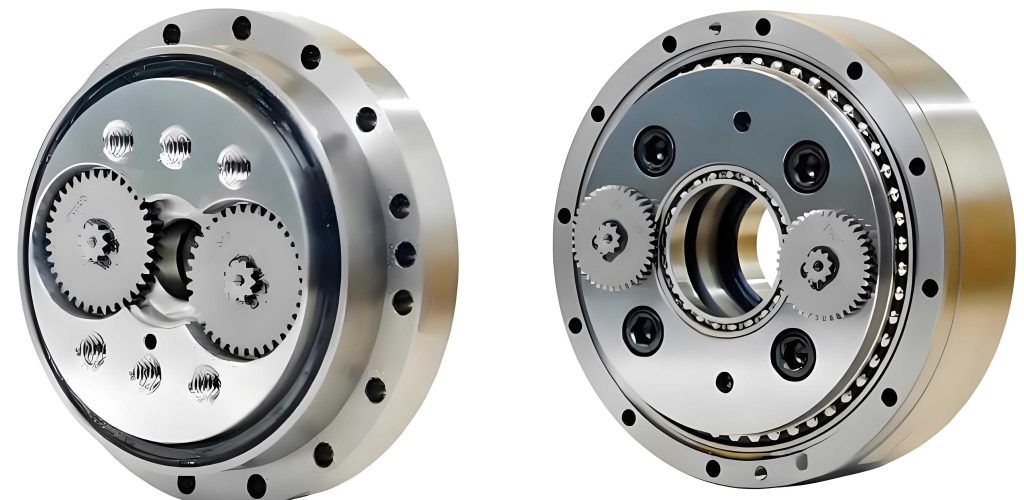
The rotary vector reducer, often abbreviated as RV reducer, is a two-stage reduction device that ensures precise motion control. The first stage involves a sun gear transmitting high-speed, low-torque input from a servo motor to planetary gears, which then drive the crankshaft. In the second stage, the crankshaft’s rotation causes two cycloidal gears, phased 180 degrees apart, to undergo cycloidal motion, ultimately outputting low-speed, high-torque through a rigid plate. This design minimizes backlash and vibration, making the rotary vector reducer ideal for applications demanding accuracy and smooth operation. Understanding the transmission principle is essential for modeling and analysis, as it highlights the complex load interactions within the rotary vector reducer components.
To conduct our analysis, we developed a detailed 3D model of the rotary vector reducer using SolidWorks software. The model includes all critical parts: the input shaft, sun gear, planetary gears, crankshaft, cycloidal gears, needle gears, and housing. We optimized the geometry by simplifying non-essential features to enhance mesh quality and computational efficiency in ANSYS. The model was exported in x-t format to ensure compatibility with the FEA software. This step is crucial for accurate simulation, as any discrepancies in the model can lead to erroneous results. The rotary vector reducer’s assembly was carefully constructed to reflect real-world interactions, with proper mating conditions and constraints applied during the modeling phase.
Material selection is a pivotal aspect of this study. We compare two thermoplastic materials: ABS resin and PLA. ABS is a terpolymer of acrylonitrile, butadiene, and styrene, known for its excellent impact resistance, chemical stability, and ease of processing. PLA, derived from renewable resources like corn starch, is a biodegradable polyester with good mechanical properties and thermal resistance. Both materials are commonly used in 3D printing, making them suitable for prototyping and manufacturing rotary vector reducers via additive techniques. The properties of these materials are summarized in Table 1, which includes key parameters such as density, Young’s modulus, shear modulus, and bulk modulus. These values are input into ANSYS to define material behavior during simulations.
| Material | Density (g/cm³) | Young’s Modulus (MPa) | Poisson’s Ratio | Shear Modulus (MPa) | Bulk Modulus (MPa) |
|---|---|---|---|---|---|
| ABS | 1.04 | 2200 | 0.35 | 3459 | 789 |
| PLA | 1.26 | 3200 | 0.35 | 3333 | 1111 |
In contrast to metals, plastics like ABS and PLA offer advantages such as low density, corrosion resistance, and design flexibility. However, their mechanical performance under load must be thoroughly evaluated. For the rotary vector reducer, stress and deformation analysis is vital to ensure operational reliability. We use the following fundamental equations to guide our FEA. The equivalent von Mises stress, which predicts yielding in ductile materials, is given by:
$$ \sigma_{vm} = \sqrt{\frac{1}{2}\left[(\sigma_1 – \sigma_2)^2 + (\sigma_2 – \sigma_3)^2 + (\sigma_3 – \sigma_1)^2\right]} $$
where $\sigma_1$, $\sigma_2$, and $\sigma_3$ are the principal stresses. For deformation, the total strain $\epsilon$ can be related to stress via Hooke’s law for isotropic materials:
$$ \sigma = E \epsilon $$
with $E$ being Young’s modulus. These formulas underpin the finite element simulations, allowing us to assess the rotary vector reducer’s behavior under dynamic loads.
The finite element analysis was conducted in ANSYS Workbench. We imported the 3D model and assigned material properties to all components—ABS for one simulation and PLA for another. Meshing was performed using a combination of tetrahedral and default elements, with a global element size of 2 mm to balance accuracy and computational cost. This resulted in 592,450 nodes and 217,996 elements. Critical areas, such as gear teeth and bearing surfaces, were refined to capture stress concentrations. Boundary conditions were applied to mimic real operating scenarios: the housing was fixed, and a rotational joint with inertia was added to the sun gear to simulate input motion. The contact settings included frictional and bonded interactions between mating parts, ensuring realistic force transmission within the rotary vector reducer.
We performed transient structural analysis to evaluate the rotary vector reducer’s response over time. The input was defined as a step torque applied to the sun gear, representing typical servo motor output. Solutions were obtained for both material cases, and results were extracted for equivalent stress, total deformation, and nonlinear convergence curves. The analysis focused on key components like the cycloidal gears and planetary gears, as these are prone to high stress due to meshing forces. By comparing ABS and PLA, we aim to identify which material offers better performance for the rotary vector reducer in terms of strength, stiffness, and durability.
The results for the cycloidal gear assembly reveal critical insights. For the PLA-based rotary vector reducer, the maximum equivalent stress was concentrated at the interface with the crankshaft and the tooth profiles engaging with needle gears, reaching a peak value of 377.36 MPa. In contrast, the ABS-based rotary vector reducer showed a lower maximum equivalent stress of 262.81 MPa, with similar stress distribution patterns. This indicates that ABS may provide better resistance to yielding under load. The stress concentrations are attributed to the high contact forces during gear meshing, which can lead to wear over time. Minimizing these stresses is essential for extending the lifespan of the rotary vector reducer.
For the overall rotary vector reducer assembly, the stress and deformation results are summarized in Table 2. The PLA material exhibited a maximum equivalent stress of 377.36 MPa and a total deformation of 3.364 mm, while ABS showed 262.81 MPa and 3.3673 mm, respectively. Although deformation values are comparable, the stress difference of 114.55 MPa highlights ABS’s superior load-bearing capacity. The stress cloud maps illustrate that the highest stresses occur in the first-stage reduction gears, where the input torque is initially transmitted. This aligns with theoretical expectations, as the sun gear and planetary gears experience significant bending and contact stresses.
| Parameter | PLA Material | ABS Material |
|---|---|---|
| Maximum Equivalent Stress (MPa) | 377.36 | 262.81 |
| Total Deformation (mm) | 3.364 | 3.3673 |
| Nonlinear Convergence Behavior | Moderate fluctuations | Smoother convergence |
The nonlinear mechanical convergence curves provide further validation. In FEA, convergence is achieved when the residual forces fall below a tolerance threshold, indicated by a plateau in the curve. For the PLA rotary vector reducer, the convergence curve exhibited more pronounced oscillations, suggesting numerical instabilities possibly due to material nonlinearity. The ABS rotary vector reducer, however, demonstrated a smoother convergence with fewer fluctuations, implying better numerical stability and reliability of results. This can be expressed mathematically by monitoring the residual norm $R$:
$$ R = \| F_{ext} – F_{int} \| $$
where $F_{ext}$ is the external force vector and $F_{int}$ is the internal force vector. A decreasing $R$ over iterations signifies convergence. The ABS material’s curve approached zero more steadily, enhancing confidence in the simulation outcomes.
Discussion of these results emphasizes the trade-offs between material properties. ABS’s lower stress levels can be attributed to its higher toughness and impact absorption, which distribute loads more evenly. PLA, while stiffer due to a higher Young’s modulus, tends to concentrate stress, making it more susceptible to cracking. For a rotary vector reducer operating in dynamic environments, fatigue resistance is crucial. We can estimate fatigue life using the S-N curve relationship:
$$ N = \left( \frac{\sigma_a}{\sigma_f’} \right)^{-b} $$
where $N$ is cycles to failure, $\sigma_a$ is stress amplitude, $\sigma_f’$ is fatigue strength coefficient, and $b$ is the fatigue exponent. With lower maximum stress, the ABS rotary vector reducer likely offers longer fatigue life, reducing maintenance needs.
Additionally, the role of 3D printing in manufacturing plastic rotary vector reducers cannot be overlooked. Additive manufacturing allows for complex geometries and lightweight designs, but material anisotropy must be considered. Our FEA assumes isotropic properties, which is a simplification. Future work could involve anisotropic material models to better capture 3D-printed behavior. Moreover, thermal effects, such as heat generation from friction, may influence material performance. The heat conduction equation:
$$ \frac{\partial T}{\partial t} = \alpha \nabla^2 T $$
with $T$ as temperature and $\alpha$ as thermal diffusivity, could be integrated into coupled thermal-stress analyses for a more comprehensive assessment of the rotary vector reducer.
From an economic perspective, using plastics like ABS or PLA for rotary vector reducers can reduce costs by up to 30% compared to metal versions, primarily due to lower material expenses and simplified production. However, designers must balance cost with performance requirements. Our study suggests that ABS is a viable alternative for applications where weight savings and corrosion resistance are priorities, without compromising structural integrity. The rotary vector reducer’s precision can be maintained by optimizing gear tolerances and incorporating wear-resistant coatings.
In conclusion, based on our ANSYS finite element analysis, the ABS material demonstrates superior performance for plastic rotary vector reducers over PLA. With a lower maximum equivalent stress of 262.81 MPa versus 377.36 MPa, comparable deformation, and smoother nonlinear convergence, ABS offers better mechanical reliability and potential for longer service life. These findings contribute to updating the material database for rotary vector reducers, encouraging the adoption of plastics in precision transmission systems. Future research should explore composite materials, dynamic loading scenarios, and experimental validation to further advance the design and manufacturing of rotary vector reducers for next-generation industrial applications.