
A new patent-based study of China’s humanoid robot sector has identified six major technology themes and traced a clear evolutionary shift from mechanical structures and basic motion control toward intelligent perception, modular design, and embodied artificial intelligence. The analysis, built on the BERTopic model, examined 1,476 humanoid robot patent records covering titles, abstracts, and dates. It offers a structured view of how humanoid robot innovation has moved from early limb support and finger-joint design to gait planning, drive systems, biomimetic materials, environmental perception, action learning, and intelligent decision-making. The findings arrive as generative artificial intelligence, large language models, and embodied intelligence push the humanoid robot field into a new phase of rapid development.
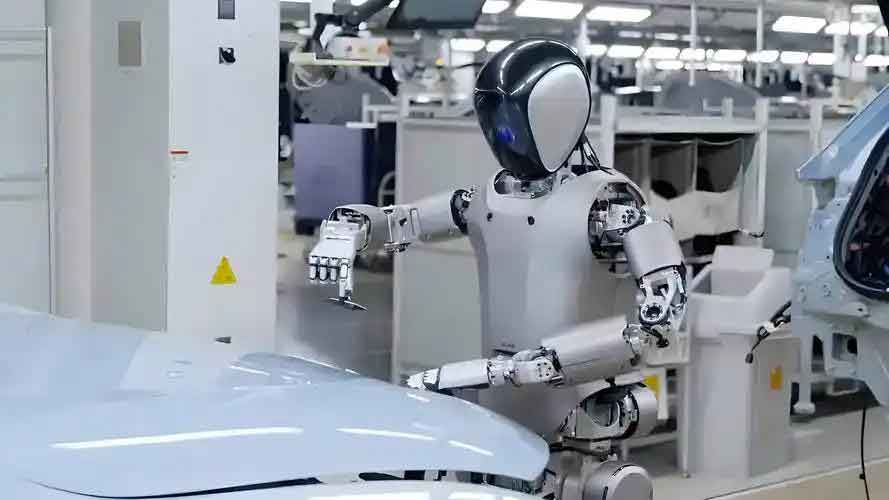
The study places humanoid robot development within a broader technological and policy context. Recent advances in generative artificial intelligence have accelerated change across many industries. Large language models such as ChatGPT and Claude have demonstrated strong semantic understanding and content generation capabilities. The rise of independently developed large models, including DeepSeek, has also signaled China’s growing capacity to compete in this field. As large models become the “brain” of artificial intelligence applications, embodied artificial intelligence has advanced rapidly. Through physical bodies that interact with environments, humanoid robot systems are becoming an important downstream application direction for artificial intelligence.
Policy support has reinforced this momentum. In 2023, the Ministry of Industry and Information Technology issued the Humanoid Robot Innovation Development Guidance, which proposed that by 2025 an initial humanoid robot innovation system should be established. The guidance called for breakthroughs in key technologies related to the “brain,” “cerebellum,” and “limbs,” and for safe and effective supply of core components. Against this backdrop, humanoid robot research and development has shown explosive growth. Patent activity reflects this expansion, with applications increasing steadily over time and rising sharply in 2024.
- Research scope, data, and method
The study selected humanoid robot patent texts as its research object. Data were collected through the PatSnap patent search platform using a search strategy that combined terms such as “humanoid robot,” “anthropomorphic robot,” “human-like robot,” “bionic human,” and “humanoid robot.” After retrieval and cleaning, 1,476 patent records remained. For each record, the title, abstract, and date were used as the original data. Patent abstracts provide a concise overview of the technical path, the problem addressed, and the corresponding solution, making them suitable for identifying technology themes in humanoid robot patents.
The research framework combined overall topic identification with stage-based topic evolution analysis. First, data collection and preprocessing were carried out. Text was segmented, stop words were removed, a user dictionary was set, and invalid information was cleaned so that the original patent text could be converted into structured data suitable for model processing. Second, topic identification and evolution path analysis were conducted. The study used the Chinese-BERT-wwm model to encode text semantics. It then applied UMAP for dimensionality reduction, with parameters including n_neighbors=13, n_components=5, min_dist=0.1, and cosine distance. HDBSCAN was used for clustering, with min_cluster_size=13, min_samples=5, and Euclidean distance. Topic extraction used c-TF-IDF to evaluate the importance of feature words.
For stage-based evolution analysis, the patent texts were divided into three time periods. BERTopic modeling was performed separately for each period. Similarity between topics in adjacent periods was calculated to build an evolution path map. The study used the top three feature words for each topic and set a similarity threshold of 0.85 to identify evolutionary relationships. This approach helped reveal the dynamic development of humanoid robot patent themes while avoiding excessive or sparse connections.
Stage Period Patent records P1 Emergence 2006–2014 274 P2 Accumulation 2015–2022 724 P3 Growth 2023 onward 478 Total 2006 onward 1,476 The three-stage division reflects both patent application trends and technological turning points. Before 2014, annual applications remained within 50 records. In 2015, the number of applications rose significantly, showing a clear stage transition. The year 2023 is widely regarded as the first year of generative artificial intelligence. To examine the impact of generative artificial intelligence on humanoid robot patent themes, the study divided the data into P1, P2, and P3. This structure allows the analysis to compare early humanoid robot foundations with later intelligent and modular developments.
- Overall humanoid robot patent topic landscape
Through BERTopic modeling and the merging of similar topics, the study identified six overall technology themes in humanoid robot patents. These themes cover joint drive and structure, gait planning and motion control, finger and joint actuation technology, data communication and power management, visual perception and intelligent decision-making, and material preparation and biomimetic structure. The topic structure suggests that humanoid robot technology is not concentrated in a single domain. Instead, it spans hardware, control, perception, energy, and materials.
The overall topic distribution indicates that technical gaps are relatively few. The six themes align with the three dimensions often used to describe humanoid robot development: the “brain,” the “cerebellum,” and the “limbs.” The “brain” dimension focuses on multimodal perception, visual perception models, generative models, language models, advanced perception, creative imagination, precise decision-making, and emotional interaction. The “cerebellum” dimension focuses on stable walking, adaptation to complex terrain, fine operation, and human-robot interaction. The “limbs” dimension focuses on rigid-flexible coupling biomimetic transmission mechanisms, compact limb structures, and dexterous hands. The six themes identified in the humanoid robot patent data correspond closely to these dimensions.
Topic Representative keywords Technology focus Topic 0 drive, connection, joint, motor, component Joint and drive unit mechanical structure Topic 1 planning, model, gait, motion, trajectory Human-like gait planning and motion control Topic 2 joint, phalanx, actuator, movement, manipulation Hand fingers and joint actuation technology Topic 3 data, charging, information, motion, collection Data collection and power management Topic 4 connection, action, vision, intelligence, head Visual perception and intelligent decision-making Topic 5 preparation, material, electrode, fiber, biology New material preparation and biomimetic technology The topic trend over time also reveals changing research priorities. Topic 0, which concerns joints and drive units, rose slowly in the early period and then showed a significant surge in 2023. Topic 1, covering gait planning and motion control, began to grow gradually from 2015 and continued to rise steadily in recent years. Topic 2, focused on finger and joint actuation, reached a peak around 2015 and then gradually declined. Topic 3, related to data collection and power management, remained relatively low overall but showed noticeable growth in 2024. Topic 4, visual perception and intelligent decision-making, and Topic 5, new material preparation and biomimetic technology, remained at low frequencies for a long time and only increased slightly in the latest stage.
Overall, early humanoid robot technology concentrated on mechanical drive and motion planning, represented by Topic 0 and Topic 1. Later, perception and data management, represented by Topic 3, began to attract attention. New material directions, represented by Topic 5, also accumulated. With external drivers such as generative artificial intelligence, mechanical themes such as Topic 0 again became research hotspots. This pattern reflects synchronous development of hardware drive and intelligent control in the humanoid robot field.
- Detailed interpretation of the six overall humanoid robot technology themes
Topic 0 focuses on drive, connection, joint, motor, and component. This theme mainly reflects the mechanical structure of humanoid robot joints and drive units. It covers the physical architecture that enables movement, including connections between components, joint mechanisms, and motor-driven units. The presence of this theme as a major category shows that hardware foundations remain central to humanoid robot development, even as intelligence becomes more prominent.
Topic 1 focuses on planning, model, gait, motion, and trajectory. This theme corresponds to human-like gait planning and motion control. In humanoid robot research, gait planning is essential for stable walking and adaptation to different terrains. Motion control includes trajectory generation, dynamic balance, and coordination between limbs. The theme indicates that researchers have continued to invest in the control algorithms and models that allow a humanoid robot to move in a human-like manner.
Topic 2 focuses on joint, phalanx, actuator, movement, and manipulation. This theme is closely associated with hand fingers and joint actuation technology. Humanoid robot hands require dexterous movement, precise manipulation, and adaptable grasping. The keywords suggest attention to finger joints, phalanx structures, and actuators that support manipulation. This area is critical for enabling humanoid robot systems to interact with objects and perform tasks in human-centered environments.
Topic 3 focuses on data, charging, information, motion, and collection. This theme highlights data collection and power management. Humanoid robot operation depends on information processing, sensor data, and reliable energy supply. Charging technology and power management influence operating time, safety, and practical deployment. The theme also suggests that data-related capabilities are becoming more important as humanoid robot systems generate and consume larger volumes of information.
Topic 4 focuses on connection, action, vision, intelligence, and head. This theme emphasizes visual perception and intelligent decision-making. Vision is a key modality for humanoid robot perception, allowing the system to recognize objects, understand scenes, and guide action. The inclusion of “intelligence” and “head” suggests that perception and decision-making are increasingly integrated into the humanoid robot platform, especially as large models and multimodal systems develop.
Topic 5 focuses on preparation, material, electrode, fiber, and biology. This theme highlights new material preparation and biomimetic technology. Materials influence weight, flexibility, durability, sensing, and human-like appearance. Electrodes and fibers can support sensing or actuation, while biological references inspire structural and functional design. This theme represents a materials science and biomimetic innovation direction that supports humanoid robot lightweighting and structural innovation.
- Time-stage division and stage-level humanoid robot topic identification
Because overall topic identification may obscure differences across stages, the study divided the humanoid robot patent data into three periods and analyzed each separately. The P1 emergence stage covers 2006 to 2014 and contains 274 patent records. The P2 accumulation stage covers 2015 to 2022 and contains 724 patent records. The P3 growth stage covers 2023 onward and contains 478 patent records. This division allows the analysis to track how humanoid robot technology themes changed as the field matured.
Stage-level modeling produced different numbers of topics. P1 contained two topics. P2 contained three topics. P3 contained eight topics. The increase in topic number suggests growing technological differentiation. Early humanoid robot research was relatively concentrated in basic structures and control. Later stages diversified into drive systems, foot mechanisms, biomimetic materials, environmental perception, motion learning, sensor units, head housing, and finger joint design. This progression reflects the broadening scope of humanoid robot innovation.
Stage Number of topics Main technology direction P1 Emergence 2 Limb support, motion control, finger joint structure P2 Accumulation 3 Drive systems, foot mechanisms, biomimetic materials P3 Growth 8 Mechanical components, perception, learning, dynamics, sensors, housing, finger joints - Emergence stage humanoid robot patent themes
In the P1 emergence stage from 2006 to 2014, BERTopic analysis identified two themes. P1-Topic0 includes support, action, angle, sensor, and controller. This indicates that early research concentrated on limb support structures and motion control schemes for humanoid robot systems. At this stage, humanoid robot research largely focused on basic movement capability. The presence of sensors and controllers shows that even early humanoid robot designs required feedback and control, but the dominant emphasis remained on physical support and fundamental action generation.
P1-Topic1 includes phalanx, adaptation, middle phalanx, and slider. This theme mainly involves finger joint structure design. It aligns with research on dexterous hands. A defining feature of a humanoid robot is its human-like hand, which can move and manipulate objects in environments designed for humans. During P1, patent themes also addressed biomimetic hand structures. By using phalanx segments and slider mechanisms, designers sought to improve hand adaptability and degrees of freedom.
These two themes can be grouped into two broad categories. One focuses on body support and motion control hardware and control systems. The other focuses on biomimetic design of hand structures. Together, they formed the early core technology direction for humanoid robot research. At this stage, the field was still in an exploratory phase oriented toward mechanical structures and basic control.
P1 Topic Representative keywords Technology focus P1-Topic0 support, action, angle, sensor, controller Limb support structure and motion control P1-Topic1 phalanx, adaptation, middle phalanx, slider Finger joint structure design - Accumulation stage humanoid robot patent themes
In the P2 accumulation stage from 2015 to 2022, the number of themes increased to three. The content became more diversified. P2-Topic0 includes drive, realization, model, rotation, and motor. This shows that drive systems and motion models became key research objects in this period. The theme focuses on drive mechanism design and motion realization, suggesting that researchers began to construct and verify drive models for humanoid robot systems.
P2-Topic1 includes toe, mechanical, installation, spring, and motor. This theme shows attention to gait and foot mechanism design. During P2, humanoid robot research invested more effort in leg and foot structures, especially foot assembly and drive. Foot mechanisms influence balance, shock absorption, push-off, and terrain adaptation. The keywords point to mechanical installation, springs, and motors as elements of foot design.
P2-Topic2 includes material, biology, size, printing, and ligament. This theme reflects the application trend of biomimetic materials and manufacturing technology. Robot skin materials can influence human-robot interaction and social acceptance. The term “printing” suggests the use of advanced manufacturing methods such as 3D printing. Terms such as “biology,” “biomimetic,” and “ligament” indicate that natural structures were referenced to optimize humanoid robot components and surface materials, enhancing human-like appearance and function. The emergence of this theme shows that materials science and new fabrication technologies became emerging hotspots in P2, providing technical support for lightweight design and structural innovation.
Overall, the three P2 themes correspond to drive systems, foot structure, and materials and biomimetic technology. Research themes expanded from the basic structures and control of P1 toward more detailed component design and new material applications. This reflects branching and deepening of humanoid robot technology.
P2 Topic Representative keywords Technology focus P2-Topic0 drive, realization, model, rotation, motor Drive systems and motion models P2-Topic1 toe, mechanical, installation, spring, motor Gait and foot mechanism design P2-Topic2 material, biology, size, printing, ligament Biomimetic materials and manufacturing technology - Growth stage humanoid robot patent themes
In the P3 growth stage from 2023 onward, the analysis identified eight themes. These themes cover a wider range of technology domains and show a trend toward high differentiation and intelligence. They can be broadly divided into mechanical structure themes and intelligent system themes.
Mechanical structure themes include P3-Topic0, P3-Topic1, P3-Topic6, and P3-Topic7. P3-Topic0 includes component, thigh, calf, leg, and rotation. It mainly involves lower limb components and joint rotation mechanisms, concentrating on the design of leg mechanical structures. P3-Topic1 includes motor, stator, gear, fixation, and rotor. It focuses on the internal structure of motors and transmission components, reflecting demand for refined design of drive components. P3-Topic6 includes head, housing, shell, surface, and component. It focuses on head housing and shell docking methods, emphasizing packaging and interface design for head components. P3-Topic7 includes phalanx, finger, palm, linkage, and rotation. It addresses the connection and motion design of humanoid robot finger joints and represents a continuation and update of earlier finger joint research from P1. These themes continue the focus on hardware components but move to a more detailed part level.
Intelligent system themes include P3-Topic2, P3-Topic3, P3-Topic4, and P3-Topic5. P3-Topic2 includes information, image, path, scene, and point cloud. It highlights environmental perception and information processing. Keywords such as “image” and “point cloud” reflect research in three-dimensional vision and environmental modeling. P3-Topic3 includes model, state, trajectory, torque, and dynamics. It focuses on motion trajectory planning and dynamics modeling, showing attention to kinematics and dynamics analysis. P3-Topic4 includes action, training, data, learning, and pose. It reflects data-trained motion control and action learning, emphasizing the use of machine learning algorithms for action planning. P3-Topic5 includes perception, unit, electrode, pressure, and buffer component. It involves sensor units and perception calibration, indicating that sensing systems have become an important research direction.
These intelligent system themes cluster around perception, learning, and control. The humanoid robot field has gradually moved from purely mechanical drive toward intelligent perception and decision-making. Reconstructing robot algorithms with large models and improving task processing capabilities has become a development priority. The “brain” technology of the humanoid robot currently centers on large models, which empower environmental perception and task planning. This has driven increased attention to keywords such as information, image, learning, and trajectory. As a result, P3 themes include perception processing, machine-learning-driven action training and planning, and composite control systems closely related to large models.
P3 Topic Representative keywords Technology focus P3-Topic0 component, thigh, calf, leg, rotation Lower limb components and joint rotation P3-Topic1 motor, stator, gear, fixation, rotor Motor internal structure and transmission P3-Topic2 information, image, path, scene, point cloud Environmental perception and information processing P3-Topic3 model, state, trajectory, torque, dynamics Motion trajectory planning and dynamics modeling P3-Topic4 action, training, data, learning, pose Data-trained motion control and action learning P3-Topic5 perception, unit, electrode, pressure, buffer component Sensor units and perception calibration P3-Topic6 head, housing, shell, surface, component Head housing and shell docking P3-Topic7 phalanx, finger, palm, linkage, rotation Finger joint connection and motion design The P3 keyword visualization shows a development pattern in which intelligent software and hardware design are both important. There are technology directions in sensing and control, as well as component modules and material innovation. This reflects the diversified and intelligent characteristics of current humanoid robot research. The growth stage is not only about adding intelligence to existing platforms. It also involves refining the mechanical body so that perception, learning, and action can be integrated more effectively.
- Evolution paths across adjacent time stages
The study calculated cosine similarity between topics in adjacent stages. Because patent technology topics often show generally high similarity, the analysis used top_k_words=3 and calculated similarity only for the first three feature words of each topic. This increased the numerical differences between topic similarities. Combined with actual topic names, the similarity threshold was set at 0.85 to identify topics with evolutionary relationships. The resulting evolution map reflected relatively complete relationships while avoiding excessive redundancy or sparsity.
From P1 to P2, P1-Topic0, which covers limb support structure and motion control, connected with P2-Topic0, P2-Topic1, and P2-Topic2. This means early research on support and motion systems was inherited by multiple later fields, including drive systems, foot structure, and biomimetic materials. P1-Topic1, which covers finger joint structure, had an inheritance relationship with P2-Topic0, the drive system and motion model theme. This indicates that P1 research on components and sensing control was integrated and expanded into more detailed directions. In general, P1 research on support, action, and hand structure provided a technical foundation for later drive design, spring-toe mechanisms, and material applications. The evolution shows a movement from overall mechanical architecture toward specific components and material innovation.
From P2 to P3, the connections become richer. P3-Topic1, P3-Topic2, P3-Topic3, P3-Topic4, P3-Topic5, and P3-Topic6 all show evolutionary relationships with the three P2 themes. This suggests that drive, structure, and material research, together with machine learning, promoted the intelligentization of action control. P3-Topic0, covering lower limb components and joint rotation, and P3-Topic7, covering finger joint connection and motion, only had evolutionary relationships with P2-Topic1, the gait and foot structure theme. They represent deeper development based on earlier joint structure research.
Earlier stage topic Later stage connection Evolutionary meaning P1-Topic0: limb support and motion control P2-Topic0, P2-Topic1, P2-Topic2 Early support and motion research fed into drive systems, foot mechanisms, and biomimetic materials P1-Topic1: finger joint structure P2-Topic0 Hand structure research was integrated with drive and motion models P2-Topic0: drive systems and motion models P3 intelligent and mechanical themes Drive and model research supported intelligent action control and component refinement P2-Topic1: gait and foot structure P3-Topic0, P3-Topic7 Foot and joint research deepened into lower limb components and finger joint motion P2-Topic2: biomimetic materials and manufacturing P3 perception, sensor, housing themes Materials and fabrication research connected with sensor units, housing, and intelligent integration In summary, the stage-level evolution path reveals how early structure and drive research gradually moved toward multimodal perception and intelligent control. P1 established the mechanical structure foundation. P2 deepened and subdivided drive, foot, and material fields. P3 produced many new themes related to perception and large models. Large models can significantly compensate for the shortage of training data and specialization in the humanoid robot field, providing strong perception, understanding, decision-making, and action capabilities. The new P3 themes also suggest that future technology may expand further into modular components and new sensing materials. The evolution map shows both inheritance and transformation in humanoid robot technology. Earlier mechanical and sensing technologies became the foundation for later complex intelligent functions, and themes from different stages connect with one another to shape the current diversified landscape of humanoid robot research.
- Technology convergence and the movement toward embodied intelligence
At the overall level, the six major humanoid robot technology themes cover joint drive and structure, gait planning and motion control, finger and joint actuation, data communication and power management, visual perception and intelligent decision-making, and material preparation and biomimetic structure. These themes match the three dimensions of humanoid robot development: the “brain,” the “cerebellum,” and the “limbs.” The overall technology structure therefore has relatively few missing areas. It shows a comprehensive innovation landscape in which hardware, control, perception, energy, and materials are all present.
When the data are divided into three time stages, humanoid robot technology shows a trend from structure and basic control toward intelligence and modularization. In P1, patents focused mostly on basic mechanical structure design and simple joint control. In P2, attention expanded to foot structure, biomimetic materials, and drive sensing. In P3, advanced perception, deep learning decision-making, and system integration became mainstream research trends. Unlike traditional industrial robots, humanoid robot systems no longer need to follow only preset plans to complete specific tasks. They can perceive and understand their surroundings, learn to make decisions, and operate beyond a single scenario. This reflects the evolution of the humanoid robot from a hardware platform toward a software-hardware integrated intelligent agent.
Patent themes have also shifted from emphasizing single-unit design and local control toward integrating intelligent perception, multi-body coordination, and modular architecture to support richer application scenarios. The technology evolution path indicates that China’s humanoid robot patents have moved from basic structure and control toward intelligence and reconfigurable design. In the context of embodied intelligence, humanoid robot research increasingly begins with high-precision environmental perception and multimodal fusion to solve the perception-decision-execution loop. Giving robots human-like cognitive capabilities is a major research direction. By integrating artificial intelligence, large model technology, and heterogeneous computing, the humanoid robot brain system can achieve multimodal perception fusion. With vision, touch, force, and other sensors, it can perform automatic intelligent complex operations in complex environments. Under the impetus of large models and embodied intelligence, Chinese humanoid robot technology is mainly focused on the integration of large models and mechanical mechanisms. This reflects a development trend from body construction toward intelligent brains.
- Industry and policy recommendations for humanoid robot development
The study’s findings lead to several development recommendations. These recommendations address core technology bottlenecks, application scenarios, and standards systems. They are intended to support the next phase of humanoid robot innovation and industrial development.
- Deepen technological innovation and break core bottlenecks. The research shows that China’s humanoid robot technology is moving from structural design toward intelligent perception and control. In recent years, themes such as image recognition, action learning, and path planning have become more prominent, indicating that the “brain” module is becoming a core development area. However, real-time multimodal data fusion remains a research difficulty. The decision latency of current mainstream methods is usually between 200 and 300 milliseconds, and the requirement of latency below 100 milliseconds has not yet been fully achieved. In software-hardware coordination, there is still a lack of integrated system solutions for complex scenarios. At the same time, the United States has comprehensive leading advantages in chips, algorithms, and large models, and it maintains leadership in the development of the humanoid robot “brain.” In the Morgan Stanley humanoid robot value chain top 100 listed companies, there are 22 companies focused on the robot “brain,” including 13 in the United States, while China has only Baidu and Horizon. To address these issues, collaborative research and development of motor drive, sensor units, systems, and large model algorithms should be accelerated, and independently controllable solutions should be proposed. Deepening technological innovation and breaking bottlenecks can help achieve software-hardware integration and lay a solid foundation for humanoid robot systems to move toward intelligence and multi-scenario applications.
- Explore scenario applications and achieve a value loop. In the P3 stage, humanoid robot patent themes clearly focus on environmental understanding and machine learning, enabling robots to perceive and understand their surroundings and no longer be limited to a single scenario. This creates basic conditions for application in complex real-world environments. At present, humanoid robot systems lack scenario applications and commercial use. To achieve a value loop, they need deep integration with application scenarios. Therefore, the transformation of results should be strengthened. The deployment of humanoid robot systems in domestic service, medical care, education assistance, and other subdivided fields should be explored. Product research and demonstration applications oriented toward actual needs should be encouraged. A closed-loop mechanism from research and development to implementation should be built so that technological achievements can be transformed into social value.
- Improve the standards system and guide regulated development. The research shows that as patent themes extend to subdivided components, humanoid robot technology themes continue to enrich and show diversified characteristics. However, there is currently a lack of a unified standards system as a constraint, which is not conducive to collaborative industrial innovation. It is therefore necessary to build a systematic, complete, and coordinated humanoid robot standards system. Leading enterprises and research institutions should be guided to take the lead in formulating group and enterprise standards, promoting standard formulation and upgrading, and building a multi-level standards system with national standards as the core, industry and local standards as support, and group and enterprise standards as supplements. This can improve technical compatibility and collaborative innovation efficiency and promote China’s humanoid robot industry toward a new stage of orderly, systematic, and high-quality development.
- Conclusion
The BERTopic analysis of 1,476 humanoid robot patent records provides a detailed map of technology themes and evolution paths in China’s humanoid robot sector. At the overall level, six major technology themes were identified, covering joint drive and structure, gait planning and motion control, finger and joint actuation, data communication and power management, visual perception and intelligent decision-making, and material preparation and biomimetic structure. These themes align with the “brain,” “cerebellum,” and “limbs” dimensions of humanoid robot development, indicating a broad technology landscape with few substantial gaps.
At the stage level, the humanoid robot patent landscape shows a clear progression. The emergence stage concentrated on limb support, motion control, and finger joint structures. The accumulation stage expanded into drive systems, foot mechanisms, and biomimetic materials. The growth stage diversified into eight themes, including lower limb components, motor transmission, environmental perception, trajectory planning, action learning, sensor units, head housing, and finger joint motion. The evolution from P1 to P2 and from P2 to P3 reveals that early mechanical and sensing foundations were inherited and transformed into more intelligent, modular, and integrated humanoid robot technologies.
The findings suggest that humanoid robot development is increasingly shaped by the convergence of large models, multimodal perception, machine learning, and advanced mechanical design. The field is moving from basic structure and local control toward embodied intelligence and software-hardware integration. For industry and policy actors, the priorities are to deepen technological innovation, overcome core bottlenecks, explore real-world application scenarios, build a value loop, and improve the standards system. These steps can support the humanoid robot industry as it moves toward more intelligent, practical, and scalable development.