
As I reflect on the recent discovery of a new species, such as the Tianbaoyan肿腿迷甲 in a national nature reserve, I am reminded of the boundless inspiration that nature offers. These biological treasures not only unravel the mysteries of evolution but also serve as a profound blueprint for innovation in robotics. The field of bionic robots, which mimics the behaviors and structures of living organisms to perform tasks, has captivated my attention for years. Driven by iterative technological advancements, bionic robots have evolved into diverse forms—from aerial birds to aquatic fish—seamlessly integrating into various facets of society. In this article, I will delve into the emergence, applications, and future prospects of bionic robots, emphasizing their transformative potential through detailed analyses, tables, and formulas.
The concept of bionic robots revolves around emulating nature’s efficiency. By studying biological systems, we can design robots that excel in adaptability, energy efficiency, and functionality. For instance, the locomotion of animals inspires robotic movement algorithms, which can be expressed through kinematic equations. Consider the basic motion of a legged bionic robot: its position in a 2D plane can be modeled using forward kinematics. If we denote joint angles as $\theta_1, \theta_2, \ldots, \theta_n$, the end-effector position $(x, y)$ for a simple two-link leg is given by:
$$x = l_1 \cos(\theta_1) + l_2 \cos(\theta_1 + \theta_2)$$
$$y = l_1 \sin(\theta_1) + l_2 \sin(\theta_1 + \theta_2)$$
where $l_1$ and $l_2$ are link lengths. Such formulas underpin the design of bionic robots, enabling them to navigate complex terrains. The versatility of bionic robots stems from their ability to replicate natural behaviors, making them invaluable in search-and-rescue, industrial inspection, and healthcare.
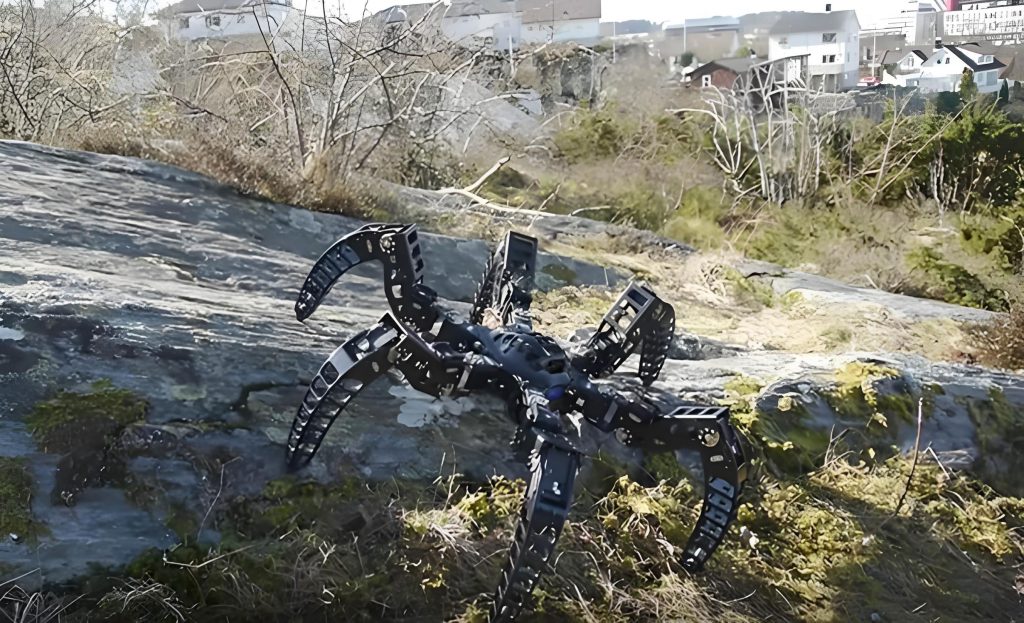
In my exploration, I have observed that bionic robots are categorized based on their biological inspirations. The table below summarizes key types of bionic robots, their inspirations, and primary applications:
| Type of Bionic Robot | Biological Inspiration | Key Applications | Notable Features |
|---|---|---|---|
| Quadruped Robots | Dogs, cats, other four-legged animals | Industrial inspection, disaster response, companionship | High terrain adaptability, dynamic stability |
| Exoskeleton Robots | Insect exoskeletons, human musculoskeletal system | Rehabilitation, heavy lifting assistance, military use | Strength augmentation, mobility restoration |
| Aerial Bionic Robots | Birds, bats, insects | Surveillance, environmental monitoring, delivery | Maneuverability, energy-efficient flight |
| Aquatic Bionic Robots | Fish, marine mammals | Ocean exploration, underwater maintenance, biology research | Low noise, efficient propulsion |
| Soft Bionic Robots | Octopuses, worms, soft-bodied organisms | Medical surgery, delicate handling, hazardous environments | Flexibility, safe human interaction |
This taxonomy highlights how bionic robots leverage natural designs to solve engineering challenges. The growth of bionic robots is fueled by advancements in materials science, artificial intelligence, and sensor technologies. For example, the control of a bionic robot often involves PID (Proportional-Integral-Derivative) controllers, which can be formulated as:
$$u(t) = K_p e(t) + K_i \int_0^t e(\tau) d\tau + K_d \frac{de(t)}{dt}$$
where $u(t)$ is the control output, $e(t)$ is the error signal, and $K_p, K_i, K_d$ are tuning parameters. Such controllers enable precise movements in bionic robots, akin to biological reflexes.
Quadruped bionic robots have particularly fascinated me due to their commercial traction. These robots mimic the gait of animals to traverse uneven surfaces. The dynamics of a quadruped bionic robot can be analyzed using the Lagrangian formulation. For a simplified model, the kinetic energy $T$ and potential energy $V$ are computed to derive equations of motion:
$$L = T – V = \frac{1}{2} \sum_{i=1}^4 m_i \dot{x}_i^2 – \sum_{i=1}^4 m_i g h_i$$
where $m_i$ is the mass of each leg segment, $\dot{x}_i$ is velocity, $g$ is gravity, and $h_i$ is height. Applying the Euler-Lagrange equation $\frac{d}{dt} \left( \frac{\partial L}{\partial \dot{q}_j} \right) – \frac{\partial L}{\partial q_j} = Q_j$ yields the governing dynamics for joint coordinates $q_j$. This mathematical framework allows engineers to optimize stability and energy consumption. Commercially, quadruped bionic robots are deployed in factories for 24/7 inspections, reducing human risk in hazardous areas. I have seen how these bionic robots can adapt to narrow passages and staircases, showcasing their versatility.
Another area where bionic robots shine is exoskeletons. Inspired by the hard shells of crustaceans, exoskeleton robots augment human strength and aid in rehabilitation. The force assistance provided by an exoskeleton can be modeled using Newton’s second law. For a lower-body exoskeleton assisting in lifting, the net force $F_{\text{net}}$ is:
$$F_{\text{net}} = m a = F_{\text{human}} + F_{\text{robot}} – f_{\text{friction}}$$
where $F_{\text{human}}$ is the human-applied force, $F_{\text{robot}}$ is the robotic assistance force, and $f_{\text{friction}}$ accounts for losses. By minimizing $F_{\text{human}}$, the bionic robot reduces fatigue. In medical settings, exoskeleton bionic robots help patients with spinal cord injuries regain mobility through repetitive gait training. The table below compares exoskeleton bionic robots based on their application domains:
| Application Domain | Key Requirements | Example Technologies | Challenges |
|---|---|---|---|
| Industrial Lifting | High torque, durability, user comfort | Powered suits, passive assist devices | Battery life, cost, weight |
| Medical Rehabilitation | Precise control, safety, adaptability | Gait trainers, neuromuscular stimulators | Personalization, regulatory approval |
| Military Enhancement | Speed, load capacity, stealth | Full-body exoskeletons, sprint aids | Power supply, integration with gear |
The proliferation of exoskeleton bionic robots underscores their societal value, especially in enhancing quality of life for individuals with disabilities.
Research breakthroughs in bionic robots continue to push boundaries. I am inspired by projects like cross-medium吸附 robots that mimic remora fish. These bionic robots use suction mechanisms to adhere to surfaces underwater and in air, enabling energy-efficient “hitchhiking.” The adhesion force $F_{\text{adh}}$ can be approximated by the Bernoulli principle for fluid-based systems:
$$F_{\text{adh}} = \frac{1}{2} \rho v^2 A C_d$$
where $\rho$ is fluid density, $v$ is velocity, $A$ is area, and $C_d$ is drag coefficient. Such innovations highlight how bionic robots can operate in hybrid environments. Similarly, deep-sea soft bionic robots, inspired by snailfish, withstand extreme pressures using compliant materials. Their motion in high-pressure environments involves non-linear elasticity, modeled by the Mooney-Rivlin equation for hyperelastic materials:
$$W = C_{10} (I_1 – 3) + C_{01} (I_2 – 3) + \frac{1}{D} (J – 1)^2$$
where $W$ is strain energy density, $I_1, I_2$ are invariants, $J$ is volume ratio, and $C_{10}, C_{01}, D$ are material constants. These bionic robots open new frontiers in oceanography and polar exploration.
Globally, bionic robot research flourishes with diverse prototypes. Aerial bionic robots, such as those模仿 bats or swallows, achieve agile flight through flapping-wing mechanisms. The lift generation $L$ for a flapping wing can be derived from unsteady aerodynamics:
$$L = \frac{1}{2} \rho v^2 S C_L(\alpha, t)$$
where $S$ is wing area, $C_L$ is time-dependent lift coefficient, and $\alpha$ is angle of attack. Companies have demonstrated swarms of bionic robots that communicate and collaborate, much like social insects. For instance,微型 bionic robots模仿 ants can perform collective tasks using simple rules, emerging into complex behaviors. This is often modeled with swarm intelligence algorithms, such as the ant colony optimization (ACO) formula for path planning:
$$p_{ij}^k = \frac{[\tau_{ij}]^\alpha [\eta_{ij}]^\beta}{\sum_{l \in \text{allowed}} [\tau_{il}]^\alpha [\eta_{il}]^\beta}$$
where $p_{ij}^k$ is the probability of ant $k$ moving from node $i$ to $j$, $\tau_{ij}$ is pheromone intensity, $\eta_{ij}$ is heuristic information, and $\alpha, \beta$ are parameters. These principles enable bionic robots to self-organize in unstructured environments.
The future of bionic robots appears boundless. As artificial intelligence converges with robotics, bionic robots will become more autonomous and cognitive. I envision bionic robots that learn from biological systems in real-time, using neural networks modeled after brains. A simple perceptron for decision-making in a bionic robot can be expressed as:
$$y = \sigma \left( \sum_{i=1}^n w_i x_i + b \right)$$
where $x_i$ are sensor inputs, $w_i$ are weights, $b$ is bias, and $\sigma$ is an activation function. This allows bionic robots to adapt to dynamic scenarios, such as avoiding obstacles or optimizing energy use. The integration of bionic robots into smart cities could revolutionize logistics, with aerial and ground bionic robots coordinating deliveries. In healthcare, bionic robots may perform minimally invasive surgeries by模仿 the dexterity of human hands.
However, challenges persist for bionic robots. Power efficiency remains a critical constraint, as many bionic robots require compact energy sources. The energy consumption $E$ of a mobile bionic robot over time $t$ can be estimated as:
$$E = \int_0^t P(\tau) d\tau = \int_0^t (F(\tau) v(\tau) + P_{\text{elec}}) d\tau$$
where $P$ is power, $F$ is propulsion force, $v$ is velocity, and $P_{\text{elec}}$ is electronics power. Advances in batteries and energy harvesting from the environment, like solar or kinetic energy, could mitigate this. Ethical considerations also arise as bionic robots become more lifelike, necessitating guidelines for design and deployment.
To quantify the progress in bionic robots, I have compiled a table of key performance metrics across different eras:
| Era | Dominant Bionic Robot Types | Average Autonomy Level | Energy Efficiency (Joules per task) | Notable Innovations |
|---|---|---|---|---|
| 1990-2000 | Simple legged robots, basic exoskeletons | Low (remote-controlled) | ~10,000 | Early biomimetic designs, PID control |
| 2000-2010 | Quadrupeds, aerial flappers | Medium (semi-autonomous) | ~5,000 | Improved sensors, modular actuators |
| 2010-2020 | Soft robots, swarm bionic robots | High (autonomous with AI) | ~1,000 | Machine learning integration, soft materials |
| 2020-Present | Cross-medium, humanoid bionic robots | Very high (cognitive autonomy) | ~500 | Neuromorphic computing, adaptive algorithms |
This evolution underscores the rapid maturation of bionic robots, driven by interdisciplinary research. The bionic robot paradigm emphasizes learning from nature, not just copying it, to create machines that complement human abilities.
In my view, the societal impact of bionic robots will deepen as they become more accessible. Educational tools like bionic robot kits can inspire future engineers, while affordable exoskeletons could democratize mobility assistance. The economic potential is vast, with markets for bionic robots expanding in agriculture, construction, and entertainment. For example, bionic robots模仿 pollinators might address declining bee populations by assisting in crop pollination. The effectiveness of such a bionic robot can be measured by pollination rate $R$, given by:
$$R = N_{\text{visits}} \times p_{\text{success}}$$
where $N_{\text{visits}}$ is the number of flower visits per hour and $p_{\text{success}}$ is the probability of successful pollen transfer. Through iterative design, bionic robots can achieve rates comparable to biological agents.
As I conclude, I am optimistic about the trajectory of bionic robots. They represent a synergy between biology and engineering, offering solutions to some of humanity’s pressing challenges. From exploring alien worlds to healing bodies, bionic robots will continue to evolve, guided by nature’s timeless wisdom. The journey of bionic robots is just beginning, and I eagerly anticipate the innovations ahead.