
In my exploration of robotics, I have witnessed how bionics has revolutionized the field, pushing the boundaries of what machines can achieve in unstructured and unknown environments. Traditionally, robots operated in structured settings, but the demands of modern applications—such as space exploration, military reconnaissance, disaster response, and medical diagnostics—require adaptability to complex, dynamic worlds. This shift has led me to delve into the rich tapestry of nature, where billions of years of evolution have produced organisms with elegant motion mechanisms and intelligent behaviors. These biological systems serve as an inexhaustible source of inspiration for bionic robots, which I believe are key to future technological advancements. The term “bionic robot” encapsulates this fusion of biology and engineering, where we learn, imitate, and replicate biological structures, functions, and control mechanisms to create or enhance mechanical systems. As a researcher, I am fascinated by how bionic robots are emerging as a vital branch of robotics, attracting widespread attention from experts worldwide. In this article, I will share my insights on the current state and future directions of bionic robots, categorizing them by their operational environments: terrestrial, aerial, and aquatic. Through detailed analysis, tables, and mathematical formulations, I aim to provide a comprehensive overview that highlights the transformative potential of bionic robots.
The concept of bionics, formalized in the 1960s, has grown into an interdisciplinary field that merges biological sciences with engineering. In my view, bionic robots represent the pinnacle of this integration, designed to mimic the agility, efficiency, and resilience of living creatures. For instance, consider the locomotion of a cheetah or the flight of a bird—these natural phenomena offer blueprints for creating robots that can navigate rugged terrains or soar through the air with minimal energy consumption. My research emphasizes that bionic robots are not merely copies of nature; they are innovative adaptations that address specific human needs. From assisting in search-and-rescue missions to exploring ocean depths, bionic robots demonstrate unparalleled versatility. As I analyze their development, I will use mathematical models to elucidate underlying principles. For example, the dynamics of a bionic robot can be described using Lagrangian mechanics, where the system’s motion is governed by equations that account for kinetic and potential energies. A general form for a bionic robot with multiple degrees of freedom is:
$$ \frac{d}{dt} \left( \frac{\partial L}{\partial \dot{q}_i} \right) – \frac{\partial L}{\partial q_i} = Q_i, $$
where \( L = T – V \) is the Lagrangian, \( T \) is kinetic energy, \( V \) is potential energy, \( q_i \) are generalized coordinates, and \( Q_i \) are generalized forces. This framework allows me to optimize design parameters for bionic robots, ensuring they mimic biological efficiency. In the following sections, I will detail the progress in terrestrial, aerial, and aquatic bionic robots, supported by comparative tables and formulas that summarize key advancements. My goal is to illustrate how these robots are evolving from simple prototypes to sophisticated systems capable of autonomous operation in diverse settings.
Terrestrial bionic robots, particularly humanoid and legged machines, have been a focal point of my studies. These robots aim to replicate human or animal locomotion, enabling them to traverse uneven ground, climb stairs, or maintain balance on slippery surfaces. The development of bionic robots for land applications began in the late 1960s, and over the past decades, I have observed remarkable strides in both hardware and control algorithms. From my perspective, the core challenge lies in achieving stable, energy-efficient gait patterns that adapt to environmental changes. To analyze this, I often use the zero-moment point (ZMP) criterion for bipedal bionic robots, which ensures dynamic stability by keeping the robot’s center of pressure within its support polygon. The ZMP condition can be expressed as:
$$ x_{ZMP} = \frac{\sum_{i=1}^n m_i ( \ddot{z}_i + g ) x_i – \sum_{i=1}^n m_i \ddot{x}_i z_i}{\sum_{i=1}^n m_i ( \ddot{z}_i + g )}, $$
where \( m_i \) are link masses, \( (x_i, z_i) \) are coordinates, \( g \) is gravity, and accelerations are derived from motion data. This formula is crucial for designing bionic robots that can walk without falling, akin to humans. Internationally, research on terrestrial bionic robots has produced iconic platforms. For example, in the United States, projects like Cog and Petman have pioneered aspects of humanoid robotics, focusing on cognitive perception, flexible manipulation, and balanced locomotion. Cog, developed at MIT, incorporated sensory systems mimicking vision, hearing, and touch, controlled by a distributed network of processors—a design I find insightful for embedding intelligence into bionic robots. Petman, from Boston Dynamics, demonstrated advanced dynamic walking and self-balancing, even simulating human physiology for testing protective gear. In Europe, robots like Rabbit from France utilized limit cycle control for walking and running, showcasing how mathematical approaches can enhance bionic robot mobility. In my analysis, I have compiled a table summarizing key terrestrial bionic robots and their characteristics:
| Bionic Robot | Key Features | Degrees of Freedom | Notable Capabilities |
|---|---|---|---|
| Cog | Humanoid upper body, distributed control, multi-sensory integration | Multiple (arms, head) | Perception and manipulation studies |
| Petman | Full-body humanoid, dynamic balance, physiological simulation | Over 30 | Walking, bending, toxic environment testing |
| Rabbit | Bipedal with wheels, limit cycle control | 5 (planar), 7 (3D) | Adaptive walking, recovery from disturbances |
| HIT series | Static and dynamic walking, multi-joint design | 10 to 32 | Stair climbing, slope traversal |
| Xianxingzhe | Human-like appearance, basic language functions | Numerous | Walking, obstacle avoidance |
In China, I have followed the progress of institutions like Harbin Institute of Technology and National University of Defense Technology, which have developed series such as HIT-I through HIT-IV and the pioneering “Xianxingzhe” robot. These bionic robots exhibit capabilities like walking on slopes, crossing obstacles, and even rudimentary speech, reflecting a growing expertise in mechatronics and control systems. My research into these systems often involves simulating their dynamics using software tools, where I apply equations of motion to predict performance. For instance, the torque required for a joint in a bionic robot can be calculated using inverse dynamics:
$$ \tau = M(q) \ddot{q} + C(q, \dot{q}) \dot{q} + G(q), $$
with \( M \) as the inertia matrix, \( C \) for Coriolis effects, and \( G \) for gravitational forces. This helps in optimizing actuator selection for bionic robots, ensuring they match the strength and speed of biological counterparts. As I look ahead, I believe terrestrial bionic robots will become more integrated into daily life, from healthcare assistants to industrial helpers, driven by advances in materials and AI.
Aerial bionic robots, inspired by birds, insects, and bats, represent another thrilling domain in my work. These machines, often called flapping-wing micro air vehicles (MAVs), leverage unsteady aerodynamics to achieve lift and maneuverability in ways that fixed-wing or rotary-wing systems cannot. In my studies, I emphasize how bionic robots for aerial applications offer unique advantages: they can operate in confined spaces, hover efficiently, and mimic natural flight patterns for stealth or agility. The physics of flapping flight is complex, but I use reduced-order models to approximate forces. For a bionic robot with wings oscillating at frequency \( f \), the lift force \( L \) can be estimated as:
$$ L = \frac{1}{2} \rho C_L S v^2, $$
where \( \rho \) is air density, \( C_L \) is lift coefficient (varying with angle of attack), \( S \) is wing area, and \( v \) is relative air velocity. However, for bionic robots with flexible wings, I incorporate added mass effects and vortex dynamics, leading to more intricate formulas like:
$$ L(t) = \rho \Gamma(t) U_{\infty} + \frac{d}{dt} \left( \rho \int \phi \, dA \right), $$
with \( \Gamma \) as circulation and \( \phi \) as velocity potential. Internationally, projects like Micro Bat and MFI (Mechanical Fly) have pushed the boundaries of miniaturization and efficiency. Micro Bat, a collaborative U.S. effort, used MEMS-fabricated wings and lightweight composites to achieve flights of several minutes, showcasing how bionic robots can harness biomimicry for energy savings. MFI, from UC Berkeley, replicated fly-like flight with piezoelectric actuators, enabling rapid wing beats and potential applications in surveillance. In my assessments, I have tabulated notable aerial bionic robots to highlight their specs:
| Bionic Robot | Inspiration | Size/Weight | Flight Performance |
|---|---|---|---|
| Micro Bat | Bat/insect wings | 15.24 cm wingspan, 10.5 g | 6 min flight, 46 m range |
| MFI (Mechanical Fly) | Housefly | 25 mm wingspan, 100 mg | 180 Hz wingbeat, solar-powered |
| Nanjing UA V bird-like | Bird | Varies by model | Successful test flights, comparable to Micro Bat |
| Northwestern Polytech MAV | Insect/bird hybrid | 16.5 kg (prototype) | 10.5 Hz flapping, 15-21 s flight |
In China, institutions like Beijing University of Aeronautics and Astronautics, Nanjing University of Aeronautics and Astronautics, and Northwestern Polytechnical University have conducted foundational research on insect flight mechanics and developed prototypes. From my perspective, these efforts underscore the global race to perfect bionic robots for aerial tasks. I often simulate their aerodynamics using computational fluid dynamics (CFD), solving Navier-Stokes equations to optimize wing shapes. For instance, the flow around a bionic robot’s wing can be modeled with:
$$ \frac{\partial \mathbf{u}}{\partial t} + (\mathbf{u} \cdot \nabla) \mathbf{u} = -\frac{1}{\rho} \nabla p + \nu \nabla^2 \mathbf{u}, $$
where \( \mathbf{u} \) is velocity, \( p \) is pressure, and \( \nu \) is kinematic viscosity. Such analyses help me design bionic robots that are both efficient and robust. As I envision the future, I see aerial bionic robots becoming ubiquitous for environmental monitoring, disaster relief, and even delivery services, with swarms of tiny fliers collaborating seamlessly.
Aquatic bionic robots, or robotic fish, captivate me with their potential to explore underwater realms while mimicking the graceful swimming of marine life. My research in this area focuses on replicating the propulsion mechanisms of fish, which often outperform traditional propellers in terms of efficiency, noise reduction, and maneuverability. The hydrodynamics of fish-like swimming involves body undulations and fin oscillations, which I model using elongated body theory or computational approaches. For a bionic robot with a flexible tail, the thrust force \( F_t \) can be derived from momentum exchange:
$$ F_t = \dot{m} (u_e – u_{\infty}), $$
where \( \dot{m} \) is mass flow rate, \( u_e \) is exit velocity, and \( u_{\infty} \) is free-stream velocity. In practice, I use more detailed equations that account for fluid-structure interactions, such as:
$$ F_t = \int_{body} \left( p \mathbf{n} + \tau \mathbf{t} \right) dA, $$
with \( p \) as pressure, \( \tau \) as shear stress, and \( \mathbf{n}, \mathbf{t} \) as normal and tangential vectors. Internationally, projects like Robotuna and RoboPike from MIT set early benchmarks, demonstrating high propulsion efficiency and acceleration. Robotuna, with its numerous parts and servo motors, achieved speeds up to 2 m/s, while RoboPike featured a flexible glass-fiber skeleton for rapid movements. In the UK, the G-series and MT-series robotic fish from Essex University advanced control strategies for unstable swimming, enabling 3D motions with minimal actuators. I have summarized key aquatic bionic robots in a table:
| Bionic Robot | Inspiration | Dimensions/Weight | Swimming Performance |
|---|---|---|---|
| Robotuna | Tuna fish | 1.25 m long, multi-part assembly | 2 m/s speed, 91% efficiency |
| RoboPike | Pike fish | 0.81 m long, 3.6 kg | Good acceleration, flexible structure |
| Essex G-series | General fish | Varies, multi-joint tail | Lifelike swimming, coordinated control |
| SPC-I and II | Fish morphology | 1.9 m long, 156 kg (SPC-I) | 1.5 m/s speed, used for archaeology |
| Harbin Eng micro fish | Small fish | 9 cm long, 60 g | ICPF actuator, biomimetic swimming |
In China, Beijing University of Aeronautics and Astronautics developed the SPC series for hydrodynamic studies and archaeological surveys, while Harbin Engineering University pioneered ionic polymer actuators (ICPF) for tiny robotic fish. These bionic robots, in my view, exemplify how biomimicry can lead to breakthroughs in underwater exploration. I often analyze their motion using vortex ring models, where shedding vortices generate thrust, described by:
$$ \Gamma = \oint \mathbf{u} \cdot d\mathbf{l}, $$
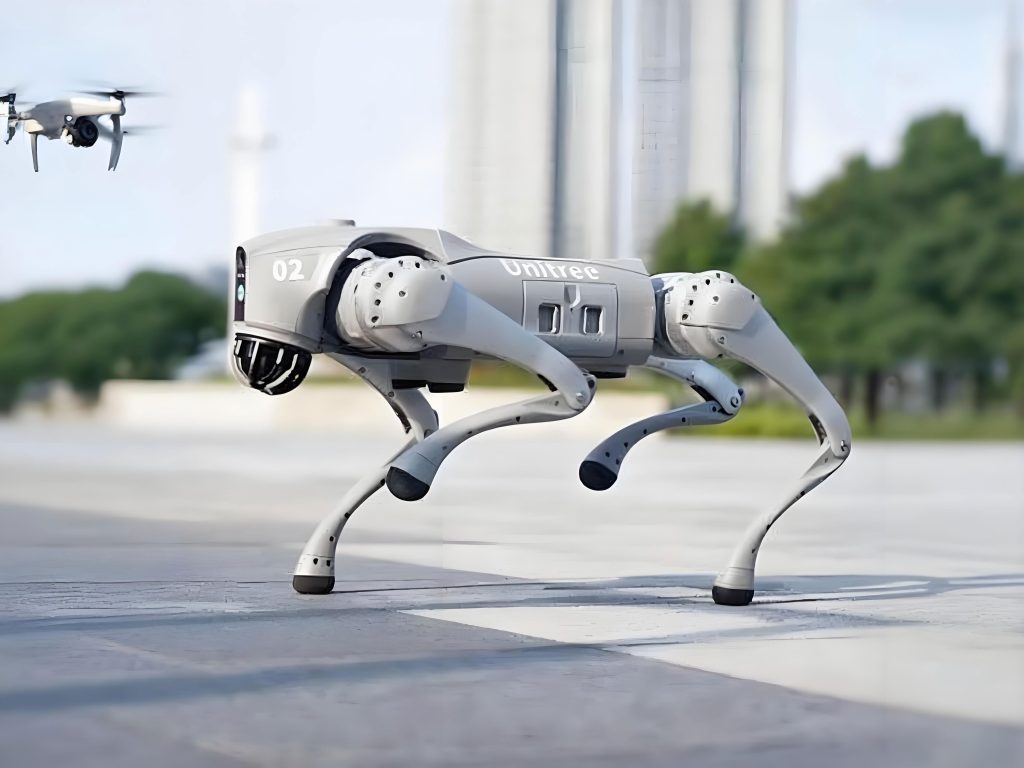
with \( \Gamma \) as circulation around a vortex. This helps me optimize tail-beat frequencies for bionic robots. The integration of such robots into oceanography, pipeline inspection, and marine biology is a trend I closely monitor. To illustrate the elegance of these designs, I include an image of a bionic robot in action:
Looking forward, I identify several key trends that will shape the evolution of bionic robots. First, miniaturization is paramount, as smaller bionic robots can access confined spaces and reduce resource consumption. This involves micro-electromechanical systems (MEMS) that integrate sensors, actuators, and processors on a single chip. I model scaling effects using dimensionless numbers like the Reynolds number \( Re = \rho u L / \mu \), which influences fluid dynamics at small scales. For a bionic robot shrinking in size, I adjust designs to maintain functionality, often using formulas for power density:
$$ P_d = \frac{P}{V}, $$
where \( P \) is power and \( V \) is volume, ensuring sufficient energy for movement. Second, intelligence is transforming bionic robots from pre-programmed machines to adaptive entities. I incorporate machine learning algorithms, such as reinforcement learning, to enable bionic robots to learn from environments. The reward function in such frameworks can be expressed as:
$$ R(s, a) = \sum_{t=0}^{\infty} \gamma^t r_t, $$
with \( s \) as state, \( a \) as action, \( r_t \) as immediate reward, and \( \gamma \) as discount factor. This allows bionic robots to optimize behaviors like obstacle avoidance or energy-efficient locomotion. Third, collaboration among multiple bionic robots is gaining traction, with swarms achieving tasks beyond individual capabilities. I use graph theory to model communication networks, where connectivity is represented by adjacency matrices \( A \) with elements \( a_{ij} = 1 \) if robots \( i \) and \( j \) interact. The collective behavior can be described by consensus algorithms:
$$ \dot{x}_i = \sum_{j \in N_i} (x_j – x_i), $$
leading to synchronized actions. Fourth, morphological fidelity—making bionic robots look like real organisms—enhances stealth and acceptance, especially in surveillance or entertainment. I apply biomimetic materials, such as soft polymers, to achieve lifelike appearances, often testing them with stress-strain equations:
$$ \sigma = E \epsilon, $$
for elastic materials, where \( \sigma \) is stress, \( E \) is Young’s modulus, and \( \epsilon \) is strain. These trends, in my analysis, will drive bionic robots toward greater autonomy and integration into society.
In conclusion, my journey through the world of bionic robots reaffirms their critical role in advancing robotics. From terrestrial walkers to aerial fliers and aquatic swimmers, bionic robots demonstrate how nature’s designs can be harnessed to solve human challenges. I am convinced that as technology progresses, bionic robots will become more pervasive, operating in hazardous environments, assisting in healthcare, and even coexisting with humans daily. The mathematical frameworks and tabular summaries I have presented highlight the interdisciplinary effort required—merging biology, engineering, and computer science. As I reflect on the future, I see bionic robots evolving beyond imitation to innovation, where they not only replicate biological functions but also surpass them in efficiency and capability. This vision motivates my ongoing research, as I continue to explore the endless possibilities that bionic robots offer for a smarter, more adaptable world.
To further quantify the advancements, I often use performance metrics for bionic robots, such as cost of transport (COT), which measures energy efficiency:
$$ COT = \frac{P}{mgv}, $$
where \( P \) is power input, \( m \) is mass, \( g \) is gravity, and \( v \) is velocity. Comparing COT across different bionic robots reveals insights into their biological plausibility. Additionally, I analyze robustness using Lyapunov stability theory, ensuring that control systems for bionic robots can handle disturbances. For a nonlinear system, I seek a Lyapunov function \( V(x) \) such that:
$$ \dot{V}(x) = \frac{\partial V}{\partial x} f(x) < 0, $$
guaranteeing asymptotic stability. These tools, combined with the trends of miniaturization, intelligence, collaboration, and morphological fidelity, will propel bionic robots into new frontiers. As I finalize this exploration, I emphasize that bionic robots are not just technological marvels; they are testaments to our ability to learn from nature and create machines that extend our reach into the unknown. The ongoing research, documented in studies worldwide, promises a future where bionic robots are integral to our daily lives, enhancing safety, efficiency, and discovery.