
As I observe the rapid advancements in robotics and artificial intelligence, I am increasingly fascinated by the emergence of humanoid robots. These machines, born from the deep integration of AI and robotics, are capturing public imagination. Recent breakthroughs in bipedal locomotion, dexterous manipulation, and cost-effective manufacturing have propelled humanoid robots into the spotlight. Events like the world’s first half-marathon for humanoid robots in Beijing have further amplified interest. From my perspective, a critical question arises: what impact will humanoid robot development have on the industrial sector, where robots are already ubiquitous? Can they drive another wave of industrial transformation and upgrade? In this article, I will explore how the technologies and concepts underpinning humanoid robots are poised to revolutionize industrial manufacturing, even if humanoid robots themselves may not become staple fixtures on factory floors in the immediate future.
The defining characteristics and advantages of humanoid robots represent significant leaps across multiple technical domains. To systematically understand these breakthroughs, I have summarized them in the following table.
| Breakthrough Area | Key Achievements | Underlying Technologies & Impact |
|---|---|---|
| Engineering Mechanics | Stable bipedal standing/running, sophisticated five-finger grasping. | Advancements in transmission systems, mechanical/structural design, motion control, and environmental perception. This enables operation in complex, unstructured environments and execution of diverse tasks. The dynamic balance can be modeled by equations for a inverted pendulum: $$ \tau = I \ddot{\theta} + mgl \sin\theta $$ where $\tau$ is the applied torque, $I$ is the moment of inertia, $m$ is mass, $g$ is gravity, $l$ is length, and $\theta$ is the angular deviation. |
| Intelligence Level | Enhanced perception and active adaptation to environmental changes. | Fusion of advanced sensor technology (LiDAR, RGB-D cameras, tactile sensors) and AI (computer vision, reinforcement learning). This grants greater autonomy and flexibility. The perception-action cycle can be framed as optimizing a policy $\pi$ that maps states $s$ to actions $a$ to maximize cumulative reward $R$: $$ \pi^* = \arg\max_\pi \mathbb{E}\left[ \sum_{t=0}^{T} \gamma^t R(s_t, a_t) \right] $$ |
| Anthropomorphic Bionics | Human-like form factor and intuitive human-robot interaction (HRI). | Design for social acceptance and natural interaction interfaces (voice, gesture). Users can issue commands in natural language without specialized training, expanding potential applications into non-specialized domains. The usability gain can be qualitatively expressed as a reduction in the interaction complexity cost function $C_{int}$. |
Despite these impressive strides, the current primary application scenarios for humanoid robots remain in demonstration, guidance, companionship, and other service or specialized fields. In my analysis, traditional industrial robots, with their longer development history and higher specialization, still dominate manufacturing due to an unwavering focus on safety, efficiency, and stability. The fundamental differences are stark and crucial for understanding the industrial landscape.
Firstly, industrial production operates on the principle of safety-first. Traditional industrial robots are typically physically isolated from human workers in cages or safeguarded spaces. Their operation and parameter modification require specialized knowledge and authorization. In contrast, service-oriented humanoid robots are designed for simpler operation and generally pose lower risks of major physical or property damage. Secondly, industry prioritizes efficiency, often at the expense of flexibility. Most industrial robots are specialized for a single, repetitive task on an assembly line—welding, painting, palletizing, transporting, or picking. Their mechanical design optimizes for power, speed, and precision in that specific task, discarding unnecessary functionalities to maximize throughput. A humanoid robot’s general-purpose, anthropomorphic design broadens its applicability but often cannot match the high efficiency and stability of a dedicated machine in a singular task. We can model the efficiency specialization with a simple productivity function $P_{task}$ for a robot dedicated to task $i$: $$ P_{task_i} = \frac{N_i}{t_i} $$ where $N_i$ is the number of task cycles and $t_i$ is the time, optimized by design. A general-purpose humanoid robot would have a lower $P_{task}$ for any given $i$ compared to a specialist robot. Thirdly, industrial production emphasizes coordination based on division of labor. Industrial robots are integrated into continuous production lines and often work in synchronized groups. For instance, a set of 4-6 welding robots might work simultaneously on a car body to address different weld points efficiently, minimizing tool changeover time. Service or home settings rarely call for multiple coordinated robots; a humanoid robot must be capable of independent operation, which sacrifices the efficiency gains from multi-robot collaboration.
The following table encapsulates this comparative analysis from my viewpoint.
| Aspect | Traditional Industrial Robots | Humanoid Robots (Current Focus) |
|---|---|---|
| Primary Design Principle | Safety, Efficiency, Stability | Versatility, Interaction, Adaptability |
| Typical Workspace | Physically isolated, structured environments | Shared, unstructured, human-centric spaces |
| Operation & Skill Requirement | High, requires specialized training | Low, aims for intuitive interaction |
| Task Orientation | Specialized for a single, repetitive task | General-purpose for multiple, varied tasks |
| Key Performance Metrics | Cycle time ($t_c$), Uptime, Repeatability ($\sigma_r$) | Task success rate ($S$), Interaction fluency, Learning capability |
| Collaboration Mode | Multi-robot synchronization on a line | Primarily independent operation |
| Dominant Application Domain | Manufacturing (e.g., automotive, electronics) | Services, hospitality, healthcare, domestic |
Therefore, I contend that different robot types excel in their respective domains. For now, humanoid robots appear more suited for commercial and domestic applications, where their reliability and cost-performance ratio in industrial production lag behind traditional counterparts. However, this is not the end of the story. I see the humanoid robot as a vital technological and conceptual proving ground. Its development directly fuels progress in robotic actuation, perception, and control systems. The philosophies embedded in humanoid robot design offer profound insights for the future evolution of industrial robotics, promising a sustained impact on industrial mechanization and intellectualization.
One of the most significant contributions, in my view, is the push toward “human-robot fusion” in industrial settings. Traditionally, safety protocols mandated strict physical separation. “Human-robot fusion” aims to dismantle these barriers through technology, allowing humans and machines to work side-by-side, leveraging their respective strengths for higher efficiency on complex tasks. Around 2015, major robot manufacturers began aggressively promoting collaborative robots (cobots) designed to share workspace with humans. Product lines like Fanuc’s CR/CRX, ABB’s YuMi/SWIFTI/GoFa, Yaskawa’s HC, and KUKA’s LBR iiwa series have rapidly expanded. These cobots share space with workers, collaborate on tasks, and ensure human safety through force-limiting designs and advanced sensors. They have found applications in automotive, electronics, metalworking, and biopharma, becoming a new family member in the industrial robot ecosystem. The collaboration efficiency gain can be modeled as a synergistic output $O_{syn}$ compared to separate work: $$ O_{syn} = \alpha O_{human} + \beta O_{robot} + \gamma (O_{human} \cdot O_{robot}) $$ where $\alpha$ and $\beta$ are coefficients, and $\gamma$ represents the synergy multiplier. Humanoid robots, inherently designed for frequent physical interaction with humans, contribute directly to this field. Their advanced sensor technologies for proximity detection, trajectory computation algorithms for safe motion planning, and refined motion control strategies are directly applicable to designing safer, more intuitive cobots. Moreover, the entire philosophy of safe and natural co-existence with humans, central to humanoid robot development, provides a valuable conceptual blueprint for the next generation of industrial collaborative robots.
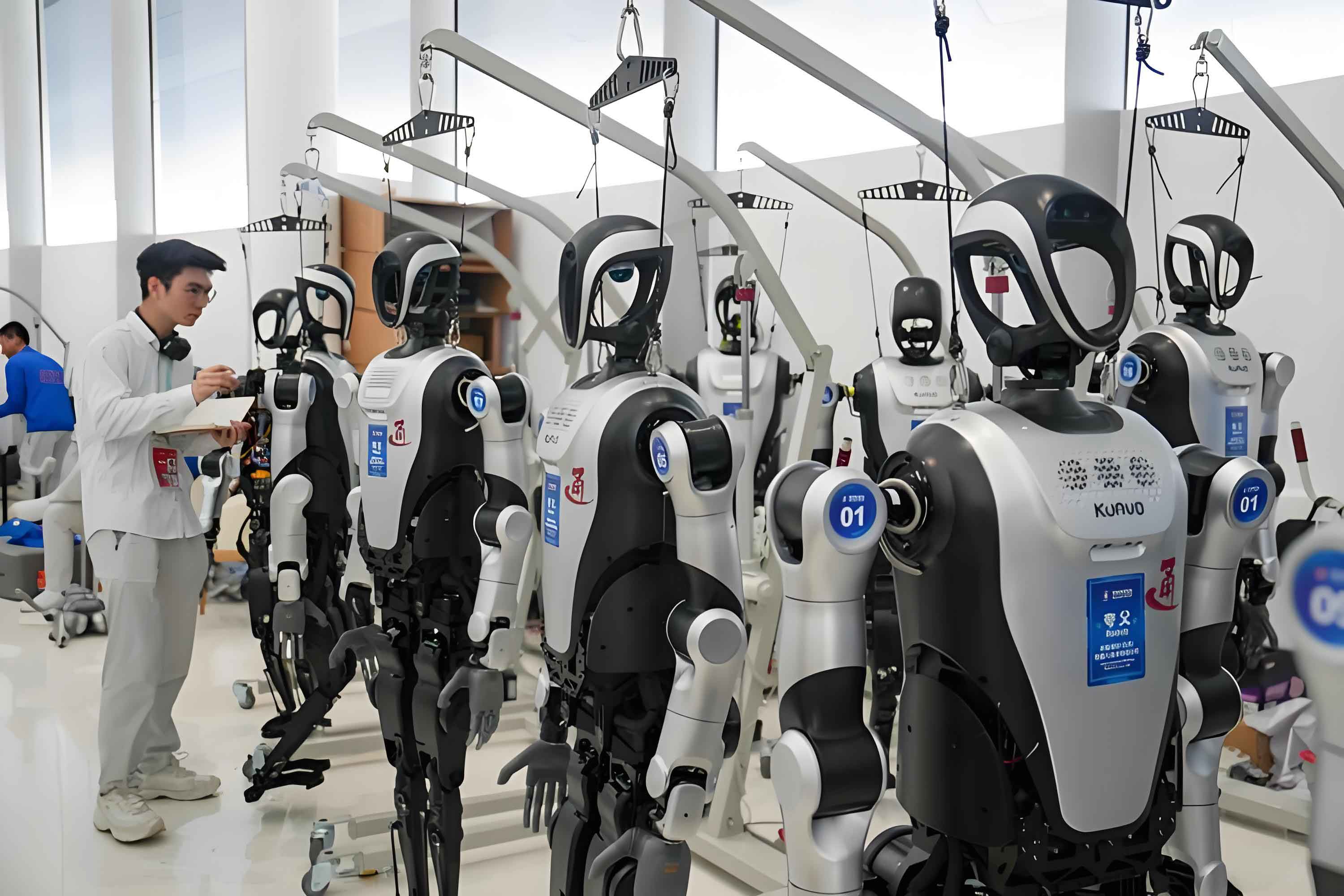
Furthermore, I believe humanoid robots are powerful catalysts for industrial digital and intelligent transformation. Traditional industrial robots operate on pre-programmed routines, largely “blind” to environmental changes and unable to self-adjust. Even minor deviations require intervention from engineers or technicians. In contrast, most advanced humanoid robots possess intelligent perception and environmental adaptation capabilities. They can perform autonomous decision-making, task planning, multi-modal fusion and interaction, and even engage in self-learning and optimization. The maturation of these technologies is pivotal for the intelligent upgrade of industrial robots. We are already seeing AI-embedded industrial robots being deployed in industries with high-mix, low-volume production, such as semiconductors, electronics, food processing, and intricate machinery. These robots can accurately and rapidly identify and grasp diverse, scattered components from a conveyor or execute differentiated programs based on the processing object. For instance, an intelligent welding robot can autonomously recognize workpieces in a small-batch, multi-variety flow, analyze their structure and spatial relationships, and autonomously execute the welding process and robotic arm driving program, drastically saving setup and debugging time. The core of this capability often involves a perception-decision-action pipeline. The decision-making can be based on a learned model $f$ that maps perceived state $s$ and goal $g$ to action parameters $a$: $$ a = f_\theta(s, g) $$ where $\theta$ are the parameters optimized through training on data or simulation. Additionally, the more friendly human-robot interaction modalities pioneered by humanoid robots, such as natural language instruction, are being adopted in industry. For example, concepts like Omron’s vision involve robots receiving verbal instructions from humans and autonomously generating, programming, and debugging an entire production process for a component, eliminating the need for manual coding.
The push toward mobility is another area where, I observe, humanoid robot development offers crucial impetus. With the exception of Automated Guided Vehicles (AGVs) for material transport and robots on limited-range tracks, the vast majority of traditional industrial robots are fixed in place. Any positional adjustment, however minor, requires rigorous verification and validation. While this ensures safety and reliability in large-scale mass production, it severely sacrifices flexibility, making it ill-suited for the demands of low-cost, large-scale customization. Humanoid robots are characterized by a high degree of autonomous mobility. The mature technologies they employ—such as wireless localization, dynamic path planning, and anti-collision algorithms—along with the very design philosophy of mobility, can accelerate the development of mobile industrial robots. This is key to realizing the future flexible and reconfigurable factory. Of course, for industrial practicality, wheeled or tracked mobility is often more stable and efficient than bipedal locomotion for humanoid robots. In recent years, we have witnessed the rapid development of compound mobile robots that integrate multi-joint manipulators or Cartesian coordinate robots with AGV platforms. These systems effectively achieve mobility for small and medium-sized industrial robots, enabling them to move between different workstations. The path planning for such mobile manipulators can be formulated as an optimization problem minimizing cost $J$ over a path $p(t)$: $$ J = \int_{t_0}^{t_f} \left( w_1 \|\dot{p}(t)\|^2 + w_2 \cdot \text{CollisionRisk}(p(t)) + w_3 \cdot \text{Energy}(p(t)) \right) dt $$ where $w_i$ are weighting factors.
To consolidate the potential industrial spillover effects from humanoid robot technologies, I present the following summary table.
| Technology Area from Humanoid Robots | Specific Technologies / Concepts | Potential Industrial Application & Impact | Representative Metric/Formula |
|---|---|---|---|
| Advanced Sensing & Perception | 3D vision, LiDAR, force-torque sensing, tactile sensors. | Enables robots to handle unstructured environments, perform quality inspection, and adapt to variable workpieces. Leads to flexible, vision-guided robotics. | Object recognition accuracy $A_{rec}$; Pose estimation error $\epsilon_{pose}$. |
| AI & Autonomous Decision-Making | Reinforcement learning, imitation learning, task and motion planning (TAMP). | Allows industrial robots to self-optimize processes, handle exceptions, and manage multi-step tasks without explicit programming for every scenario. | Learning convergence rate; Task success rate under variation: $S = \frac{N_{success}}{N_{total}}$. |
| Natural HRI & Interface | Natural language processing (NLP), gesture recognition, intuitive programming by demonstration. | Simplifies robot programming, setup, and re-tasking, reducing the skill barrier and enabling faster production changeovers. | Programming time reduction $\Delta T_{prog}$; Operator learning curve coefficient $\kappa$. |
| Safe Motion & Control | Collision detection, reflexive stopping, compliant control, trajectory optimization. | Directly enables safe human-robot collaboration (cobots), expanding robot applications to direct assembly and finishing tasks alongside workers. | Force/torque limits for safety: $\|F\| < F_{max}$, $\|\tau\| < \tau_{max}$. |
| Mobile Platform Integration | SLAM (Simultaneous Localization and Mapping), dynamic navigation, whole-body control for mobile manipulation. | Facilitates the creation of mobile manipulators for flexible factory layouts, just-in-sequence part delivery, and large-scale asset inspection. | Navigation accuracy; Task completion time for mobile manipulation $T_{mm}$. |
In conclusion, from my extensive analysis, I am convinced that within the diverse robot taxonomy, industrial robots and humanoid robots follow distinct technical trajectories tailored for different scenarios. The humanoid robot, while unlikely to see mass adoption inside factories in the short term, serves as an unparalleled innovation engine. It provides a rich stream of advanced technologies and pioneering concepts—from embodied AI and sophisticated sensing to the ideals of safe coexistence and adaptive intelligence. These elements are steadily permeating the industrial sphere, making future production systems more efficient, flexible, safe, and intelligent. The journey of the humanoid robot is not just about creating machines in our image; it is about refining the tools and ideas that will build the next generation of industry. The convergence of these paths promises a future where the boundaries between dedicated automation and general-purpose assistance blur, ultimately leading to smarter, more responsive, and more human-centric manufacturing ecosystems.