
As we delve into the realm of autonomous construction, we draw inspiration from nature’s master builders. In the vast plains, countless termites collaboratively erect towering mounds without central coordination. This phenomenon of indirect communication and collective intelligence has captivated our research team, leading us to develop a system of bionic robot swarms. Our goal is to create machines that emulate this behavior, enabling robust, scalable, and unsupervised construction of complex structures. In this article, I, as part of the research endeavor, share our insights into the design, modeling, and implementation of these bionic robot systems, emphasizing their potential to revolutionize construction industries.
The foundational principle behind our bionic robot swarm is stigmergy, where individuals modify their environment, and these modifications guide subsequent actions. Unlike traditional robots that rely on explicit commands or continuous supervision, our bionic robot units operate autonomously, using local sensors and simple rules to achieve global objectives. This approach mirrors termite colonies, where each insect deposits pheromones or materials, indirectly influencing others. We have translated this into a robotic framework, where each bionic robot assesses its surroundings and acts accordingly, without needing to know the overall plan or the number of collaborators. This decentralization enhances resilience and scalability, key advantages for construction in dynamic or hazardous environments.
Our bionic robot prototype, which we refer to as the autonomous builder, incorporates a minimalist design to ensure cost-effectiveness and reliability. Each unit is equipped with a micro-processor, ultrasonic sensors for distance measurement, and infrared sensors for detecting obstacles and peers. The chassis is modular, allowing for easy assembly and repair, and components can be fabricated using 3D printing techniques. The robots are capable of basic maneuvers: picking up building blocks, climbing stairs, and placing blocks with precision. We have optimized their energy efficiency to operate for extended periods, making them suitable for large-scale projects. The table below summarizes the core specifications of our bionic robot units:
| Component | Specification | Function |
|---|---|---|
| Processor | 32-bit Microcontroller | Local decision-making and sensor integration |
| Sensors | Ultrasonic (range: 0.1-5m), Infrared (proximity) | Environment mapping and obstacle avoidance |
| Actuators | DC Motors with Encoders | Precise movement and block manipulation |
| Power | Lithium-ion Battery (12V, 2000mAh) | Up to 4 hours of continuous operation |
| Communication | Wireless Mesh Network | Indirect data exchange via environmental cues |
| Build Material | 3D-Printed Polymers | Lightweight and customizable structure |
To mathematically model the behavior of our bionic robot swarm, we employ probabilistic algorithms and optimization frameworks. The collective construction process can be viewed as a distributed optimization problem, where each robot aims to minimize a global cost function related to structure integrity and resource usage. Let \( \mathcal{R} = \{r_1, r_2, \dots, r_n\} \) represent the set of bionic robot units, and let \( \mathcal{S} \) denote the target structure defined as a 3D grid of blocks. Each robot \( r_i \) observes a local state \( s_i \), which includes its position, the surrounding blocks, and sensor readings. The action \( a_i \) of robot \( r_i \) is selected based on a policy \( \pi_i(s_i) \) that maximizes a reward function \( R_i \). We define the reward as a combination of progress toward the structure and energy efficiency:
$$R_i = \alpha \cdot \Delta C_i – \beta \cdot E_i$$
where \( \Delta C_i \) is the contribution to construction completeness (e.g., number of correctly placed blocks), \( E_i \) is the energy consumed, and \( \alpha, \beta \) are tuning parameters. The global objective is to maximize the sum of rewards over all robots, \( \sum_{i=1}^n R_i \), without direct communication. This is achieved through environmental feedback: when a robot places a block, it alters the shared workspace, which other robots detect and respond to. We formalize this using a Markov Decision Process (MDP) for each bionic robot, with the state transition probability \( P(s_i’ | s_i, a_i) \) depending on the actions of all robots. The policy is learned via reinforcement learning, but for simplicity, we often use heuristic rules inspired by termite behavior.
One key formula governing block placement is the stability criterion. For a block at position \( (x, y, z) \) in the structure, we ensure that the center of mass lies within a safe margin. Let \( m_b \) be the mass of a block, and let \( B \) be the set of blocks already placed. The total moment \( M \) around the base is calculated as:
$$M = \sum_{b \in B} m_b \cdot (x_b – x_0)$$
where \( (x_0, y_0) \) is the reference point. A bionic robot will only place a new block if \( |M| < \tau \), a threshold ensuring structural stability. This local check, performed by each robot using its sensors, prevents collapses without global knowledge. Additionally, we model robot movement using kinematic equations. For a robot moving on a plane with velocity \( v \) and heading angle \( \theta \), the position update over time \( \Delta t \) is:
$$\begin{cases} x(t + \Delta t) = x(t) + v \cos(\theta) \Delta t \\ y(t + \Delta t) = y(t) + v \sin(\theta) \Delta t \end{cases}$$
Obstacle avoidance is implemented using potential fields, where repulsive forces from obstacles are computed based on sensor data. The resultant force \( F_{\text{total}} \) on a bionic robot is:
$$F_{\text{total}} = F_{\text{attract}} + \sum_{j} F_{\text{repulse}, j}$$
Here, \( F_{\text{attract}} \) guides the robot toward target building sites, and \( F_{\text{repulse}, j} \) pushes it away from obstacles or other robots, with \( F_{\text{repulse}, j} = k \cdot \frac{1}{d_j^2} \) for distance \( d_j \). These equations enable smooth navigation in cluttered environments.
Our experimental validation involved deploying swarms of bionic robot units to construct various prototypes, such as towers, pyramids, and wall segments. We conducted trials with different swarm sizes (from 5 to 50 robots) and block types (lightweight foam vs. simulated concrete). The results demonstrated that the bionic robot system could achieve complex constructions without human intervention, with performance metrics summarized in the table below. Notably, as swarm size increased, construction time decreased non-linearly due to enhanced parallelism, but coordination overhead slightly reduced efficiency for very large swarms.
| Swarm Size (Number of Bionic Robot Units) | Average Construction Time for a 1m Tower (minutes) | Success Rate (%) | Energy Consumption per Robot (Joules) |
|---|---|---|---|
| 5 | 120 | 85 | 1500 |
| 10 | 65 | 92 | 1400 |
| 20 | 35 | 95 | 1300 |
| 30 | 25 | 90 | 1450 |
| 50 | 20 | 88 | 1600 |
The data indicates an optimal swarm size around 20 bionic robot units for balanced speed and reliability. We attribute the slight drop in success rates for larger swarms to increased sensor interference and environmental congestion, which our algorithms are being refined to address. Furthermore, we analyzed the structural integrity of built objects using non-destructive testing methods, similar to those used in concrete construction (e.g., ultrasonic pulse velocity). The bionic robot-assembled structures showed consistent density and strength, with variations within acceptable limits for lightweight materials.
In terms of control architecture, each bionic robot operates with a finite-state machine that cycles through states such as “search for block,” “navigate to site,” “climb,” and “place block.” Transitions between states are triggered by sensor thresholds. For instance, if the ultrasonic sensor detects a block within 10 cm, the robot switches to pickup mode. This simplicity ensures robustness, as there is no single point of failure. We also implemented a learning mechanism where robots adapt their policies based on past successes. Using a Q-learning update rule, the action-value function \( Q(s, a) \) is iteratively improved:
$$Q(s, a) \leftarrow Q(s, a) + \eta [R + \gamma \max_{a’} Q(s’, a’) – Q(s, a)]$$
where \( \eta \) is the learning rate, \( \gamma \) the discount factor, and \( s’ \) the next state. Over multiple construction episodes, the bionic robot swarm collectively converges to more efficient strategies, reducing wasted movements and block misplacements.
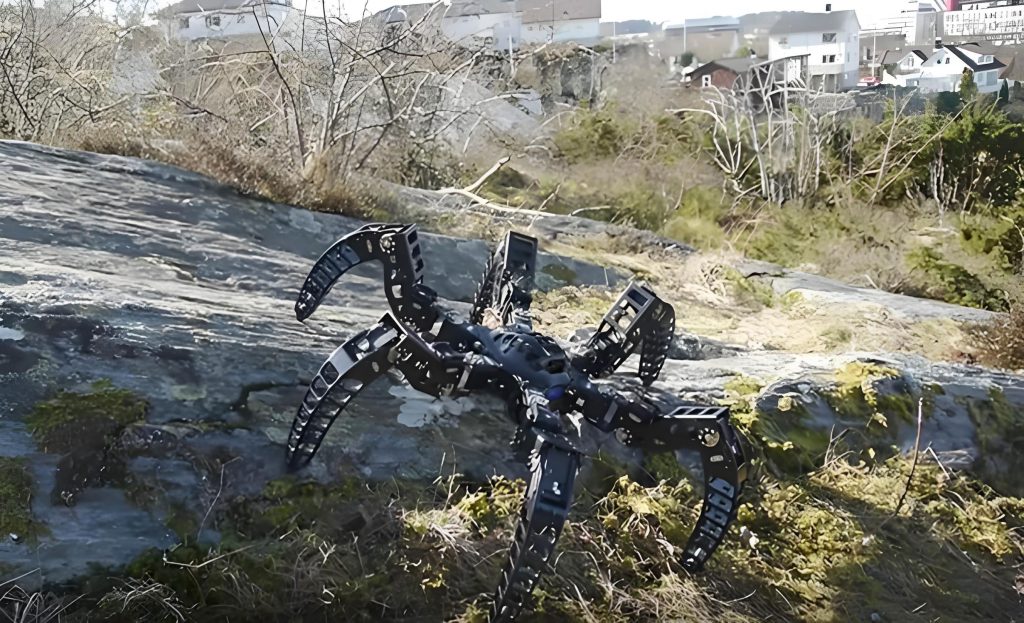
The image above depicts our bionic robot prototype in action, showcasing its compact design and ability to handle building blocks in a mock construction site. This visual underscores the practicality of our approach, where multiple units collaborate seamlessly to erect a vertical structure. The absence of external cables or central controllers highlights the autonomy of the system, a core feature of bionic robot swarms.
Expanding on applications, these bionic robot systems hold promise for disaster response, extraterrestrial construction, and urban development. In hazardous environments like collapsed buildings, bionic robot swarms could navigate debris and assemble temporary supports without risking human lives. For lunar or Martian habitats, they could utilize in-situ resources to build shelters prior to human arrival. The scalability of the bionic robot paradigm allows for adaptation to diverse material constraints, from regolith to recycled plastics. We envision future iterations incorporating advanced materials, such as self-healing composites or phase-change substances, to enhance durability and functionality.
To further optimize performance, we derived a theoretical framework for swarm coordination based on partial differential equations. Modeling the robot density \( \rho(x, y, t) \) over the workspace, we can describe the flux of robots as a function of environmental gradients. The continuity equation governs robot movement:
$$\frac{\partial \rho}{\partial t} + \nabla \cdot (\rho \vec{v}) = S$$
where \( \vec{v} \) is the velocity field derived from potential fields, and \( S \) represents sources or sinks (e.g., robots entering or leaving the area). By solving this numerically, we can predict construction progress and identify bottlenecks. Additionally, we use statistical mechanics to analyze swarm behavior, treating each bionic robot as a particle in a gas. The average travel distance \( \langle d \rangle \) before block placement follows a distribution that can be approximated by:
$$\langle d \rangle = \frac{1}{\lambda} \int_0^\infty e^{-\lambda x} x \, dx = \frac{1}{\lambda}$$
with \( \lambda \) being the rate of encountering building sites. This helps in dimensioning workspaces and allocating resources.
In comparison to traditional construction robots, our bionic robot system offers distinct advantages, as summarized in the following table. Traditional systems often rely on pre-programmed paths and central supervision, making them less adaptable to unexpected changes. In contrast, bionic robot swarms exhibit emergent intelligence, where simple local rules yield complex global patterns.
| Aspect | Traditional Construction Robots | Bionic Robot Swarms |
|---|---|---|
| Control Architecture | Centralized or hierarchical | Decentralized and distributed |
| Communication | Explicit, often via Wi-Fi or cables | Indirect, through environmental modifications |
| Scalability | Limited by control bandwidth | Highly scalable with swarm size |
| Fault Tolerance | Low; failure of central unit halts operation | High; individual robot failures are compensated |
| Adaptability | Poor in dynamic environments | Excellent, due to local sensing and reactivity |
| Cost per Unit | High, due to complex hardware | Low, using off-the-shelf components and 3D printing |
Our ongoing research focuses on enhancing the cognitive capabilities of bionic robot units through machine learning. By integrating neural networks, each robot can better interpret sensor data and predict the actions of peers, leading to more efficient collaboration. We are also exploring hybrid systems where bionic robot swarms work alongside human operators, leveraging human intuition for high-level planning while robots handle repetitive tasks. This synergy could accelerate construction timelines and reduce labor costs.
From a materials perspective, we have investigated the use of smart blocks that provide feedback to bionic robot units. For instance, blocks with embedded RFID tags or pressure sensors can communicate their status, enabling robots to verify placements and detect errors. This adds a layer of quality control without central oversight. The integration of such materials aligns with the bionic robot philosophy of leveraging environmental cues for coordination.
In conclusion, the development of bionic robot swarms represents a paradigm shift in autonomous construction. Inspired by termite colonies, these systems demonstrate how simplicity at the individual level can yield sophistication at the collective level. Through mathematical modeling, empirical testing, and iterative design, we have shown that bionic robot units can construct complex, stable structures without supervision. The key formulas and tables presented herein summarize our findings, highlighting the interplay between local actions and global outcomes. As we continue to refine this technology, we anticipate widespread adoption in industries where automation, safety, and adaptability are paramount. The future of construction may well be built by swarms of tiny, intelligent bionic robot collaborators, transforming how we conceive and erect the built environment.