
In recent years, with the acceleration of agricultural integration in urban and rural areas, the number of young and middle-aged laborers engaged in agricultural production has been decreasing significantly. This shortage of agricultural labor and the continuous rise in labor costs have severely impacted the development of the flower and fruit industry. To ensure the sustainable growth of this sector, the advancement of intelligent agricultural equipment, particularly automated and intelligent harvesting machinery, has become increasingly urgent. The development of flower and fruit harvesting robots, such as those for roses, can alleviate labor shortages, reduce the workload of agricultural workers, improve working conditions, and lower harvesting costs. As a researcher in this field, I focus on designing an effective end effector for rose harvesting robots, which is critical for maintaining the economic value of roses by ensuring that harvested flowers are structurally intact with minimal damage to blossoms and stems.
The existing harvesting devices on the market are not suitable for the complex environments of rose fields, necessitating a new design that considers the growth characteristics and conditions of roses. This paper presents the design and analysis of an integrated clamping and cutting end effector for rose harvesting robots. The end effector is engineered to be compact, reliable, and cost-effective, with the ability to interface with machine vision systems for precise targeting. Key requirements for the end effector include minimizing damage to rose flowers and stems, providing sufficient cutting force to sever stems, and ensuring efficient pickup operations. The design adopts a single power source to drive both clamping and cutting mechanisms, reducing overall size and enhancing suitability for narrow rose field environments.
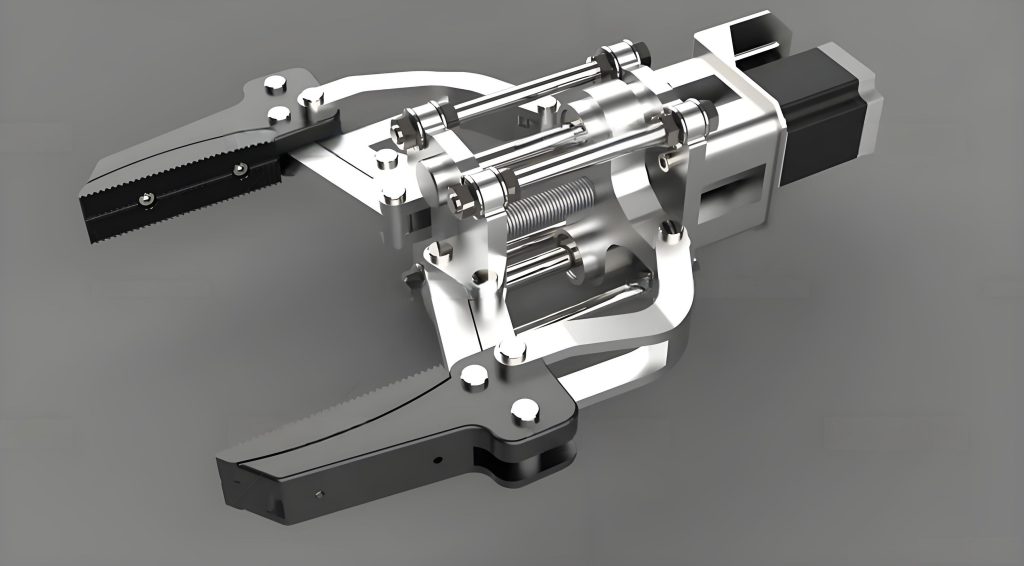
The end effector consists of several modules: a clamping module, a cutting module, a power output module, internal structural connectors, and a camera mount for integration with vision systems. The clamping module uses two rotating fingers to grip the rose stem, while the cutting module employs two blades that mesh together to cut the stem. The power output module is driven by a motor, which transmits torque through gears and linkages to synchronize the clamping and cutting actions. This integrated approach allows for simultaneous gripping and cutting, streamlining the harvesting process and improving efficiency. The end effector’s design leverages a gear and连杆 mechanism to ensure that the blades complete the cut before the clamp fully closes, preventing instances where the stem is gripped but not severed.
To analyze the performance of the end effector, I examine the force transmission during the harvesting action. The力矩传递 involves a motor-driven gear system, where the driving gear rotates to engage with transmission gears connected to the clamping fingers and blade holder. The传动比 between the gears determines the torque amplification. For instance, if the driving gear has 17 teeth and the transmission gear has 24 teeth, the传动比 is calculated as: $$n = \frac{24}{17} \approx 1.41$$ This ratio affects the torque required from the motor to achieve the necessary cutting force. Assuming the blades need a force of 100 N to cut the rose stem, and the distance from the transmission gear to the blade tip is 200 mm, the torque at the transmission gear can be estimated using the formula: $$M = F \times L$$ where \(M\) is the torque, \(F\) is the force, and \(L\) is the lever arm. For the blade contact point, when the angle \(\phi\) is near zero, the torque is: $$M = 100 \, \text{N} \times 0.2 \, \text{m} = 20 \, \text{N} \cdot \text{m}$$ Given the传动比, the motor must provide a torque of: $$M_{\text{motor}} = \frac{M}{n} = \frac{20}{1.41} \approx 14.1 \, \text{N} \cdot \text{m}$$ To ensure reliability, a motor with a rated torque of 25 N·m is selected, which exceeds the requirement and accounts for potential losses or variations in operation.
The harvesting sequence of the end effector can be summarized in three stages: approach, clamping and cutting, and retrieval. Initially, the end effector is positioned near the rose stem using guidance from a depth camera. The clamping fingers are open, and the blades are separated. Upon activation, the motor drives the gears to close the fingers and blades simultaneously. As the fingers move inward, the blades make contact with the stem first, severing it before the fingers fully grip. This ensures that the rose is cut cleanly and held securely without additional steps. The synchronization is achieved through the linkage design, which coordinates the motion of the clamping and cutting modules. The advantages of this end effector include reduced harvesting time, minimal damage to the rose, and adaptability to dense rose fields due to its compact size.
To validate the structural integrity of the end effector, finite element analysis (FEA) is conducted on critical components, particularly the blades, using ANSYS software. The blades are subjected to static loads simulating the cutting force. For a force of 100 N applied to the blade edge, the deformation and stress distribution are analyzed. The initial design shows a maximum deformation of 0.007695 mm, which, while small, could lead to fatigue failure under repeated cycling. To optimize the blade structure, the thickness is increased by 2 mm, and the analysis is repeated. The results indicate a reduced maximum deformation of 0.002893 mm, enhancing durability and reliability. The material properties used in the analysis are summarized in Table 1, which includes parameters for common blade materials such as 65Mn steel.
| Material | Young’s Modulus (GPa) | Yield Strength (MPa) | Poisson’s Ratio |
|---|---|---|---|
| 65Mn Steel | 210 | 785 | 0.3 |
| Stainless Steel | 200 | 690 | 0.3 |
The FEA process involves meshing the blade geometry, applying boundary conditions, and solving for displacements and stresses. The governing equation for linear static analysis is: $$\sigma = E \epsilon$$ where \(\sigma\) is stress, \(E\) is Young’s modulus, and \(\epsilon\) is strain. For the blade under load, the von Mises stress is calculated to assess yielding risk. The optimized blade design shows a safety factor above 2, indicating adequate strength for repetitive harvesting tasks. Additionally, modal analysis is performed to evaluate vibration characteristics, ensuring that the end effector operates smoothly without resonance issues that could affect precision.
Further design considerations for the end effector include the selection of components for the power transmission system. The齿轮 system must be designed to minimize backlash and ensure precise motion control. The gear parameters are detailed in Table 2, which outlines the specifications for the driving and transmission gears. These gears are made of hardened steel to withstand the torque and wear from frequent use.
| Gear Type | Number of Teeth | Module (mm) | Material |
|---|---|---|---|
| Driving Gear | 17 | 2 | Hardened Steel |
| Transmission Gear | 24 | 2 | Hardened Steel |
The连杆 mechanism in the end effector converts rotational motion from the gears into linear or angular movements for the clamping fingers and blades. The design uses a four-bar linkage to achieve the desired trajectory. The kinematic analysis involves calculating the positions and velocities of the linkage points. For a given input angle \(\theta\) from the gear, the output displacement of the clamping finger can be derived using vector loop equations: $$\vec{r_1} + \vec{r_2} = \vec{r_3} + \vec{r_4}$$ where \(\vec{r_1}\) to \(\vec{r_4}\) represent the link vectors. Solving these equations allows for optimization of the linkage dimensions to maximize grip force and cutting accuracy. The end effector’s performance metrics, such as clamping force and cutting speed, are summarized in Table 3 based on simulation results.
| Metric | Value | Unit |
|---|---|---|
| Clamping Force | 50-100 | N |
| Cutting Force | 100 | N |
| Harvesting Cycle Time | 2-3 | seconds |
| Motor Power | 50 | W |
Integration with machine vision systems is crucial for the end effector to autonomously locate and target roses. The camera mount on the end effector accommodates a depth camera that provides 3D coordinates of rose stems. The vision algorithm processes images to identify stem positions and orientations, guiding the robotic arm to align the end effector accurately. The coordination between vision and actuation involves real-time feedback loops, where the end effector adjusts its position based on camera data. This enhances the precision of the harvesting process, reducing miss rates and damage to adjacent plants.
In terms of control, the end effector uses a microcontroller to manage the motor driver and sensor inputs. The control strategy involves position control for the clamping and cutting actions, with potentiometers or encoders providing feedback on finger and blade positions. The control law can be expressed as: $$u(t) = K_p e(t) + K_i \int e(t) dt + K_d \frac{de(t)}{dt}$$ where \(u(t)\) is the control signal, \(e(t)\) is the error between desired and actual positions, and \(K_p\), \(K_i\), \(K_d\) are PID gains. Tuning these gains ensures smooth and rapid response during harvesting. The end effector’s reliability is further tested through fatigue analysis, simulating thousands of harvesting cycles to predict lifespan and maintenance needs.
Environmental adaptability is another key aspect of the end effector design. Rose fields often have varying stem diameters and densities, so the end effector must accommodate these variations. The clamping fingers are designed with compliant tips to grip stems of different sizes without causing damage. Additionally, the blades are self-sharpening or replaceable to maintain cutting efficiency over time. The end effector’s materials are selected for corrosion resistance, considering outdoor conditions with humidity and temperature fluctuations.
Comparative analysis with other end effector types highlights the advantages of the integrated clamping and cutting design. Traditional end effectors may use separate mechanisms for gripping and cutting, leading to larger sizes and slower operation. Non-contact methods, such as suction or laser cutting, can be less effective for delicate roses due to potential damage or energy requirements. The proposed end effector balances simplicity, cost, and performance, making it suitable for widespread adoption in rose farming. Future improvements could involve incorporating sensors for force feedback to adjust gripping pressure dynamically, or using lightweight composites to reduce weight and energy consumption.
In conclusion, the design and analysis of this rose harvesting robot end effector demonstrate a viable solution for automated rose harvesting. The end effector integrates clamping and cutting functions into a compact, single-power-source system, ensuring efficient and damage-free operation. Through力矩传递 analysis and finite element optimization, key components like blades are enhanced for durability. The end effector’s compatibility with machine vision and control systems enables precise autonomous harvesting, addressing labor shortages in agriculture. Continued research will focus on field testing and refinement to further improve the end effector’s performance and adaptability in real-world rose cultivation environments.