
As a core functional terminal in humanoid robots, the dexterous robotic hand has seen rapid development in recent years, driven by industry advancements that continuously push functional boundaries. However, the morphological expression of the dexterous robotic hand, as a critical component of human-robot interaction, has not received attention commensurate with its value. In this article, we propose an innovative morphological design method for dexterous robotic hands. This method leverages Kansei Engineering for quantitative analysis of perceptual descriptions, establishes aesthetic templates, and facilitates engineering transformation. It explores the connection between artistic anatomy principles and the morphological design of dexterous robotic hands, applying these insights to the design of form, proportion, structure, and other morphological elements. The dexterous robotic hand developed based on this method achieves a significant enhancement in visual aesthetics while maintaining functional reliability.
We begin by addressing the current state of dexterous robotic hand design. Existing dexterous robotic hands often suffer from issues such as bulky shapes, disproportionate ratios, oversized dimensions, and structural distortions. These problems are evident when comparing prominent dexterous robotic hands with a 190-mm-long male human hand. Morphology is not merely about external appearance; it is intrinsically linked to internal structure. Current research on robot design frequently focuses on external form, color, and texture, neglecting the inherent unity between structure and morphology. For the morphological design of humanoid robotic hands, there is a notable gap in academic methodology. In broader industrial design, the common approach for complex objects is to first determine functional structural modules and then proceed with外观 design. This sequential process often lacks cross-disciplinary collaboration, leading to compromises in aesthetics for functionality. The fusion of artistic aesthetics and scientific technology has long been advocated in industrial design, but dexterous robotic hands have yet to achieve a good balance between beauty and engineering. This stems from the subjective and qualitative nature of aesthetic evaluations, which hinders their transformation under strict technical constraints and scientific objectivity requirements.
The challenge of transforming aesthetics into engineering is multifaceted. First, the aesthetic evaluation of hand morphology is highly perceptual. The hand, with its vast range of motion, serves as a “touch of emotion” in artistic expressions, often depicted with exaggerated or emphasized features based on subjective experience. Second, engineering technology is grounded in scientific objectivity and faces numerous implementation constraints, such as spatial limitations and performance trade-offs. Engineering processes rely on experimental data, theoretical models, and computational validation, eschewing subjective assumptions. The core difficulty lies in quantifying perceptual aesthetics and translating them into engineering specifications. The key is to identify the major obstacles to this transformation and achieve a high evaluation in both aesthetic standards and engineering performance.
To address these challenges, we developed a method that integrates artistic anatomy principles with engineering design. We observed that engineering techniques abstract core biomechanical functions like grasping and manipulation from hand anatomy, simplifying bone and tendon networks into drivable joint structures and rotation mechanisms. This abstraction parallels the approach of artistic anatomy, which distills the essential forms and structures of the human hand for expressive purposes. Both methods do not seek literal replication but rather extract fundamental principles. Thus, we hypothesized that the aesthetic insights from artistic anatomy could be applied to the morphological design of dexterous robotic hands.
We employed Kansei Engineering to quantitatively analyze perceptual descriptions. In service scenarios, the亲和力 of a robot’s form is crucial. To differentiate dexterous robotic hands from the cold, mechanical feel of industrial robot end-effectors, we focused on “beauty and亲和力.” We selected eight existing dexterous robotic hand samples and conducted a survey using the semantic differential method. Thirty participants rated each sample on a five-point Likert scale from -10 (no beauty or亲和力) to 10 (excellent beauty and亲和力). The overall scores were low, indicating general dissatisfaction. From this, we extracted higher-scoring samples (8, 4, 5, and 3) for a second round of testing. Through questionnaires, we identified key factors affecting morphological evaluation, which were consolidated into four elements: (1) proportion, (2) external form, (3) construction, and (4)运动仿生. These elements point to the ultimate requirement of “high anthropomorphic仿生度.” Users evaluate dexterous robotic hand morphology by comparing it to the human hand, a biological reference. This aligns with the trend toward more human-like dexterous robotic hands in both engineering and aesthetics.
The four elements confirmed our hypothesis: artistic anatomy principles can be effectively translated into dexterous robotic hand design. Using the Analytic Hierarchy Process (AHP), we derived engineering transformation indicators from these perceptual descriptions. The process involved hierarchical expansion from基层 to指标层, as summarized in Table 1.
| Layer | Description | Details |
|---|---|---|
| Base Layer | Beauty and亲和力, High Anthropomorphic仿生度 | Core goals for the dexterous robotic hand |
| Indicator Layer | High Integration | Overall requirement for compact design |
| Decomposition Layer | Proportion,外观, Structure | Key aspects derived from survey |
| Element Layer | Proportion, External Form, Construction, Motion仿生 | Specific factors influencing morphology |
| Cognition Layer | Artistic Anatomy Abstraction Methods | Theoretical basis for design |
| Guidance Layer | Proportional Relationships and Aesthetic Template, Hard Materials, Non-contrasting Colors, Anthropomorphic Forms and Joint Structures, “Dexterity,” Direct Force Transmission, Built-in Actuation | Design directives for the dexterous robotic hand |
| Expansion Layer | Golden Ratios for Whole Hand and Parts, Balanced Male-Female Hand Characteristics, Abstracted Geometric Joint Axes, Simulated Muscle-Tendon Stretch, Simulated Bone Joint Motion | Detailed design considerations |
| Technical Layer | Finger Length, Palm Length and Width/Thickness, Trends in Phalange Dimensions and Diameters, Palm Arc and Surface Curvatures, Male Hand Robustness, Female Hand Slenderness, Non-orthogonal to Orthogonal Joint Axis Conversion, Mapping Degrees of Freedom, Abstracted Linkages and Levers, Full Active Distributed Actuation, Simplified Roll-Slide to Rotation Motion | Engineering implementations |
| Index Layer | Data Extraction, Verification, and Calibration | Quantifiable metrics for the dexterous robotic hand |
From this analysis, the major obstacle to engineering transformation emerged: high-density integration of the actuation system within a small space. To tackle this, we first constructed a standard hand aesthetic template (hereafter “aesthetic template”) as a 3D digital model. This template, guided by artistic anatomy principles and engineering feasibility, systematically characterizes form from整体到局部. Key dimensions include setting the hand length to 190 mm, equivalent to an adult male hand, and balancing male and female hand characteristics for a universal aesthetic. The aesthetic template provides a foundation for subsequent design, reducing coordination difficulties between engineering and aesthetics.
The design and fabrication phase focused on solving high-density integration. We followed a step-by-step process that applied artistic anatomy abstraction to structural design. Step 1 involved translating complex motions and geometrically重构 complex joints. For instance, the “rolling + sliding” motion of human hand joints was abstracted into rotational motion for engineering implementation, as shown in the formula for motion conversion:
$$ \text{Complex Motion} \rightarrow \text{Rotational Motion: } \theta = f(\phi, \psi) $$
where $\theta$ represents the joint rotation angle, and $\phi$ and $\psi$ are original motion parameters. Similarly, non-orthogonal joint axes of the metacarpophalangeal joints were simplified to orthogonal axes to preserve key flexion and abduction features while meeting engineering constraints. Step 2 entailed joint mapping guided by distributed actuation. The human hand relies on distributed muscles and tendons for versatile movements. We mapped human hand joints to 22 degrees of freedom (DoFs), with 6 dual-DoF joints and 10 single-DoF joints, fully actuated by 22 motor modules in a distributed manner. Compared to mixed active-passive systems like Tesla Optimus, this design minimizes coupling interference. The DoF mapping can be expressed as:
$$ \text{Total DoFs} = \sum_{i=1}^{6} 2 + \sum_{j=1}^{10} 1 = 22 $$
Step 3 involved避空处理 inspired by joint decoupling characteristics. For example, the fifth metacarpal was独立出来 to allow inward flexion during grasping, with避空 in the palm area to prevent interference. This仿生优化 is often overlooked in existing dexterous robotic hands. Step 4 integrated mechanisms and机电 systems. We designed仿生 joint运动链系 using “mortise-and-tenon” configurations to map joint morphology and function. Actuation units were topologically optimized for compact arrangement, mimicking muscle-tendon dynamics. Electrical wiring was布局 based on human joint ligament distribution, enhancing space utilization and visual coordination. A comparison of dimensions with other dexterous robotic hands is shown in Table 2.
| Product | Length (mm) | Notes |
|---|---|---|
| Shadow Hand | ~220 | External actuation |
| DexHand | ~210 | Compact design |
| Our Dexterous Robotic Hand A | 190 | High-density integration |
Step 5 involved fine-tuning and finalization. We optimized surface continuity, checked for motion interference via simulation, and ensured stress-free贴合 of electronic skin. After validation, all functional indicators were met, and the dexterous robotic hand A was finalized.
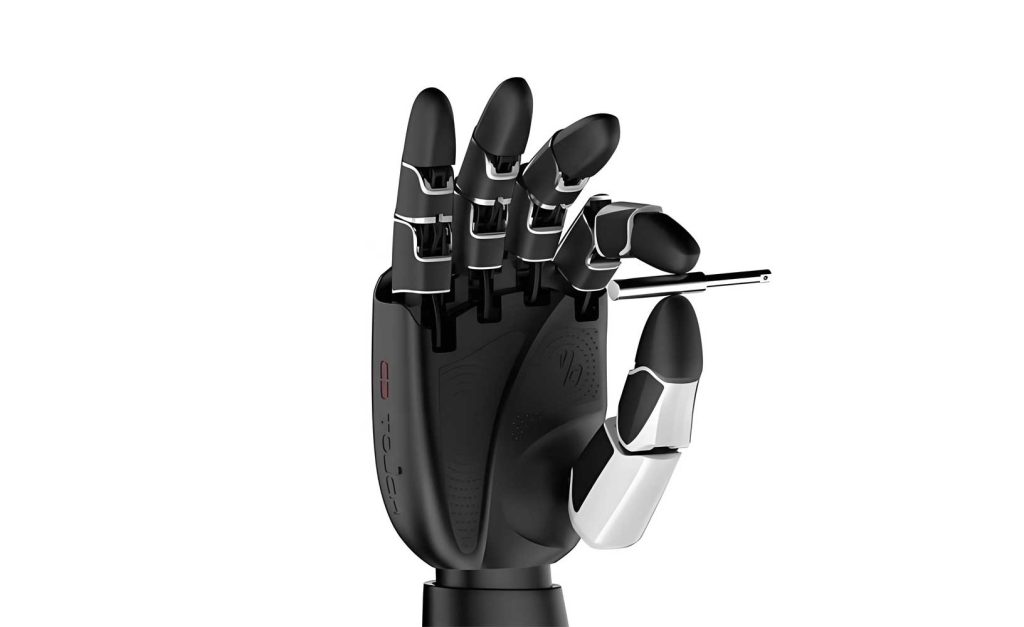
The resulting dexterous robotic hand A is a functional end-effector for精细操作 scenarios,兼容 with humanoid robots or multi-axis manipulators. It boasts high DoFs, anthropomorphic design, and intelligent control, with applications in research, education, service, industrial assembly, healthcare, space exploration, rescue, and creative arts. After completion, we conducted another survey using the semantic differential method, comparing dexterous robotic hand A with the four higher-scoring samples from the initial study. Twenty participants rated them on the same Likert scale for “beauty and亲和力.” dexterous robotic hand A scored significantly higher, demonstrating superior morphological expression. The dexterous robotic hand A was officially released at the IEEE International Conference on Robotics and Automation (ICRA 2025), where it received widespread acclaim from international attendees. Its performance metrics are competitive, with standout features in size, full active DoFs, dynamic tactile sensing, and distributed built-in actuation, as summarized in Table 3.
| Product | DoFs | Actuation Method | Sensing | Output Force | Speed | Precision | Sensitivity |
|---|---|---|---|---|---|---|---|
| Shadow Hand | 20 active, 4 passive | Distributed, external | Tactile | N/A | N/A | N/A | N/A |
| DH2012 | 12 active, 8 passive | Mixed, built-in | Tactile | 15 kg | N/A | N/A | N/A |
| Unitree Dex5 | 16 active, 4 passive | Mixed, built-in | Tactile | N/A | N/A | N/A | N/A |
| Zhiyuan | 12 active, 7 passive | Mixed, built-in | Vision, tactile | N/A | N/A | N/A | N/A |
| MagicHand S01 | 11 active | Centralized, built-in | Current, tactile | 5 kg | N/A | N/A | N/A |
| XHAND1 | 12 active | Centralized, built-in | N/A | 80 N/hand, 20 kg load | N/A | N/A | N/A |
| DH-ROBOTICS | 6 active, 5 passive | Centralized, built-in | Force sensing | N/A | N/A | N/A | N/A |
| eHand-6 | 6 active | Centralized, built-in | Tactile | 10 N/hand, 5 kg load | N/A | N/A | 3N-10N dynamic force control |
| RH56E2 | 6 active | Centralized, built-in | Tactile, force | 30 N/fingertip | N/A | ±0.2 mm repeatability | N/A |
| Zhaowei | 17 active | Centralized, built-in | N/A | N/A | N/A | N/A | N/A |
| Our Dexterous Robotic Hand A | 22 active | Distributed, built-in | Dynamic Tactile Array (DTA) | 20 N/fingertip | 4 Hz/s | 1 mm spatial resolution | 6,000 pressure levels, 180 Hz frame rate |
In conclusion, the morphological design method for dexterous robotic hands based on artistic anatomy principles employs a parallel,交叉, and nested approach that integrates engineering and aesthetics. This method elevates aesthetic cognition beyond mere imitation, transforming formal aesthetic规律 into core engineering logic. It finds a巧妙 balance between rigorous engineering and perceptual expectations of beauty. Future work should expand the research scope, deepen methodologies, and conduct long-term dynamic follow-ups. The dexterous robotic hand A exemplifies how such integration can yield a dexterous robotic hand that excels in both form and function, paving the way for more harmonious human-robot interaction. Through this process, we have demonstrated that a dexterous robotic hand can achieve high performance while embodying aesthetic qualities that resonate with users, making the dexterous robotic hand not only a tool but also a visually appealing interface.
The development of the dexterous robotic hand A involved numerous iterations and validations. We continuously refined the design based on feedback from both engineering tests and aesthetic evaluations. For instance, the proportion calculations were derived from artistic anatomy principles, such as the golden ratio applied to finger segments. This can be expressed as:
$$ \text{Finger Segment Ratio: } \frac{L_{\text{proximal}}}{L_{\text{middle}}} \approx \phi, \quad \phi = \frac{1+\sqrt{5}}{2} $$
where $\phi$ is the golden ratio. Similarly, the掌弧 curvature was optimized using parametric equations to ensure smooth transitions. The actuation force distribution was modeled to simulate human hand dynamics, with the output force per motor given by:
$$ F_i = k \cdot \tau_i \cdot \eta, \quad \sum_{i=1}^{22} F_i \geq F_{\text{required}} $$
where $F_i$ is the force at joint $i$, $k$ is a constant, $\tau_i$ is the motor torque, and $\eta$ is efficiency. These engineering considerations were balanced with aesthetic goals, such as maintaining slender profiles and natural postures. The dexterous robotic hand A’s success underscores the importance of interdisciplinary collaboration in robotics design. By bridging art and science, we have created a dexterous robotic hand that not only performs tasks reliably but also engages users emotionally. This approach can be extended to other robotic components, fostering innovation in the field. The dexterous robotic hand stands as a testament to the potential of融合 design philosophies, and we anticipate that future dexterous robotic hands will continue to evolve along these lines, becoming more intuitive and human-centric.