
The China National Intellectual Property Administration has published a design patent for a humanoid robot held by BYD Co., Ltd., marking the first time the automaker has disclosed a complete patent document for a self-developed humanoid robot. The disclosure places the vehicle manufacturer at the center of a rapidly widening contest in embodied intelligence, where automotive engineering, supply chain capacity and artificial intelligence are converging on the humanoid robot as the next major product platform. The patent, together with a set of previously disclosed performance figures and a clearly sequenced deployment plan, suggests that the humanoid robot has moved from an internal research topic onto BYD’s productization pipeline.
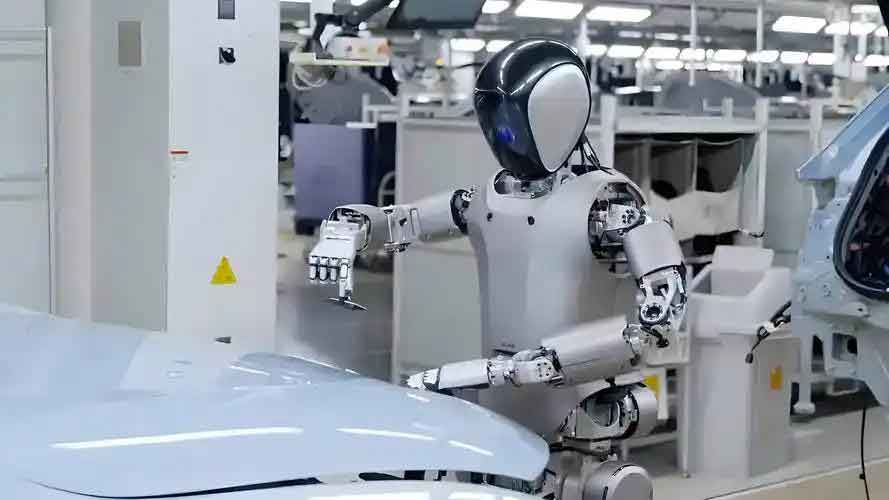
- Patent Filing Details a Humanoid Robot Built for Walking, Balance and Interaction
According to the brief description accompanying the design patent, the product covered by the filing is an intelligent humanoid robot equipped with walking, balance and interaction functions. The document states that the design may be applied to service robots, education scenarios and industrial settings. The patent lists a filing date of April 30, 2026, and an authorization announcement date of October 6, 2026. The publication of the design patent gives the market its first complete, formally filed view of the exterior of BYD’s humanoid robot, and it is the first time the company’s self-developed humanoid robot has been presented to the public in the form of a full patent file.
Design patents cover appearance rather than engineering architecture, so the document does not disclose actuators, sensors, control boards or software stacks. Even so, the publication of a design patent is a meaningful signal in the humanoid robot sector. Companies typically file design patents only when a humanoid robot has advanced far enough to have a stabilized industrial design and a plausible route to production. For observers of the humanoid robot industry, the appearance of a complete patent file is therefore less about aesthetics and more about timing: it indicates that the humanoid robot has crossed from concept studies into a formalized product development process.
The patent describes a humanoid robot intended for mixed use across service, education and industrial applications, a positioning that matches the broader direction of the embodied intelligence sector. Most humanoid robot programs now begin in structured environments where tasks repeat and where data can be collected consistently, before extending into semi-structured commercial spaces and, eventually, into homes. The framing of the patent suggests that BYD’s humanoid robot is designed with that same progression in mind, rather than being aimed immediately at the consumer market.
- Disclosed Specifications Place the Humanoid Robot in the Mid-Size Service Class
Although the physical humanoid robot has not yet appeared in public, a set of core parameters has already been released through official channels. The humanoid robot stands 1.61 meters tall and weighs 58.5 kilograms. It has 31 degrees of freedom across the body, and its dexterous hands achieve repeat positioning accuracy of plus or minus 1 millimeter. The humanoid robot uses a core component commonality rate of more than 60 percent, while the self-development rate of core components reaches 80 percent. It runs on the BYD RobotOS 1.0 operating system, and its end-to-end control latency is below 50 milliseconds.
| Parameter | Disclosed Figure | What It Signals for the Humanoid Robot |
|---|---|---|
| Height | 1.61 meters | Mid-size humanoid robot suited to factory workstations and retail floors |
| Weight | 58.5 kilograms | Comparable to adult human mass; relevant for safety and mobility |
| Degrees of freedom | 31 | Whole-body motion capability for walking, balance and manipulation |
| Dexterous hand repeat positioning accuracy | Plus or minus 1 millimeter | Precision handling for assembly, inspection and service tasks |
| Core component commonality rate | Above 60 percent | Shared parts across units as a lever for scale cost reduction |
| Self-development rate of core components | 80 percent | Deeper control over cost, supply and iteration cycles |
| Operating system | BYD RobotOS 1.0 | A dedicated software stack for the humanoid robot platform |
| End-to-end control latency | Under 50 milliseconds | Responsiveness for balance control and real-time interaction |
These figures describe a humanoid robot that is engineered for practical deployment rather than demonstration. A height of 1.61 meters and a weight of 58.5 kilograms keep the humanoid robot within the envelope of existing factory workstations, doorways, shelving and vehicle interiors, which matters because the first wave of humanoid robot deployments is expected to happen in environments originally designed for people. The 31 degrees of freedom give the humanoid robot enough whole-body articulation to walk, balance and manipulate objects, while the millimeter-level repeat positioning accuracy of the dexterous hands points to tasks that require consistency rather than raw strength.
The two most commercially significant figures are the commonality rate and the self-development rate. A core component commonality rate above 60 percent means that a large share of the humanoid robot’s parts can be shared across units and potentially across product generations, which is the standard precondition for cost reduction at scale. A core component self-development rate of 80 percent gives BYD control over the design, supply and iteration of the majority of the humanoid robot’s critical parts. Together, these two numbers describe a humanoid robot program that is being built with manufacturing economics in mind from the beginning, rather than as a research demonstrator to be re-engineered later.
- Executive View: The Humanoid Robot Contest Rests on Manufacturing, Software and Hardware
BYD executive vice president Li Ke has previously framed the competition in robotics in straightforward terms, saying that the contest over robots comes down to who has the strongest manufacturing capability, software capability and hardware capability. Li Ke also noted that automotive-related artificial intelligence and robotics share the same origin. If the humanoid robot can one day enter households, Li Ke said, BYD’s humanoid robot could be sold through the company’s dealer network.
That statement captures the strategic logic behind the humanoid robot program. Automotive manufacturing and humanoid robot manufacturing draw on overlapping competencies: precision mechanical assembly, motor and actuator production, battery and power management, sensor integration, thermal management, quality control at volume, and a supplier base accustomed to tight cost targets. The same overlap applies on the software side, where perception, planning, control and simulation for autonomous driving share mathematical foundations with the perception, planning, control and simulation required by a walking, balancing humanoid robot.
The reference to the dealer network is equally important for the commercial path of the humanoid robot. A vehicle dealer network is a ready-made channel of physical locations, trained staff, service capacity and customer traffic. If the humanoid robot is deployed first inside those locations as a working device, the network becomes both a proving ground and a sales floor at the same time, allowing the same footprint to be used for validation, demonstration and distribution of the humanoid robot.
- Deployment Sequence: Factory First, Stores Second, Homes Later
The published plan for the humanoid robot follows a deliberate order. BYD intends to first place the humanoid robot in its own factories to replace high-intensity, repetitive positions on production lines. The humanoid robot would then move into stores, with the stated target of placing two to three humanoid robots in each dealer outlet.
Wang Hangyu, a researcher who has long worked on embodied intelligence, said in an interview that the first publication of the design patent means BYD has already pushed the humanoid robot into its productization pipeline. Wang said he pays more attention to the order in which BYD has arranged the humanoid robot’s deployment: first into its own factories to absorb high-intensity repetitive positions, and then into dealer stores. Factory scenarios are relatively structured, data can be closed-loop, and the cost of trial and error is controllable, Wang said, which makes this route far more pragmatic than charging directly at the home scenario.
Wang argued that BYD’s underlying advantages lie in the supply chain capability and cost control experience accumulated through whole-vehicle manufacturing, together with the 80 percent self-development rate of core components. With a hardware commonality rate above 60 percent, Wang said, the company already has a concrete lever for cost reduction at scale. Hardware can be reused directly, he noted, but the intelligence layer must be accumulated from scratch, fed day by day through algorithm iteration and scenario data. Appearance and specifications amount to no more than a ticket to entry, according to Wang; whether a humanoid robot can withstand the unpredictable situations that appear once it enters a store will become clear within about half a year.
The distinction Wang draws between hardware reuse and software accumulation is central to how the humanoid robot race is likely to unfold. A vehicle manufacturer can transfer manufacturing discipline, supplier relationships and cost engineering to the humanoid robot almost immediately. It cannot transfer a mature embodied intelligence stack in the same way, because the humanoid robot must learn to operate in spaces where objects move, people behave unpredictably and tasks vary from one encounter to the next. That learning process depends on real deployment, real failures and real data, which is precisely why the factory-first sequence matters for the humanoid robot.
- A Structured Factory Floor Offers the Humanoid Robot a Controlled Learning Environment
A vehicle assembly plant is an unusually favorable first environment for a humanoid robot. Workstations are fixed, parts arrive on schedule, lighting is controlled, and tasks repeat thousands of times per shift. Success and failure are both measurable, and any deviation can be traced to a specific step in a specific cycle. For a humanoid robot still building its control policies and manipulation skills, this structure reduces the number of variables the system must handle at once.
Factories also place the humanoid robot under the supervision of the same organization that builds it. Engineering teams can observe the humanoid robot at close range, adjust tasks, refine the hardware and push software updates on a short cycle. The high-intensity repetitive positions that BYD has identified as the first target are also the positions where human labor is hardest to sustain over long periods, which gives the humanoid robot a clear value proposition from the outset rather than a speculative one.
Dealer stores represent the next level of difficulty. A showroom floor is semi-structured: the layout is known, but customers are not. A humanoid robot in a store must handle greeting, guidance, demonstration and simple question answering while navigating around visitors who may stand in unexpected places or ask unexpected questions. The task set is broader than in a factory, the tolerance for error is narrower, and the humanoid robot is visible to the public throughout. Moving from the factory to the store is therefore a meaningful escalation rather than a simple change of address.
The home remains the most demanding environment of all, and the published plan treats it as a later stage. Homes combine clutter, uneven surfaces, unpredictable human behavior and high safety expectations. The reference to selling a humanoid robot through the dealer network if it can one day enter households describes an end state rather than a near-term target, and it underlines how long the road from factory floor to living room is likely to be for any humanoid robot program.
- Embodied Intelligence Build-Out Extends Beyond the Patent
BYD’s activity in embodied intelligence did not begin with this design patent. The company established an embodied intelligence research team in 2022. In 2023 it took a strategic stake in AgiBot. In 2025 it invested in the tactile sensing company Paxini Sensory Technology and became its second-largest shareholder.
| Year | Milestone in the Humanoid Robot and Embodied Intelligence Build-Out |
|---|---|
| 2022 | Embodied intelligence research team established |
| 2023 | Strategic investment in AgiBot |
| 2025 | Investment in Paxini Sensory Technology, becoming its second-largest shareholder |
| 2026 | Design patent for a humanoid robot filed on April 30 and announced as authorized on October 6 |
Read together, these steps describe a layered approach to the humanoid robot. An internal research team builds core competence. A strategic stake in a humanoid robot developer provides visibility into an external program and its talent pool. An investment in tactile sensing addresses one of the hardest technical problems in the field, because a humanoid robot that cannot feel contact cannot safely manipulate objects around people. The design patent then adds the industrial design layer that a humanoid robot needs before it can be manufactured, marketed and sold.
The tactile sensing investment deserves particular attention in the context of the humanoid robot’s stated accuracy figures. Repeat positioning accuracy of plus or minus 1 millimeter describes where the hand goes; tactile sensing describes what the hand feels once it arrives. Both are necessary for the kind of contact-rich manipulation that factory assembly, store demonstration and household assistance all require. Building or securing capability in both areas is consistent with the 80 percent self-development rate that BYD has disclosed for the humanoid robot’s core components.
- Automakers Are Becoming a Major Force in the Humanoid Robot Sector
The entry of large vehicle manufacturers is becoming a new force in the humanoid robot sector. A survey of public announcements shows that the deployment timelines of major automakers are converging on the same window, and that most of them are following a similar path from internal validation to commercial scenarios.
| Company | Humanoid Robot Program | Stated Status and Deployment Plan |
|---|---|---|
| Tesla | Third-generation humanoid robot | Planned for release at the end of 2026; the Fremont factory is converting Model S and Model X lines into humanoid robot lines, with a final planned annual capacity of one million units |
| BYD | Self-developed humanoid robot with a published design patent | Design patent filed April 30, 2026 and announced as authorized October 6, 2026; planned deployment begins in BYD factories, then moves to dealer stores at two to three units per outlet |
| XPeng | Next-generation IRON humanoid robot | Completed automated final assembly and walked off the line on September 8; production line officially opened; planned to enter volume production by the end of the year, starting in XPeng stores and campuses |
| GAC Group | Fourth-generation GoMate Mini humanoid robot from incubated company Huilun Technology | Nearly 50 units deployed in Guangzhou, Hong Kong, Xiamen and Tianjin, covering vehicle line inspection, campus security and subway security assistance |
| Chery | Humanoid robot from incubated company Mojia Robotics | Completed centralized delivery of 100 units and signed contracts for 1,000 units; deployed in stores for customer reception and vehicle introduction |
The comparison shows how quickly the humanoid robot has moved from laboratory demonstrations to structured commercial pilots. Tesla’s plan to convert existing vehicle lines into humanoid robot lines illustrates the scale advantage that an automaker can bring: a factory designed for high-volume vehicle production already contains much of the tooling, logistics and quality infrastructure that a humanoid robot line requires. The stated final planned annual capacity of one million units positions the humanoid robot as a volume product rather than a limited-run device.
XPeng’s IRON humanoid robot completed automated final assembly and walked off the line on September 8, and the company’s humanoid robot production line is now officially in operation. The plan calls for the humanoid robot to enter volume production by the end of the year, with the first deployments in XPeng stores and campuses. The fact that the humanoid robot walked off the line under its own control is a meaningful milestone, because it demonstrates that the unit passed assembly and basic functional validation as an integrated system rather than as a collection of separately tested subsystems.
GAC Group’s incubated company Huilun Technology has taken a different route with its fourth-generation GoMate Mini humanoid robot. Nearly 50 units have been deployed across Guangzhou, Hong Kong, Xiamen and Tianjin, covering vehicle production line inspection, campus security and subway security assistance. This spread of locations and tasks is notable because it exposes the humanoid robot to a wider range of environments than a single factory trial would, generating data across inspection, patrol and public-facing assistance work.
Chery’s incubated company Mojia Robotics has completed centralized delivery of 100 humanoid robots and signed contracts for 1,000 units, with the humanoid robot handling customer reception and vehicle introduction in stores. This is the closest parallel to BYD’s stated plan of placing two to three humanoid robots in each dealer outlet, and it suggests that the vehicle showroom is emerging as one of the first commercial venues where the humanoid robot can generate measurable value.
- Why the Vehicle Showroom Became an Early Home for the Humanoid Robot
The showroom is an attractive early deployment site for the humanoid robot for several reasons. Vehicle retail already depends on explanation, demonstration and guided interaction, tasks that a humanoid robot can partially absorb. Showrooms are open to the public, so a working humanoid robot generates direct marketing value in addition to performing a task. The environment is climate controlled and mapped in advance. Staff are present to intervene if the humanoid robot encounters a situation it cannot handle.
Deploying a humanoid robot in a showroom also produces a specific type of data that factory deployment cannot. Customer interactions are varied, repetitive in pattern but not in detail, and rich in natural language. A humanoid robot that spends months in a showroom accumulates a record of how people approach it, what they ask, how they move around it and where they expect it to be. That record is directly relevant to the long-term ambition of bringing a humanoid robot into the home, because it captures human behavior in an open, semi-structured space.
At the same time, the showroom raises the bar for reliability. A humanoid robot that fails in a factory delays a production step that can be recovered. A humanoid robot that fails in a showroom does so in front of customers. This is consistent with Wang Hangyu’s observation that whether a humanoid robot can withstand unpredictable situations in a store will become clear within about half a year, and that appearance and specifications alone count only as a ticket to entry.
- Hardware Reuse and the Software Gap Facing Every Humanoid Robot Program
The structural advantage that automakers bring to the humanoid robot is easiest to see in hardware. Motors, reducers, actuators, batteries, power electronics, sensors, wiring harnesses and structural components all have close relatives in vehicle manufacturing. A company that already produces these items at volume, with established quality processes and supplier relationships, can apply that capability to the humanoid robot with far less friction than a startup building a supply chain from zero.
The disclosed 80 percent self-development rate for core components and the commonality rate above 60 percent both point in this direction. They describe a humanoid robot whose bill of materials is largely under the control of the company that builds it, which shortens iteration cycles, reduces exposure to supplier bottlenecks and creates room to cut cost as volumes rise. For a humanoid robot intended to be placed by the thousand in dealer outlets and by the tens of thousands in factories, that control is a prerequisite rather than a bonus.
The software side is harder to compress. Embodied intelligence for a humanoid robot requires perception, spatial understanding, motion planning, balance control, manipulation, task reasoning and human interaction to work together in real time, and the control latency figure of under 50 milliseconds indicates how tight the timing budget is. The BYD RobotOS 1.0 system provides a dedicated platform for that work, but a platform is a foundation rather than a finished capability. The intelligence layer of the humanoid robot improves through repeated exposure to real tasks, which is why deployment sequence matters as much as engineering talent.
This is also where the factory-first strategy pays a second dividend. Every hour a humanoid robot spends on a production line produces structured data about failures, near-misses, cycle times and task variations. That data is the raw material for improving the humanoid robot’s control policies. A program that deploys a humanoid robot internally before selling it externally accumulates this material under controlled conditions, and it can adjust the humanoid robot before customers encounter it.
- What to Watch as the Humanoid Robot Moves Toward Market
The humanoid robot sector now has a clear set of signals that separate programs making real progress from programs making announcements. The first is the transition from a design patent to a physical unit. A published design patent confirms that a humanoid robot has a stabilized exterior and a formal product process behind it, but the appearance of a working humanoid robot in front of an audience is a different milestone. BYD’s humanoid robot was originally scheduled to appear as a physical unit at the Di Space venue in Zhengzhou in August, but the promotional material was withdrawn shortly afterwards and the planned public appearance did not take place. The humanoid robot has therefore not yet formally appeared before the public.
The second signal is the movement from a single demonstration to repeated work. A humanoid robot that completes a task once proves capability; a humanoid robot that completes the same task across thousands of cycles proves reliability. The deployment targets that BYD has published, first in its own factories and then at two to three units per dealer outlet, describe a path built around repetition rather than spectacle.
The third signal is cost. A humanoid robot priced for pilot programs and a humanoid robot priced for broad deployment are different products. The commonality rate above 60 percent and the self-development rate of 80 percent are the mechanisms through which a humanoid robot can move from the first category to the second, and the speed at which those mechanisms produce visible cost reduction will shape how quickly the humanoid robot reaches dealer showrooms at scale.
The fourth signal is the breadth of scenarios. GAC Group’s deployment of nearly 50 humanoid robots across four cities and multiple task types, Chery’s delivery of 100 humanoid robots into stores, and XPeng’s plan to place its humanoid robot in stores and campuses all indicate that the industry is testing the humanoid robot in a spread of environments rather than a single showcase. The program that accumulates the widest base of scenario data will be best positioned when the humanoid robot moves toward the home.
- A Cross-Industry Sample With Consequences for the Whole Sector
The publication of BYD’s humanoid robot design patent is a small administrative event with a larger meaning. It confirms that a company with deep manufacturing capacity, a mature supplier network, an established artificial intelligence effort and a nationwide retail footprint has committed to the humanoid robot as a product line rather than a research exercise. It also adds a concrete data point to the argument that the humanoid robot will be commercialized first by organizations that already know how to build complex machines at volume.
For the humanoid robot industry, the arrival of vehicle manufacturers changes the competitive baseline. Cost, reliability and manufacturing scale, which were once secondary considerations in a field dominated by research demonstrations, are now central. The humanoid robot is being evaluated against the standards of industrial production: cycle time, uptime, serviceability, spare parts availability and unit economics. Companies that cannot meet those standards will find it difficult to remain in the humanoid robot supply chain regardless of the sophistication of their demonstrations.
For BYD specifically, the next period will be defined by execution rather than disclosure. The humanoid robot must move from patent file to factory floor, from factory floor to dealer showroom, and from showroom to a broader commercial offering. The stated plan of placing two to three humanoid robots in each dealer outlet gives the program a measurable target, and the decision to begin with high-intensity repetitive positions in its own factories gives it a controlled starting point.
The wider field is moving at the same time. Tesla’s third-generation humanoid robot is planned for release at the end of 2026, with its Fremont factory converting existing vehicle lines into humanoid robot lines and a final planned annual capacity of one million units. XPeng’s IRON humanoid robot has already walked off an automated assembly line and is planned for volume production by the end of the year. GAC Group’s GoMate Mini humanoid robot is already working across four cities, and Chery’s Mojia humanoid robot has moved from delivery to contracted volume. Against that backdrop, the publication of BYD’s humanoid robot design patent is best read as the opening of a new phase rather than the conclusion of one.
The humanoid robot has spent years being described in terms of what it might eventually do. The current cycle of patent filings, production line openings, batch deliveries and store deployments is beginning to describe what the humanoid robot actually does, where it does it and at what cost. That shift, more than any single specification, is what will determine which humanoid robot programs become durable businesses and which remain engineering projects. BYD’s design patent places the company inside that transition, and the coming months of factory and showroom deployment will show how far the humanoid robot has actually traveled.