
In the field of precision mechanical systems, strain wave gears, also known as harmonic drives, are widely utilized for their high torque capacity, compact design, and excellent positional accuracy. However, during prolonged operation, these gears are susceptible to fatigue and crack formation in critical components such as the wave generator, flexspline, and output shaft. The presence of cracks significantly alters the torsional stiffness of the strain wave gear transmission system, impacting dynamic performance, vibration characteristics, and overall reliability. In this article, we develop a comprehensive methodology to compute the stiffness coefficient of strain wave gear drives when cracks are considered, integrating principles from fracture mechanics, material mechanics, and system dynamics. Our approach provides analytical formulas for flexibility and stiffness coefficients of each member, offering a practical tool for engineering calculations aimed at enhancing the design and maintenance of strain wave gear systems.
The torsional stiffness is a fundamental parameter in the dynamic modeling of strain wave gear transmissions, influencing natural frequencies, response to loads, and stability. Traditionally, stiffness calculations assume ideal, crack-free conditions, but in reality, cracks introduce additional compliance, reducing effective stiffness. We address this by deriving the total flexibility coefficient as the sum of individual flexibilities for the wave generator, flexspline, and output shaft, each modified to account for crack-induced additional compliance. Using fracture mechanics, we calculate stress intensity factors for different crack types and integrate them to obtain additional displacement and flexibility. This method allows us to quantify the degradation in stiffness due to cracks, enabling more accurate predictions of system behavior under real-world conditions.
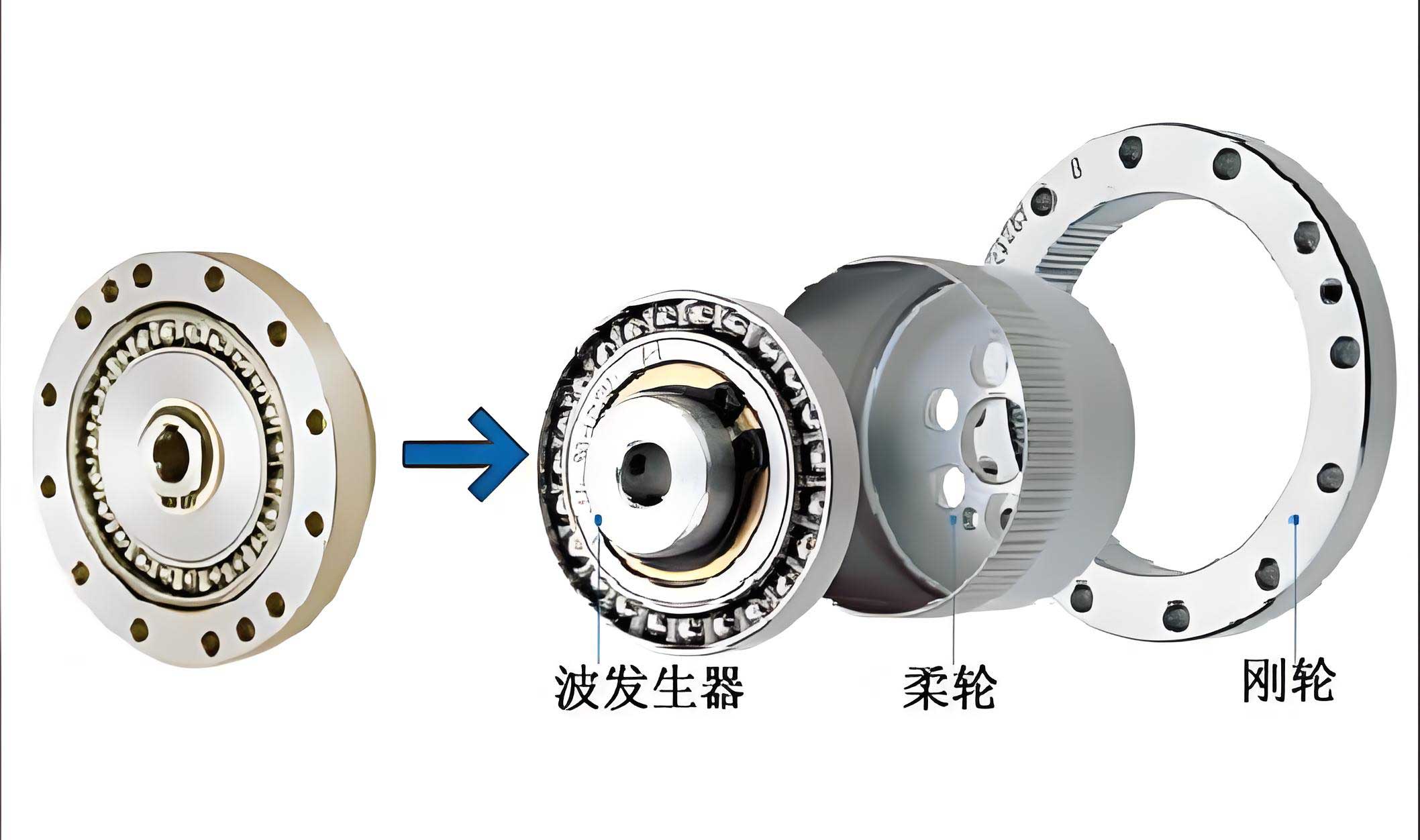
To begin, we define the overall torsional stiffness coefficient, denoted as \( K_{HD} \), which is the inverse of the total flexibility coefficient \( \lambda_{\sum} \). The total flexibility is the sum of the flexibility coefficients of the wave generator (\( \lambda_H \)), flexspline (\( \lambda_f \)), and output shaft (\( \lambda_{so} \)), as shown in the following equation:
$$ \lambda_{\sum} = \lambda_H + \lambda_f + \lambda_{so} $$
Thus, the stiffness coefficient is:
$$ K_{HD} = \frac{1}{\lambda_{\sum}} = \frac{1}{\lambda_H + \lambda_f + \lambda_{so}} $$
Here, \( \lambda_H \), \( \lambda_f \), and \( \lambda_{so} \) have units of rad/(N·mm), and \( K_{HD} \) is in N·mm/rad. When cracks are present, each component exhibits an additional flexibility term, \( \Delta \lambda \), derived from fracture mechanics. The energy release rate \( G \) for mixed-mode cracking is expressed as:
$$ G = \frac{K_I^2}{E’} + \frac{K_{II}^2}{E’} + \frac{K_{III}^2}{E'(1 – \nu)} $$
where \( K_I \), \( K_{II} \), and \( K_{III} \) are the stress intensity factors for Mode I, II, and III cracking, respectively; \( E’ \) is the generalized elastic modulus; and \( \nu \) is Poisson’s ratio. For a generalized load \( P \), the additional displacement \( \Delta u \) and additional flexibility \( \Delta \lambda \) are given by:
$$ \Delta u = \frac{\partial (\Delta U)}{\partial P} = \int_0^A \frac{G}{P} \, dA $$
$$ \Delta \lambda = \frac{2 \partial (\Delta U)}{\partial P^2} = \int_0^A \frac{2G}{P^2} \, dA $$
Since the stress intensity factors are proportional to the load, i.e., \( K_I/P \), \( K_{II}/P \), and \( K_{III}/P \) are functions of geometry only, we can simplify these integrals. For engineering applications, we focus on specific crack configurations in each component of the strain wave gear.
First, consider the wave generator, which typically consists of a cam or roller bearing assembly. Cracks often initiate in the bearing rings, particularly the inner ring, due to high stress concentrations. We model this as a semi-elliptical surface crack. The additional radial displacement \( \Delta u_H \) caused by a crack of depth \( a \) in the bearing inner ring is derived using Mode I stress intensity factor \( K_I \). For a radial load \( F_r \) on the wave generator, we have:
$$ K_I = 1.95 \sigma \sqrt{\frac{a}{Q}} $$
where \( \sigma \) is the circumferential stress in the inner ring, and \( Q \) is the surface crack parameter. The stress \( \sigma \) is approximated from the contact pressure due to \( F_r \), ignoring other effects for simplicity:
$$ \sigma = \frac{1}{2} \beta \sigma_{\text{max}}, \quad \sigma_{\text{max}} = \frac{3F_r}{2\pi a’ b’} $$
Here, \( \beta \) is a coefficient depending on the Hertzian contact ellipse dimensions \( a’ \) and \( b’ \), typically between 0.4278 and 0.5. Substituting into the integral for \( \Delta u_H \), we obtain:
$$ \Delta u_H = \frac{2}{E} \int_0^A K_I \frac{K_I}{F_r} \, dA = 0.217 t_i \left( \frac{\beta a}{a’ b’} \right)^2 \frac{F_r^2}{E Q} $$
where \( t_i \) is the thickness of the bearing inner ring. The additional radial stiffness coefficient \( \Delta K_G \) is then:
$$ \Delta K_G = \frac{F_r}{\Delta u_H} = \frac{E Q}{0.217 F_r t_i \left( \frac{\beta a}{a’ b’} \right)^2} $$
The radial stiffness without cracks, \( K_{G0} \), accounts for elastic deformations of the bearing rings, wave generator elements, and support shafts, calculated from standard mechanical formulas. The effective radial stiffness with cracks is \( K_G = K_{G0} – \Delta K_G \). This radial stiffness is converted to torsional flexibility relative to the output shaft using geometric relations. For a strain wave gear with wave number \( U \), radial displacement \( w_0 \), and transmission ratio \( i_h \), the torsional flexibility of the wave generator is:
$$ \lambda_H = \frac{k_r}{K_G} \cdot \frac{\pi}{2 d_1 U w_0 i_h} $$
where \( k_r \) is the force transmission coefficient, and \( d_1 \) is the pitch diameter of the flexspline.
Next, we analyze the flexspline, which is a thin-walled cylindrical shell prone to cracks originating at the tooth root and propagating at an angle. Under torque \( T \), the crack experiences mixed Mode I and II loading. The additional flexibility \( \Delta \lambda_f \) is calculated from:
$$ \Delta \lambda_f = \frac{2}{E} \int_0^A \left[ \left( \frac{K_I}{T} \right)^2 + \left( \frac{K_{II}}{T} \right)^2 \right] dA $$
For a small crack inclined at angle \( \beta = 45^\circ \), the stress intensity factors are:
$$ K_I = \tau \sin 2\beta \sqrt{\pi a} = \tau \sqrt{\pi a}, \quad K_{II} = \tau \cos 2\beta \sqrt{\pi a} = \tau \sqrt{\pi a} $$
with shear stress \( \tau = \frac{T}{2\pi r_m^2 \delta} \), where \( r_m \) is the mean radius of the undeformed flexspline, and \( \delta \) is the wall thickness at the tooth ring. Including a stress distribution non-uniformity coefficient \( K_u \) and dynamic load coefficient \( K_d \), and integrating over crack area \( dA = \delta \, da \), we get:
$$ \Delta \lambda_f = \frac{K_u K_d a^2}{2\pi E r_m^4 \delta} $$
The flexibility without cracks, \( \lambda_{f0} \), is derived from material mechanics for a cylindrical shell:
$$ \lambda_{f0} = \frac{k_r k_G c_L}{0.1 \mu \left[1 – (1 – 2c_\delta)^4\right] d_1^3} $$
where \( c_L = L/d_1 \) is the relative length of the flexspline cylinder, \( c_\delta = \delta/d_1 \) is the relative wall thickness, \( k_f \) is a shape coefficient (0.83 for bell-shaped, 1.0 for cylindrical), \( k_G \) is a structural coefficient (0.83 for cup-shaped, 1.0 otherwise), and \( \mu \) is the shear modulus. The total flexspline flexibility is \( \lambda_f = \lambda_{f0} + \Delta \lambda_f \).
For the output shaft, cracks are often circumferential and subject to combined tension and shear, leading to mixed Mode I and III cracking. The additional flexibility \( \Delta \lambda_{so} \) is:
$$ \Delta \lambda_{so} = \int_0^A \left[ \frac{2}{E} \left( \frac{K_I}{P} \right)^2 + \frac{1}{\mu} \left( \frac{K_{III}}{T} \right)^2 \right] dA $$
For a shaft with an outer diameter \( d_s \) and crack depth \( a \), the effective diameter is \( d_e = d_s – 2a \). The stress intensity factors for an annular crack under tensile load \( P \) and torque \( T \) are:
$$ K_I = M_p \frac{4P}{\pi d_e^2} \sqrt{\pi a}, \quad K_{III} = M_M \frac{16T}{\pi d_e^3} \sqrt{\pi a} $$
where \( M_p \) and \( M_M \) are geometry-dependent coefficients given by:
$$ M_p = 0.5 \left( \frac{d_e}{d_s} \right)^{1/2} + 0.25 \left( \frac{d_e}{d_s} \right)^{3/2} + 0.188 \left( \frac{d_e}{d_s} \right)^{5/2} + 0.182 \left( \frac{d_e}{d_s} \right)^{7/2} + 0.166 \left( \frac{d_e}{d_s} \right)^{9/2} $$
$$ M_M = 0.376 \left( \frac{d_e}{d_s} \right)^{1/2} + 0.188 \left( \frac{d_e}{d_s} \right)^{3/2} + 0.141 \left( \frac{d_e}{d_s} \right)^{5/2} + 0.117 \left( \frac{d_e}{d_s} \right)^{7/2} + 0.102 \left( \frac{d_e}{d_s} \right)^{9/2} + 0.078 \left( \frac{d_e}{d_s} \right)^{11/2} $$
Integrating with \( dA = 2\pi a \, da \), the additional flexibility becomes:
$$ \Delta \lambda_{so} = \frac{16 M_p^2 a^2}{\pi E d_e^4} + \frac{512 M_M^2 a^3}{3\mu d_e^6} $$
The crack-free flexibility of the output shaft, for a length \( L_s \), is:
$$ \lambda_{so0} = \frac{L_s}{0.1 \mu d_s^4} $$
and the total shaft flexibility is \( \lambda_{so} = \lambda_{so0} + \Delta \lambda_{so} \).
To illustrate the application of these formulas, we present a detailed example for a double-wave strain wave gear with specific parameters. This example demonstrates how cracks in each component affect the overall stiffness coefficient, emphasizing the importance of considering fractures in design analyses for strain wave gear systems.
| Component | Parameter | Symbol | Value | Unit |
|---|---|---|---|---|
| Strain Wave Gear System | Transmission Ratio | \( i_h \) | 100 | – |
| Radial Displacement | \( w_0 \) | 0.8 | mm | |
| Pitch Diameter | \( d_1 \) | 160 | mm | |
| Flexspline Wall Thickness | \( \delta \) | 2.24 | mm | |
| Flexspline Length | \( L \) | 160 | mm | |
| Output Shaft Outer Diameter | \( d_s \) | 70 | mm | |
| Output Shaft Inner Diameter | – | 45 | mm | |
| Elastic Modulus | \( E \) | 2.1 × 10⁵ | MPa | |
| Material Properties | Shear Modulus | \( \mu \) | 8 × 10⁴ | MPa |
| Force Transmission Coefficient | \( k_r \) | 0.35 | – | |
| Crack Depth (all components) | \( a \) | 0.1 | mm |
Using these parameters, we compute the flexibility coefficients for each component with and without cracks. The wave generator involves additional parameters such as \( a’ = 2.5 \) mm, \( b’ = 1.8 \) mm, \( \beta = 0.46 \), \( Q = 1.2 \), and \( t_i = 5 \) mm, estimated from typical bearing geometry. The radial load \( F_r \) is approximated as \( 1.15 k_r T / d_1 \), with torque \( T \) set to 1000 N·mm for calculation. For the flexspline, we assume \( k_f = 1.0 \), \( k_G = 0.83 \), \( K_u = 1.1 \), \( K_d = 1.2 \), and \( r_m = d_1/2 = 80 \) mm. The output shaft length \( L_s \) is taken as 200 mm. The results are summarized in the following table:
| Condition | Wave Generator Flexibility \( \lambda_H \) (×10-10 rad/(N·mm)) | Flexspline Flexibility \( \lambda_f \) (×10-10 rad/(N·mm)) | Output Shaft Flexibility \( \lambda_{so} \) (×10-10 rad/(N·mm)) | Total Flexibility \( \lambda_{\sum} \) (×10-10 rad/(N·mm)) | Stiffness Coefficient \( K_{HD} \) (×1010 N·mm/rad) |
|---|---|---|---|---|---|
| Without Cracks | 3.407118 | 2.358804 | 6.906294 | 12.672216 | 7.891270 |
| With Cracks | 3.558495 | 2.358805 | 6.906333 | 12.823633 | 7.798100 |
The table shows that cracks reduce the stiffness coefficient by approximately 1.2%, from 7.891270 × 10¹⁰ to 7.798100 × 10¹⁰ N·mm/rad. The contributions to total flexibility are about 28% from the wave generator, 19% from the flexspline, and 53% from the output shaft, indicating that the output shaft and wave generator are critical for stiffness enhancement in strain wave gear designs. This example underscores the need to account for cracks in dynamic analyses, as even small cracks can measurably affect performance.
Expanding on the theoretical framework, we delve deeper into the fracture mechanics aspects. For strain wave gears, cracks often initiate due to cyclic loading, leading to fatigue failure. The stress intensity factors depend on crack geometry and loading conditions. In general, for a crack of area \( A \), the energy release rate \( G \) can be expressed in terms of compliance \( C \) as:
$$ G = \frac{P^2}{2} \frac{dC}{dA} $$
where \( C \) is the compliance (inverse of stiffness). This relation links fracture mechanics to stiffness calculations. For mixed-mode cracking, we use superposition principles to compute \( K \) values. In practice, for strain wave gear components, finite element analysis or experimental calibration may refine the coefficients, but our analytical formulas provide a efficient first approximation.
For the wave generator, the radial stiffness conversion to torsional flexibility involves the kinematics of strain wave gearing. The wave generator produces a traveling wave in the flexspline, and the torsional stiffness relates to the radial deflection through the gear ratio. The flexibility \( \lambda_H \) derived earlier assumes a linear relation, valid for small deformations. In reality, the strain wave gear exhibits nonlinear stiffness due to contact variations, but our linearized model is sufficient for many engineering applications.
Regarding the flexspline, the crack inclination angle of 45° is typical for shear-dominated failures. The additional flexibility formula \( \Delta \lambda_f \) assumes a uniform stress distribution, but the coefficients \( K_u \) and \( K_d \) account for deviations. For complex flexspline geometries, such as those with stress relief grooves, modified formulas may be needed, but the core approach remains applicable.
For the output shaft, the coefficients \( M_p \) and \( M_M \) are derived from series expansions for annular cracks in cylindrical bars. These coefficients capture the geometry effect as the crack depth increases. The additional flexibility terms show that \( \Delta \lambda_{so} \) scales with \( a^2 \) for Mode I and \( a^3 \) for Mode III, highlighting the sensitivity to crack depth.
To further generalize, we can express the total flexibility with cracks as:
$$ \lambda_{\sum} = \lambda_{0} + \Delta \lambda_H + \Delta \lambda_f + \Delta \lambda_{so} $$
where \( \lambda_{0} \) is the crack-free total flexibility. The degradation in stiffness \( \Delta K_{HD} \) can be approximated for small \( \Delta \lambda \) as:
$$ \Delta K_{HD} \approx -\frac{\Delta \lambda}{\lambda_{0}^2} $$
This linear approximation aids in quick assessments of crack impact on strain wave gear dynamics.
In dynamic modeling of strain wave gear transmissions, the stiffness coefficient \( K_{HD} \) appears in the equation of motion:
$$ J \ddot{\theta} + c \dot{\theta} + K_{HD} \theta = T_{\text{ext}} $$
where \( J \) is inertia, \( c \) damping, and \( \theta \) angular displacement. A reduced \( K_{HD} \) due to cracks lowers natural frequencies, potentially leading to resonance issues. Therefore, accurate stiffness calculation is crucial for predictive maintenance and design optimization of strain wave gear systems.
We also consider practical implications for monitoring and inspection. Non-destructive testing techniques, such as ultrasonic or eddy current methods, can detect cracks in strain wave gear components. Our formulas allow engineers to estimate stiffness loss from measured crack dimensions, facilitating condition-based maintenance schedules. For instance, if a crack of depth \( a = 0.2 \) mm is found in the output shaft, one can compute the new \( \lambda_{so} \) and reassess system performance.
Moreover, the methodology can be extended to other gear types, but strain wave gears are unique due to their flexibility-based operation. The term “strain wave gear” emphasizes the wave-like deformation of the flexspline, which is central to its function. Cracks directly interfere with this deformation, making stiffness analysis particularly important. In high-precision applications, such as robotics or aerospace, even minor stiffness changes can affect positioning accuracy, underscoring the value of our calculations.
To enhance the analysis, we present additional tables summarizing key parameters and their effects. The following table lists typical material properties and crack parameters for strain wave gear components:
| Component | Material | Elastic Modulus \( E \) (GPa) | Poisson’s Ratio \( \nu \) | Typical Crack Depth Range \( a \) (mm) | Crack Type |
|---|---|---|---|---|---|
| Wave Generator Bearing | Bearing Steel | 210 | 0.3 | 0.05–0.5 | Semi-elliptical Surface |
| Flexspline | Alloy Steel | 200 | 0.29 | 0.1–1.0 | Inclined Through-thickness |
| Output Shaft | Carbon Steel | 190 | 0.28 | 0.2–2.0 | Annular Circumferential |
Another table shows the sensitivity of stiffness coefficient to crack depth for a sample strain wave gear:
| Crack Depth \( a \) (mm) | \( \Delta \lambda_H \) (×10-10) | \( \Delta \lambda_f \) (×10-10) | \( \Delta \lambda_{so} \) (×10-10) | \( \Delta K_{HD} \) (%) |
|---|---|---|---|---|
| 0.05 | 0.075 | 0.000001 | 0.00002 | 0.6 |
| 0.1 | 0.151 | 0.000001 | 0.00004 | 1.2 |
| 0.2 | 0.302 | 0.000004 | 0.00016 | 2.4 |
| 0.5 | 0.755 | 0.000025 | 0.00100 | 5.9 |
These tables illustrate that crack depth has a more pronounced effect on the wave generator compared to the flexspline and output shaft in this example, but the output shaft’s contribution dominates overall flexibility. Engineers can use such data to prioritize inspection efforts on components most sensitive to cracks in strain wave gear assemblies.
In conclusion, we have developed a comprehensive method for calculating the stiffness coefficient of strain wave gear transmissions when cracks are present. By integrating fracture mechanics with traditional material and system dynamics, we derive analytical formulas for the flexibility of the wave generator, flexspline, and output shaft, including additional terms due to cracks. The total stiffness coefficient is obtained as the inverse of the sum of these flexibilities. Our example demonstrates a practical application, showing how cracks reduce stiffness and highlighting the relative importance of each component. This method is straightforward and suitable for engineering calculations, enabling more accurate dynamic modeling and design optimization of strain wave gear systems. Future work could incorporate nonlinear effects, temperature dependencies, and probabilistic crack growth models to further refine the analysis.
Throughout this article, we emphasize the critical role of stiffness in strain wave gear performance. The term “strain wave gear” appears repeatedly to underscore its relevance in precision mechanics. By considering cracks, we move closer to real-world conditions, enhancing the reliability of strain wave gear applications in robotics, aerospace, and industrial automation. The formulas and tables provided serve as a valuable reference for engineers and researchers working on advanced gear systems.