
As I observe the rapid evolution of global trends, I am struck by how China is strategically weaving together its efforts in energy conservation, carbon reduction, and digital transformation. These initiatives are not isolated; they form a cohesive framework aimed at fostering sustainable development and technological leadership. In this article, I will delve into the key policies and projections, emphasizing the interplay between green initiatives and digital advancements, with a particular focus on the burgeoning field of humanoid robots. The integration of these domains represents a forward-thinking approach to addressing contemporary challenges.
The State Council’s issuance of the “2024-2025 Energy Conservation and Carbon Reduction Action Plan” marks a significant step in China’s commitment to environmental sustainability. This plan sets clear targets for reducing energy consumption and carbon emissions, reflecting a nuanced understanding of economic growth intertwined with ecological responsibility. For 2024, the goal is to decrease energy consumption per unit of GDP by approximately 2.5% and carbon dioxide emissions by about 3.9%, while reducing energy consumption per unit of added value in industries above a designated scale by around 3.5%. Additionally, the share of non-fossil energy consumption is targeted to reach 18.9%. By 2025, this share is expected to rise to 20%, with cumulative energy savings and carbon reduction efforts aiming to meet the “14th Five-Year Plan” constraints. The plan outlines ten key actions across 27 tasks, spanning sectors like steel, petrochemicals, non-ferrous metals, building materials, construction, transportation, public institutions, and energy-using equipment.
To better summarize these targets, I present the following table that encapsulates the key metrics for 2024 and 2025:
| Indicator | 2024 Target | 2025 Target |
|---|---|---|
| Unit GDP Energy Consumption Reduction | Approx. 2.5% | N/A (Cumulative towards 14th FYP) |
| Unit GDP CO₂ Emission Reduction | Approx. 3.9% | N/A (Cumulative towards 14th FYP) |
| Industrial Unit Added Value Energy Consumption Reduction | Approx. 3.5% | N/A |
| Non-fossil Energy Consumption Share | Approx. 18.9% | Approx. 20% |
| Energy Savings from Key Sectors (Standard Coal Equivalent) | ~50 million tons | ~50 million tons (cumulative) |
| CO₂ Reduction from Key Sectors | ~130 million tons | ~130 million tons (cumulative) |
The mathematical representation of these reductions can be expressed through formulas that model progress. For instance, the annual reduction in energy intensity can be described as:
$$ \Delta E_t = E_{t-1} \times (1 – r_e) $$
where \( \Delta E_t \) is the energy consumption at time \( t \), \( E_{t-1} \) is the previous period’s consumption, and \( r_e \) is the reduction rate (e.g., 2.5%). Similarly, for carbon emissions:
$$ \Delta C_t = C_{t-1} \times (1 – r_c) $$
with \( \Delta C_t \) as emissions at time \( t \), \( C_{t-1} \) as prior emissions, and \( r_c \) as the reduction rate (e.g., 3.9%). These formulas highlight the compounded efforts required to achieve long-term goals, underscoring the importance of consistent policy implementation.
In parallel, China is advancing its digital transformation through multiple avenues. The “Guidance on Deepening Smart City Development and Promoting City-wide Digital Transformation,” issued by four departments including the National Development and Reform Commission, introduces the novel concept of “digital-adaptive reform.” This involves institutional innovation to align management services with digital realities, emphasizing data interoperability, digital twin technologies, and standardized operations. The guidance encourages cities to adapt their governance models, fostering a holistic approach to urban digitization. This aligns with the State Council’s approval of the “Manufacturing Digital Transformation Action Plan,” which aims to propel new industrialization by tailoring solutions to industry-specific scenarios, enhancing core technologies, and supporting small and medium enterprises in their digital journeys.
A critical aspect of this digital push is the development of cutting-edge technologies, such as satellite communications. The issuance of radio frequency permits for the “Smart Sky Net One 01 Star” to a leading university facilitates experiments in medium-orbit broadband communication, enabling data links between domestic and Antarctic research stations. This not only boosts scientific capabilities but also lays groundwork for future digital infrastructure. Moreover, the “Digital Aging China Tour” initiative focuses on making digital services accessible to older adults, reflecting an inclusive approach to technology adoption. These efforts collectively create an ecosystem where digital tools enhance efficiency and inclusivity, indirectly supporting energy conservation through smart systems and optimized resource use.
Among the most exciting developments in this digital landscape is the rise of the humanoid robot industry. According to a recent report, the humanoid robot sector in China entered a period of explosive growth in 2023, with projections indicating that the industry scale will surpass 20 billion yuan by 2026. This surge is driven by advancements in generative artificial intelligence, which could lead to超预期增长 (super-expected growth) for humanoid robots. The potential applications of humanoid robots are vast, spanning manufacturing, healthcare, and daily assistance, making them a cornerstone of future digital economies. As I reflect on this, the humanoid robot represents not just a technological marvel but a transformative force that can integrate with green initiatives—for instance, by performing energy-intensive tasks more efficiently or monitoring environmental parameters.
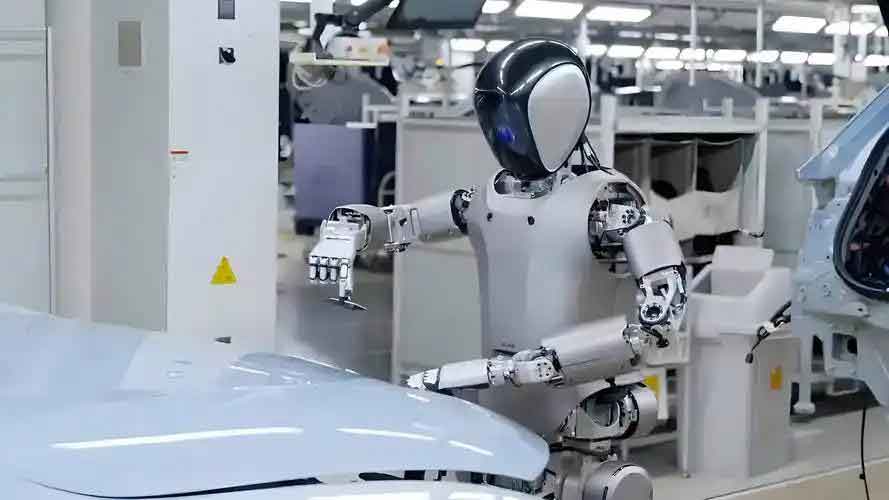
The growth trajectory of the humanoid robot industry can be modeled using exponential functions, given its rapid adoption. If we denote the industry size \( I(t) \) at time \( t \) (in years), with an initial size \( I_0 \) and a growth rate \( g \), we have:
$$ I(t) = I_0 \times e^{gt} $$
For example, if \( I_0 \) corresponds to the 2023 baseline and \( g \) is derived from the projected 2026 value, we can estimate intermediate growth. Assuming a compound annual growth rate (CAGR), the formula becomes:
$$ \text{CAGR} = \left( \frac{I_{2026}}{I_{2023}} \right)^{\frac{1}{3}} – 1 $$
This mathematical approach helps quantify the expansion of the humanoid robot market, emphasizing its significance. Furthermore, the integration of humanoid robots into sectors like manufacturing can amplify digital transformation efforts, as seen in the aforementioned action plan. The humanoid robot, with its ability to learn and adapt, could revolutionize production lines, reducing waste and energy use—thus contributing to carbon reduction goals. In my view, the humanoid robot is poised to become a ubiquitous element in smart cities, assisting in public services and enhancing operational efficiency.
To illustrate the synergies between these policies, I present a comparative table highlighting how energy conservation, digital transformation, and humanoid robot development intersect:
| Policy/Initiative | Key Focus | Potential Impact on Humanoid Robot Adoption | Contribution to Energy/Carbon Goals |
|---|---|---|---|
| Energy Conservation and Carbon Reduction Action Plan | Reducing fossil fuel use, promoting non-fossil energy | Humanoid robots can optimize energy management in industries | Direct through efficiency gains; indirect via smart grids |
| Smart City Digital Transformation Guidance | City-wide digitization, data interoperability | Humanoid robots serve as interactive nodes in urban ecosystems | Enables predictive maintenance and reduced resource consumption |
| Manufacturing Digital Transformation Action Plan | Industry-specific digital upgrades, SME support | Humanoid robots automate complex tasks, enhancing productivity | Lowers energy per unit output through precision and automation | Digital Aging China Tour | Inclusive digital services for older adults | Humanoid robots provide companionship and assistance, promoting tech adoption | Minimal direct impact, but fosters societal acceptance of digital tools |
The mathematical interplay can be further explored through optimization models. For instance, consider a scenario where humanoid robots are deployed in a manufacturing plant to reduce energy consumption. The total energy savings \( S \) can be expressed as a function of the number of humanoid robots \( N \) and their efficiency factor \( \epsilon \):
$$ S = N \times \epsilon \times E_{\text{baseline}} $$
where \( E_{\text{baseline}} \) is the baseline energy use per robot-assisted process. This simplistic model underscores how scaling humanoid robot adoption can linearly contribute to energy goals, though in reality, diminishing returns or synergies may apply. Additionally, the carbon reduction from such deployments can be estimated using emission factors, linking directly to the targets in the action plan.
As I delve deeper, it becomes evident that the humanoid robot industry is not just a standalone sector but a catalyst for broader change. The report predicting突破200亿元 (breaking 200 billion yuan) by 2026 underscores the economic vitality of humanoid robots. In generative AI contexts, humanoid robots can leverage large language models to perform complex decision-making, potentially accelerating their integration into diverse fields. This aligns with China’s emphasis on innovation, as seen in the support for satellite technology and digital reforms. The humanoid robot, therefore, embodies the fusion of AI and robotics, driving what some term the “Fourth Industrial Revolution.”
Reflecting on the management mechanisms outlined in the energy plan—such as strengthening target responsibility, rigorous project reviews, and enhanced statistical accounting—I see parallels in the digital realm. For humanoid robots, similar frameworks could ensure ethical deployment and efficiency standards. The concept of “digital-adaptive reform” might evolve to include regulations for autonomous systems like humanoid robots, ensuring they align with societal values and sustainability goals. This holistic governance approach is crucial for mitigating risks while maximizing benefits.
In terms of numerical projections, let’s extrapolate the humanoid robot industry growth beyond 2026. Using the CAGR formula, if we assume an initial size of \( I_{2023} \) (not explicitly given but implied from the report) and a target of \( I_{2026} = 200 \) billion yuan, we can compute growth rates. For instance, if \( I_{2023} \) were 50 billion yuan, the CAGR would be:
$$ \text{CAGR} = \left( \frac{200}{50} \right)^{\frac{1}{3}} – 1 \approx 0.5874 \text{ or } 58.74\% $$
This high rate highlights the explosive potential of humanoid robots. In a more conservative scenario, if \( I_{2023} \) were higher, the CAGR would adjust, but the trend remains upward. Such growth necessitates supportive policies, like those for digital transformation, to infrastructure and skills development. The humanoid robot, as a product of advanced manufacturing, benefits from the digital action plan’s focus on core technologies and platform building.
Moreover, the energy savings from key sectors—约5000万吨标准煤 (about 50 million tons of standard coal equivalent)—can be contextualized with humanoid robot contributions. If each humanoid robot in industrial settings saves an average of \( x \) tons of coal equivalent per year, the required deployment to meet a fraction of this target can be calculated. Let \( N_{\text{robots}} \) be the number of robots, and \( s_{\text{avg}} \) the average annual savings per robot; then:
$$ N_{\text{robots}} \times s_{\text{avg}} = \text{Target Savings} $$
This equation illustrates how scaling humanoid robot adoption could directly support energy goals, provided technological efficiencies are achieved. It also emphasizes the need for cross-sector collaboration, as outlined in the policy documents.
As I conclude this analysis, I am optimistic about the convergence of these initiatives. China’s strategy exemplifies a balanced approach to growth and sustainability, where digital tools like humanoid robots play a pivotal role. The repeated emphasis on humanoid robots in this discussion—whether in economic forecasts, technological integration, or policy synergies—underscores their transformative potential. Looking ahead, I anticipate that humanoid robots will become integral to smart cities, manufacturing hubs, and even household environments, driving efficiency and innovation. The ongoing policies provide a robust foundation, but continuous adaptation will be key to navigating the complexities of a rapidly changing world. In essence, the journey toward a sustainable digital future is not just about meeting targets but fostering an ecosystem where technology serves humanity and the planet.
To further quantify these interrelationships, consider a composite index \( \Gamma \) that measures the integrated progress across energy, digital, and humanoid robot domains. This index could be defined as a weighted sum of normalized metrics:
$$ \Gamma = w_1 \cdot \frac{E_{\text{reduction}}}{E_{\text{target}}} + w_2 \cdot \frac{D_{\text{adoption}}}{D_{\text{baseline}}} + w_3 \cdot \frac{H_{\text{growth}}}{H_{\text{projection}}} $$
where \( w_1, w_2, w_3 \) are weights reflecting policy priorities, \( E \) represents energy reduction, \( D \) digital transformation indicators, and \( H \) humanoid robot industry growth. Such an index could help policymakers track synergies and adjust strategies accordingly. In practice, this aligns with the multi-faceted tasks described in the action plans, emphasizing holistic evaluation.
In summary, China’s recent policies weave a tapestry of sustainability and digitization, with the humanoid robot emerging as a key thread. From energy conservation targets to smart city reforms, each element supports the other, creating a virtuous cycle of innovation and efficiency. As I reflect on these developments, the humanoid robot stands out not merely as a technological product but as a symbol of this integrated future. The road ahead will require diligent implementation, but the framework is in place for a transformative era where humanoid robots and digital systems collectively drive progress toward a greener, more connected world.