
The technology of strain wave gear transmission, emerging in the late 1950s alongside advancements in aerospace technology, represents a fundamentally distinct approach to motion and power transfer. This mechanism utilizes controlled elastic deformation, or a “wave,” in a flexible component to enable meshing and torque transmission. Compared to conventional gear systems, strain wave gears offer unparalleled advantages including exceptionally high positional accuracy, minimal backlash, compact size and weight, high torque capacity, and superior efficiency. These characteristics have cemented their role in demanding fields such as space mechanisms, precision instrumentation, robotics, and medical devices.
The core functionality of a strain wave gear relies on the elastic deformation of a thin-walled, flexible gear known as the flexspline. In the most common configuration, a wave generator, typically an elliptical cam or set of bearings, is inserted into the flexspline, forcing it to conform to an elliptical shape. This deformation allows the flexspline’s external teeth to engage with the internal teeth of a rigid circular spline at two diametrically opposed regions. The difference in the number of teeth between the flexspline and circular spline (usually by 2 for a standard double-wave system) creates a high reduction ratio with each revolution of the wave generator.
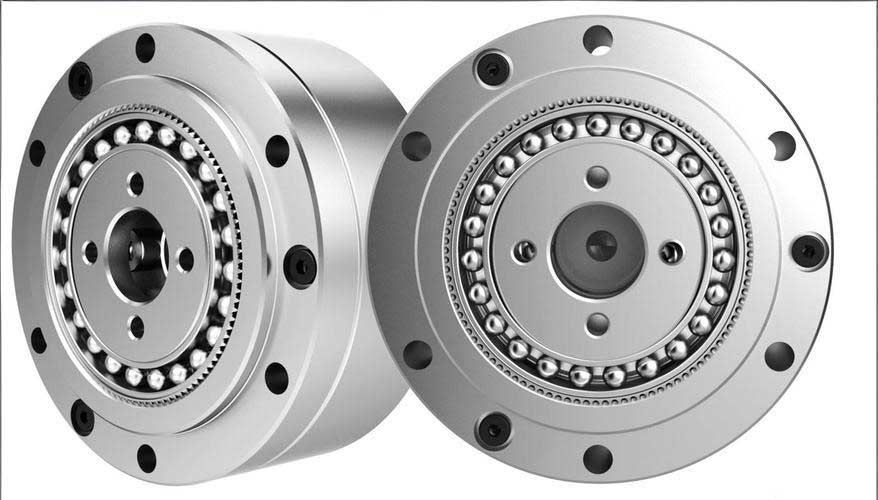
Traditionally, wave generators have been rigid, maintaining a constant major axis dimension during operation. However, recent conceptual developments have introduced the idea of an elastic wave generator. The proposed advantage of such a design is the ability to actively adjust the radial deformation force applied to the flexspline, thereby modulating its elliptical deformation and potentially achieving zero-backlash meshing by compensating for wear or manufacturing tolerances. A critical prerequisite for designing such an adaptive system is a profound and accurate understanding of the relationship between the force applied to the flexspline and its resulting radial deformation. While the basic operating principle is well-established, detailed quantitative models linking deformation force to specific geometric and material parameters, especially for practical, toothed flexsplines, are less prevalent in literature. This work aims to establish, validate, and refine a calculative model for this fundamental relationship, providing a theoretical cornerstone for the development of next-generation strain wave gear systems with active control capabilities.
The initial deformation force in a strain wave gear arises during assembly. Prior to the insertion of the wave generator, the flexspline is a perfect cylinder. The wave generator’s major axis is deliberately designed to be slightly larger than the nominal inner diameter of the undeformed flexspline. During assembly, as the wave generator is pressed or rotated into place, it elastically strains the flexspline wall, forcing it into an elliptical contour. This process generates a significant internal radial force, which is the origin of the preload ensuring continuous tooth contact during operation. Accurately predicting this force for a given target deformation is essential for stress analysis, longevity prediction, and the design of novel generators.
Theoretical Modeling of Flexspline Deformation
To derive a mathematical relationship between the radial deformation and the required force, a mechanical model of the flexspline must be established. The flexspline is a complex component: a cylindrical shell with external gear teeth. A direct analysis incorporating the detailed tooth geometry is exceedingly complex for a closed-form analytical solution. Therefore, a common and effective simplification is adopted: the flexspline is modeled as an equivalent smooth, thin-walled cylindrical shell. The analysis focuses on the neutral surface of the shell wall. The following fundamental assumptions are made, based on the classical moment theory of shells and the specific operating conditions of the strain wave gear:
- The elastic deformation state of the flexspline’s neutral surface under the applied deformation force and subsequent meshing forces remains stable and unchanged during operation.
- The elastic deformations are considered small relative to the dimensions of the flexspline, allowing the use of linear elastic theory.
- During the deformation induced by the wave generator, the midline (neutral surface) of the flexspline shell neither extends nor contracts; its length remains constant. This implies that the membrane strains in the mid-surface are negligible compared to bending strains for the initial conformity deformation.
The model is represented schematically as a cylindrical shell subjected to a concentrated radial force, 2P, applied at two opposite points (φ=0 and φ=π) to simulate the action of a standard two-lobe wave generator. Due to symmetry, analysis on one half is sufficient. We define a coordinate system where the axial direction is z, the circumferential (tangential) direction is φ, and the radial direction is w (positive outward).
For a cylindrical shell, the mid-surface strains are given by:
$$ \epsilon_z = \frac{\partial u}{\partial z} $$
$$ \epsilon_\phi = \frac{1}{R} \left( \frac{\partial v}{\partial \phi} + w \right) $$
$$ \gamma_{z\phi} = \frac{\partial v}{\partial z} + \frac{1}{R} \frac{\partial u}{\partial \phi} $$
where \(u\), \(v\), and \(w\) are the displacements in the axial, tangential, and radial directions, respectively, and \(R\) is the nominal radius of the flexspline’s neutral surface. Based on assumption (3), we set these mid-surface strains to zero for the initial deformation problem:
$$ \epsilon_z = 0, \quad \epsilon_\phi = 0, \quad \gamma_{z\phi} = 0 $$
This set of constraints simplifies the displacement field.
The primary resistance to deformation for a thin shell in this configuration comes from bending. The governing bending differential equation for the radial displacement \(w(\phi)\), derived from shell theory and neglecting membrane effects for this specific load case, is:
$$ \frac{d^2 w}{d\phi^2} + w = -\frac{M_\phi R^2}{D(1-\nu^2)} $$
Here, \(M_\phi\) is the circumferential bending moment per unit length, \(D\) is the cylindrical flexural rigidity, \(E\) is Young’s modulus, \(\nu\) is Poisson’s ratio, and \(\delta\) is the wall thickness of the equivalent shell.
$$ D = \frac{E \delta^3}{12(1-\nu^2)} $$
The total strain energy \(V\) stored in the deformed shell due to bending is:
$$ V = \int_0^{2\pi} \frac{M_\phi^2 R}{2D(1-\nu^2)} d\phi $$
To solve for the deformation shape, we assume the radial displacement can be expressed as a Fourier series, which naturally satisfies the periodicity condition:
$$ w(\phi) = \sum_{n=1}^{\infty} \left( a_n \sin(n\phi) + b_n \cos(n\phi) \right) $$
For a symmetric deformation about \(\phi=0\) (induced by forces at \(\phi=0\) and \(\pi\)), the sine terms vanish (\(a_n = 0\)). Furthermore, the rigid body mode \(n=1\) (translation) does not contribute to strain energy. Therefore, the series reduces to:
$$ w(\phi) = \sum_{n=2,4,6,\ldots}^{\infty} b_n \cos(n\phi) $$
Substituting this series into the expression for the second derivative and then into the strain energy integral yields:
$$ V = \frac{\pi D(1-\nu^2)}{2R^3} \sum_{n=2,4,6,\ldots}^{\infty} (n^2 – 1)^2 b_n^2 $$
The coefficients \(b_n\) are determined using the principle of virtual work. The virtual work done by the external force \(P\) (at one lobe) during a virtual displacement \(\delta w\) is \(P \cdot \delta w(0)\). Applying this principle leads to:
$$ b_n = \frac{2PR^3}{\pi D(1-\nu^2) (n^2 – 1)^2} \quad \text{for } n=2,4,6,\ldots $$
Thus, the radial deformation profile is:
$$ w(\phi) = \frac{2PR^3}{\pi D(1-\nu^2)} \sum_{n=2,4,6,\ldots}^{\infty} \frac{\cos(n\phi)}{(n^2 – 1)^2} $$
The maximum radial deformation, \(w_0\), occurs at \(\phi = 0\) (and \(\phi = \pi\)):
$$ w_0 = w(0) = \frac{2PR^3}{\pi D(1-\nu^2)} S $$
where \(S\) is the sum of the series:
$$ S = \sum_{n=2,4,6,\ldots}^{\infty} \frac{1}{(n^2 – 1)^2} $$
This series converges rapidly. For a double-wave deformation (n=2 being the dominant harmonic), the sum is dominated by the n=2 term:
$$ S \approx \frac{1}{(2^2 – 1)^2} + \frac{1}{(4^2 – 1)^2} + \frac{1}{(6^2 – 1)^2} + \ldots = \frac{1}{9} + \frac{1}{225} + \frac{1}{1225} + \ldots \approx 0.1141 $$
Rearranging the equation for \(w_0\) gives the fundamental theoretical model for the deformation force \(P\) as a function of the required radial deflection \(w_0\):
$$ P_{\text{theory}} = \frac{\pi D (1-\nu^2) w_0}{2 R^3 S} $$
Substituting the expression for \(D\):
$$ P_{\text{theory}} = \frac{\pi E \delta^3 w_0}{24 R^3 S} $$
This model reveals key parametric dependencies: The deformation force \(P\) is directly proportional to the elastic modulus \(E\) and the cube of the wall thickness \(\delta\). It is also directly proportional to the desired radial deformation \(w_0\). Crucially, it is inversely proportional to the cube of the nominal radius \(R\). This strong cubic relationship with \(\delta\) and \(R\) highlights the extreme sensitivity of the deformation force to the flexspline’s geometric dimensions. For a standard strain wave gear, this force can be substantial.
| Parameter | Symbol | Influence on Force (P) | Practical Design Consideration |
|---|---|---|---|
| Young’s Modulus | E | Linear Proportional | Material selection (e.g., alloy steel vs. titanium) directly sets force level. |
| Wall Thickness | δ | Cubic Proportional (δ³) | Most sensitive parameter. Small increases drastically raise force and stress. |
| Radial Deformation | w₀ | Linear Proportional | Determined by gear module and wave generator profile. Defines meshing conditions. |
| Neutral Radius | R | Inversely Cubic Proportional (1/R³) | Larger gears require significantly less force per unit deformation. |
| Poisson’s Ratio | ν | Minor, via constant S and (1-ν²) term | Typically fixed by material choice. |
Experimental Investigation and Model Refinement
The theoretical model derived above is based on a smooth, isotropic cylindrical shell. A practical flexspline for a strain wave gear has a toothed outer surface, a non-uniform cross-section along its length (e.g., cup-style), and is subject to manufacturing imperfections. To validate and correct the theoretical model, an experimental study was designed and conducted.
The core objective was to measure the force required to induce a specific radial deformation in a real flexspline. The test setup consisted of three main subsystems:
- Drive System: A servo-motor coupled to a high-precision ball screw assembly to provide controlled linear motion.
- Test Fixture: A rigid base platform and a movable platen. The flexspline was mounted between them, with its rim spanning the gap. One end was fixed relative to the base, while the moving platen applied displacement to the opposite side, forcing the rim into an elliptical shape.
- Measurement System:
- A piezoelectric force sensor (e.g., CL-YD-301A type) installed on the moving platen to measure the applied force (P).
- A non-contact eddy current displacement sensor (e.g., CWY-DO-501 type) positioned to measure the radial displacement (w) at the point of force application. Since the fixture applies displacement at one point and the opposite point is fixed, the measured displacement corresponds to 2*w₀.
Data from both sensors was acquired simultaneously via a data acquisition card during a slow, quasi-static loading cycle.
The test specimen was a standard cup-type flexspline from a commercial XB1-100-80 model strain wave gear drive. Its key parameters are summarized below:
| Parameter | Symbol | Value | Notes |
|---|---|---|---|
| Number of Teeth | z_f | 200 | Flexspline tooth count. |
| Module | m | 0.4 mm | Gear module. |
| Nominal Radius (Tooth Root) | R | Approx. 40 mm | Calculated from m*z_f / 2. |
| Wall Thickness (Body) | δ | 0.68 mm | Measured average thickness. |
| Cup Length | L | 70 mm | Length of the cylindrical section. |
| Material | – | Alloy Steel | Typical material, assumed properties used. |
| Young’s Modulus (Assumed) | E | 206 GPa | Standard value for steel. |
| Poisson’s Ratio (Assumed) | ν | 0.3 | Standard value for steel. |
The experimental data, consisting of force (P) versus total radial displacement (2w₀), was processed and analyzed. The theoretical model was plotted using the parameters from Table 2 and the series sum \(S \approx 0.1141\):
$$ P_{\text{theory}} = \frac{\pi \times 206\times10^9 \text{ Pa} \times (0.68\times10^{-3} \text{ m})^3 \times w_0}{24 \times (40\times10^{-3} \text{ m})^3 \times 0.1141} $$
This simplifies to a linear relationship: \(P_{\text{theory}} = k_1 \cdot w_0\), where the theoretical slope \(k_1\) is approximately 1625 N/mm.
The raw experimental data showed a clear, primarily linear trend but with some slight nonlinearity possibly due to settling, micro-slip, or material effects. A third-order polynomial was fitted to the experimental data to capture its characteristic trend, resulting in a fitted curve. The slope of the experimental data in the main operating range was derived from this fit. Critically, the experimental force for a given deformation was found to be significantly lower than the theoretical prediction. The slope \(k_2\) of the experimental trend was approximately 210 N/mm.
The substantial discrepancy, by nearly an order of magnitude, confirms that the smooth-shell model overestimates the force. This is expected and attributable to several factors neglected in the initial theory:
- Presence of Teeth: The external teeth significantly reduce the bending stiffness of the rim in the radial direction compared to a smooth, solid wall of thickness δ. The teeth create a discontinuous, more compliant structure.
- Cup Geometry and Boundary Conditions: The model assumes an infinitely long shell or specific simple boundaries. The actual cup flexspline has a complex, variable-thickness profile from the diaphragm to the rim, and the boundary condition at the diaphragm end is not perfectly rigid, allowing some compliance.
- Stress Relief Grooves: Many flexsplines include stress-relief features which further reduce local stiffness.
To make the model useful for practical engineering design, especially for sizing components of an elastic wave generator, a comprehensive influence coefficient, \(K\), is introduced. This dimensionless factor encapsulates the net effect of all the simplifying assumptions. It is defined as the ratio of the experimental stiffness to the theoretical stiffness:
$$ K = \frac{k_2}{k_1} = \frac{210}{1625} \approx 0.13 $$
Thus, the refined and empirically corrected model for predicting the deformation force in a real, toothed flexspline for a strain wave gear becomes:
$$ P_{\text{corrected}} = K \cdot P_{\text{theory}} = K \cdot \frac{\pi E \delta^3 w_0}{24 R^3 S} $$
For the specific gear tested, the working formula is:
$$ P_{\text{corrected}} \approx 0.13 \times \frac{\pi E \delta^3 w_0}{24 R^3 S} $$
| Model | Governing Equation | Slope (k) [N/mm] | Basis | Applicability |
|---|---|---|---|---|
| Theoretical (Smooth Shell) | $$ P = \frac{\pi E \delta^3 w_0}{24 R^3 S} $$ | ~1625 | Elastic theory of cylindrical shells. | Idealized case, provides upper-bound force estimate. |
| Corrected (Empirical) | $$ P = K \cdot \frac{\pi E \delta^3 w_0}{24 R^3 S} $$ | ~210 | Theoretical model scaled by empirical factor K (0.13). | Practical design for similar cup-type flexsplines. K must be determined for different geometries. |
This corrected model was subsequently used to specify the force output requirement for a prototype elastic wave generator designed to match the tested flexspline. Experimental validation confirmed that the generator, designed using this force-deformation relationship, successfully produced the target radial deformation (\(w_0\)), verifying the utility of the refined model as a design tool.
Conclusion and Implications for Strain Wave Gear Design
This investigation into the deformation mechanics of the flexspline provides critical insights for the analysis and advanced design of strain wave gear systems. The primary outcomes are summarized as follows:
- Foundational Model: A fundamental analytical model linking radial deformation force to key geometric and material parameters was rigorously derived from thin-shell elasticity theory. The model establishes the proportionalities \(P \propto E \delta^3 w_0 / R^3\), highlighting the extreme sensitivity to wall thickness and radius.
- Experimental Validation and Discrepancy: Experimental testing on a commercial cup-type flexspline confirmed a linear relationship between force and deformation in the operational range. However, the measured force was only about 13% of the theoretical prediction, quantitatively exposing the significant stiffness-reducing effect of the toothed structure and complex geometry not captured by the smooth-shell analogy.
- Practical Refined Model: A corrected engineering model was proposed by introducing a comprehensive influence coefficient \(K\). For the specific flexspline tested, \(K \approx 0.13\). The model \(P = K \cdot (\pi E \delta^3 w_0)/(24 R^3 S)\) serves as a practical tool for predicting deformation forces in similar designs.
- Design Application: The validated force-deformation relationship is essential for designing novel actuation systems for strain wave gears, such as the conceptual elastic wave generator. It allows for the precise sizing of actuators (e.g., piezoelectric, hydraulic, or mechanical) required to achieve a specific controlled deformation, enabling potential features like active backlash compensation or variable stiffness control.
The value of the influence coefficient \(K\) is not universal; it will vary with flexspline geometry (cup, hat, pancake), tooth parameters, and manufacturing details. Future work should focus on establishing a parametric database or a more detailed analytical model (e.g., using finite element analysis or ring theory with tooth compliance factors) to predict \(K\) from basic design parameters, making the force prediction fully generative for new strain wave gear designs. Nevertheless, the methodology presented—theoretical modeling followed by empirical correction via targeted experiment—provides a robust framework for developing accurate performance models for critical components in precision mechanical systems.