
In a landmark event at the GITEX Global 2025 technology exhibition in the United Arab Emirates, China Telecom unveiled its revolutionary RaaS (Robot as a Service) product, marking a significant stride in the integration of advanced robotics into everyday applications. This innovative offering harnesses the vast computational resources, big data analytics, and cutting-edge artificial intelligence algorithms of Tianyi Cloud to provide comprehensive services for a diverse array of offline robot terminals. Empowered by AI large models, China Telecom is relentlessly refining its core robotics technologies, driving the widespread adoption of intelligent solutions across multiple sectors and enhancing the quality of life for communities globally. The introduction of this humanoid robot as a service model is poised to transform industries by offering scalable, efficient, and accessible robotic capabilities, thereby accelerating the transition towards a more automated and intelligent future.
- Humanoid Robot Industry Enters a New Phase of Large-Scale Commercialization
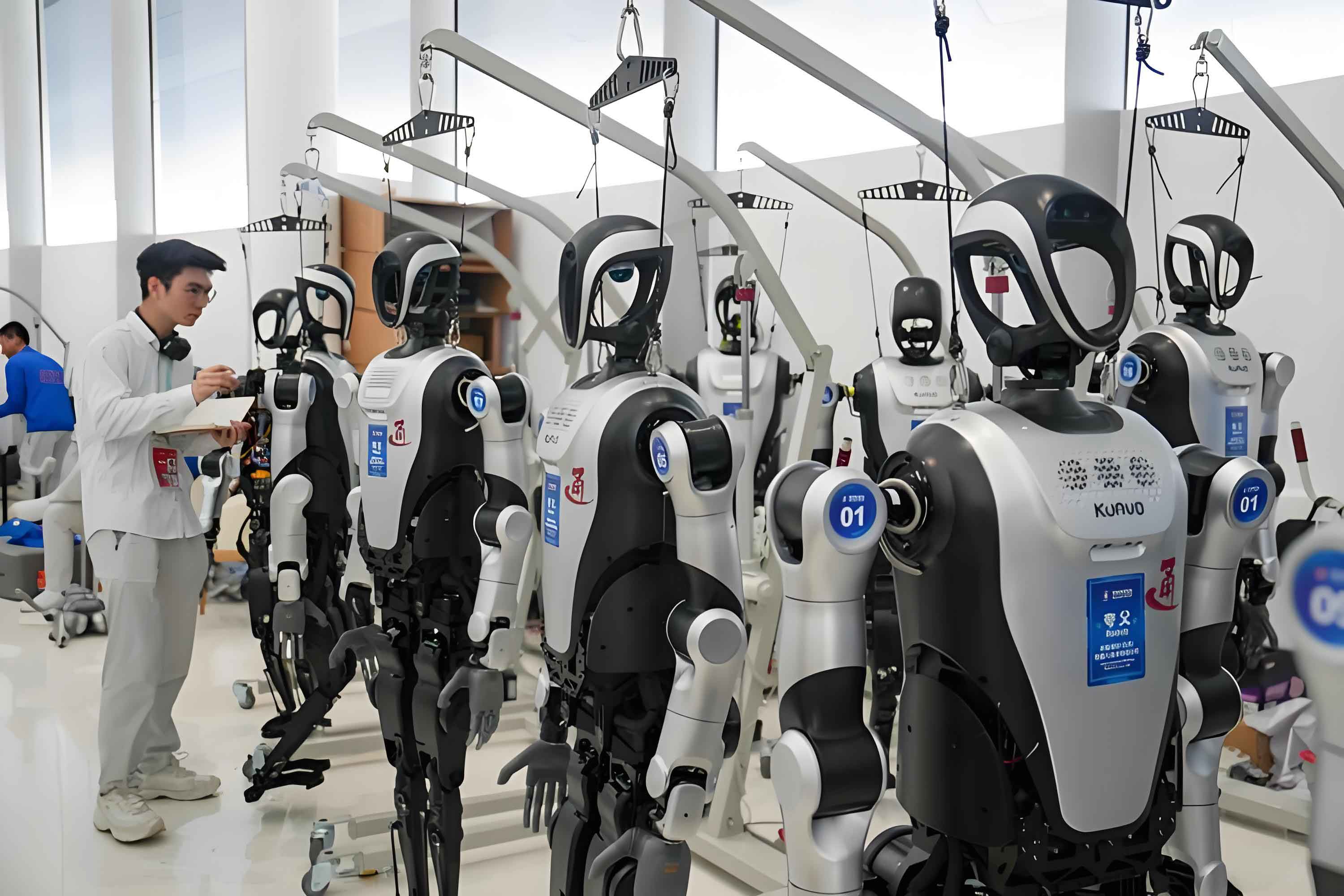
The “14th Five-Year Plan” period in China has catalyzed unprecedented opportunities for the rapid advancement of the humanoid robot industry, with technological innovations and robust policy frameworks acting as dual catalysts for growth. This era has seen the sector evolve from nascent exploration to a more mature stage, characterized by increased investment and widespread implementation. According to the “2025 Humanoid Robot and Embodied Intelligence Industry Research Report,” the global embodied intelligence market is undergoing explosive expansion, with an estimated value of 195.25 billion yuan by 2025. Notably, China demonstrates formidable potential in this arena, accounting for nearly half of the worldwide market share and establishing itself as a critical growth driver for the global humanoid robot industry. The proliferation of artificial intelligence large models has been instrumental in accelerating the deployment of humanoid robots across a spectrum of environments, including manufacturing plants, medical facilities, and residential homes, igniting a new wave of intelligent transformation within physical industries. The humanoid robot sector is not merely expanding; it is redefining operational paradigms by introducing levels of automation and intelligence previously unattainable. As these humanoid robots become more adept at handling complex tasks, they are expected to address pressing challenges such as labor shortages, operational inefficiencies, and the need for personalized services, thereby fostering a more resilient and adaptive economic landscape. The continuous integration of humanoid robots into various domains underscores their versatility and potential to revolutionize how businesses and societies function, making them indispensable components of the fourth industrial revolution.
- Advancing Core Technologies to Fuel the Growth of the Robot Industry
As the humanoid robot industry approaches the pivotal juncture of large-scale commercialization, China Telecom is delivering end-to-end support through breakthroughs in technology, real-world application deployments, and collaborative ecosystem development. In the realm of artificial intelligence, the company’s indigenously developed Xingchen large model constitutes a robust intelligent core, consistently achieving top-tier performance in international benchmark evaluations. For instance, in home-based desktop AI robots, the Xingchen large model facilitates a shift from reactive responses to proactive service delivery, significantly enriching user interactions and satisfaction. On the networking front, 5G-A networks provide the essential infrastructure for low-latency, high-reliability communication channels, which are critical for the seamless operation of humanoid robots in dynamic settings. Complementing this, China Telecom’s introduction of the “Adversarial Motion and Behavior Imitation (ALMI)” framework establishes a foundation for tackling intricate scenarios, enabling humanoid robots to mimic human-like movements and behaviors with greater precision. Ecosystem partnerships further amplify industrial dynamism; China Telecom’s joint release of the “Mobile AI” white paper with Huawei outlines pivotal strategies such as the general-computing integration architecture, designed to meet the exacting demands of intelligent robots for high bandwidth and minimal delay. The relentless pursuit of technological excellence in AI and networking is vital for ensuring that humanoid robots can operate effectively in real-time environments, from autonomous navigation in crowded spaces to delicate manipulations in industrial assembly lines. China Telecom’s holistic approach to innovation not only fortifies its leadership in the robotics domain but also propels the entire humanoid robot industry forward, setting new standards for performance and reliability.
- China Telecom Facilitates the Deep Integration of Humanoid Robots into Daily Life Scenarios
In the wave of large-scale commercialization sweeping the humanoid robot industry, China Telecom is persistently extending the reach of these intelligent machines from industrial contexts to民生领域, ensuring that the benefits of automation permeate every aspect of society. In industrial settings, China Telecom’s collaboration with ZTE has given rise to the Nanjing Binjiang Smart Factory, which features 24 distinct categories of 5G+ industrial fusion innovations. A standout example is the “Look, Listen, Ask, and Feel” humanoid robot, equipped with sophisticated components such as robotic arms, high-definition cameras, and integrated remote conferencing systems. This humanoid robot performs continuous equipment monitoring, leveraging real-time data analysis to detect anomalies and issue alerts, while its integration with 5G cloud-based PLCs enables synchronized machine operations, cutting production line adjustment times by over 20%. In healthcare environments, humanoid robots and AI systems collaborate to mitigate resource constraints. With support from China Telecom, the Kashi Prefecture Traditional Chinese Medicine Hospital has implemented an intelligent service system that incorporates the DeepSeek V3 medical large model, working in tandem with deployed service robots to execute routine functions like medication distribution and patient guidance. In domestic spheres, China Telecom’s “Beautiful Home” robot family offers a versatile suite of products: the child companion desktop humanoid robot engages young users through interactive questioning to stimulate cognitive development, generates detailed growth records that are automatically synced to Tianyi Cloud Drive for remote parental oversight, and the wheeled companion humanoid robot assists the elderly with daily activities, while the wheel-arm humanoid robot interfaces with smart home devices to enable context-aware automation. From factory floors and medical centers to private residences, China Telecom is dismantling traditional application barriers through technological ingenuity, allowing intelligent services to infuse every facet of daily existence. The escalating adoption of humanoid robots in these diverse scenarios highlights their adaptability and potential to overhaul conventional practices, delivering enhancements in efficiency, safety, and convenience that are crucial for modern living.
China Telecom’s endeavors in the humanoid robot domain reflect a deep-seated commitment to harnessing technology for the betterment of society. By consistently pushing the frontiers of innovation, the company is not only propelling the robotics industry to new heights but also guaranteeing that the rewards of intelligent automation extend to all segments of life, from industrial output to personal well-being. The successful implementation of humanoid robots across a broad spectrum of use cases attests to their practical utility and lays the groundwork for ongoing advancements. As the global community strides toward an increasingly interconnected and smart future, humanoid robots are destined to assume a more prominent role, and China Telecom is leading this charge with unwavering dedication and vision. The humanoid robot as a service model exemplifies how cloud-based solutions can democratize access to advanced robotics, fostering inclusivity and driving sustainable growth in the digital age.