
As a researcher in the field of social robotics, I have observed the escalating global challenge of population aging, which is particularly acute in many developed and developing nations. By 2025, it is projected that a significant portion of the world’s elderly will live alone, often termed “empty nesters,” facing profound isolation, health neglect, and psychological distress such as anxiety and depression. This social imperative drives my focus on developing technological solutions, specifically the design of advanced companion robots. A companion robot is not merely an assistive device; it is an interactive entity intended to provide emotional support, continuous monitoring, and meaningful engagement to mitigate the adverse effects of loneliness. In this article, I will detail a comprehensive design framework for a companion robot tailored for empty nesters, incorporating robust mechanical systems, intelligent control, and empathetic interaction modalities. The core philosophy is to create a companion robot that transcends functional utility to become a source of genuine companionship, akin to a familial presence.
The global landscape for companion robots has seen considerable innovation, especially in countries with severe aging demographics. For instance, Japanese research institutions have pioneered robots capable of physical assistance and autonomous navigation, while other international efforts have yielded robots with communicative and reminder functionalities. However, many existing solutions are institution-oriented, focusing on physical aid rather than emotional connection. The market for companion robots addressing the affective needs of empty nesters remains nascent, presenting a critical gap. My design initiative aims to fill this void by prioritizing psychological well-being alongside physical care. The companion robot envisioned here is conceived as a holistic system, integrating multiple technological domains to deliver a seamless and responsive陪伴 experience. Throughout this discussion, the term “companion robot” will be emphasized to underscore its central role in redefining elderly care.
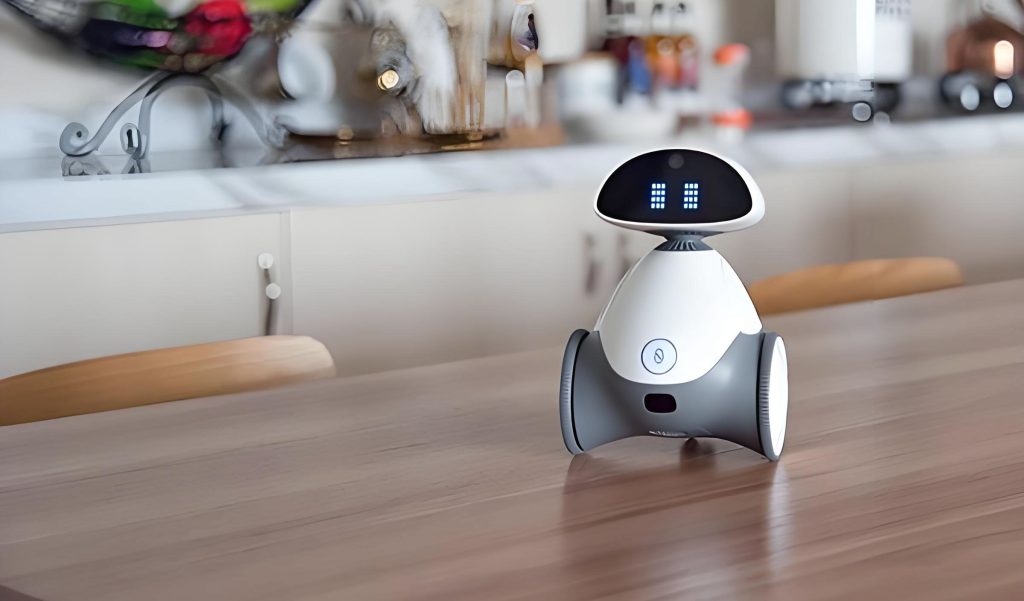
The design定位 for this companion robot is rooted in the specific psychosocial needs of empty nesters. Unlike traditional assistive robots, this companion robot is designed to emulate the comforting presence of a child, offering familiarity and warmth. The外观 adopts a simplistic, child-like form with a neutral color scheme (e.g., black and white) to evoke亲和力 and reduce the intimidation often associated with complex machinery. The primary objectives are threefold: first, to provide continuous emotional engagement through拟人化 interactions; second, to monitor health parameters proactively and relay information to family members; and third, to facilitate social connection via integrated communication tools. This companion robot must be intuitive, requiring minimal operational complexity from elderly users, who may have declining cognitive or physical abilities. Thus, every aspect of the design, from voice commands to tactile responses, is tailored to foster a sense of陪伴 and security.
To achieve these goals, the companion robot relies on a sophisticated system architecture comprising several interconnected subsystems. I will elaborate on each using tables and mathematical models to clarify their functions and interactions. The overall system can be represented by the following high-level block diagram, described functionally: the companion robot perceives environmental and user inputs via sensors, processes data through an AI-driven neural network, executes actions through mechanical actuators, and communicates via a user interface. The integration ensures that the companion robot operates as a cohesive entity, capable of adaptive behavior.
The mechanical structure system forms the physical embodiment of the companion robot. It includes actuators, joints, and mobility mechanisms that enable movement and manipulation. For example, the companion robot might use servo motors for limb movements and omnidirectional wheels for navigation. The kinematic equations governing motion can be expressed using the Denavit-Hartenberg parameters for robotic manipulators. For a simple arm segment, the transformation matrix between consecutive links is given by:
$$ T_i^{i-1} = \begin{bmatrix} \cos\theta_i & -\sin\theta_i \cos\alpha_i & \sin\theta_i \sin\alpha_i & a_i \cos\theta_i \\ \sin\theta_i & \cos\theta_i \cos\alpha_i & -\cos\theta_i \sin\alpha_i & a_i \sin\theta_i \\ 0 & \sin\alpha_i & \cos\alpha_i & d_i \\ 0 & 0 & 0 & 1 \end{bmatrix} $$
where $\theta_i$ is the joint angle, $a_i$ is the link length, $\alpha_i$ is the twist angle, and $d_i$ is the link offset. This formalism allows precise control of the companion robot’s gestures, such as reaching out to hand over an object or mimicking a child’s playful motions. The mobility system ensures the companion robot can follow the user around the home, avoiding obstacles through sensor fusion.
The control system of the companion robot is the central nervous system, coordinating all activities. It employs a hybrid architecture combining reactive control for immediate responses and deliberative planning for complex tasks. The decision-making process can be modeled as a partially observable Markov decision process (POMDP), which handles uncertainty in sensor data. The objective is to maximize a reward function $R(s, a)$ that encapsulates the陪伴 goals, such as user engagement and health safety. The value function $V(s)$ for a state $s$ is computed iteratively:
$$ V(s) = \max_{a \in A} \left[ R(s, a) + \gamma \sum_{s’} P(s’ | s, a) V(s’) \right] $$
where $\gamma$ is a discount factor, $P(s’ | s, a)$ is the transition probability, and $A$ is the set of actions. This enables the companion robot to choose actions like initiating a conversation or alerting a caregiver based on inferred user state. The control system integrates inputs from multiple sensor modalities, processed in real-time to ensure the companion robot behaves responsively.
The sensor system is critical for the companion robot’s awareness. It comprises various sensors that emulate human senses, allowing the companion robot to perceive the user and environment. Below is a table summarizing key sensor types, their functions, and example specifications for this companion robot:
| Sensor Type | Primary Function | Example Technology | Output Parameters |
|---|---|---|---|
| Visual Sensor | Facial expression recognition, gesture detection | RGB-D camera | Pixel arrays, depth maps |
| Auditory Sensor | Speech recognition, emotion detection from voice | Microphone array | Audio waveforms, frequency spectra |
| Tactile Sensor | Detect touch or pressure for interactive responses | Pressure-sensitive skin | Force vectors, contact points |
| Environmental Sensor | Monitor room temperature, air quality | Thermohygrometer | Temperature (°C), humidity (%) |
| Biometric Sensor | Track heart rate, blood pressure | Photoplethysmography (PPG) | BPM, systolic/diastolic pressure |
Data from these sensors are fused using Bayesian inference to estimate the user’s emotional and physical state. For instance, let $E$ represent an emotional state (e.g., “happy” or “depressed”), and $S_v, S_a, S_t$ be observations from visual, auditory, and tactile sensors. The posterior probability is:
$$ P(E | S_v, S_a, S_t) = \frac{P(S_v | E) P(S_a | E) P(S_t | E) P(E)}{P(S_v, S_a, S_t)} $$
This probabilistic approach allows the companion robot to adapt its behavior, such as offering comforting words if depression is detected. The sensor system ensures the companion robot remains attuned to the user’s needs, embodying true陪伴.
The neural network intelligent system underpins the companion robot’s cognitive capabilities. It is built on deep learning architectures, such as convolutional neural networks (CNNs) for image processing and recurrent neural networks (RNNs) for sequential data like speech. The learning objective is to minimize a loss function $L(\theta)$ over a dataset of interactions:
$$ L(\theta) = -\frac{1}{N} \sum_{i=1}^N \left[ y_i \log \hat{y}_i + (1 – y_i) \log (1 – \hat{y}_i) \right] + \lambda \|\theta\|^2 $$
where $\theta$ are network parameters, $y_i$ is the ground-truth label (e.g., user emotion), $\hat{y}_i$ is the predicted probability, and $\lambda$ is a regularization term. This system enables the companion robot to recognize patterns, predict user intentions, and generate appropriate responses. For example, the companion robot might learn that certain voice tones correlate with loneliness and respond by initiating a game. The neural network is continuously updated via cloud connectivity, enhancing the companion robot’s adaptability over time.
The voice recognition system allows the companion robot to understand and process natural language commands. It uses automatic speech recognition (ASR) followed by natural language understanding (NLU). The accuracy of ASR can be modeled using the word error rate (WER):
$$ \text{WER} = \frac{S + D + I}{N} $$
where $S$ is the number of substitutions, $D$ is deletions, $I$ is insertions, and $N$ is the total words in the reference. To optimize for elderly speech, which may be slower or less articulate, the companion robot employs acoustic models trained on senior voices. This ensures robust interaction, allowing users to control the companion robot effortlessly through speech, reinforcing the陪伴 bond.
The human-machine interface (HMI) of the companion robot is designed for simplicity and engagement. The primary interface is the robot’s “face,” which features a display screen showing emotive expressions and interactive menus. Key components include fingerprint and pupil recognition for security, a video-calling portal for family communication, and a health dashboard displaying vital signs. The interface layout prioritizes large icons and voice feedback to accommodate potential visual or motor impairments. The emotional expressiveness of the companion robot is governed by a formula that maps internal states to facial animations. For instance, let $H$ denote happiness level (0 to 1), $S$ sadness, and $A$ arousal. The expression parameters (e.g., smile curvature $C$) can be computed as:
$$ C = \alpha H – \beta S + \gamma A $$
where $\alpha, \beta, \gamma$ are weighting coefficients. This dynamic表达 enhances the perceived liveliness of the companion robot, making interactions more natural and comforting.
In terms of operational autonomy, the companion robot includes energy management systems. When battery level $B(t)$ falls below a threshold $B_{\text{min}}$, the companion robot announces its need to charge and navigates to a docking station using path planning algorithms. The navigation can be formulated as solving for a path $P$ that minimizes cost $C(P)$:
$$ C(P) = \int_{P} w_1 \cdot \text{distance} + w_2 \cdot \text{obstacle risk} \, ds $$
with $w_1, w_2$ as weights. This self-sufficiency reduces user burden, ensuring the companion robot remains available for陪伴 without frequent manual intervention.
To summarize the technical integration, the following table outlines the core modules of the companion robot system and their interrelationships:
| Module | Key Components | Function in陪伴 | Performance Metrics |
|---|---|---|---|
| Mechanical System | Actuators, joints, wheels | Physical movement and gesture execution | Speed (m/s), precision (mm) |
| Control System | POMDP solver, real-time OS | Decision-making and action coordination | Response time (ms), decision accuracy (%) |
| Sensor Fusion | Camera, microphone, biometrics | Perceiving user state and environment | Detection rate (%), false positive rate |
| AI Engine | Deep neural networks, cloud AI | Learning and adapting interaction patterns | Learning loss, inference speed (FPS) |
| Interaction Layer | Voice ASR, emotional model | Facilitating natural communication | WER, user satisfaction score |
The effectiveness of this companion robot design can be further analyzed through usability metrics. Suppose we define a陪伴 quality index $Q$ as a weighted sum of factors: emotional support $E_s$, health monitoring $H_m$, and ease of use $U$. Then:
$$ Q = w_1 E_s + w_2 H_m + w_3 U $$
where $w_i$ are weights determined by user studies. By iteratively refining the design based on such metrics, the companion robot can evolve to better serve empty nesters.
In conclusion, the design of a companion robot for empty nesters represents a multidisciplinary endeavor merging robotics, AI, and human-centered design. This companion robot aims to address not only physical assistance but also the profound emotional voids experienced by solitary elderly individuals. By employing advanced sensor fusion, adaptive control algorithms, and拟人化 interfaces, this companion robot can offer a sustainable solution to the social challenge of aging populations. Future work will involve prototyping and longitudinal studies to validate the陪伴 impact in real-world settings. Potential enhancements include integrating more sophisticated affective computing models and expanding social connectivity features. Ultimately, the vision is for companion robots to become ubiquitous in elderly care, providing consistent companionship that enriches the quality of life for empty nesters globally. Through continuous innovation, the companion robot will evolve from a mere tool to a trusted partner in daily life, embodying the essence of compassionate technology.