
The performance and precision of industrial robots are fundamentally dependent on the quality of their core transmission components. Among these, the RV reducer stands as a critical element within the robot’s joints, enabling high reduction ratios, compact size, exceptional torsional stiffness, and precise motion control. Mastering the manufacturing technology for high-precision RV reducers is therefore paramount for advancing automation. A central challenge in this pursuit lies in the fabrication of its most critical component: the cycloidal gear. This gear, central to the unique two-stage transmission principle of the RV reducer, demands extremely high dimensional accuracy, geometric tolerances, and superior mechanical properties. This article delves into a detailed process design for manufacturing cycloidal gears and employs finite element simulation to analyze and mitigate a key manufacturing challenge—thermal deformation during heat treatment, providing a systematic approach to guide production.
The transmission system of an RV reducer is a sophisticated combination of two stages. The first stage typically consists of a planetary gear train with involute gears, providing an initial speed reduction. The second stage, which gives the reducer its name (Rotary Vector), is a cycloidal-pin gear planetary mechanism. This second stage is responsible for the reducer’s high reduction ratio and compactness. The interaction between the cycloidal gear and the pin gear housing is crucial. Unlike standard cycloidal drives where pins roll within a shell, the pins in an RV reducer are rigidly fixed into precision-machined holes on the pin gear housing. This design, while offering superior rigidity and load capacity, imposes significantly stricter requirements on the manufacturing accuracy of the cycloidal gear’s tooth profile, the pins, and the pin housing bores. Any deviation directly impacts the transmission error, backlash, and overall efficiency of the RV reducer.
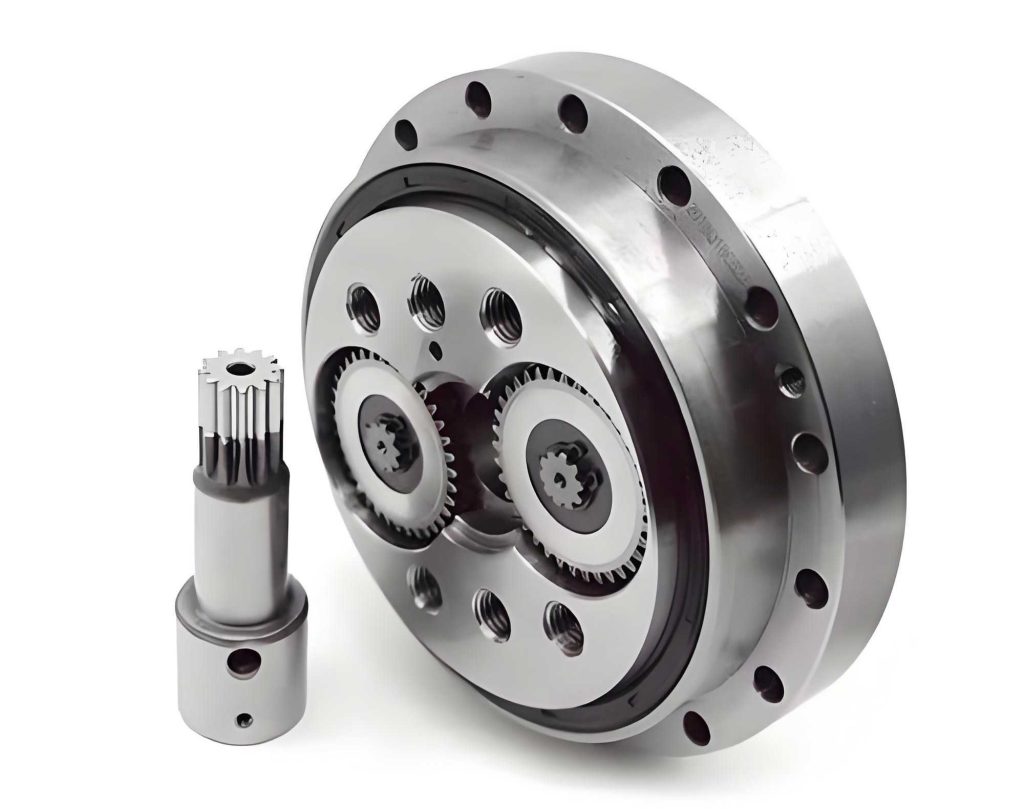
Based on the demanding operational conditions within the RV reducer—including high cyclic contact stresses, the need for wear resistance, and high fatigue strength—the material selection is critical. Through-G hardened bearing steel, such as AISI 52100 (equivalent to GCr15), is an excellent choice for the cycloidal gear. This steel grade, with its chromium content, offers high hardenability, allowing for the development of a uniformly hard and wear-resistant surface layer through heat treatment while maintaining a tough core. Its well-established processing characteristics make it suitable for the complex machining and heat treatment cycles required for precision components like the cycloidal gear in an RV reducer.
The machining of the cycloidal gear presents several specific challenges that dictate the process flow: achieving high precision on the central bore and bearing bores (including both size and positional tolerances), ensuring excellent parallelism and surface finish on the two end faces, accurately generating the complex cycloidal tooth profile, and managing the significant distortions induced by the necessary hardening heat treatments. To address these, a comprehensive process plan is designed and summarized in the table below.
| Process Step | Description | Primary Objective |
|---|---|---|
| 1. Precision Forging | Near-net-shape forming of the gear blank. | To achieve a dense, continuous grain flow for high strength and fatigue resistance, while minimizing subsequent machining stock. |
| 2. Isothermal Annealing | Controlled cooling to a specific temperature range and holding. | To soften the forged structure, relieve internal stresses, and produce a uniform spheroidized microstructure ideal for machining and subsequent hardening. |
| 3. Shot Blasting | Impact cleaning of the surface. | To remove scale and oxides from forging and annealing, preparing a clean surface for further operations. |
| 4. Through-Hardening (Quenching) | Austenitizing followed by rapid cooling (oil quench). | To transform the microstructure to martensite, achieving high and uniform bulk hardness (typically 58-62 HRC). |
| 5. Tempering | Reheating to a low temperature (e.g., 150-200°C). | To relieve quenching stresses, improve toughness, and stabilize dimensions. |
| 6. Rough Grinding | Initial grinding of end faces, bores, and tooth flanks. | To remove the majority of the post-heat-treatment stock and correct gross distortions. |
| 7. Finish Grinding | Precision grinding of all critical surfaces. | To achieve the final dimensional, geometric, and surface finish specifications required for the RV reducer assembly. |
| 8. Cleaning & Inspection | Final washing and metrological verification. |
A critical parameter in this sequence is the amount of stock left after heat treatment for the grinding operations. Insufficient stock risks leaving uncorrected distortion, leading to scrap. Excessive stock reduces productivity and increases grinding wheel wear. To rationally determine this grinding allowance, a simulation of the most distortion-prone step—quenching—is essential. Here, a coupled thermal-structural finite element analysis (FEA) using ANSYS provides invaluable insights into the stress and deformation behavior of the cycloidal gear during cooling.
The foundation of an accurate simulation is a proper geometric model and material definition. The complex cycloidal profile is generated parametrically using its defining equations and modeled in 3D CAD software before import into the FEA environment. The material properties of AISI 52100 steel, which are temperature-dependent, are crucial inputs. Key properties include thermal conductivity ($k$), specific heat ($C_p$), density ($\rho$), coefficient of thermal expansion ($\alpha$), and Young’s modulus ($E$). These can be represented as functions of temperature ($T$):
$$
k = k(T), \quad C_p = C_p(T), \quad \alpha = \alpha(T), \quad E = E(T)
$$
A simplified table of key properties at reference temperatures is shown below for the simulation setup.
| Temperature (°C) | Thermal Expansion $\alpha$ (10-6/°C) | Young’s Modulus E (GPa) | Thermal Conductivity k (W/m·°C) |
|---|---|---|---|
| 20 | 11.5 | 212 | 40.1 |
| 300 | 13.5 | 193 | 36.7 |
| 600 | 14.5 | 168 | 30.1 |
The quenching process is modeled as a transient heat transfer problem followed by a structural analysis. The initial condition sets the entire gear at the austenitizing temperature, $T_{initial} = 840^\circ C$. The boundary condition governs the heat extraction at the surface and is the most complex part of the model. The heat flux ($q$) from the gear surface to the quenchant (oil at $T_{\infty} = 60^\circ C$) is modeled primarily as convective heat transfer:
$$
q = h(T) \cdot (T_{surface} – T_{\infty})
$$
where $h(T)$ is the temperature-dependent heat transfer coefficient (HTC). For oil quenching, the HTC varies non-linearly, being high during the vapor phase and lower during the convective cooling phase. An approximation of the HTC curve is used, and an effective average value of $h \approx 840 \, W/(m^2 \cdot K)$ is applied to the model surfaces for this simulation.
The thermal analysis calculates the temperature history $T(x,y,z,t)$ at all points. This temperature field drives the structural analysis through thermal strains. The total strain $\epsilon_{total}$ is considered as the sum of elastic strain $\epsilon_{elastic}$, plastic strain $\epsilon_{plastic}$, and thermal strain $\epsilon_{thermal}$:
$$
\epsilon_{total} = \epsilon_{elastic} + \epsilon_{plastic} + \epsilon_{thermal}
$$
where the thermal strain is $\epsilon_{thermal} = \alpha \cdot \Delta T$. The resulting stress $\sigma$ is calculated from the elastic strain via Hooke’s law, considering the temperature-dependent modulus:
$$
\sigma = E(T) \cdot \epsilon_{elastic}
$$
The FEA results reveal critical patterns. The equivalent (von Mises) stress distribution after quenching shows peak stresses, often exceeding 150 MPa, concentrated at the root and tip regions of the cycloidal teeth and around the bores. These are areas of geometric discontinuity and stress concentration. More importantly for machining planning, the total deformation plot indicates the magnitude and location of distortion. The maximum displacement is typically found in the thin webs between the central bore and the bearing bores, or at the outer edges of the gear blank. For a gear of common dimensions, the simulated maximum deformation ranges from 0.12 mm to 0.18 mm.
This simulation provides a vital quantitative guide: the minimum grinding stock must exceed the predicted maximum deformation to ensure it can be fully removed. A practical rule derived from this analysis and empirical knowledge for the cycloidal gear in an RV reducer is to allocate a finishing allowance of approximately 2-3% of the critical dimensions on the diameter and face width. This ensures corrective capacity without being excessively wasteful.
Practical validation confirms the simulation trends. Actual quenched gears exhibit measurable warpage, primarily a bending or “dishing” distortion of the end faces, with magnitudes aligning with the simulated range (0.10-0.18 mm). This distortion arises from non-uniform cooling; areas with greater surface area or thinner sections cool and contract faster than bulkier sections, inducing bending moments. To combat this, process control during quenching is essential: gears should be fixtured or racked to ensure uniform oil flow on all surfaces, preventing stacking which creates localized cooling variations.
The final and crucial step for distortion control is tempering. While tempering relieves micro-stresses, it can also allow residual macro-stresses to further distort the component if it is not constrained. A dedicated tempering fixture is therefore highly recommended for the cycloidal gear of an RV reducer. This fixture applies a light, uniform clamping pressure across the two end faces of the gear during the tempering cycle. This mechanical constraint counteracts the bending tendency, effectively “training” the part to a flatter state as stresses are relieved. The use of such a fixture is a simple yet highly effective method to reduce final warp and minimize the stock removal required during subsequent grinding, directly enhancing the manufacturability and consistency of the RV reducer’s core component.
In conclusion, the path to manufacturing a high-performance cycloidal gear for an RV reducer involves a meticulously designed process chain anchored by precision forging and finishing grinding. The intermediate heat treatment step, while essential for performance, introduces significant distortion. The integration of finite element-based thermal-structural simulation into the process design phase provides a powerful tool to predict this deformation, enabling the scientific determination of grinding allowances and highlighting critical risk areas like thin webs and tooth roots. Furthermore, practical measures such as controlled quenching practices and the use of a constraining tempering fixture are indispensable for mitigating distortion. This combined approach of simulation-informed design and pragmatic process engineering is key to achieving the stringent precision and reliability requirements of the cycloidal gear, thereby contributing to the successful domestic production of high-quality RV reducers essential for advanced robotics and automation systems.