
The harmonic drive gear, a revolutionary transmission concept based on elastic deformation, offers unparalleled advantages in compactness, high reduction ratio, and precision. However, the traditional involute tooth profile often falls short in meeting the escalating demands for load capacity, stiffness, and positional accuracy in advanced applications such as robotics and aerospace. The double-circular-arc (DCA) tooth profile, characterized by its convex and concave circular arcs connected by a common tangent, presents a superior alternative. Its design significantly influences the meshing characteristics, including the conjugate zones and the geometry of the mating gear teeth. This article delves into the parametric design of the DCA profile for the flexspline, establishing its mathematical model and comprehensively analyzing the impact of key profile shape parameters and positioning parameters on the meshing performance of the harmonic drive gear. The goal is to provide a foundational understanding for optimizing the harmonic drive gear for superior transmission quality.
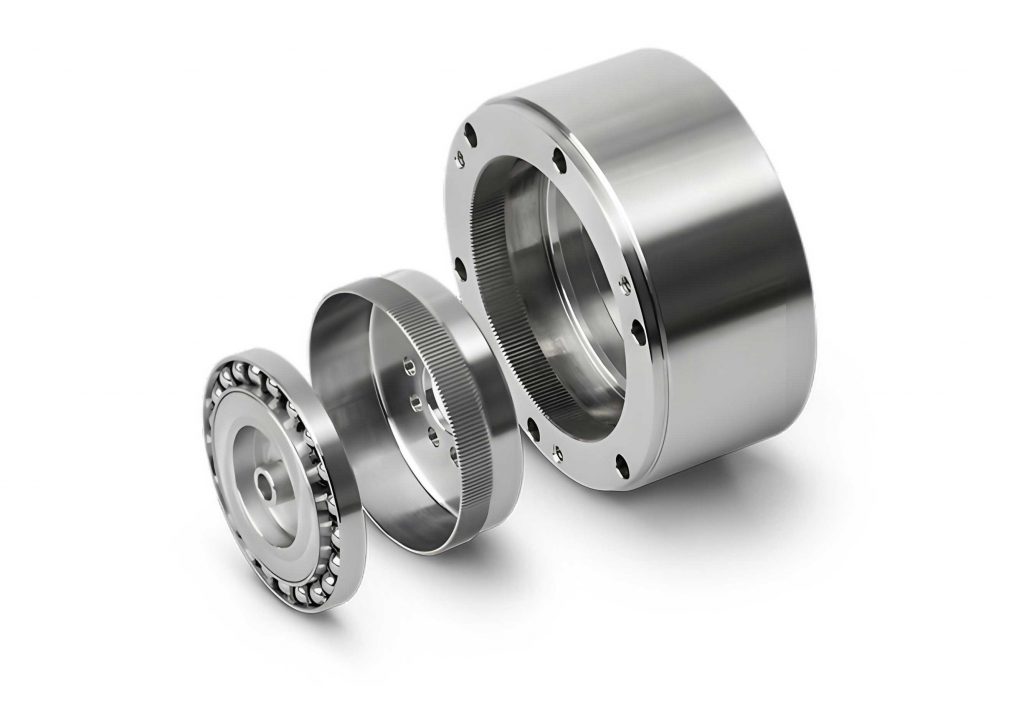
The core of a harmonic drive gear lies in the controlled elastic deformation of its flexspline by the wave generator, enabling multi-tooth meshing with the rigid circular spline. The shape of the flexspline’s tooth profile dictates the contact conditions, stress distribution, and kinematic accuracy throughout this process. The DCA profile, with its rounded contact surfaces, promotes favorable lubrication conditions, reduces contact stress, and increases the instantaneous contact ratio compared to pointed involute teeth. To analyze its performance, we first establish a precise geometric model. A coordinate system is attached to the flexspline tooth, with the Y-axis aligned to the tooth’s symmetry line and the X-axis tangent to the neutral curve of the flexspline cup at the origin. The profile is defined segment by segment using the arc length \(s\) as the parameter.
The convex arc segment \(AB\) is described by:
$$ \mathbf{r}_{AB}(s) = \begin{bmatrix} \rho_a \cos(\alpha_a – s/\rho_a) + x_a \\ \rho_a \sin(\alpha_a – s/\rho_a) + y_a \\ 0 \\ 1 \end{bmatrix}, \quad \mathbf{n}_{AB}(s) = \begin{bmatrix} \cos(\alpha_a – s/\rho_a) \\ \sin(\alpha_a – s/\rho_a) \\ 0 \\ 1 \end{bmatrix} $$
for \( s \in (0, l_1) \), where \(l_1 = \rho_a (\alpha_a – \delta_L)\). Here, \(\rho_a\) is the convex arc radius, \(\alpha_a = \arcsin((h_a + h_f + d_L/2 – y_a)/\rho_a)\), \(\delta_L\) is the common tangent inclination angle, and \(d_L\) is the cup wall thickness.
The common tangent segment \(BC\) is given by:
$$ \mathbf{r}_{BC}(s) = \begin{bmatrix} \rho_a \cos \delta_L + x_a + (s – l_1) \sin \delta_L \\ \rho_a \sin \delta_L + y_a – (s – l_1) \cos \delta_L \\ 0 \\ 1 \end{bmatrix}, \quad \mathbf{n}_{BC} = \begin{bmatrix} -\cos \delta_L \\ -\sin \delta_L \\ 0 \\ 1 \end{bmatrix} $$
for \( s \in (l_1, l_2) \), where \(l_2 = l_1 + (\rho_a + \rho_f) \tan \delta_L\).
The concave arc segment \(CD\) is defined as:
$$ \mathbf{r}_{CD}(s) = \begin{bmatrix} x_f – \rho_f \cos(\delta_L + (s – l_2)/\rho_f) \\ y_f – \rho_f \sin(\delta_L + (s – l_2)/\rho_f) \\ 0 \\ 1 \end{bmatrix}, \quad \mathbf{n}_{CD}(s) = \begin{bmatrix} -\cos(\delta_L + (s – l_2)/\rho_f) \\ -\sin(\delta_L + (s – l_2)/\rho_f) \\ 0 \\ 1 \end{bmatrix} $$
for \( s \in (l_2, l_3) \), where \(l_3 = l_2 + \rho_f (\arcsin((y_f + h_f)/\rho_f) – \delta_L)\) and \(\rho_f\) is the concave arc radius.
The meshing theory for the harmonic drive gear is based on the conjugate condition derived from the relative motion between the flexspline and the circular spline. Using a modified kinematic method, the condition for a point on the flexspline profile to be in contact with the circular spline profile at a specific rotation angle \(\alpha\) of the wave generator is expressed by the fundamental meshing equation. Solving this equation for the angle \(\alpha\) for all points along the profile arc length \(s\) reveals the conjugate zone—the range of wave generator angles where contact is theoretically possible for a given profile segment. The corresponding locus of points on the circular spline that mate with the flexspline profile is the conjugate tooth profile. For the DCA profile in a harmonic drive gear, analysis typically reveals two distinct conjugate zones (Zone 1 and Zone 2) during a meshing cycle, separated by a “blank zone” where no conjugate contact exists. This phenomenon leads to unique meshing characteristics like double-point conjugation (two points on the flexspline simultaneously contact the circular spline at one wave generator angle) and twice conjugation (one point on the flexspline contacts the circular spline at two different wave generator angles), which are crucial for enhancing load sharing and smoothness in the harmonic drive gear.
The performance of the harmonic drive gear is highly sensitive to the choice of DCA profile parameters. We can categorize these into Shape Parameters, defining the geometry of the un-deformed tooth, and Positioning Parameters, defining the tooth’s location relative to the flexspline’s neutral layer under load.
| Parameter | Type | Primary Influence on Conjugate Zone | Primary Influence on Conjugate Tooth Profile | General Optimization Trend* |
|---|---|---|---|---|
| Convex Arc Radius (\(\rho_a\)) | Shape | Reduces Zone 2 angle/interval; Zone 1 unchanged. | Increases Zone 1 radius; decreases Zone 2 radius/length. | Smaller values can enhance Zone 2 overlap and conjugation phenomena. |
| Concave Arc Radius (\(\rho_f\)) | Shape | Reduces Zone 2 angle/interval/length; Zone 1 length decreases. | Increases Zone 1 radius; Zone 2 largely unchanged. | Smaller values can increase Zone 2 engagement length. |
| Common Tangent Angle (\(\delta_L\)) | Shape | Dramatically increases blank zone; reduces Zone 1 & 2 intervals. | Rotates Zone 1 profile; shifts Zone 2 profile. | Smaller values are critical to minimize blank zone and maintain conjugation. |
| Common Tangent Length (\(h_l\)) | Shape | Increases Zone 1 angle, decreases Zone 2 angle; reduces blank zone. | Increases Zone 1 radius; shifts Zone 2 profile. | Optimal non-zero value balances zone sizes and minimizes blank zone. |
| Radial Deformation Coefficient (\(w^*_0\)) | Positioning | Dramatically increases blank zone; reduces intervals of both zones. | Shifts Zone 1 and Zone 2 profiles in opposite Y-directions. | Should be minimized to the practical limit for max. conjugation. |
| Cup Wall Thickness (\(d_L\)) | Positioning | Reduces blank zone; shifts engagement between zones. | Shifts both conjugate profiles along +Y axis. | Thicker walls generally improve meshing continuity. |
*Trend based on analyzed example; final optimization requires multi-objective consideration.
To illustrate these effects quantitatively, consider a harmonic drive gear with module \(m=0.3175\), 160 flexspline teeth, 162 circular spline teeth, and an elliptical wave generator. The base values for shape parameters are: \(\rho_a = 0.60\ mm\), \(\rho_f = 0.65\ mm\), \(\delta_L = 12^\circ\), \(h_l = 0.05\ mm\). The base positioning parameters are: radial deformation coefficient \(w^*_0 = 1.0\) and wall thickness \(d_L = 0.83\ mm\). The analysis below varies one parameter at a time while holding others constant.
1. Influence of Convex Arc Radius (\(\rho_a\)): Increasing \(\rho_a\) primarily affects the second conjugate zone. As \(\rho_a\) grows from 0.55 mm to 0.65 mm, the angular width and the arc length of engagement in Zone 2 decrease. The conjugate tooth profile in Zone 2 becomes smaller in radius and shorter. The blank zone remains unaffected. This suggests that a smaller \(\rho_a\) favors a larger Zone 2, potentially increasing the overlap where both conjugate zones are active, thereby promoting double-point contact in the harmonic drive gear.
2. Influence of Concave Arc Radius (\(\rho_f\)): Similar to \(\rho_a\), a larger \(\rho_f\) diminishes the second conjugate zone’s angular range and engaged arc length. Its effect on the conjugate profile is more pronounced in Zone 1, where the profile radius increases. For a harmonic drive gear designed to maximize the continuous engagement arc, a smaller \(\rho_f\) might be beneficial.
3. Influence of Common Tangent Angle (\(\delta_L\)): This is one of the most critical shape parameters for the harmonic drive gear. An increase in \(\delta_L\) catastrophically expands the blank zone, severely interrupting meshing continuity. While it slightly increases the angular range of Zone 2, it shrinks the angular interval for both zones where conjugation occurs. Therefore, maintaining a low \(\delta_L\) is essential for achieving seamless, uninterrupted power transmission in a harmonic drive gear.
4. Influence of Common Tangent Length (\(h_l\)): Introducing a tangent segment (increasing \(h_l\) from 0) redistributes the conjugate zones. It enlarges Zone 1’s angular range while shrinking Zone 2’s, but crucially, it reduces the blank zone, improving meshing continuity. The trade-off is a reduction in the total engaged arc length from the circular arcs. An optimal \(h_l\) exists that minimizes the blank zone without excessively compromising the conjugate arc lengths in the harmonic drive gear.
5. Influence of Radial Deformation Coefficient (\(w^*_0\)): This parameter, governing the magnitude of radial deflection imposed by the wave generator, has a drastic effect. A larger \(w^*_0\) greatly widens the blank zone and compresses both conjugate zones into narrower angular intervals, significantly reducing the potential for double-point and twice conjugation. Minimizing \(w^*_0\) to the lowest value that guarantees proper tooth separation and assembly is key to maximizing the conjugate zone width in a harmonic drive gear.
6. Influence of Cup Wall Thickness (\(d_L\)): A thicker wall shifts the neutral layer, altering the effective positioning of the tooth profile. Increasing \(d_L\) reduces the blank zone and subtly increases the potential for conjugation phenomena. It also causes an upward shift (in +Y direction) of the entire conjugate tooth profile on the circular spline. Adequate wall thickness is necessary not only for structural strength but also for favorable meshing geometry in the harmonic drive gear.
The interplay of these parameters defines the meshing quality. The ideal scenario for a high-performance harmonic drive gear is to have conjugate zones from Zone 1 and Zone 2 overlap or connect seamlessly, eliminating the blank zone. This maximizes the total arc of contact, promotes double-point meshing (increasing load capacity), and ensures twice meshing (improving kinematic accuracy and smoothness). The conjugate tooth profiles should be smooth, continuous, and generate favorable pressure angles.
| Parameter | Value Set 1 | Value Set 2 (More Optimal) | Observed Improvement |
|---|---|---|---|
| \(\rho_a\) (mm) | 0.65 | 0.55 | Larger Zone 2 engagement arc. |
| \(\rho_f\) (mm) | 0.75 | 0.60 | Increased Zone 2 length, better profile continuity. |
| \(\delta_L\) (deg) | 14 | 10 | Dramatically reduced blank zone. |
| \(h_l\) (mm) | 0.00 | 0.04 | Small blank zone, balanced zone sizes. |
| \(w^*_0\) | 1.2 | 0.9 | Wider conjugate zones, minimal blank zone. |
| \(d_L\) (mm) | 0.26 | 0.30 | Improved meshing continuity and structural integrity. |
In conclusion, the design of a double-circular-arc tooth profile for a harmonic drive gear is a sophisticated balancing act. Parameters like the convex and concave arc radii (\(\rho_a, \rho_f\)), the common tangent geometry (\(\delta_L, h_l\)), and the system positioning parameters (\(w^*_0, d_L\)) collectively determine the existence, extent, and characteristics of the conjugate meshing zones. The analysis demonstrates that targeted reduction of certain parameters—such as the arc radii, tangent angle, and radial deformation coefficient—while optimizing the tangent length and ensuring sufficient wall thickness, can effectively expand the conjugate zones, minimize or eliminate the non-conjugate blank zone, and enhance the valuable phenomena of double-point and twice meshing. This comprehensive parametric understanding is fundamental for engineers to tailor the harmonic drive gear for specific high-demand applications, ultimately achieving superior performance in terms of torque capacity, positional accuracy, torsional stiffness, and operational smoothness. The optimization must always be validated through detailed stress analysis and prototype testing to ensure the durability of the harmonic drive gear under real operating conditions.