
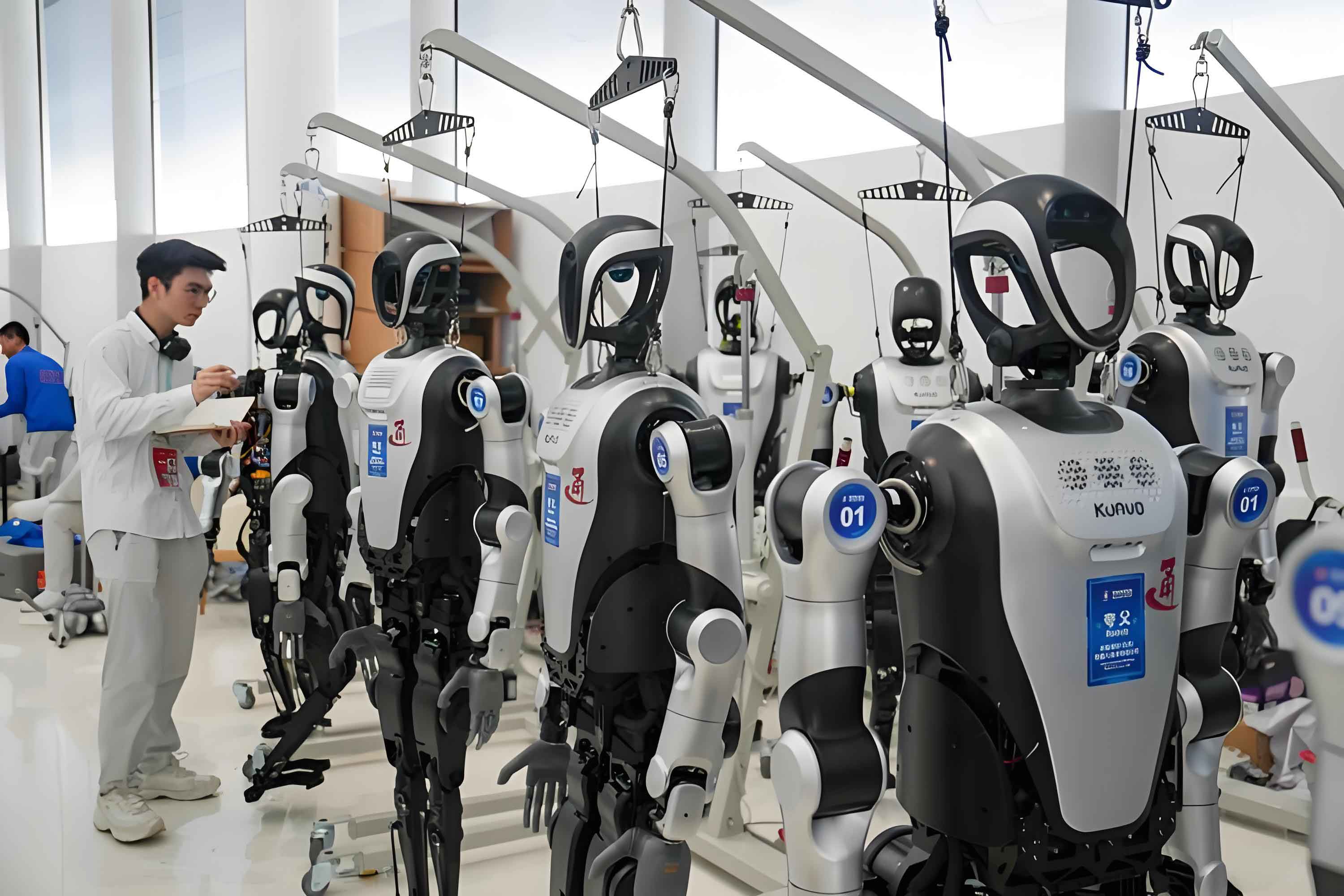
The rapid ascent of the robotics industry, particularly the strategic push towards advanced humanoid robots, presents a profound challenge and opportunity for higher education. As national strategies explicitly target breakthroughs in “brain, cerebellum, and limbs” technologies and the establishment of a secure industrial supply chain for humanoid robots, the demand for a new generation of engineers has never been more acute. The assertion that the market for humanoid robots may one day surpass that of the automotive industry underscores the scale of this impending transformation. However, a significant disconnect persists between the dynamic, systems-oriented needs of this frontier industry and the structure of traditional engineering curricula. Core courses, such as Fundamentals of Mechanical Design, often remain siloed in legacy content and pedagogical approaches, failing to equip students with the integrated design thinking, familiarity with modern components, and innovative prowess required to contribute meaningfully to humanoid robot development. This article, from my perspective as an educator deeply involved in this transition, outlines a comprehensive reform of the Mechanical Design Fundamentals course, recentering it entirely on the design process of humanoid robot products.
The Imperative for Change: Limitations of the Traditional Curriculum
Traditional Mechanical Design Fundamentals courses are typically organized as a series of discrete knowledge modules: structural analysis of planar mechanisms, planar linkage mechanisms, cams, intermittent motion mechanisms, threaded connections, belt drives, chain drives, gear drives, worm gears, gear trains, shafts and hub connections, bearings, couplings, clutches, brakes, and balancing. While foundational, this structure harbors critical shortcomings when viewed through the lens of modern humanoid robot engineering.
| Core Issue | Traditional Course Manifestation | Humanoid Robot Design Demand | Resulting Gap |
|---|---|---|---|
| Compartmentalized Knowledge | Chapters are treated as independent units with weak logical connections. | Requires a top-down, systems engineering approach where design tasks are decomposed from the whole system. | Students lack holistic design thinking and the ability to trace requirements from system-level performance down to component selection. |
| Outdated & Incomplete Content | Focus on classical components (e.g., V-belts, standard deep-groove ball bearings). | Relies heavily on modern components like harmonic drives, cycloidal drives, precision roller screws, crossed roller bearings, timing belts, and parallel manipulators. | Graduates are unfamiliar with key technologies that are standard in modern humanoid robot actuation and structure. |
| Theory-Practice Disconnect | Analytical and graphical design methods are emphasized over computational tools. | Industry standard practice involves extensive use of CAD, CAE, and multi-body dynamics software (e.g., SOLIDWORKS, ANSYS, ADAMS). | Students are not proficient in the digital tools essential for contemporary design, analysis, and iteration. |
| Neglect of Innovation Cultivation | Historical context is minimal; focus is on understanding existing mechanisms, not inventing new ones. | Innovation in actuation (e.g., proprioceptive actuators, quasi-direct drives), materials, and bionic structures is driving the field forward. | The course does not actively foster the creative and innovative mindset necessary for breakthrough design. |
| Fragmented Learning Journey | Theory lectures, lab sessions, and the capstone course design project are often poorly aligned. | Real-world design is an iterative continuum from concept modeling and simulation to detailed component design and prototyping. | Learning experiences are disjointed, preventing students from synthesizing knowledge into a coherent design capability. |
These gaps create a precarious situation where the educational pipeline risks producing graduates ill-prepared for the realities of the very industry they are meant to serve. The reform proposed here is not merely an update but a fundamental re-orientation of the course’s philosophy, structure, and delivery.
Reconstructing the Theoretical Framework: A Humanoid Robot-Centric Approach
The cornerstone of this reform is the complete restructuring of the course sequence around the canonical design workflow for a humanoid robot. We abandon the bottom-up, component-first approach in favor of a top-down, system-first methodology. The curriculum narrative follows the engineer’s logical progression: from defining application scenarios and conceptualizing the whole-body model, to performing system-level analysis, and finally down to the detailed design of critical subsystems like the joint actuators.
The entire course is framed as a journey to design two archetypal platforms: a full-size, high-power humanoid robot and a smaller, agile research or service humanoid robot. This duality allows us to explore different technical solutions (e.g., high-ratio reducers vs. quasi-direct drive) within the same conceptual framework.
| Design Phase | Course Modules & Content | Specific Knowledge & Skills | Modern Design Tools Introduced | Pedagogical Goal |
|---|---|---|---|---|
| 1. System Definition & Conceptual Design | • Introduction to Humanoid Robots & Design Challenges • Planar Mechanism Structural Analysis • Planar Linkage Mechanisms (for limb conceptualization) |
• Defining DOF, workspace, and performance specs. • Calculating mobility (Grübler’s criterion) for simplified limb models. • Synthesizing simple linkage structures for arms/legs. |
• SOLIDWORKS / Fusion 360 (Basic 3D sketching & assembly) | To establish the “big picture” and introduce the language of mechanical systems from day one, applied directly to a humanoid robot context. |
| 2. System-Level Modeling & Analysis | • Belt & Chain Drives (potential for tendon-driven or transmission design) • Cam Mechanisms (for specialized motions) • Screw Mechanisms (for linear actuators or load-bearing structures) |
• Selecting transmission elements for conceptual designs. • Understanding force and motion transmission at a system level. • Creating a preliminary mass-property model of the robot. |
• SOLIDWORKS (Mass properties, simple motion studies) • MATLAB/Simulink (for initial kinematic calculations) |
To translate concepts into parameterized models and understand early-stage trade-offs in transmission and actuation. |
| 3. Detailed Actuator & Joint Design (The Core) | • Gear Drives (Spur, Helical, Bevel) • Advanced Gear Systems (Harmonic, Cycloidal, Planetary Trains) • Shafts, Keys, and Splines • Rolling Contact Bearings (including Crossed Roller Bearings) • Journal Bearings & Lubrication • Couplings, Clutches, and Brakes • Rotor Balancing |
• Designing gearboxes for required torque/speed. • Analyzing and selecting specialized reducers for humanoid robot joints. • Designing shafts for complex loading. • Selecting bearings for combined loads and compactness. • Integrating motors, sensors, and brakes into a joint assembly. |
• Kisssoft (Gear design & optimization) • ANSYS Static/Modal Analysis (Shaft/Bearing validation) • Maxwell (Motor electromagnetic basics) • Python (Scripting for design calculations) |
To provide deep, applied knowledge of the core mechanical components that form the muscle and skeleton of a humanoid robot. |
This sequence creates a compelling narrative. Students begin by asking, “What should my humanoid robot do?” and end by knowing how to design the gear train inside its knee joint to achieve that performance. Each new topic is motivated by a clear need arising from the larger design project.
Integrating Modern Analysis and Design Tools
A key failure of traditional courses is the omission of modern digital tools. In this reformed course, software is not an add-on but an integral part of the learning process for analyzing humanoid robot systems.
System Dynamics & Simulation: Early in the course, students use multi-body dynamics software to analyze their preliminary humanoid robot models. This drives home the importance of mass distribution and inertia. For a simplified leg model, the equations of motion from Lagrange’s formulation might be explored:
$$ \frac{d}{dt} \left( \frac{\partial L}{\partial \dot{q}_i} \right) – \frac{\partial L}{\partial q_i} = \tau_i $$
where \( L = T – V \) is the Lagrangian, \( T \) is kinetic energy, \( V \) is potential energy, \( q_i \) are the generalized coordinates (joint angles), and \( \tau_i \) are the generalized forces (joint torques). Students learn that the required joint torque \( \tau_i \) is a function of the desired acceleration, gravity, and inertial coupling terms—directly informing motor and reducer selection.
Structural Optimization: When covering materials and stress analysis, we introduce Finite Element Analysis (FEA) for lightweighting. The goal is to minimize the mass \( m \) of a link subject to stress \( \sigma \) and deflection \( \delta \) constraints:
$$ \text{Minimize: } m = \int_V \rho \, dV $$
$$ \text{Subject to: } \sigma_{\text{max}} \leq \sigma_{\text{yield}}/SF, \quad \delta_{\text{max}} \leq \delta_{\text{permissible}} $$
This makes the abstract concept of “strength-to-weight ratio” a tangible, computable objective crucial for a humanoid robot’s energy efficiency and dynamic performance.
Kinematic Configuration Optimization: For designing arm or leg linkages, students use matrix transformations and computational tools to optimize for workspace. The forward kinematics of a serial chain are expressed as:
$$ ^0T_n = ^0T_1(\theta_1) \cdot ^1T_2(\theta_2) \cdots ^{(n-1)}T_n(\theta_n) $$
They can script analyses in Python or MATLAB to evaluate how different link lengths (Denavit-Hartenberg parameters) affect the reachable space of their humanoid robot’s limb, directly connecting mechanism theory to practical design choice.
Expanding Content: The Modern Humanoid Robot Component Palette
The course dedicates significant time to components that are ubiquitous in modern robotics but absent from traditional textbooks.
Harmonic Drives & Cycloidal Drives: We derive their unique motion principles. For a harmonic drive, the gear reduction ratio \( i \) is given by:
$$ i = -\frac{N_f}{N_f – N_s} $$
where \( N_f \) is the number of teeth on the flexspline and \( N_s \) on the circular spline. The negative sign indicates opposite rotation direction. We discuss their exceptional advantages—high reduction ratio in a compact stage, zero-backlash, high torque capacity—and their trade-offs, such as torsional stiffness and the presence of kinematic error, which are critical considerations for precise humanoid robot control.
Crossed Roller Bearings & Rotary Actuators: These are presented as the optimal solution for supporting moment loads in humanoid robot joints, such as hips and shoulders. Their compactness and ability to handle combined radial, axial, and moment loads are compared against traditional bearing pairs.
Timing Belt & Cable-Driven Transmission: We analyze them not just as simple power transmission elements, but as key technologies for implementing tendon-driven actuation or remote motor placement to reduce limb inertia—a vital concept in dynamic humanoid robot design.
| Joint Type (Humanoid Robot Application) | Typical Drive Solution | Key Mechanical Components Involved | Primary Course Module for Detailed Study |
|---|---|---|---|
| High-Torque Joint (Hip, Knee, Ankle of large humanoid robot) | High-torque motor + High-ratio reducer (Harmonic/Cycloidal) | Harmonic/Cycloidal Reducer, Crossed Roller Bearing, Output Shaft, Casing | Advanced Gear Systems, Bearings, Shaft Design |
| Quasi-Direct Drive Joint (Agile leg joint of small humanoid robot) | High-torque-density motor + Low-ratio planetary gear or direct drive | Planetary Gearbox (low ratio), High-performance Bearings, Torque Sensor Integration | Gear Drives (Planetary), Shafts, Couplings |
| Compact Wrist/Shoulder Joint | Motor + Miniature Planetary or Custom Spur Gear Train | Spur/Helical Gears, Deep Groove Ball Bearings, Compact Housing | Gear Drives, Bearing Selection, Housing Design |
Fostering Innovation: Building the Creative Engineer
Moving beyond knowledge transmission to innovation cultivation is a central pillar of this reform. We explicitly integrate several strategies to build students’ creative capacity.
1. Teaching the History of Technology & Innovation Tools: We examine the evolution of humanoid robot joint technology, from rigid force-controlled joints to series elastic actuators (SEA) and the recent shift towards quasi-direct drive. Understanding this history—the “why” behind each shift—helps students anticipate future trends. Furthermore, we introduce formal innovation methodologies like TRIZ (Theory of Inventive Problem Solving). Students learn to apply tools like the “Final Ideal Result” or “Contradiction Matrix” to solve mechanical design challenges for humanoid robots, such as increasing joint power density without increasing size or weight.
2. Research-Led Teaching: Current research frontiers are brought directly into the classroom. For instance, when discussing gear design, the concept of novel gear geometries (like non-circular gears or face gears for compact differentials) is presented not as a solved problem, but as an active research area with potential applications in humanoid robot actuation. This exposes students to the cutting edge and demonstrates that textbook knowledge is a foundation, not a ceiling.
3. Innovative Design Assignments: Alongside traditional calculation-based homework, students are given open-ended, innovation-focused assignments. A prompt might be: “Propose a novel actuation or transmission concept for a humanoid robot shoulder joint that improves workspace or reduces inertia. Use TRIZ principles to guide your concept generation. Provide a simplified sketch and a qualitative analysis of advantages/disadvantages.”
A Coherent Learning Pathway: From Theory to Competition
To solve the fragmentation problem, we meticulously align all course activities—theory, labs, the final project, and extracurricular competitions—along the single narrative of humanoid robot design.
Revised Laboratory Sessions: Labs are transformed from passive observation to active, tool-driven investigation.
- Lab 1 (Modern Component Cognition): Instead of static models, students disassemble and inspect actual harmonic drive reducers, cycloidal speed reducers, and crossed roller bearings, comparing them to catalog specifications.
- Lab 2 (Kinematic Analysis with Software): Students use SOLIDWORKS or a dedicated kinematics tool to model a 3-DOF robotic arm, derive its Denavit-Hartenberg parameters, and simulate its workspace, replacing manual drawing of mechanism sketches.
- Lab 3 (Gearbox Design & Analysis): Using Kisssoft or similar, students design a two-stage spur gear reducer for a specified humanoid robot joint torque/speed requirement, performing stress and safety factor calculations digitally: $$ S_F = \frac{\sigma_{HG}}{\sigma_H} \quad \text{(Contact Safety Factor)}, \quad S_H = \frac{\sigma_{FG}}{\sigma_F} \quad \text{(Bending Safety Factor)} $$
- Lab 4 (FEA for Lightweighting): Students take a simple bracket model for a humanoid robot limb and use ANSYS or Fusion 360 FEA to perform a topology optimization study, visually seeing how material is strategically removed to minimize mass while maintaining stiffness.
Transformed Capstone Course Design: The semester-final project is no longer a generic gearbox. The task is now: “Design a detailed electromechanical joint module for a humanoid robot.” Students must:
- Choose a joint (e.g., elbow, knee) and define specifications from a system-level dynamics analysis.
- Select and size a motor and reducer (harmonic, planetary, etc.).
- Design the shaft, housing, and bearing arrangements.
- Integrate considerations for sensors (encoder, torque) and sealing.
- Create detailed CAD models, assembly drawings, and a bill of materials.
- Perform verification calculations using both classical formulas and digital tools.
This project mirrors real-world engineering tasks for humanoid robot development, requiring synthesis of virtually every topic in the course.
Gateway to Disciplinary Competitions: The course explicitly prepares students for and encourages participation in major robotics competitions. The skills learned—3D modeling, actuator selection, transmission design, system thinking—are directly applicable in contests like RoboCup Humanoid League, the RAICOM (RoboCom) Humanoid events, or the National University Robot Competition. Success in these competitions becomes a powerful validation of the integrated learning approach.
| Learning Activity | Traditional Focus | Reformed, Humanoid Robot-Centric Focus | Outcome & Synthesis |
|---|---|---|---|
| Theory Lectures | Abstract principles of components. | Principles applied within the design flow of a humanoid robot. | Provides the “why” and foundational knowledge. |
| Laboratory Work | Observation, manual graphing, simple disassembly. | Hands-on analysis of modern components; use of CAD/CAE for design validation. | Builds practical skill with tools and real hardware. |
| Course Design Project | Design a standard speed reducer. | Design a complete, specified humanoid robot joint module. | Synthesizes all knowledge into a complex, realistic product design. |
| Extracurricular Pathway | Optional, disconnected. | Directed preparation for humanoid robot-focused学科 competitions. | Applies learning in a competitive, team-based, systems-integration environment. |
Implementing a Multidimensional Assessment System
A reformed course requires a reformed assessment strategy that values the full spectrum of developed competencies, not just memorization. The traditional 60/20/20 split (final exam/classwork/homework) is replaced by a more holistic model.
| Assessment Dimension | Weight | Assessment Method & Content | Measured Competency |
|---|---|---|---|
| Fundamental Knowledge & Analysis | 50% | Final Theory Examination (40%): Problems requiring calculation and analysis applied to humanoid robot design scenarios (e.g., “Select bearings for a hip joint given loading conditions…”). Regular Homework (10%): Traditional problem sets ensuring mastery of core calculations. |
Depth of technical understanding and ability to apply core formulas. |
| Engagement & Collaboration | 10% | Classroom Performance: Participation in discussions, quality of in-class problem-solving, and peer collaboration. | Professional communication and teamwork skills. |
| Innovation Capacity | 20% | Innovation Design Assignments (20%): Evaluation of the creativity, technical feasibility, and justification of solutions for open-ended humanoid robot design challenges. | Ability to think creatively, use innovation tools, and propose novel concepts. |
| Practical & Synthesis Ability | 20% | Laboratory Reports (10%): Quality of analysis, tool proficiency, and insights from modern component and software labs. Course Design Project (10%): Completeness, technical accuracy, and quality of the final humanoid robot joint design report, CAD models, and presentations. |
Proficiency with modern engineering tools and the capstone ability to synthesize knowledge into a complete design. |
This system sends a clear message: success in this course, and by extension, as a future humanoid robot engineer, requires not only knowing the equations but also knowing how to innovate, use modern tools, and integrate knowledge into a functional design. Notably, participation and excellence in relevant disciplinary competitions can be used as a bonus component or as validation for high scores in the Innovation and Practical ability categories.
Conclusion: Educating the Engineers of the Humanoid Robot Era
The strategic importance of humanoid robots is clear, and the window for establishing educational leadership in this field is now. The traditional mechanical design curriculum, while filled with valuable fundamentals, is structurally misaligned with the systems engineering, innovation-driven, and tool-intensive nature of modern humanoid robot development. The reform outlined here—centering the entire Mechanical Design Fundamentals course on the humanoid robot product design process—provides a coherent framework to bridge this gap. By reconstructing the theory sequence, integrating indispensable modern components and digital tools, forging a seamless path from theory to practice and competition, actively cultivating innovation, and implementing a competency-based assessment model, we can transform how future engineers are trained. This approach does not discard foundational principles but rather re-contextualizes them within the most exciting and demanding mechanical design challenge of our time: creating capable, reliable, and ultimately, useful humanoid robots. The success of such educational reforms will be a critical factor in realizing the ambitious national and industrial visions for a world transformed by advanced humanoid robotics.