
This article focuses on the critical aspect of tooth profile design for circular-arc harmonic drive gears and the subsequent optimization of meshing backlash. Harmonic drive transmissions are renowned for their high reduction ratios, compact size, lightweight construction, and exceptional positional accuracy, making them indispensable in fields such as aerospace, robotics, and precision instrumentation. The core of their operation lies in the elastic deformation of a flexible spline, or flexspline, induced by a wave generator. This deformation enables multi-tooth engagement, distributing the load and enhancing torque capacity. The geometry of the tooth profile on both the flexspline and the circular spline is paramount to achieving smooth, efficient, and low-backlash motion transmission. While profiles have evolved from straight-sided to involute, the circular-arc profile offers significant advantages, including improved manufacturability and reduced stress concentration at the tooth root of the flexspline due to a wider tooth space.
The primary objective here is to establish a comprehensive methodological framework. First, we will derive the conjugate tooth profiles for both the flexspline and circular spline based on the kinematics of the wave generator. Second, we will develop a precise analytical model for the meshing backlash between these circular-arc profiles. Finally, we will formulate and solve an optimization problem to minimize this backlash under a set of practical geometric constraints, thereby maximizing the potential transmission accuracy and stiffness of the harmonic drive gear system.
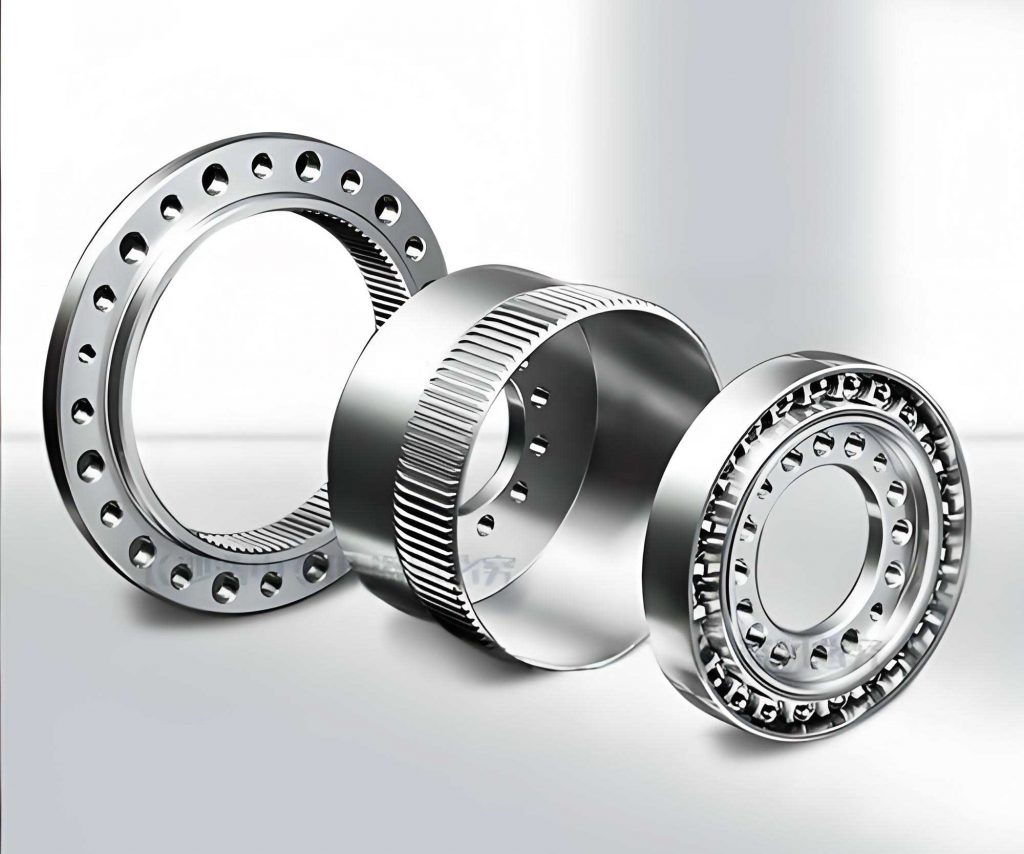
Fundamentals of Harmonic Drive Gearing
A standard harmonic drive gear comprises three key components: a rigid Circular Spline (CS), a flexible Flexspline (FS), and an elliptical Wave Generator (WG). The wave generator, often an elliptical cam, is inserted into the flexspline, causing its initially circular rim to deform into an elliptical shape. The flexspline typically has two fewer teeth than the circular spline. As the wave generator rotates, the points of major axis engagement between the two splines travel around the circumference. This relative motion, where the flexspline teeth engage and disengage with the circular spline teeth, results in a very high reduction ratio between the wave generator’s input and the flexspline’s output.
The kinematic interaction can be understood by considering pitch curves. The deformed neutral curve of the flexspline is its elastic pitch curve. For perfect rolling contact without slip, this curve must maintain the same arc length as the original, undeformed flexspline pitch circle. The circular spline’s pitch circle is rigid. The conjugate action requires that the tooth profiles on both splines are derived from the relative motion dictated by these pitch curves.
Conjugate Circular-Arc Tooth Profile Design
1.1 Kinematic Model and Flexspline Displacement
We begin by analyzing the kinematics. Let the elastic pitch curve of the flexspline under load be described in polar coordinates by $ρ = ρ(φ_1)$, where $φ_1$ is the angular parameter on the flexspline. The circular spline pitch circle has a constant radius $r_2$. The original, undeformed flexspline pitch circle has a radius $r_3$.
For a point $A_1$ on the flexspline pitch curve that rotates to a contact point $P$, the arc lengths traveled from both the flexspline pitch curve and the circular spline pitch circle must be equal for pure rolling. This leads to the relationship for the rotation angle of the circular spline, $φ_2$:
$$
φ_2 = \frac{1}{r_2} \int_{0}^{φ_1} \sqrt{ρ^2 + (ρ’)^2} \, dφ_1
$$
where $ρ’ = dρ/dφ_1$. The instantaneous transmission ratio $i_{32} = ω_3/ω_2$ (flexspline to circular spline) is then:
$$
i_{32} = \frac{dφ_3}{dφ_2} = \frac{r_2}{r_3}
$$
The tooth profile of the flexspline must conform to the elastic deformation. For any point $A_1$ on its pitch curve, the deformation consists of a tangential displacement $S_t$ and a normal displacement $S_n$. The locus of points formed by these displacements defines the desired flexspline tooth profile.
Through geometric analysis of the contacting pitch curves, these displacements are derived as:
$$
S_t = r_2 \sin(\mu + θ) – ρ \sin \mu
$$
$$
S_n = ρ \cos \mu – r_2 \cos(\mu + θ)
$$
where:
• $μ = \arctan(ρ’ / ρ)$ is the angle between the radial line and the normal to the pitch curve.
• $θ = φ_1 – φ_2$ is the kinematic angular shift.
1.2 Flexspline Profile for an Elliptical Wave Generator
For a standard elliptical cam wave generator, the flexspline’s pitch curve is approximated as an ellipse. Let $a$ and $b$ be the semi-minor and semi-major axes, respectively. The ellipse equation is:
$$
ρ(φ_1) = \frac{ab}{\sqrt{b^2 \sin^2 φ_1 + a^2 \cos^2 φ_1}}
$$
The major axis $b$ is related to the nominal radius and the maximum radial deformation $ω_0$: $b = r_3 + ω_0$. Enforcing the condition of constant arc length (the perimeter of the ellipse equals the circumference of the original pitch circle $2πr_3$) allows us to solve for the minor axis $a$. Using an approximate elliptic perimeter formula:
$$
\int_{0}^{2π} \sqrt{ρ^2 + (ρ’)^2} \, dφ_1 ≈ 2πa + 4(b – a) = 2πr_3
$$
Solving gives:
$$
a = r_3 – \frac{2}{π – 2} ω_0
$$
With $ρ(φ_1)$ and its derivative known, $μ$, $θ$, and subsequently $S_t(φ_1)$ and $S_n(φ_1)$ can be calculated for $0 ≤ φ_1 ≤ π/2$. The flexspline tooth profile is then generated by plotting $S_n$ against $S_t$ or by fitting coordinates. A sample calculation for an elliptical wave generator is shown below.
| $φ_1$ (rad) | $ρ$ (mm) | $μ$ (rad) | $θ$ (rad) | $S_t$ (mm) | $S_n$ (mm) |
|---|---|---|---|---|---|
| 0 | 50.875 | 0.000 | 0.0000 | 0.000 | 0.256 |
| π/12 | 50.779 | -0.014 | 0.0018 | 0.087 | 0.353 |
| π/6 | 50.520 | -0.024 | 0.0061 | 0.297 | 0.617 |
| π/4 | 50.173 | -0.027 | 0.0144 | 0.710 | 0.972 |
| π/3 | 49.833 | -0.023 | 0.0263 | 1.315 | 1.311 |
| 5π/12 | 49.586 | -0.013 | 0.0394 | 1.994 | 1.531 |
| π/2 | 49.500 | 0.000 | 0.0501 | 2.561 | 1.567 |
1.3 Derivation of the Conjugate Circular Spline Profile
The circular spline profile is the envelope of the family of flexspline tooth profiles during the meshing motion. Let a coordinate system $D_1 \{ X_1, Y_1, O_1 \}$ be attached to the flexspline tooth, with its origin $O_1$ at the pitch point $A_1$, and the $Y_1$-axis aligned with the tooth’s normal direction. The flexspline profile $S_1$ is defined here as a circular arc of radius $r$, with its center offset by $(l_a, X_a)$ in this coordinate system. The profile equation is:
$$
\mathbf{r}_1 = \begin{bmatrix} r \cos α_M – l_a \\ r \sin α_M – X_a \\ 0 \\ 1 \end{bmatrix}
$$
where $α_M$ is the pressure angle variable at a potential contact point $M$.
The coordinate system $D_2 \{ X_2, Y_2, O_2 \}$ is fixed to the circular spline, with its origin at the gear center $O$. The transformation matrix $\mathbf{M}_{21}(φ_1)$ maps coordinates from $D_1$ to $D_2$. The family of surfaces of $S_1$ in $D_2$ is:
$$
\mathbf{r}_2′(φ_1, α_M) = \mathbf{M}_{21}(φ_1) \cdot \mathbf{r}_1(α_M)
$$
The conjugate profile $S_2$ on the circular spline is the envelope of this family, found by simultaneously satisfying the meshing equation:
$$
\mathbf{n}_1^T \cdot \mathbf{B}(φ_1) \cdot \mathbf{r}_1 = 0
$$
where $\mathbf{n}_1 = [\cos α_M, \sin α_M, 0, 0]^T$ is the unit normal to the flexspline profile $S_1$, and $\mathbf{B}(φ_1)$ is the meshing matrix specific to the harmonic drive kinematics. Solving the meshing equation for $α_M$ for each $φ_1$, and substituting back into $\mathbf{r}_2’$, yields discrete points $(x_2′, y_2′)$ of the conjugate circular spline tooth profile, which can then be fitted.
| $φ_1$ (rad) | $α_M$ (rad) | $x_2’$ (mm) | $y_2’$ (mm) |
|---|---|---|---|
| 0 | 0.000 | -0.20 | 50.778 |
| π/12 | 1.5385 | 13.65 | 49.392 |
| π/6 | 1.5342 | 23.37 | 41.230 |
| π/4 | 1.5270 | 36.04 | 35.260 |
| π/3 | 1.5370 | 42.26 | 21.340 |
| 5π/12 | 1.5422 | 46.33 | 12.680 |
| π/2 | 1.5590 | 49.50 | 0.055 |
Meshing Backlash Modeling and Optimization
2.1 Definition and Analytical Model of Backlash
In the context of harmonic drive gears, meshing backlash refers to the minimum gap between non-contacting but potentially interacting tooth surfaces of the flexspline and circular spline. Excessive backlash increases positional error and reduces torsional stiffness, while insufficient backlash can lead to jamming or excessive wear. Therefore, its precise calculation and minimization are crucial for high-performance applications.
Consider two conjugate surfaces $S_1$ (flexspline) and $S_2$ (circular spline) in contact at point $M$. The common unit normal vector $\mathbf{n}_1$ points from the material of the flexspline tooth into the void. On the common tangent plane at $M$, choose an arbitrary direction $\alpha$. Let $T_1$ and $T_2$ be the normal sections of $S_1$ and $S_2$ in the $\alpha$ direction. Take points $Q_1$ on $T_1$ and $Q_2$ on $T_2$ such that the line $Q_1Q_2$ is parallel to $\mathbf{n}_1$. The distance $d = \overline{Q_1Q_2}$ along $\mathbf{n}_1$ is defined as the local backlash in the $\alpha$ direction at $M$.
Using second-order Taylor expansion and considering that the projections of the arc increments onto the tangent plane are equal ($\Delta s_1 = \Delta s_2 = \rho$), the backlash $d$ can be expressed as:
$$
d = \frac{1}{2} K_{12}^{\alpha} \cdot \rho^2
$$
where $K_{12}^{\alpha}$ is the induced normal curvature of surface $S_2$ relative to surface $S_1$ in the $\alpha$ direction. This is a fundamental result from differential geometry of gear meshing. For a harmonic drive gear with circular-arc profiles, applying Willis’ theorem and Euler’s formula, the induced curvature can be derived in terms of key geometric parameters:
$$
K_{12}^{\alpha} = \frac{\sin α_M \cdot \sin^2(2μ)}{h}
$$
where $h$ is the total tooth depth of the flexspline profile. Substituting back, the backlash model becomes:
$$
d(α_M, μ, h, ρ) = \frac{\sin α_M \cdot \sin^2(2μ)}{2h} \cdot \rho^2
$$
Here, $ρ$ represents the arc length increment $\Delta s_1$ on the flexspline tooth surface from the contact point $M$.
2.2 Optimization Problem Formulation
To achieve optimal performance of the harmonic drive gear, we aim to minimize the meshing backlash $d$ subject to practical design constraints. Based on the derived model, we select four primary design variables:
$$
\mathbf{X} = [α_M, \ h, \ μ, \ ρ]^T
$$
Objective Function:
Minimize the backlash:
$$
\min f(\mathbf{X}) = \frac{\sin α_M \cdot \sin^2(2μ)}{2h} \cdot ρ^2
$$
Constraints:
1. Non-Interference Condition: To avoid curvature interference, the induced normal curvature must be non-negative: $K_{12}^{\alpha} ≥ 0 \implies \frac{\sin α_M \cdot \sin^2(2μ)}{h} ≥ 0$.
2. Angular Range: The parameter $φ_1$ defining the meshing zone lies between the major and minor axes: $0 ≤ φ_1 ≤ π/2$.
3. Pressure Angle Limit: For circular-arc profiles typical in harmonic drives, the pressure angle is limited: $α_M ≤ 25° \ (≈5π/36 \ \text{rad})$.
4. Tooth Depth Limit: The full tooth depth is generally related to the module $m$: $h ≤ 2.2m$.
5. Arc Increment Limit: The considered arc length on the tooth flank is bounded: $0 ≤ ρ ≤ 0.6 \ \text{mm}$.
6. Normal Tilt Angle Limit: The flexspline tooth normal rotation is small: $μ ≤ 0.1 \ \text{rad}$.
This forms a nonlinear constrained optimization problem that can be solved using appropriate numerical algorithms, such as sequential quadratic programming (SQP) or interior-point methods.
Case Study and Validation
To validate the proposed methodology for the design and optimization of a circular-arc harmonic drive gear, a specific case is examined.
Basic Parameters:
• Wave Generator: Standard elliptical cam.
• Max Radial Deformation, $ω_0$: 0.5 mm.
• Module, $m$: 0.5.
• Transmission Ratio, $i_{32}$: 1.015 (Flexspline output / Circular spline fixed).
• Flexspline Pitch Radius, $r_3$: 50.375 mm.
Step 1: Kinematic and Geometric Parameters.
From $i_{32} = r_2 / r_3$, the circular spline pitch radius is $r_2 = r_3 \times 1.015 = 51.131 \ \text{mm}$.
The major semi-axis of the deformed ellipse: $b = r_3 + ω_0 = 50.875 \ \text{mm}$.
Applying the constant perimeter condition: $a = r_3 – \frac{2}{π-2} ω_0 ≈ 49.499 \ \text{mm}$.
Step 2: Flexspline Profile Generation.
Using the equations for $ρ(φ_1)$, $μ(φ_1)$, $θ(φ_1)$, $S_t(φ_1)$, and $S_n(φ_1)$, the flexspline tooth profile coordinates are calculated as shown in the first table above and fitted to define the working profile.
Step 3: Circular Spline Profile Generation.
Assuming a circular-arc flexspline tooth with $r=0.6$ mm, $l_a=0.4$ mm, $X_a=0.1$ mm in its local coordinate system $D_1$, the conjugate circular spline profile points are computed via the transformation and meshing equations, yielding coordinates like those in the second table above.
Step 4: Backlash Optimization.
Solving the formulated optimization problem for the designed harmonic drive gear system yields the optimal set of design variables that minimize backlash while satisfying all constraints:
| Design Variable | Symbol | Optimal Value |
|---|---|---|
| Contact Point Pressure Angle | $α_M$ | 0.165 rad (~9.45°) |
| Flexspline Total Tooth Depth | $h$ | 0.686 mm |
| Flexspline Tooth Normal Rotation | $μ$ | 0.009 rad |
| Tooth Surface Arc Increment | $ρ$ | 0.725 mm |
With these optimal parameters, the minimized backlash value is:
$$
d_{\min} = \frac{\sin(0.165) \cdot \sin^2(2 \times 0.009)}{2 \times 0.686} \cdot (0.725)^2 ≈ 1.88 \times 10^{-5} \ \text{mm}
$$
This extremely small theoretical backlash value validates the effectiveness of the proposed design and optimization model in achieving a high-precision conjugate action for the circular-arc harmonic drive gear.
Conclusion
This work presents a systematic approach for the design and analysis of circular-arc tooth profiles in harmonic drive gears. The method begins with the fundamental kinematics of the elliptical wave generator to derive the deformed flexspline pitch curve and the resulting tooth profile displacements. By applying coordinate transformations and the gear meshing equation, the conjugate circular spline profile is precisely determined.
A significant contribution is the development of a second-order analytical model for meshing backlash based on the induced normal curvature between the circular-arc flanks. This model explicitly identifies the key geometric parameters influencing backlash: the contact point pressure angle ($α_M$), the flexspline tooth depth ($h$), the normal tilt of the tooth ($μ$), and the considered arc length on the tooth surface ($ρ$).
Formulating these parameters as design variables within a constrained optimization framework allows for the minimization of functional backlash. The case study demonstrates the practical application of this methodology, resulting in an optimal geometric configuration that theoretically reduces backlash to a negligible magnitude. This process provides a powerful tool for engineers to design high-performance, low-backlash harmonic drive gear systems tailored to demanding motion control applications, ensuring both kinematic accuracy and structural integrity.